
NOYITO AC to DC Power Supply Module
4.2Editor score
12V output reaches 8A
5V output supports 1A
Includes three protection features
A dual voltage power supply converts AC mains electricity into separate 12V and 5V DC outputs, allowing one unit to power circuits, controllers, LED systems, and electronics with different voltage requirements. The best model depends on output current, total wattage, installation method, environmental protection, and the types of equipment being powered.
This guide compares ten dual-output or multi-voltage power supplies using the information published for each product. It covers dedicated 5V/12V industrial models, enclosed Mean Well RD series units, an open-frame switching supply, and a variable-voltage adapter that can also produce both requested levels.
Each review highlights the most useful balance of current capacity, protection features, installation convenience, and practical versatility. The picks are not interchangeable because some prioritize compact enclosure options while others provide greater output power, broader surge tolerance, or a wider selection of connection methods. Prices and availability can change.
4.2Editor score

4.0Editor score
5.0Editor score
As an Amazon Associate we earn from qualifying purchases.
This side-by-side comparison organizes all ten options by output configuration, available current, construction, input range, and practical application. It also distinguishes purpose-built industrial supplies from open-frame and adjustable consumer-oriented alternatives.



The NOYITO AC to DC Power Supply Module combines a dedicated 12V output with a lower-current 5V rail, making it a practical dual-output option for mixed electronics projects. Its 4.2 rating reflects a generally capable design, and the most notable attraction is the 8A rating on the 12V side. That makes it considerably more capable for 12V motors, pumps, LED arrangements, and control systems than a small low-wattage adapter.
We may earn a commission when you buy through this link, at no additional cost to you.
The module accepts a broad 100–260V AC input at 50/60Hz, reducing sensitivity to differences between common mains systems. Its listed protection suite covers overcurrent, overload, and short-circuit conditions, which are important safeguards in a permanently installed supply. A double-sided PCB is also specified, giving the product a more purposeful construction than a completely enclosed consumer adapter.
The important limitation is the 5V branch. It is rated at 500mA and may support up to 1A only when the module is strengthened for cooling. Buyers should not interpret the 1A figure as permission to run a sustained 1A load in every installation. The 100W total rating and 200mV or lower specified ripple noise also require sensible load planning and adequate ventilation.
This is an appealing choice for a maker, technician, or control-system builder who needs a strong 12V output and only light 5V demand. It is less appropriate for densely packaged electronics or installations where the 1A 5V limit cannot be accommodated. For those circumstances, the higher-current RD models are stronger choices.
The 8A 12V output provides useful margin for 12V LED strips, small motors, cooling fans, and automation relays. It is a better fit for project supplies that draw materially more current at 12V than at 5V.
Overcurrent, overload, and short-circuit protection provide practical safeguards against common installation faults. Proper ventilation remains essential, particularly when approaching the stated limits of either output.
We may earn a commission when you buy through this link, at no additional cost to you.
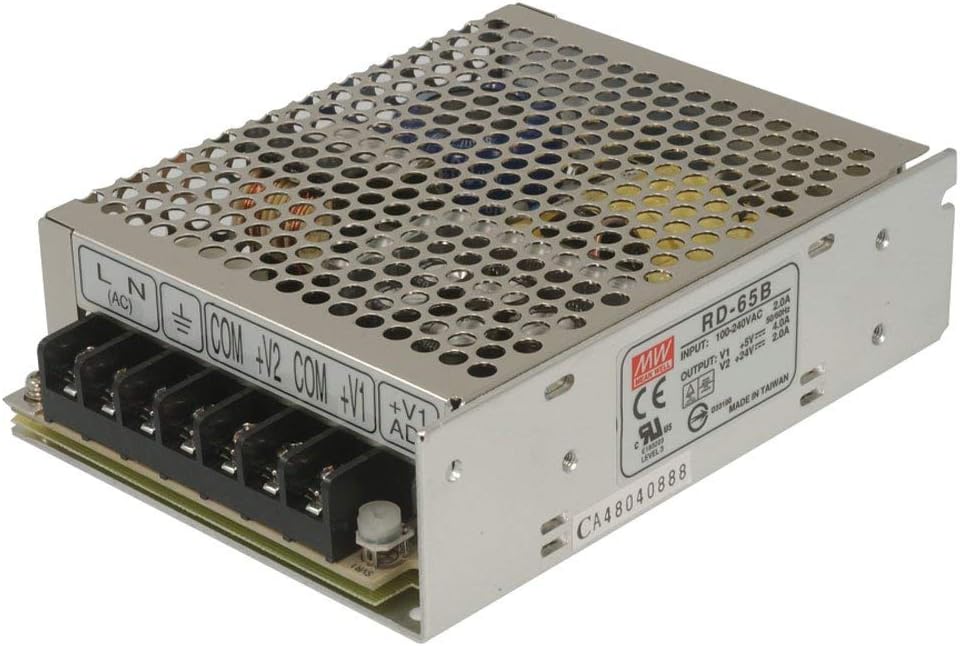
The Mean Well RD-35A is a compact 32W supply with a 5V primary output rated at 4A and a secondary 12V output rated at 1A. Its 4.5 rating and recognizable RD series format make it a sensible middle ground for control electronics, relay circuits, and mixed low-voltage systems that do not need substantial 12V current.
We may earn a commission when you buy through this link, at no additional cost to you.
Its main strength is the generous 4A capacity of the 5V rail. That output can serve dense logic systems, USB-related circuitry, and other 5V loads that would quickly exceed the capacity of the smaller DIN rail model in this guide. The 12V branch is useful for sensors, indicator lamps, and light auxiliary devices, but its 1A limit requires careful load calculations.
The tradeoff is that the 32W total output rating makes this unit less flexible than the 54W, 66W, 100W, and 130.9W alternatives. It can be an excellent fit when the actual 5V demand dominates, but it is not the right choice for powering a 12V motor, large LED strip, or other equipment that would benefit from several amps. Confirm the exact branch ratings and the load requirements before installation.
Buyers should choose the RD-35A when they want a neat, established dual-output platform with unusually strong 5V capability in a relatively compact package. It is particularly attractive for laboratory controls, access systems, and electronics enclosures where both voltages are required but total consumption remains moderate.
The 4A 5V branch has enough capacity for more demanding controllers and communication equipment than the 1A or 2A alternatives. It remains important to keep total consumption within the 32W product limit.
This model belongs to the RD series, which is oriented toward straightforward AC-to-DC conversion and dependable integration. Its compact rating makes it useful where space is limited but industrial-style organization is desired.
We may earn a commission when you buy through this link, at no additional cost to you.
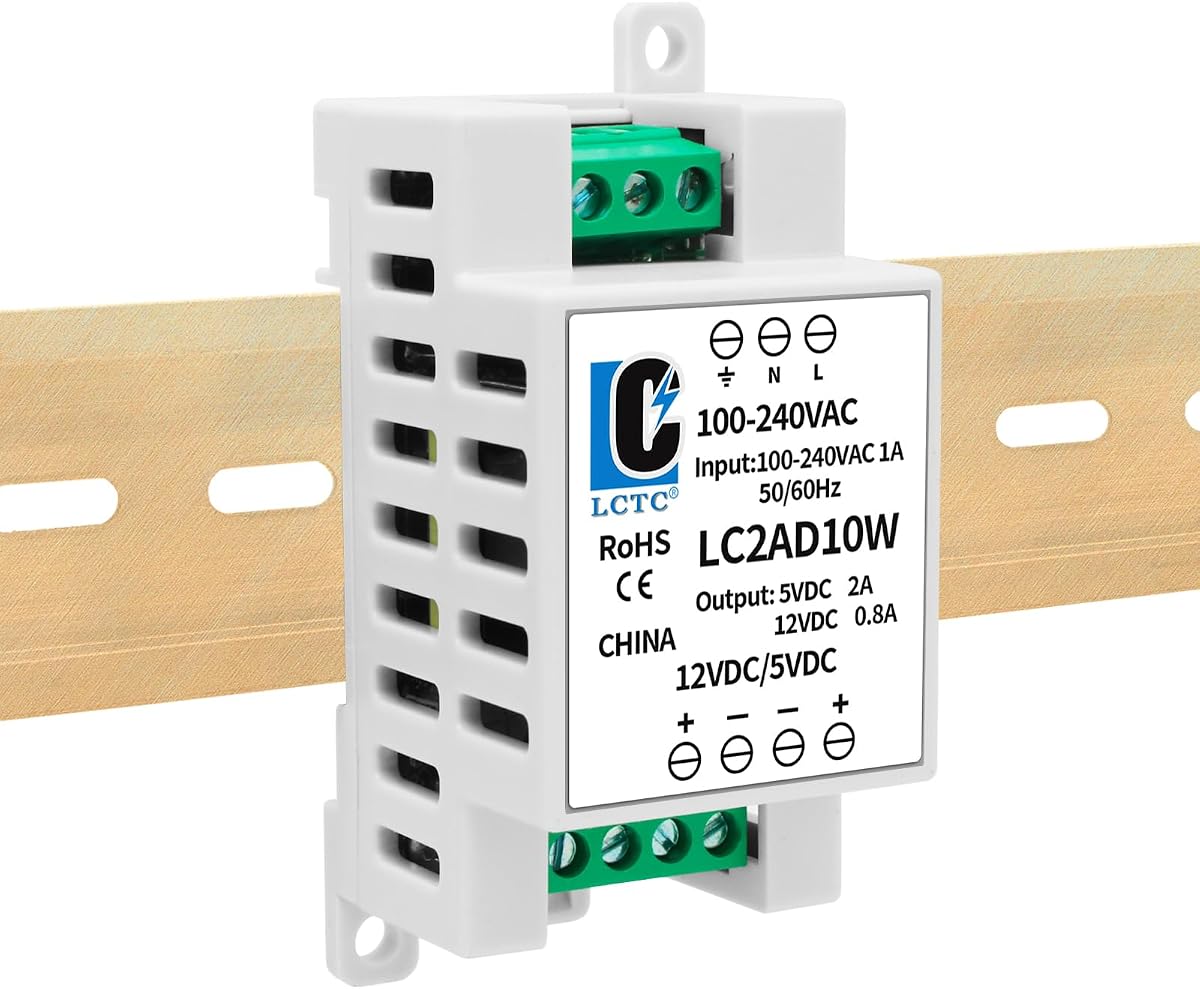
This compact DIN rail supply provides 5V at 2A and 12V at 0.8A from a 10W dual-output design. It is aimed at distribution boxes, LED installations, CCTV equipment, Arduino projects, and other small electronics where clean panel organization matters more than high current capacity.
We may earn a commission when you buy through this link, at no additional cost to you.
The primary installation benefit is the DIN rail format. Mounting the unit on a standard rail can simplify cable routing in a control cabinet and leave more working space than a loosely mounted adapter. Its 100–240V AC input works across a broad range of mains environments, while overload, overvoltage, and short-circuit protection cover the most common electrical faults.
The lower 3.6 rating and 10W total output limitation are the principal considerations. A 2A 5V branch is useful for controllers and modest sensor systems, but the 0.8A 12V branch leaves little room for motors, LED runs, or multiple accessories. The flame-retardant shell is a positive feature for organized installations, yet enclosure material alone does not replace correct mounting and electrical isolation.
This supply is most suitable for a small, well-defined mixed-voltage circuit installed in a distribution box. Choose it when the combined load stays comfortably below its ratings and DIN rail mounting is a priority. Users needing more current should move to one of the enclosed RD supplies instead.
DIN rail mounting keeps the supply organized and makes it easier to service the surrounding wiring. This is especially helpful in compact distribution boxes where every centimeter of space matters.
Overload, overvoltage, and short-circuit protection help protect a small circuit against common faults. Users should still size the load below the stated branch and total power limits.
We may earn a commission when you buy through this link, at no additional cost to you.
The Mean Well RD-65A is a 66W enclosed dual-output supply with a 5V primary branch and an additional 12V branch. Its 4.3 rating reflects a middle-ground option for projects that need more flexibility than a 10W or 32W unit but do not require the RD-125A's higher capacity.
We may earn a commission when you buy through this link, at no additional cost to you.
Enclosure is one of the most important benefits. A closed housing is generally easier to organize than exposed circuitry and can be more suitable for permanent equipment installations. The product data identifies a 6A output current, although the title refers to 8A. That inconsistency makes the structured specifications particularly important for anyone planning a load near the limit.
The 66W total rating allows more useful headroom than the smaller RD models. That makes it relevant for control panels that combine 5V electronics with 12V relays, indicator circuits, and modest auxiliary loads. The main precaution is to rely on the listed 6A specification unless additional documentation confirms a different current. The product title alone should not be used to determine safe loading.
This is a versatile middle choice for installers who prefer a recognized RD-series format and an enclosed design. It is best for fixed installations with moderate mixed-voltage demand. If the 5V and 12V loads are both substantial, the RD-125A offers more room; if enclosure space is extremely tight, the smaller models may be easier to accommodate.
At 66W, this model occupies a practical middle ground between lightweight DIN rail units and high-output RD systems. It offers room for several connected low-voltage devices without requiring the largest enclosure.
The title states 8A, while the detailed specifications list 6A. Confirm the documentation for the exact unit and size loads around the conservative figure rather than assuming the higher title rating.
We may earn a commission when you buy through this link, at no additional cost to you.
The Arcity 5V 12V 24V Output Switching Power Supply stands apart with three available DC levels rather than only the requested 5V and 12V outputs. It delivers 5V at 8A, 12V at 7A, and 24V at 5A, giving it the flexibility to support LED strips, 3D printers, game equipment, CCTV cameras, amplifiers, and other mixed electronics.
We may earn a commission when you buy through this link, at no additional cost to you.
Its 4.6 rating reflects a versatile feature set and strong output currents. The switchable 110V/220V AC input also allows the same unit to suit different mains arrangements when configured correctly. An open-frame metal housing supports heat dissipation, although the design may be less visually tidy than a fully enclosed DIN rail or terminal-block unit.
Protection is unusually comprehensive, covering overvoltage, overcurrent, short circuit, over-temperature, surge and inrush, and overpower conditions. The enclosure measures 160 by 98 by 38 millimeters, giving installers useful dimensions for planning. Users must still provide appropriate wiring, strain relief, grounding where applicable, and a safe enclosure if the installation area requires one.
This supply is ideal for a workshop, arcade build, or multi-device cabinet where 5V, 12V, and occasionally 24V are all useful. It offers more flexibility than dedicated industrial RD units, but that versatility comes with a more exposed construction. For a permanently installed, neatly packaged control system, an enclosed screw-terminal model may be easier to manage.
The additional 24V output makes this model useful for equipment beyond ordinary 5V and 12V projects. It can simplify a mixed installation by reducing the number of separate supplies required.
OVP, OCP, SCP, OTP, surge and inrush, and OPP cover a broad set of operating risks. These safeguards make the unit more versatile for equipment with differing load characteristics.
We may earn a commission when you buy through this link, at no additional cost to you.
The Wefomey Universal Power Supply is a variable 3–24V adapter with a 3A maximum current and 72W capacity. It can produce both 5V and 12V, but its defining advantage is the ability to serve many other common voltages through one product while displaying the selected setting on an LCD.
We may earn a commission when you buy through this link, at no additional cost to you.
A broad collection of DC tips makes it useful for equipment with different barrel connector sizes. The included options cover several common dimensions, Micro-USB, USB-C, a DC terminal connector, a four-way splitter, and alligator clips. The clips are especially useful for breadboards, bare wires, and DIY projects where a conventional wall adapter would be inconvenient.
The product includes several protections and carries stated FCC, UKCA, CE, and RoHS certifications. The display is helpful, but the stated voltage tolerance of ±5% remains important: for example, a 12V setting may measure approximately 11.4 to 12.6V. Devices with strict tolerances should be checked carefully. The four-way splitter also divides available current, with each connected branch limited accordingly.
This is the most convenient choice for a bench, repair kit, or collection of devices with varied connector and voltage requirements. It is not a true simultaneous 5V-and-12V supply, so projects needing both outputs at once should use a dedicated dual-output model. For general-purpose testing and repair, however, the connector system is exceptionally useful.
The broad voltage range and extensive tip collection reduce the need to keep a separate adapter for every small electronic device. Connector dimensions should still be verified before connection.
The LCD reduces uncertainty when selecting a voltage, while the alligator leads make the adapter useful beyond factory-packaged equipment. A selector cable and splitter add flexibility, although they also constrain available current.
We may earn a commission when you buy through this link, at no additional cost to you.
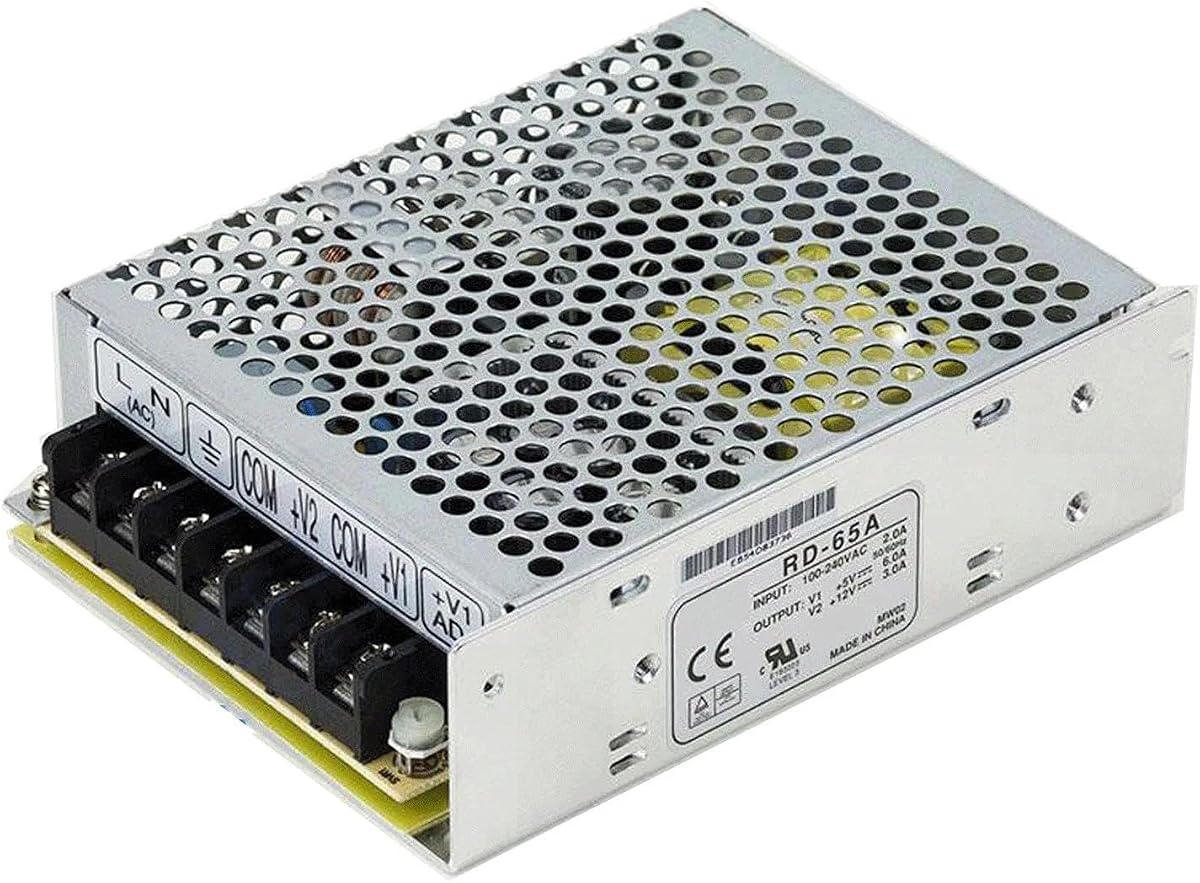
The RD-65A 5V/12V Dual Output 66W Power Supply is a purpose-built industrial option with clearly specified 5V and 12V outputs. The 5V branch is rated at 6A, the 12V branch at 3A, and its published 5.0 rating is the highest among the ten products listed here.
We may earn a commission when you buy through this link, at no additional cost to you.
Its standout feature is environmental resilience. The operating range extends to 70°C, the unit is described as tested against 300VAC surge input, and it is also noted to withstand 5G vibration. Long-life 105°C electrolytic capacitors and comprehensive protection features further support its suitability for demanding industrial environments.
The 66W output ceiling means it cannot accommodate unlimited loads, but the stated branch currents are much easier to plan than an ambiguous title. A 6A 5V rail and 3A 12V rail suit control electronics, communications equipment, industrial sensors, and other loads that need dependable regulated output in challenging locations.
This is the strongest premium recommendation for a buyer whose application genuinely values surge tolerance, temperature capability, and industrial construction. A simple LED project may not need those qualities and could favor a lower-cost model, but for machinery, control cabinets, or demanding field installations, the documented resilience justifies a closer look.
A 70°C operating range and 5G vibration tolerance make this supply more appropriate for industrial conditions than a basic external adapter. These characteristics matter where heat, movement, and supply disturbances are routine.
Testing for 300VAC surge input indicates preparation for more severe mains disturbances than ordinary consumer supplies may handle. It does not replace correct fusing, grounding, and installation practices.
We may earn a commission when you buy through this link, at no additional cost to you.
The Mean Well RD-125A is the highest-output option in this group, with a maximum output power of 130.9W. Its detailed specifications list a 7.7A output current, a 5V primary voltage, and an additional 12V output, making it the natural choice when a project needs more headroom than the 66W RD models can provide.
We may earn a commission when you buy through this link, at no additional cost to you.
The 4.0 rating is still respectable, though lower than several alternatives, and reflects a highly capable unit rather than the best score in the comparison. The product title mentions 15A and 10A, while the structured data gives different current values. Buyers must therefore use the detailed 7.7A figure for cautious planning and seek documentation for the exact 12V branch rating.
The substantial power ceiling is the decisive benefit. It can support more demanding 5V electronics, multiple 12V accessories, or a mixed installation that would exceed the capacity of the 32W and 54W models. The RD family format also gives it a more structured appearance than an open-frame switcher, which may simplify permanent integration.
This is our editor's choice for buyers whose main priority is power headroom within an established product family. It is not automatically the best unit for a small project because the larger supply may be unnecessary. For applications approaching its limits, however, it provides more room to grow than any other dual-output selection reviewed here.
A 130.9W ceiling is valuable when several 5V and 12V loads must operate from one source. It provides meaningful expansion capacity without moving to multiple supplies.
The product title and detailed specifications do not present the same current figures. For a high-load installation, confirm the model's technical documentation and size each output from the lower, verified value.
We may earn a commission when you buy through this link, at no additional cost to you.
The Mean Well RD-50A-VP combines dual 5V and 12V outputs in a compact enclosed switching supply rated at 54W. Its 4.6 rating and listed dimensions make it an attractive option for control panels, equipment enclosures, and other permanent installations where neat packaging matters.
We may earn a commission when you buy through this link, at no additional cost to you.
Screw terminal blocks are a major practical benefit. They allow incoming mains and outgoing DC wiring to be connected without relying on barrel plugs or proprietary connectors, which is preferable for fixed equipment. The compact housing measures 1.4 inches high by 3.8 inches wide by 3.9 inches long, making it easier to incorporate into a panel than a large open-frame unit.
The input range of 88–264VAC and a minimum isolation voltage of 3000V support professional installation. However, the supplied specifications do not break down the individual output currents for 5V and 12V, so the load must be confirmed from the device documentation. Its 54W total rating places it between the RD-35A and RD-65A.
Choose the RD-50A-VP for a tidy, moderately powered installation with direct screw connections. It is a particularly good fit for technicians who want a conventional enclosed supply without moving up to a much larger unit. Exact branch-current verification remains the key step before connecting substantial 5V or 12V equipment.
A screw terminal block is more suitable for permanent wiring than a push-fit barrel connection. It also keeps both output voltages accessible within a neatly arranged enclosure.
The stated dimensions help when planning a control cabinet or equipment box. The enclosed format provides a more orderly appearance than exposed switching hardware.
We may earn a commission when you buy through this link, at no additional cost to you.
The RD-50A 54W 5V 6A 12V 2A Dual Output Power Supply offers one of the clearest load specifications in the group. It provides 6A at 5V and 2A at 12V, with a 54W total output rating and an 85–264VAC input range.
We may earn a commission when you buy through this link, at no additional cost to you.
Those figures make capacity planning straightforward. The 5V branch is suitable for logic, communications, and control electronics, while the 12V branch can handle relays, indicator lights, and moderate auxiliary equipment. A total output ceiling of 54W provides a useful middle tier between the compact 32W unit and the larger RD-65A models.
The weakness is limited documentation. The supplied product information identifies it as an industrial power supply but does not describe protection circuitry, enclosure details, operating temperature, terminals, or isolation. No customer rating is available either, so the product's published rating field is left unassigned rather than replaced with an unsupported score.
This model is worth considering when explicit 5V and 12V current figures are the priority. Before buying, request or locate the full datasheet to verify connection details, dimensions, and protection features. It may be an effective 54W choice, but the sparse information makes it a less complete choice than the better-documented Mean Well alternatives.
The stated 6A 5V and 2A 12V outputs make it easier to compare this unit against conventional dual-output supplies. Those values also establish a clear baseline for load calculations.
The product data is limited, so technical documents should be checked for terminal layout, dimensions, grounding, and operating conditions. A complete installation should never rely on assumptions beyond the stated ratings.
We may earn a commission when you buy through this link, at no additional cost to you.
The right dual voltage supply depends on more than having 5V and 12V printed on the case. Start with the load, then compare current ratings, connection style, construction, environmental needs, and protection features.
Calculate the current required by every device on the 5V rail and every device on the 12V rail. Compare those figures with each branch's rated current rather than looking only at total wattage. A supply can have ample overall capacity but still lack enough current on the voltage your most demanding device uses. Add expected startup surges for motors, fans, and lighting, then compare those peaks with the manufacturer's limits.
Total wattage reveals whether the unit can sustain the combined load. The products in this guide range from 10W for the compact DIN rail model to 130.9W for the RD-125A. A 66W model offers a useful middle tier for mixed systems, while a 54W unit can be sufficient when both rails remain moderate. Do not treat the headline wattage as permission to operate every output continuously at its maximum.
A true dual-output supply provides 5V and 12V simultaneously, whereas a variable adapter offers one selectable voltage at a time. The Arcity model goes further by adding 24V, and the Wefomey adapter can be adjusted across many levels. Choose a dedicated dual output when both voltages must operate continuously; choose a variable supply for repair work, testing, or a collection of devices with changing requirements.
DIN rail mounting is convenient inside distribution boxes, screw terminals suit permanent cabinet wiring, and open-frame construction can make heat dissipation and modification easier. Fully enclosed products look tidier and help organize exposed circuitry. Consider available space, cable direction, terminal accessibility, ventilation, and whether a separate enclosure will be necessary. The RD-50A-VP's stated dimensions are particularly useful when panel space is limited.
Look for overcurrent, overload, overvoltage, short-circuit, and thermal protection. Some models also specify surge, inrush, overpower, and internal over-temperature protection. These features reduce the consequences of wiring errors and abnormal loads, but they are not substitutes for correct fusing, adequate ventilation, or sound installation practice. Industrial settings may also justify paying closer attention to surge tolerance and component temperature ratings.
Most products accept a wide AC input range, from 88 or 85V through 264V, while the Arcity model uses a 110V/220V switch. Confirm the input configuration before connection and never assume that the nominal range guarantees suitability in every country. The Arcity's switch must be set correctly before use, and industrial users should consider local grounding, isolation, and surge requirements.
A compact supply can still run warm when both outputs approach their limits. The NOYITO model specifically notes that stronger cooling is needed to support the upper end of its 5V output. The Arcity housing is designed around effective heat dissipation, while industrial models are better viewed in terms of their operating-temperature specifications. Maintain airflow around the unit, avoid enclosing it in an unventilated space, and derate loads when heat cannot dissipate.
Fixed installations are easiest with screw terminals, while project builders may need barrel adapters, alligator leads, or DIN rail hardware. The Wefomey product includes an extensive tip collection, but connector dimensions must still be checked. For any enclosed unit, review its data sheet for terminal assignments, dimensions, isolation, grounding, and environmental limits. Clear documentation can be as valuable as a small increase in output capacity.
Before wiring anything, disconnect the AC supply and identify the correct input terminals, output polarity, branch ratings, and grounding requirements. Route mains and low-voltage wiring separately, use suitable wire gauge, and tighten screw terminals securely. A DIN rail unit should be mounted to a proper rail, while a panel supply should be positioned with ventilation space and protected from accidental contact.
Connect the load to the correct 5V or 12V branch without exceeding either the current or total power rating. Test with a suitable meter before attaching important equipment, and use a variable adapter's LCD and the measured voltage to confirm the selected level. Remember that a stated tolerance still permits a small difference from the nominal setting, so strict or safety-sensitive devices may require a more precisely regulated supply.
For ongoing care, inspect wiring for heat discoloration, looseness, corrosion, and signs of overload. Keep ventilation openings clear, avoid placing the unit in a sealed hot compartment, and check the output periodically under representative load. Replace damaged wiring rather than repairing it with exposed connections, and do not continue using a supply that shows unusual odor, discoloration, or repeated fault protection.
A dedicated dual-output supply can generally run both voltage branches simultaneously, provided each branch and the total wattage remain within their ratings. A variable adapter is different because it normally provides one selected output voltage at a time. Check the product description carefully to determine whether the outputs are independent and simultaneously available.
Add the current requirements of all devices connected to that voltage and compare the total with the branch rating. Include startup or surge current for motors, fans, and some lighting. Also verify that the combined load does not exceed the supply's total wattage rating.
Neither is universally better because the useful rating depends on the load connected to each rail. A 5V 10A branch may be ideal for dense logic, while a 12V 2A branch may suit motors or industrial control circuits. Select a supply whose stronger rail matches the equipment that actually demands more current.
Models with DIN rail mounting, screw terminals, or enclosed housings are well suited to control cabinets. Confirm the unit's operating-temperature rating, isolation, grounding requirements, and available space. Open-frame models may also be used when the surrounding enclosure provides appropriate protection and airflow.
The displayed 12V setting may measure somewhat above or below 12V, and the stated example places that range at approximately 11.4 to 12.6V. This is normal for many regulated adapters. Equipment with a narrow tolerance may perform better with a supply that offers more precise regulation and a documented output tolerance.
Internal protection is useful, but it is not always a substitute for correctly rated external fuses and proper circuit design. Protection circuits help the supply recover from faults; they do not eliminate the need to protect wiring and select an appropriate disconnect for the installation.
No. A variable adapter normally has one DC output whose voltage is selected manually. It can be configured for either 5V or 12V, but it does not normally provide both at once. A dedicated dual-output model is required when both rails must operate simultaneously.
Keep the unit away from insulating surfaces and do not seal it inside an unventilated enclosure unless its documentation specifically permits that arrangement. Heat reduces reliability and can shorten component life. Allow more conservative loading when airflow is limited or the surrounding temperature is high.
The NOYITO module is the best budget-oriented choice for projects with a strong 12V load and modest 5V demand. The Mean Well RD-125A offers the most output headroom, while the RD-65A industrial model is the premium pick for demanding environments with clearly documented 5V and 12V currents, broad temperature capability, and strong surge tolerance.
Most buyers should prioritize branch current, total wattage, and installation method before any secondary feature. A DIN rail model is convenient in a distribution box, screw-terminal units are tidy for permanent wiring, and an open-frame multi-output unit is useful when several voltages and high currents are required. Variable adapters serve a different need and should be selected for testing or connector flexibility rather than simultaneous dual output.
Before placing an order, verify the exact electrical requirements, connector arrangement, environmental conditions, and available installation space. Product details and prices can change over time, so checking the current listing and manufacturer documentation is the safest way to confirm that the selected supply still matches the project.