
BAOFENG Dual Band Antenna
4.6Editor score
2.15 dBi gain
Dual-band coverage
Lightweight flexible whip
Broad radio compatibility
Discover the best antenna for walkie talkies by comparing compatibility, frequency, gain, length, construction, and practical outdoor features.
Antenna selection can determine how a walkie talkie performs in the field, especially when range, battery life, and reliable communication matter. The right replacement should match your radio connector, supported frequencies, mounting style, and expected operating environment while adding useful gain without creating portability problems.
This guide compares ten whip, tactical, dual-band, and vehicle-mounted antennas using the published specifications for each product. We focus on frequency coverage, nominal gain, connector type, physical length, flexibility, intended equipment, and compatibility lists, separating everyday value from specialized long-range and mobile options.
The selections show where a compact standard whip makes sense, where a longer foldable antenna may help, and when a dedicated 462 MHz antenna is the safer choice. Each review explains the relevant trade-offs, while current prices and availability can change, so confirm the final fit and radio requirements before buying.
4.6Editor score

4.6Editor score

4.7Editor score
The comparison below organizes all ten antennas by their intended use, frequency coverage, connector, gain, and physical format, making it easier to identify the option that fits a particular handheld or mobile radio setup.

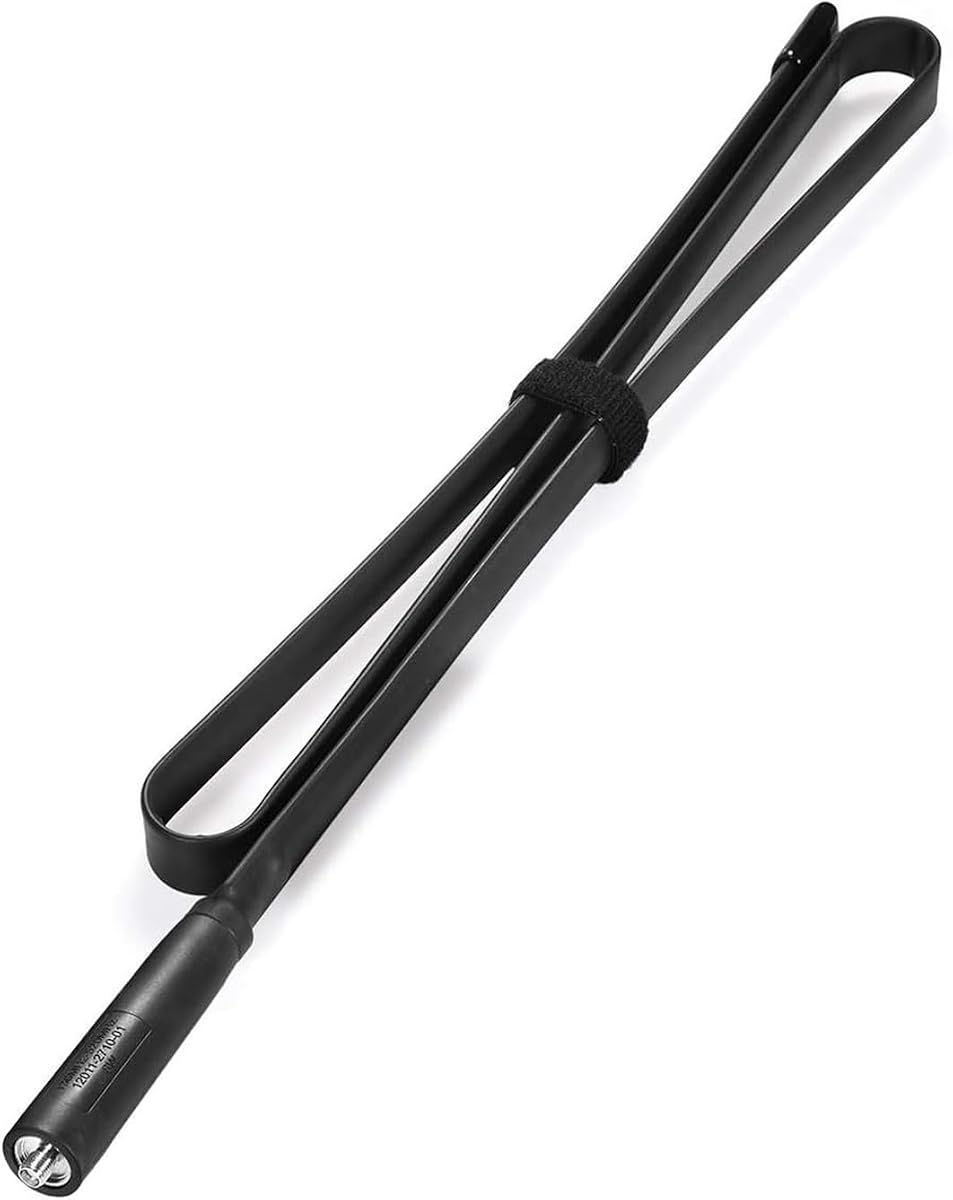


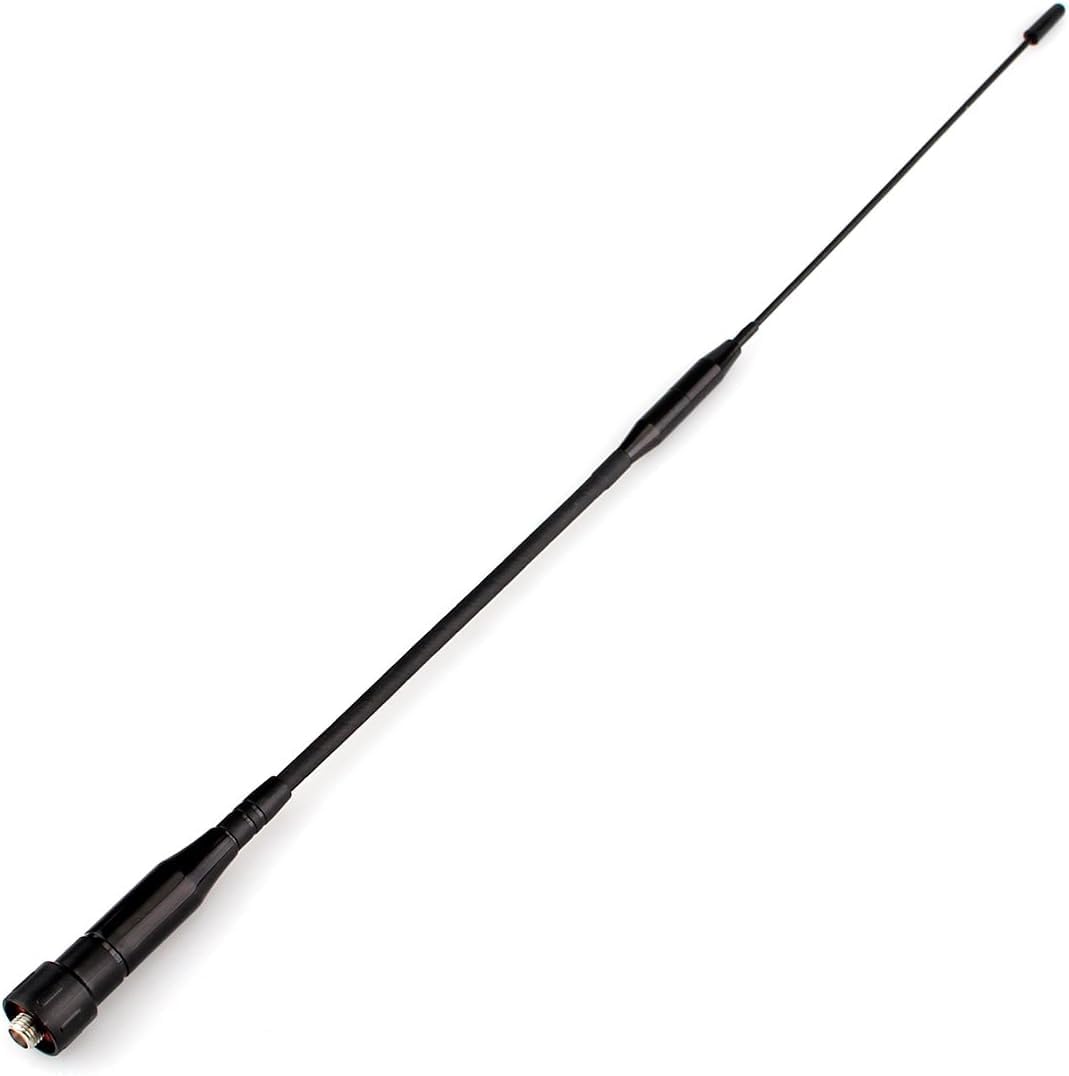


The ABBREE SMA-Female Ham Radio Antenna is a 4.5-rated 18.8-inch tactical whip designed around 144/430 MHz dual-band operation. Its 2.15 dBi nominal gain, flexible CS-style construction, and foldable design make it a practical middle ground between a compact standard antenna and a much longer high-gain model. It is especially relevant to users of the numerous Baofeng, Quansheng, and related handheld models listed in its product title.
We may earn a commission when you buy through this link, at no additional cost to you.
The main benefit is balance. A long antenna can improve communication on a radio that is already tuned to the correct bands, but a 42.5-inch whip can dominate a pack and interfere with convenient handling. This model gives the user a noticeable increase in physical antenna length while remaining short enough for everyday carrying. Its updated AR-152A construction is described as more bendable, which is valuable during hiking, camping, or other activities where a rigid whip may be vulnerable.
The principal limitation is that its frequency coverage is specifically for 144/430 MHz radios. It is not a universal antenna for every walkie talkie, particularly GMRS-only equipment operating around 462 MHz. Buyers should also check whether their radio uses the stated SMA-female connection and whether its connector or housing is physically compatible. The 2.15 dBi rating is useful but not as ambitious as the 5 dBi specifications claimed by the longer ABBREE tactical alternatives.
This is a strong recommendation for hiker, camper, or field user who wants a more substantial dual-band antenna without committing to the largest available whip. It is less suitable for someone who needs a dedicated GMRS antenna or a permanently mounted mobile setup. In those cases, one of the frequency-specific or vehicle-oriented choices in this guide will offer a cleaner fit.
The foldable construction and improved bend tolerance suit users who carry a radio on long trips. Its 18.8-inch length adds useful presence without taking up the space of a full-length tactical antenna.
The 144/430 MHz design and SMA-female connector align with many amateur handheld radios. Checking the exact model against the compatibility list is the safest way to prevent a connector or housing mismatch.
We may earn a commission when you buy through this link, at no additional cost to you.
The Bingfu Long Range Ham Radio Antenna is a 4.4-rated 42.5-inch whip with a 3.5 dBi gain rating, 50-ohm impedance, and a stated 136–520 MHz frequency range. It is built as a foldable CS tactical antenna and is marketed for long-range VHF/UHF communication. Its most notable feature is the extensive compatibility list, which includes numerous Baofeng, Kenwood, Wouxun, Linton, HYT, TYT, and Puxing models.
We may earn a commission when you buy through this link, at no additional cost to you.
That broad radio list makes the antenna useful for owners of a mixed collection of handhelds. Rather than limiting the product to a few familiar UV-series models, the listing addresses a substantial assortment of SMA-equipped radios from several familiar amateur-radio manufacturers. The specified 3.5 dBi gain offers a more substantial improvement over a short stock antenna than the 2.15 dBi alternatives, while the 136–520 MHz span gives it broad band coverage.
Its drawbacks are closely tied to the same features that make it useful. At 108 centimeters, the antenna is long enough to be inconvenient when walking, driving, or operating from a pack. It may also collide with other equipment mounted on the radio, and its stated maximum input power of 8 W is lower than the 10 W or 20 W figures given for some alternatives. That distinction matters for users who transmit at the upper end of their radio's permitted output.
The Bingfu antenna is a strong fit for a radio enthusiast who owns several compatible handheld models and prioritizes a single long-range-style antenna that can move between them. It is less attractive as a compact everyday carry antenna and should not be selected for a GMRS-only radio. Buyers should confirm both the connector and the radio's transmission requirements before committing.
The long compatibility list is this product's defining strength. It can simplify equipment collection when a user operates several brands of handheld radio and wants one long whip for common field tasks.
The listed 8 W maximum input rating is a meaningful constraint, even though it suits many normal handheld operations. Confirm the radio's output level and the connector's handling characteristics before using the antenna at high power.
We may earn a commission when you buy through this link, at no additional cost to you.
The Authentic Genuine Nagoya NA-771 is a 4.6-rated 15.6-inch whip for 144/430 MHz VHF/UHF radios with an SMA-female connector. It offers up to 3 dBi of gain and is positioned for Baofeng and BTECH users as well as other compatible amateur handhelds. That combination of measured specifications, compact proportions, and outdoor-oriented flexibility makes it the most broadly useful selection in this guide.
We may earn a commission when you buy through this link, at no additional cost to you.
Three dBi is enough of a published gain figure to distinguish it from the 2.15 dBi compact options, yet the 15.6-inch body remains manageable for daily carry. The soft, durable whip is designed to bend without immediately losing its usable form, a useful characteristic for camping, hiking, and other mobile activities. The antenna's stated dual-band purpose also makes its intended use easier to understand than that of an extremely broad-range accessory.
As with every radio accessory, the connector and frequency must match the equipment. A 144/430 MHz antenna will not provide the intended performance for a GMRS-only 462 MHz radio, and an SMA-female plug cannot be assumed to fit every handheld merely because the radio resembles a listed model. The product's advantage over larger tactical whips is its more practical length, while its advantage over shorter 2.15 dBi antennas is the higher stated gain.
For an amateur-radio handheld owner seeking a dependable replacement or enhancement without carrying an oversized whip, the Nagoya NA-771 is the recommendation to prioritize. It combines meaningful gain, flexible construction, and a relatively compact format. It is not the right choice for a dedicated GMRS setup or for a radio that uses another connector system, but it represents the most balanced option for compatible dual-band equipment.
The up-to-3 dBi specification provides a clear reason to choose this whip over a standard shorter replacement. It is a meaningful upgrade for compatible radios without requiring the footprint of a 42.5-inch tactical model.
A soft yet durable flexible design helps the antenna tolerate routine field handling. The 15.6-inch size also remains easier to manage when walking or storing a radio in a pocket, belt pouch, or pack.
We may earn a commission when you buy through this link, at no additional cost to you.
The BAOFENG Ham Radio Antenna Dual Band is a 4.6-rated 15.3-inch replacement whip with a 2.15 dBi gain rating. It supports 144/430 MHz frequencies, uses an SMA-female connector, and is listed for a broad selection of common handhelds, including UV-5R-series, BF-F8HP, UV-21R, BF-888S, UV-82-series, and several Quansheng models. Its simple design makes it an accessible choice for users who need a dependable compatible replacement.
We may earn a commission when you buy through this link, at no additional cost to you.
The 50-ohm impedance and stated 10 W maximum power align with normal expectations for an amateur handheld whip. More importantly, the long-soft-whip design combines a relatively useful physical length with low weight and flexibility. That makes the antenna straightforward to carry during camping, hunting, or general outdoor work. The listed compatibility range also provides more reassurance than a product associated with only one radio family.
Its 2.15 dBi gain is lower than the 3 dBi offered by the Nagoya NA-771 and the 3.5 dBi Bingfu option. It should therefore be considered a convenient flexible replacement rather than the highest-gain antenna available. The dual-band rating also means it is unsuitable for a GMRS radio centered around 462 MHz, and the product listing does not remove the need to verify connector fit.
This antenna is best for a common BaoFeng or compatible dual-band handheld that needs a lightweight, flexible replacement at an approachable cost. It offers enough length and gain for many outdoor applications while remaining easy to carry. Users seeking greater nominal gain can move to the Nagoya option, while those operating exclusively on GMRS should choose the frequency-specific TD-771.
The broad model list makes this a practical first check for owners of widely used dual-band handhelds. Its straightforward whip format and 10 W power rating suit normal amateur-radio use.
The 15.3-inch antenna is light and flexible enough to pack without the bulk of a full-length tactical whip. That balance is useful when comfort and quick access matter more than maximum published gain.
We may earn a commission when you buy through this link, at no additional cost to you.
The LUITON 15.6-Inch Whip is a 4.6-rated replacement antenna with 3 dBi of gain and an SMA-female connector. Its stated frequency coverage spans VHF from 136–174 MHz and UHF from 400–470 MHz, giving it broader nominal coverage than antennas described simply as 144/430 MHz. The product listing includes compatibility with BaoFeng, BTECH, Wouxun, Retevis, and numerous other radio models.
We may earn a commission when you buy through this link, at no additional cost to you.
At 15.6 inches, it closely matches the compact dimensions of the Nagoya NA-771 while presenting a similarly useful 3 dBi gain. The soft, durable design is intended to handle outdoor activities without the rigidity associated with a short factory-style antenna. Buyers also receive a stated 12-month warranty and a straightforward return process, which adds reassurance when connector compatibility is uncertain.
The compatibility wording is extensive, but physical fit still depends on the radio's antenna port and housing. A female SMA connector is not universal across every walkie talkie, even when both devices are handheld radios. The listed UHF range ends at 470 MHz, so this is not the correct dedicated antenna for many GMRS systems operating around 462–468 MHz. At higher frequencies within the stated range, users should still understand that broader coverage does not guarantee equal performance.
The LUITON antenna is well suited to a dual-band amateur-radio user who values a compact 3 dBi whip, a broad supported-radio list, and warranty support. It is a particularly sensible alternative when the exact handheld is listed and the operator wants more gain than a 2.15 dBi basic replacement. It is not intended to replace a dedicated GMRS antenna, and the single-pack format is better for single-radio owners than for maintaining several matching radios.
The 3 dBi rating and standard-length whip provide a useful performance increase without adopting the extreme dimensions of a 42.5-inch tactical antenna. It is a comfortable middle option for many compatible handhelds.
A stated 12-month warranty and simple return process can be reassuring when replacing an unfamiliar accessory. Buyers should still confirm the connector, frequency, and model rather than relying on warranty coverage alone.
We may earn a commission when you buy through this link, at no additional cost to you.
The TIDRADIO TD-771 is a 4.6-rated 15.15-inch antenna designed specifically for GMRS radios in the 462–468 MHz range. Unlike most dual-band amateur-radio whips in this list, its tuning is focused on GMRS use. The product is compatible with a stated selection of TIDRADIO, Baofeng, Radioddity, UV-5G Plus, UV-9G, GM21, and other GMRS handheld models, and the package includes two antennas.
We may earn a commission when you buy through this link, at no additional cost to you.
A dedicated 462–468 MHz design can be preferable for users who do not need amateur VHF/UHF operation. The listing emphasizes high-gain long-range performance, clear audio in noisy environments, and interference reduction attributed to precise band tuning. Its lightweight flexible construction also makes the relatively long whip manageable in a backpack or vehicle. Supplying a second antenna provides a spare or allows identical antennas to be used across two radios.
The main limitation is deliberate specialization. This is not a replacement for a 144/430 MHz amateur-radio antenna, and its narrow frequency range gives it little value outside compatible GMRS equipment. The listed specifications and a few sentences in the bullet list even differ slightly on whether the length is 15.15 or 15.3 inches, so buyers should treat the dimensions as approximate. Connector compatibility should also be confirmed with the exact radio model.
This TD-771 is the most sensible choice for a GMRS operator seeking a longer, purpose-tuned replacement and a two-pack value. It is especially useful for teams that want matching antennas on more than one radio. Users operating both GMRS and amateur bands should instead select a dual-band antenna, while someone with a single GMRS radio who does not need a spare may find a single-pack option less practical.
Operating on 462–468 MHz makes this antenna a better match for GMRS equipment than a general amateur-radio whip. Purpose-specific tuning can help users focus on the frequencies their team actually uses.
Including two units allows a matching setup across radios or provides a field spare. The 15.15-inch flexible design remains portable despite being longer than a basic stock whip.
We may earn a commission when you buy through this link, at no additional cost to you.
The Midland MXTA25 3DB MicroMobile Compatible Gain Ghost Antenna is a 4.7-rated mobile antenna designed to enhance reception on 462 MHz radios. It stands apart from the handheld whips in this guide because it is intended for a vehicle or other MicroMobile installation rather than direct handheld use. Its three-decibel gain and focused 462 MHz design give it a clear purpose in mobile communication setups.
We may earn a commission when you buy through this link, at no additional cost to you.
The product is described as a high-performance antenna constructed for reliable 462 MHz radio reception. That makes it potentially useful for operators who want more antenna presence than a compact handheld accessory can provide, while preserving the familiar 462 MHz band used by many GMRS-style radios. The Ghost form also reflects the broader appeal of performance-oriented mobile accessories without attempting to serve every possible radio type.
The important trade-off is installation. This is not a plug-in replacement for a handheld antenna, and users need compatible mobile equipment, mounting hardware, and a suitable connection arrangement. Its narrow 462 MHz target also makes it less useful for dual-band VHF/UHF operation. Although the product description is brief, the specialized format and straightforward purpose make the intended application easier to understand than that of a universal accessory.
The Midland MXTA25 is the premium recommendation for someone building a 462 MHz mobile radio system rather than simply replacing a handheld whip. It is especially relevant when vehicle placement and stable reception matter more than packability. Buyers should verify the radio's required connector and mounting configuration before purchase, while handheld-only users should favor one of the SMA-female whips instead.
The MicroMobile format is the key distinction. It is intended for a fixed vehicle installation where a longer, properly mounted antenna can remain extended while the radio operates.
The antenna is built around the 462 MHz band rather than the amateur 144/430 MHz ranges. That focus makes it a cleaner choice for compatible GMRS-style mobile equipment.
We may earn a commission when you buy through this link, at no additional cost to you.
The Retevis Dual Band Whip Antenna is a 4.5-rated 14.2-inch antenna with a detachable two-section design. It supports 144/430 MHz frequencies, uses an SMA-female connector, and has a stated 2.15 dBi gain, 50-ohm impedance, and 20 W maximum power. Compatibility is listed for several Retevis, Baofeng, BTECH, and Aliunce handheld models, giving it a broad but clearly dual-band role.
We may earn a commission when you buy through this link, at no additional cost to you.
The strongest distinguishing feature is its ability to divide into two sections for easier carrying. That makes the antenna practical for travel and storage while still offering more length than a minimal factory whip. Its ABS construction and heat-shrinkable sleeve are described as durable enough for continued use, and the 20 W maximum input rating is the highest power figure listed among the compact whip options here.
The lower 2.15 dBi gain means it does not offer the same published performance improvement as the Nagoya, LUITON, or Bingfu alternatives. Its supported frequency range excludes the 462 MHz GMRS band, and an SMA-female connector still limits compatibility to radios that accept that specific connection. The detachable joint also becomes another interface that must be tightened and protected from moisture.
This antenna is a good choice for a Retevis or other listed dual-band handheld where compact storage, detachable construction, and a higher power rating are priorities. It is less appropriate for an operator seeking the largest published gain or a dedicated GMRS setup. Among compact whips, it is especially attractive for users who travel frequently and want to separate the antenna into a shorter package.
The detachable design reduces packed length and lets the user separate the antenna from the radio. This is convenient for travel, organized gear storage, and fast-moving field work.
The stated 20 W maximum power handling is a notable feature for a compact whip. It offers more published power capacity than the alternatives in this roundup that list 5 W, 8 W, or 10 W.
We may earn a commission when you buy through this link, at no additional cost to you.
The ABBREE 42.5-Inch Length SMA-Female Dual Band set is a 4.4-rated two-pack of foldable tactical antennas with a stated 5 dBi gain. Operating on 144/430 MHz with an SMA-female connector, the set is listed for a range of Baofeng, GMRS-style, UV-21R, UV-5G Plus, K5PLUS, AR-152, and GM-15 Pro radios. The updated AR-152A design emphasizes improved flexibility and signal performance.
We may earn a commission when you buy through this link, at no additional cost to you.
Five dBi is the highest nominal gain in this comparison, making the antennas attractive to users who want the largest possible improvement in their radio's antenna system. Including two units allows a user to equip two radios with matching antennas or retain a spare. The foldable tactical design helps address the bulk problem associated with such a long whip, and the stated improved bend tolerance is valuable when the radios are carried on a pack.
There are meaningful compromises. A 42.5-inch antenna can be cumbersome while walking, and a two-pack further increases the amount of gear to manage. The listing also explicitly notes that some waterproof radio models do not fit. Although the title mentions GMRS radios, the specified 144/430 MHz frequency is the operative technical detail, so users should not assume compatibility with a dedicated 462–468 MHz radio.
This set is best for a pair of compatible dual-band handhelds used in settings where maximum published gain and spare equipment matter. It is less suitable for compact daily carry, waterproof models with incompatible connectors, or GMRS-only systems. As with the other 5 dBi long antennas, its length and specialized fit should be weighed carefully before purchase.
The 5 dBi specification gives this set the highest nominal gain among the products reviewed. That can be useful for compatible amateur handhelds operated in challenging outdoor environments.
The two-pack format is practical for teams operating multiple radios. It also provides a spare without requiring a separate accessory purchase.
We may earn a commission when you buy through this link, at no additional cost to you.
The ABBREE Ham Radio Antenna 42.5-inch is a 4.5-rated foldable CS tactical antenna with a stated 5 dBi gain. It operates on 144/430 MHz and uses an SMA-female connector, making it intended for compatible dual-band handheld radios such as the listed UV-5R, BF-F8HP Pro, UV-21R, K5PLUS, AR-152, GM-15 Pro, and UV-5G Plus models. The updated AR-152A design is promoted as a flexible, rough-use-resistant alternative to a rigid stock whip.
We may earn a commission when you buy through this link, at no additional cost to you.
The combination of high published gain and foldability is the main attraction. Users who value longer-range-oriented radio performance can benefit from the 5 dBi specification, while the 108-centimeter antenna folds down for transport. Flexible construction also helps it tolerate the bending and pressure associated with hiking, camping, and mobile use better than a small rigid antenna would.
Length remains the trade-off. Even when folded, a 42.5-inch antenna is larger than the standard whips in this guide, and it can interfere with storage, vehicle use, or hands-on operation. The 144/430 MHz specification does not make it a universal solution for GMRS-only equipment, and the exact radio housing must accept the connector. The product listing itself directs buyers to verify compatibility, which is an important reminder.
This antenna is a strong option for a compatible dual-band handheld used in outdoor settings where the user values gain and foldable durability over minimum size. It is less suitable for compact carry, a dedicated GMRS radio, or any waterproof model with an incompatible connector. For most users, checking the radio model first is essential before choosing this high-gain long whip.
The 5 dBi gain specification is attractive for users seeking more antenna performance from a compatible handheld. Folding reduces the storage burden that would otherwise come with a long rigid whip.
The flexible AR-152A construction is intended to withstand more rough handling than a conventional short antenna. That makes it especially relevant to camping, hiking, and field work.
We may earn a commission when you buy through this link, at no additional cost to you.
The best replacement is defined less by a universal gain figure than by an exact match among radio model, connector, frequency, power handling, and operating environment. Use the following factors to narrow the options before making a purchase.
Start with the complete model name of the radio, not merely its brand or general appearance. A connector can look similar while differing in thread, diameter, gender, or mounting arrangement, and some radios add a housing or weather-sealing system that prevents a connector from seating correctly. Compatibility lists are a useful starting point, but they should be checked against the exact handheld, including suffix variations and production revisions.
The nine SMA-female whip options in this guide are primarily intended for radios with that antenna connection. The Midland MXTA25 is different because it is a MicroMobile vehicle antenna rather than a handheld replacement. Confirm connector type, mounting requirements, and intended equipment before choosing an accessory based only on appearance or gain.
An antenna should support the frequencies your radio actually uses. Most of the tactical and amateur whips here are specified for 144/430 MHz, which covers VHF and UHF amateur-radio bands. The TIDRADIO TD-771 is instead optimized for 462–468 MHz GMRS use, while the Midland is focused on 462 MHz. Using an antenna outside its intended band can lead to poor matching, unexpected behavior, or simply ineffective communication.
A radio that supports several bands still benefits from a clearly matched antenna. Avoid assuming that a dual-band label covers GMRS, FRS, commercial VHF, or other adjacent allocations. When practical, choose an antenna whose published coverage includes the exact band plan used by your group rather than relying on a broad but ambiguous description.
Published gain helps distinguish the products in this guide, ranging from 2.15 dBi or 2.15 dB to 5 dBi. A larger antenna can improve the radio's effective radiation and receiving characteristics when the installation, radio tuning, terrain, and power settings are appropriate. It does not override obstacles, incorrect connectors, poor antenna placement, unsuitable frequencies, or an already noisy operating environment.
Choose gain according to how you use the radio. A compact 2.15 dBi whip may be enough for ordinary local communication, while a 3 dBi or 5 dBi antenna can make more sense for open terrain, hiking groups, and longer working distances. Always view the gain number as one part of system performance, not a promise of a specific number of miles.
Length affects portability, handling, and physical clearance from the radio. The 14.2- to 15.6-inch whips remain convenient for everyday carry, while the 18.8-inch model adds a little more presence and the 42.5-inch tactical antennas demand careful packing. A long antenna may also be more noticeable when operating from a vehicle or in a crowded work area.
If a long whip is chosen, consider whether it folds cleanly, whether its base fits the radio, and whether it can be extended without contacting a pack, helmet, microphone cable, or vehicle frame. The two-section Retevis design and foldable ABBREE models address this concern, but actual transport and mounting conditions should guide the final decision.
Maximum input power is a safety and compatibility specification. The products reviewed list maximum ratings of 5 W, 8 W, 10 W, or 20 W, while the Midland mobile antenna has a 3 dB gain designation. These figures are not directly comparable in every respect, but they provide useful context when a radio can transmit at different output levels.
Match the antenna's stated capability to the radio's actual transmission power. Also follow the radio manufacturer's guidance about antenna accessories and do not exceed a published limit. A lower power rating may be entirely adequate for ordinary handheld use, but an operator who routinely transmits at a higher setting should pay particular attention to the specification.
Field antennas are exposed to bending, impact, moisture, and repeated packing. A flexible whip is easier to manage around clothing, packs, and other equipment than a rigid antenna of the same length. Product descriptions for several choices emphasize softness, bend tolerance, ABS construction, heat-shrinkable sleeves, or updated tactical designs. These attributes can be more valuable than a small difference in nominal gain for users who work outdoors.
Avoid permanently creasing any flexible whip and do not store it tightly folded for long periods. Detachable antennas also need their threaded joint checked before use and after rough handling. A good antenna should be easy to inspect, clean, and replace without tools.
Handheld users need an antenna that attaches directly to the radio, while mobile users need a permanent or semi-permanent vehicle installation. The Midland MXTA25 belongs in the latter category and should not be treated as a direct handheld replacement. Long whip antennas are more useful when the radio is carried, mounted high on a pack, or operated in an open location where clearance matters.
For a vehicle, antenna placement can be as important as the gain specification. A well-mounted antenna with a suitable coax system and the correct frequency may outperform a longer handheld whip used inside a metal vehicle. Check mounting hardware, grounding or grounding requirements, coax type, connector compatibility, and local installation practices before purchasing mobile equipment.
The radio, battery, terrain, transmit power, antenna height, and user behavior all influence communication. A high-gain antenna cannot fix a low battery, a poor channel choice, or incompatible frequency settings. A compact 3 dBi whip may outperform a larger 5 dBi antenna if it is correctly tuned, properly connected, and positioned higher than nearby obstacles.
Consider how often and where the radio will be used. For local events, a compact whip may be more convenient; for hiking, hunting, search-and-rescue support, or remote work, reach may justify a longer design. Review the full radio setup and avoid selecting an antenna solely from the number printed in its listing.
Before installation, power the radio off and confirm that the replacement has the correct connector, frequency coverage, and physical fit. Hold the antenna by its base rather than the whip, align the connector with the radio port, and tighten it gently by hand. A properly seated connector should feel secure without forcing it; if threads bind or the connector does not match, stop and verify compatibility instead of forcing the parts together.
After installation, perform a basic radio check in a safe area, confirm that receive audio is clear, and test transmission only where permitted. Never operate a radio while driving, near places where transmission is restricted, or without following local rules. A longer antenna should be extended with enough clearance from packs, helmets, cables, and vehicle surfaces, and it should be folded only when the radio is not in active use.
Inspect the connector and whip regularly for looseness, corrosion, cuts, crushed sections, or damaged threads. Clean exterior surfaces with a dry or slightly damp cloth, allowing moisture to dry fully before reinstalling the antenna. Avoid abrasive cleaners and do not flood the connector. Replace a damaged antenna rather than operating a radio with a loose, split, or visibly worn connection.
For a UV-5R, the Nagoya NA-771 is the strongest general recommendation in this guide because it combines a 3 dBi gain rating with a manageable 15.6-inch length. The BAOFENG 15.3-Inch Whip is a more compact and economical option, while the 42.5-inch ABBREE antennas prioritize higher gain over compactness. Confirm the exact connector and model before ordering any replacement.
A longer antenna can improve effective range when it has suitable gain, matches the radio's frequency, and is installed correctly. Terrain, buildings, radio output, antenna height, and battery condition can have an equally large effect. Longer also means less convenient carrying, so a 15.6-inch whip may be a better real-world choice than a 42.5-inch model for many users.
A 144/430 MHz antenna is not the same as a 462–468 MHz GMRS antenna, even if the connector appears to fit. The TIDRADIO TD-771 is specifically listed for the GMRS range, while the Midland is designed for 462 MHz mobile use. Using a poorly matched antenna can reduce performance and may create unintended behavior, so frequency compatibility should be confirmed first.
The connector gender must match the radio's antenna port; a male connector cannot be assumed to fit a female port, and vice versa. Most handhelds in this guide use an SMA-female antenna connector. The connector designation also refers to the antenna-side fitting, so read both the radio specification and the antenna listing before purchasing.
No. The 5 dBi models can offer a stronger antenna response for compatible radios, but they are also much longer and may be less convenient. Connector fit, frequency, power handling, terrain, and antenna placement can matter as much as the published gain. For most dual-band users, a flexible 3 dBi whip is the more balanced starting point.
Not automatically. Waterproof radios may use a sealed connector, a recessed port, or a housing that prevents an external antenna from seating correctly. The ABBREE 42.5-inch listing specifically notes that some waterproof models do not fit. Always verify the exact radio model and connector design before ordering a replacement antenna.
Yes, if the model is foldable and the radio is mounted where the antenna will not strike clothing, the pack, or other equipment. Two-section or folding designs make storage easier, but users should avoid crushing the whip or creating sharp permanent creases. A compact 14- to 16-inch antenna is usually more convenient for continuous movement.
A correctly working antenna should seat securely, show no visible damage, and provide normal receive audio and effective transmission within the radio's specified range. Compare reception and signal behavior with the original antenna in a consistent location if possible. Replace the accessory if the connector is loose, the whip is split, or performance is clearly abnormal.
The Nagoya NA-771 is the best overall choice because its 3 dBi gain, 15.6-inch length, flexible construction, and 144/430 MHz compatibility form a balanced package for compatible amateur handhelds. The BAOFENG 15.3-Inch Whip is the best value option for a broad range of common dual-band radios, while the Midland MXTA25 stands apart as the premium choice for a 462 MHz vehicle installation.
Prioritize frequency and connector compatibility before gain. Choose a compact 3 dBi whip for everyday portability, the BAOFENG or LUITON models for flexible dual-band use, a dedicated TD-771 for GMRS, and a long foldable ABBREE antenna when maximum published gain justifies the extra length. Match the antenna to the radio, intended environment, and actual communication distance rather than treating it as a universal upgrade.
Finally, verify the exact model, connector, power rating, mounting needs, and current availability before purchasing. Ratings and specifications provide a useful starting point, but they cannot account for every radio revision or installation condition. Current prices and product details can change, so compare the available options carefully and choose the one that best matches the equipment you actually use.