
PT177 Gas Leak Detector
4.6Editor score
Compact pocket-sized design
Thirty-second startup calibration
Five escalating red alarm LEDs
RV propane leak detectors compared for sensitivity, probe reach, alarm strength, power options, installation, and portability to help RV owners choose safely.
RV propane leak detectors help owners identify combustible gas around cylinders, regulators, valves, pipes, appliances, and other fuel-system components. A useful detector should provide prompt visual and audible warnings while remaining easy to operate, maintain, and store. The right choice depends heavily on whether you need a portable sniffer or a permanently installed alarm.
We compared all ten products by examining supported gases, detection methods, response timing, alarm features, power requirements, probe reach, display information, installation considerations, and RV suitability. The list includes handheld gas sniffers, fixed RV alarms, rechargeable tools, and a plug-in combination alarm. It also distinguishes devices designed to locate a leak from those intended to monitor an occupied space continuously.
Each review explains the product's strongest use case, practical limitations, and ideal owner profile. The top selections show why a flexible probe, a percentage-of-LEL display, and permanently installed protection can matter in different RV setups. Product availability and prices change over time, so compare current listings, included accessories, dimensions, and installation requirements before purchasing.
4.6Editor score

4.6Editor score
4.6Editor score
The table below compares each detector's form, sensing display, power arrangement, and practical advantages. It shows how portable sniffer tools differ from permanently installed RV alarms and helps identify the right balance of probe access, concentration information, and continuous protection.


The PT520A is a handheld gas leak detector built around a flexible 17-inch gooseneck, making it one of the most versatile tools in this roundup. It detects propane, methane, butane, natural gas, LPG, and other combustible gases. Its 4.6 rating reflects a strong balance of portability, probe flexibility, fast response, and straightforward controls.
We may earn a commission when you buy through this link, at no additional cost to you.
The long probe is the feature that sets it apart from basic pocket sniffers. It can reach along pipelines, into storage areas, around gas fireplaces, and behind furnishings where the detector body cannot easily fit. The supplied instructions call for a 30-second warm-up in clean air and placing the probe within 1–5 centimeters of a suspected source.
Visual and audible alerts make the tool easier to use in confined or poorly lit spaces. Seven colored bars increase with detected concentration, while a 75-decibel alarm provides a clear warning. The stated methane-based range is 50–10,000 ppm, and the product claims a response within 0.5 seconds. An auto-power-off setting, mute button, and non-slip grip further improve daily handling.
The PT520A is best for RV owners who want one tool for investigating suspected leaks in several fuel-system locations without climbing into tight spaces. It does not provide a numeric %LEL reading, and it must be operated manually rather than relied upon as a continuously monitoring alarm. Even with those limitations, its flexible reach and included accessories make it the most versatile overall pick here.
The 17-inch gooseneck can curve around obstacles and enter narrow spaces that are difficult or unsafe to inspect by hand. It is especially useful beside regulators, appliance connections, under cabinetry, and around partially concealed piping.
The rising bar display and intensifying 75-decibel alarm provide both visual and audible feedback. These cues make the detector more practical when the operator cannot continuously watch the screen.
We may earn a commission when you buy through this link, at no additional cost to you.
The PT199 is a compact, pocket-sized detector for checking accessible propane and natural-gas connections throughout an RV. It supports methane, propane, butane, LPG, and other combustible gases, and its 4.6 rating indicates a well-regarded, uncomplicated tool for quick leak checks.
We may earn a commission when you buy through this link, at no additional cost to you.
The unit responds with both audible and visual alarms in 0.5 seconds. Its LCD becomes red at high gas levels, providing a useful warning that is easier to interpret than a light alone. Based on methane, the stated detection range is 50–1,000 ppm, with an operating distance of 1–5 centimeters from the suspected leak.
Two AAA batteries are included, and the detector is ready after a 30-second warm-up. A low-battery indicator activates below 2.4 volts, while automatic shutdown after five minutes of inactivity helps preserve power. The non-slip housing, included storage bag, and simple controls also make it suitable for carrying in a toolbox or RV storage compartment.
Choose the PT199 when convenience and compactness matter more than extended reach. It works well near exposed regulators, hose connections, stovetop burners, and other readily accessible components. Its limitations are the relatively short sensing distance and lack of a flexible probe, but those are reasonable compromises for a lightweight, dedicated gas sniffer.
The small body and included bag make the PT199 easy to keep near an RV's utility storage or in a maintenance kit. It is a convenient option for routine checks that do not require reaching behind walls or around deep obstacles.
When gas is detected, the LCD turns red as concentration rises. This visual signal complements the audible alarm and helps the operator recognize that the reading has entered a more serious range.
We may earn a commission when you buy through this link, at no additional cost to you.
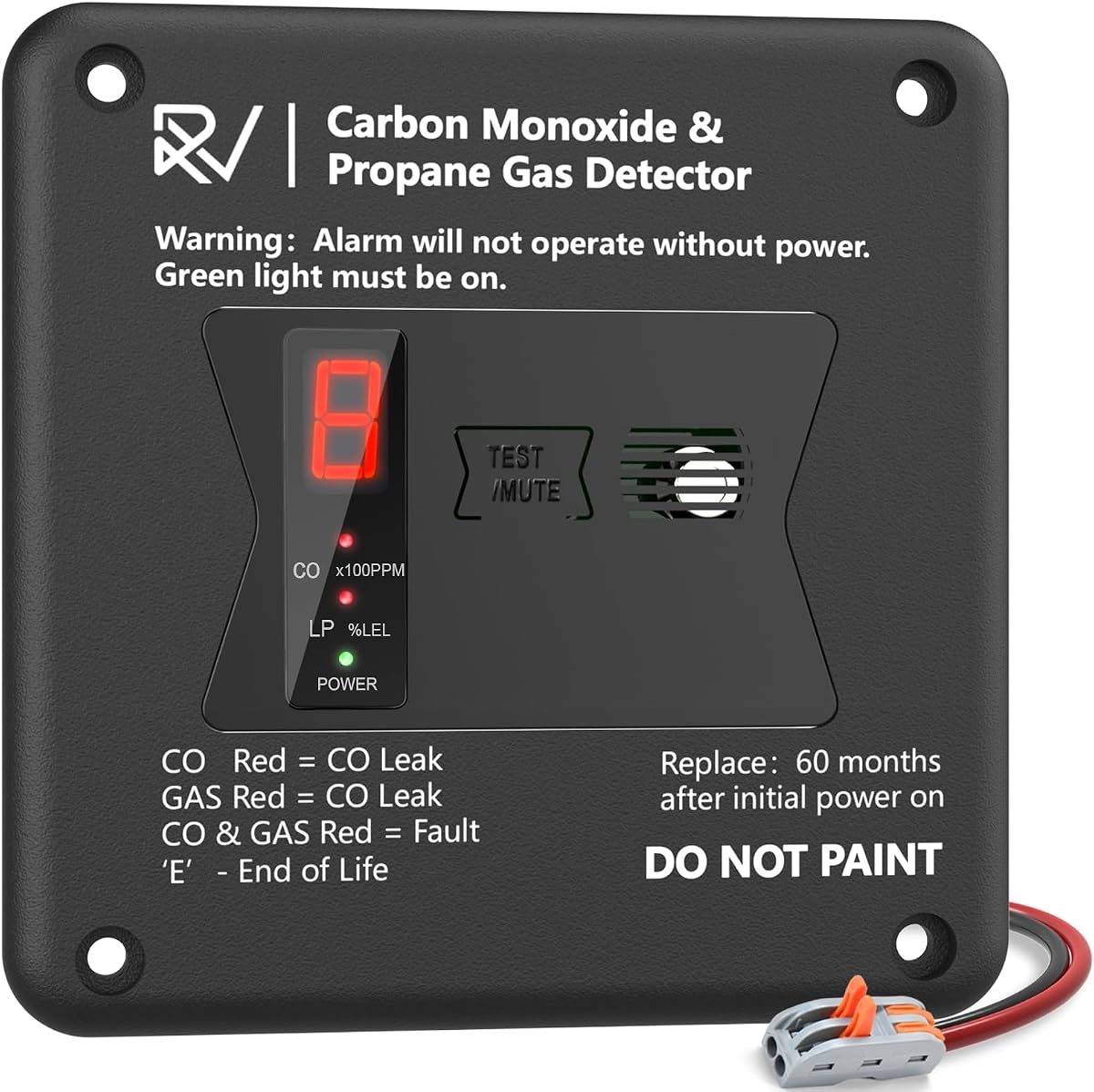
The R503 is a permanently installed RV safety alarm rather than a portable leak sniffer. It combines carbon monoxide and gas detection in a flush-mounted housing designed for motorhomes, travel trailers, motor coaches, and truck campers. Its 4.6 rating makes it a strong option for owners seeking integrated protection.
We may earn a commission when you buy through this link, at no additional cost to you.
Two independent sensors monitor carbon monoxide and gas, while a digital LED display indicates sensing status and the carbon monoxide level. The stated audible alarm reaches 100 decibels, which is designed to produce a conspicuous warning inside an occupied RV. Unlike a portable detector, it remains in place and does not depend on an owner remembering to pick it up.
Installation is a major strength for compatible vehicles. The unit operates on 12-volt DC within a stated plus-or-minus 20-percent range and uses lever-nut connectors to reduce wiring work. Its screw spacing is compatible with the 31011 detector, while the listed cutout dimensions help owners compare the opening with the existing installation.
This detector is best for RV owners replacing an older hardwired unit or building a new permanent alarm into a motorhome. It is not the right tool for finding the source of a small leak with a probe, and installation should follow the manual and applicable RV safety practices. For a compatible vehicle, however, it offers the most complete fixed-installation approach in the roundup.
The R503 combines carbon monoxide and combustible-gas sensing in a single flush-mounted device. That dual function can simplify the number of installed warning devices and centralize status information in one display.
Compatibility with 31011 screw spacing and lever-nut terminals can make an upgrade more manageable. Owners should still verify cutout dimensions, wiring polarity, placement, and local requirements before installation.
We may earn a commission when you buy through this link, at no additional cost to you.
The PT205 stands out for showing gas concentration as a percentage of the Lower Explosive Limit. It detects propane, methane, butane, LPG, ethane, natural gas, coal gas, gas fuel, and liquefied natural gas. Its 4.6 rating and informative LCD make it a strong all-purpose handheld option for RV maintenance.
We may earn a commission when you buy through this link, at no additional cost to you.
The stated measurement range is 1% to 10% LEL, equivalent to 100–5,000 ppm based on methane. A bar graph rises as concentration increases, the screen turns red at higher levels, and a beep provides audible confirmation. This combination gives the user more information than a simple alarm-only sniffer.
A 30-second warm-up countdown appears on the display, helping the operator avoid using the sensor before it is ready. The package includes two AAA alkaline batteries, a storage bag, and a pen hook for carrying. Low-battery indication and automatic power-off add convenience, while the pocket-sized body supports use around accessible appliances and fuel-system connections.
The PT205 is ideal for an RV owner who wants a numerical indication rather than only bars or warning lights. It remains a manual inspection device, and the absence of a flexible probe limits its usefulness in deeply confined locations. Even so, its readable %LEL display, broad gas compatibility, and clear warm-up process make it a particularly informative portable detector.
A numeric %LEL readout helps distinguish a trace response from a substantially higher concentration. The bar graph and color changes still provide quick visual interpretation when the user is moving around a leak area.
The displayed warm-up timer shows when calibration is complete. Starting inspections only after that countdown can support more consistent results and reduces the likelihood of misreading the detector's initial behavior.
We may earn a commission when you buy through this link, at no additional cost to you.
The PT177 is a lightweight, pocket-sized gas sniffer that offers an approachable way to inspect an RV's propane system. It supports LPG, methane, ethane, propane, butane, natural gas, and coal gas. Its 4.6 rating reflects a simple design with fast alerts and strong customer appeal.
We may earn a commission when you buy through this link, at no additional cost to you.
Five red LEDs and a 75-decibel alarm provide increasingly noticeable feedback as gas concentration rises. The product can trigger an alarm within 0.5 to three seconds, depending on the detection conditions described by the manufacturer. A 30-second auto-calibration in clean air prepares the unit for use.
Its pocket clip makes it easy to carry during inspections, and the included drawstring bag protects it during storage. Two AAA batteries are supplied. The power indicator flashes below 2.4 volts, and automatic shutdown after five minutes of inactivity or no detection conserves battery life.
The PT177 is a strong budget-oriented choice for routine checks near exposed hoses, valves, burners, and fittings. It does not show a numerical %LEL value, and the device must be brought very close to a suspected leak. Those limitations make it less appropriate for inaccessible locations, but its portability, straightforward alarms, and low-battery reminder make it highly useful as a basic maintenance tool.
The pocket clip and compact dimensions encourage users to keep the detector with a maintenance kit. A storage bag prevents the body from collecting dirt or being scratched when it is carried between trips.
The five red LEDs and increasing alarm output make changes in concentration easier to notice. This is helpful in an RV interior, where background noise and limited lighting can complicate a quick inspection.
We may earn a commission when you buy through this link, at no additional cost to you.
The PT210S combines a pen-shaped body, a four-inch probe, and a two-digit %LEL display. It detects propane, natural gas, methane, and butane, making it a practical middle ground between a basic pocket sniffer and a long-probe diagnostic tool. Its 4.6 rating reflects a versatile feature set.
We may earn a commission when you buy through this link, at no additional cost to you.
The probe allows the sensing end to reach around edges and into partially obstructed areas. A clear two-digit display reports the current gas leakage in percent LEL, helping the operator understand severity. The stated range is 100–5,000 ppm, or 1–10% LEL, and the product claims it can find a leak in 0.5 seconds.
Visual feedback includes a red screen and rising bar graphs, while a 75-decibel buzzer sounds as concentration increases. The unit offers high-sensitivity and low-sensitivity modes, which can be useful when moving from general inspection to closer evaluation. A low-battery light appears below 2.5 volts, and automatic shutdown occurs after five minutes of inactivity.
The PT210S suits owners who want more access and more information than a simple LED sniffer without carrying a full-length probe. It remains compact and is well suited to exposed regulators, appliance edges, cabinet spaces, and storage compartments. For deeper, inaccessible areas, however, the 17-inch PT520A or extendable PT760 offers greater reach.
The four-inch probe adds meaningful access without making the detector as bulky as a full telescopic model. It can reach behind an accessible appliance edge or around a fitting where a flat sensor face cannot go.
Switching between high- and low-sensitivity modes can make systematic inspection easier. The mode choice allows the user to work through an area with the setting that best matches the immediate task.
We may earn a commission when you buy through this link, at no additional cost to you.
The PT760 is a rechargeable gas detector designed for owners who want extended reach and fewer disposable battery changes. It detects LPG, methane, ethane, propane, butane, natural gas, coal gas, and gas fuel. Its 4.5 rating reflects a capable tool with a useful combination of telescopic probe, numeric display, and flashlight.
We may earn a commission when you buy through this link, at no additional cost to you.
The 12-inch stainless-steel probe extends into narrow or hard-to-reach areas such as inside pipes and behind cabinets. It retracts afterward so the unit remains compact for storage, and the included protective case helps organize the detector and cable. The instructions recommend keeping the sensor 1–5 centimeters from the suspected leak point.
The screen displays the current lower explosive limit value over a stated range of 1–20% LEL, or 100–10,000 ppm. Visual and audible alarms activate within 0.5 seconds, with the screen color and alarm tone changing as concentration rises. A built-in flashlight is particularly valuable in dark storage compartments and behind RV furnishings.
The PT760 is an excellent choice for an RV owner who repeatedly inspects recessed fuel-system areas and wants a rechargeable device. Because it relies on an internal rechargeable battery, runtime and charging habits become important considerations. For routine checks of exposed fittings, a smaller battery-powered unit may be more convenient, but for confined-space inspection, the telescopic probe is a major advantage.
The stainless-steel telescopic section can enter spaces that are difficult to view or reach safely by hand. It also retracts cleanly, making it easier to carry from one compartment to another.
A Type-C charging port simplifies recharging with compatible cables. The built-in flashlight adds another layer of practicality when the leak point is behind an appliance, inside a compartment, or otherwise poorly illuminated.
We may earn a commission when you buy through this link, at no additional cost to you.
The PT299 is a portable propane and natural-gas sniffer with an adjustable telescopic pole. It supports propane, methane, natural gas, LPG, gasoline, and other combustible leaks. Its 4.6 rating reflects a straightforward, responsive detector with useful visual concentration feedback.
We may earn a commission when you buy through this link, at no additional cost to you.
The pole adjusts from 2.20 to 6.30 inches, allowing the sensing end to approach pipelines, storage tanks, fireplaces, basements, and RV compartments without placing the entire body directly at the leak source. A 30-second preheat countdown shows when the detector is ready for use.
Alerts begin in 0.5 seconds. Nine analog bars rise with concentration, the screen turns red, and a 75-decibel buzzer helps locate the source. The stated methane-based detection range is 1–10% LEL, or 100–5,000 ppm. Low-battery warning and an optional five-minute automatic shutdown help manage routine use.
The PT299 is a good fit for RV owners who want better reach than a flat handheld detector without carrying a long, heavy tool. Its extension is shorter than the 12-inch PT760 probe and the 17-inch PT520A gooseneck, so very deep spaces may still be difficult. For typical exposed fittings, cabinet edges, and storage-tank areas, however, the adjustable rod offers a practical balance.
The telescopic pole can remain short for open fittings and extend for more concealed locations. This flexibility makes the device useful across several kinds of RV fuel-system inspections.
Nine rising bars and a red screen clearly communicate when gas is detected and becoming more concentrated. Although the display lacks a numeric value, the expanding bar pattern offers quick visual guidance.
We may earn a commission when you buy through this link, at no additional cost to you.
The Safe T Alert 20 Series is a compact LP-gas alarm designed specifically for RV environments. It is intended for travel trailers, fifth wheels, truck campers, and folding campers, and its 4.7 rating is the highest among the ten products included here.
We may earn a commission when you buy through this link, at no additional cost to you.
The alarm activates below 25% LEL of propane or methane. Its mute button allows ventilation while the rapid-recovery sensor reactivates if dangerous propane levels remain. This design recognizes that an RV occupant may need to move and ventilate after an alarm rather than simply silencing a nuisance condition.
The unit operates on 12-volt DC at 75 milliamps, so it does not require disposable backup batteries. Its compact case measures 3.5 inches wide by 2.5 inches high by 1.25 inches deep, and an included mounting bracket supports installation in tight spaces. The stated operating range extends from minus 40 to 158 degrees Fahrenheit.
The Safe T Alert is best for owners who want a dedicated, always-ready propane alarm for an RV rather than a handheld inspection tool. It is not designed to display concentration, locate a leak, or monitor carbon monoxide, and its surface-mounted position should be considered when selecting a location. Within its propane-alarm role, it is compact, rugged, and well rated.
Because the alarm draws power from the RV's 12-volt system, it can remain operational whenever the vehicle's electrical system is supported. This avoids routine disposable-battery replacement for a permanently installed gas alarm.
The mute function supports immediate ventilation without disabling safety monitoring permanently. The sensor reactivates if propane remains at a dangerous level, helping prevent an occupant from treating the mute control as a permanent solution.
We may earn a commission when you buy through this link, at no additional cost to you.
The Kidde combination alarm is a plug-in safety device for homes, apartments, and similar spaces where standard wall outlets are available. It combines carbon monoxide sensing with explosive natural-gas and propane detection. Its 4.5 rating reflects a versatile design, although it is less directly tailored to an RV installation than the dedicated RV alarms in this roundup.
We may earn a commission when you buy through this link, at no additional cost to you.
Installation is straightforward because the unit plugs into a standard 120-volt outlet. A 9-volt battery provides backup during power outages, and an 85-decibel alarm warns of either carbon monoxide or explosive gas. The digital display shows the carbon monoxide level or states GAS when explosive gas is present.
LED status indicators provide additional operating feedback, while peak-level memory records the last time carbon monoxide was detected or the unit was tested. These features make the alarm easier for occupants to check and can help reveal whether a previous event occurred while nobody was present.
This Kidde unit is best for an RV owner seeking a simple plug-in combination alarm, particularly one used in a travel setup with reliable access to a suitable outlet. It is not a handheld propane sniffer, does not include a probe for locating leaks, and may not suit an RV without an appropriate powered receptacle. Its strongest appeal is combined gas and carbon monoxide coverage with outage backup.
Monitoring carbon monoxide and explosive gas in one unit can simplify protection in living spaces where both hazards are relevant. The display distinguishes between a carbon monoxide reading and a GAS warning.
The 9-volt battery keeps the alarm available during an outage, while peak-level memory preserves a record of the last detected carbon monoxide event or test. These are useful additions when occupants may be away for stretches of time.
We may earn a commission when you buy through this link, at no additional cost to you.
The most important choice is whether you need a portable sniffer to investigate a suspected leak, a fixed alarm to monitor an occupied RV, or both. Sensor type, power, reach, and installation should be matched to the RV's layout and how the owner expects to use the device.
A portable gas sniffer is operated during maintenance and moved close to hoses, valves, connectors, pipes, appliances, and storage areas. It is intended to help locate a leak rather than continuously monitor the entire vehicle. A fixed alarm is installed in a suitable location and remains connected to RV power, making it better suited to warning occupants while the motorhome is in use.
A handheld detector is not a substitute for a permanently installed alarm. For comprehensive protection, consider using both types: a sniffer for periodic service and a fixed detector for ongoing monitoring.
Look for explicit support for propane because that is the primary fuel used by many RV appliances. Many listed detectors also recognize methane, natural gas, butane, LPG, and related combustible gases. Methane-based measurement ranges may not exactly describe performance around every propane concentration or in every environment.
Choose a model whose published gas list explicitly includes the material in your RV system. Avoid assuming that a natural-gas detector automatically offers identical performance for every propane appliance or fitting.
Probe length determines how closely you can inspect concealed components. Flat sensors are convenient around exposed fittings, while four-inch probes, short telescopic rods, a 12-inch stainless-steel extension, and a 17-inch gooseneck can reach farther around obstacles. A long flexible probe is especially useful behind cabinets, beside pipes, and inside crowded storage compartments.
Match the probe to the spaces you expect to inspect rather than choosing solely by maximum length. Consider the detector's bulk, the distance at which it can operate, and whether the probe can hold a stable position near the source.
Simple LED and bar indicators show that gas is present and may become more intense as concentration rises. Numeric %LEL displays provide a more specific representation of severity, which can help an experienced user understand the relative risk. %LEL means the measured concentration as a percentage of the lower explosive limit.
A numeric display is useful, but it does not replace safe operating procedures. Compare readings consistently, keep the sensing tip at the manufacturer's specified distance, and treat any alarm as a reason to shut off the fuel source, ventilate, and investigate professionally when necessary.
Battery-powered sniffers are portable and simple to deploy, while 12-volt DC units integrate naturally with an RV's electrical system. Rechargeable tools reduce disposable-battery use but require regular charging. Plug-in combination alarms need a suitable 120-volt outlet and should not be assumed to provide a permanent RV installation.
For a hardwired alarm, verify the cutout dimensions, screw spacing, wire type, power polarity, and placement instructions. For a portable model, check battery inclusion, warm-up time, low-battery warning, charging method, and expected storage conditions.
A useful alarm provides both visual and audible warnings. Rising bars, colored bars, LED arrays, a red display, or a numeric reading make results easier to understand, while an alarm in the 75–100 decibel range is intended to be conspicuous in an RV. Alarm behavior should become more urgent as detected concentration increases.
Consider the environment in which you will use the detector. Engine noise, fans, generators, and enclosed compartments can make an audible signal harder to hear, so a strong visual indicator is an important complement.
A fixed alarm with a rapid-recovery sensor can reactivate after a mute button is used if dangerous propane remains present. Portable detectors may offer mute, auto-calibration, warm-up countdowns, automatic power-off, and low-battery indicators. These functions simplify routine use but should be understood before relying on the tool.
Review the start-up procedure carefully. Several models require a 30-second warm-up in clean, gas-free air, and some auto-calibrate during that period. Beginning the inspection too early can produce misleading behavior.
The detector's role depends on where fuel cylinders, regulators, pipes, and appliances are located. A long probe helps when the most critical components sit behind cabinetry or in tight service areas. A fixed alarm is most useful when placed according to its instructions in a location that lets sound carry through occupied spaces.
Larger RVs with multiple appliances may benefit from both a permanent alarm and a portable inspection tool. Smaller trailers may have accessible plumbing and appliance areas, making a compact sniffer sufficient for service tasks, though it should not be treated as a replacement for fixed protection.
Before use, read the included manual and identify the detector's sensing limits, warm-up process, operating distance, and supported gases. For models requiring calibration, place the unit in clean, gas-free air and allow the full warm-up countdown to finish. Inspect the probe, sensor openings, display, buttons, and battery or power connections before beginning.
During an inspection, work systematically from the cylinder and regulator outward, moving the sensing tip slowly along each hose, connector, valve, pipe, and appliance connection. Stay within the stated detection distance, which is commonly 1–5 centimeters. Do not spray a suspected leak with an open flame, and do not operate electrical switches in an area where gas could be present.
If a detector alarms, move away from the suspected source, avoid creating additional ignition sources, and follow the RV's emergency procedure. Shut off the propane supply when it can be done safely, ventilate the area, and contact qualified service personnel for repairs. Store portable devices dry and securely, remove batteries if they will be unused for an extended period, and follow the manufacturer's test and replacement schedule for installed alarms.
No. A handheld detector is mainly a maintenance tool used to inspect suspected leaks, while a fixed alarm is intended to monitor an area and warn occupants. RV owners may benefit from both a portable sniffer and a permanently installed propane alarm. The exact placement and number of alarms should follow the device instructions and applicable RV safety guidance.
%LEL means the detected gas concentration expressed as a percentage of the Lower Explosive Limit. A higher percentage represents a larger fraction of the concentration associated with the lower explosive limit. These values are useful for understanding relative severity, but a portable detector should not be treated as a substitute for professional gas-system inspection.
Several of the listed products specify an operating distance of approximately 1–5 centimeters from the suspected source. Move the probe slowly along fittings and hoses while watching the display and listening for the alarm. The exact distance and technique should follow the instructions supplied with the specific detector.
Yes, for the models that specify a warm-up or auto-calibration period. The PT177, PT199, PT205, PT299, PT520A, and PT760 use a roughly 30-second preparation process in clean air, depending on the model. Waiting for the displayed countdown or startup cycle helps ensure that the sensor is ready before a leak search begins.
Many products in this roundup explicitly list propane, methane, natural gas, butane, LPG, or several of these gases as detectable. Check the exact supported-gas list and the stated calibration basis. Published ppm ranges often reference methane, so the displayed values should be interpreted according to the manufacturer's instructions.
The appropriate number and placement depend on the RV's floor plan, fuel-system layout, appliance locations, and alarm instructions. One fixed detector may not provide equivalent coverage in every large or divided interior. An RV owner should review the device's installation guidance, identify all propane appliances and connections, and consider a professional safety assessment where placement is uncertain.
Keep the sensor openings clean and unobstructed, protect the probe from impact, and store the device in a dry protective bag or case. Replace batteries as indicated, recharge rechargeable models according to the manual, and avoid leaving the unit in a hot vehicle or damp storage area. Periodic test functions can verify that the display, buzzer, and warning indicators still operate.
Treat every alarm seriously. Avoid flames, sparks, smoking, and unnecessary electrical switching, then move occupants and pets to fresh air if there is any doubt about safety. Shut off the propane supply only if this can be done without entering a hazardous area, ventilate the RV, and arrange qualified service for the fuel system. Do not silence an alarm and assume the hazard has passed.
The PT520A is the strongest all-around portable choice because its 17-inch flexible gooseneck combines broad gas support with rapid visual and audible alerts. The PT177 offers a straightforward, budget-friendly pocket sniffer, while the R503 stands out for owners seeking a permanent, 12-volt RV installation with combined carbon monoxide and gas sensing.
Prioritize the function you actually need. Choose a probe that can reach your most concealed fittings, a display that provides useful concentration feedback, and power that suits your maintenance routine. For continuous protection, select a fixed alarm positioned according to its instructions; for leak investigation, keep a portable sniffer accessible in the maintenance kit.
Before buying, compare the current listing with the specifications in this guide, including supported gases, detection range, probe length, warm-up time, included accessories, cutout dimensions, and wiring requirements. Product availability, bundles, and prices change, so checking the current listing helps ensure the selected model fits both your RV and your intended use.