
Fosi Audio TP-02
4.4Editor score
Maximum output rated 220W
Adjustable low-pass control
Compact subwoofer-focused design
Plate amplifier for subwoofer guide comparing power, inputs, filtering, protection, controls, and installation needs for home, car, and PA projects.
A plate amplifier for subwoofer is the compact power-processing unit that turns a passive speaker cabinet into an active subwoofer. A strong choice should match the driver’s power needs while providing the correct inputs, crossover controls, speaker terminals, protection, and power options for its intended installation.
This guide compares ten plate amplifiers across homes, cars, DIY builds, and professional sound systems. The evaluation considers continuous or rated output, low-pass filtering, gain and phase adjustments, connection options, thermal design, electrical requirements, and safeguards, while recognizing that maximum marketing power does not always predict clean low-frequency performance.
Each review identifies the most suitable use for that model rather than treating raw wattage as the only measure of quality. The list also shows how the products differ in installation complexity and system flexibility. Prices and availability can change, so confirm the current specifications and manufacturer details before purchasing or modifying a cabinet.
4.4Editor score

4.3Editor score

5.0Editor score
The comparison below highlights each model’s most important design choices, including amplifier class, stated output, connection style, control features, and typical application. Because the products serve very different systems, the most appropriate choice depends on speaker impedance, cabinet design, source connections, power supply, and whether the amplifier must support live PA operation.



The WAudio SUA-350 is a 350W RMS Class-D plate amplifier built for four-ohm subwoofers, making it a versatile choice for a new powered cabinet or a replacement module. Its 4.3 rating reflects a balanced combination of useful controls, flexible signal connections, operating modes, and protective circuitry. The feature set goes beyond basic gain and crossover adjustment.
We may earn a commission when you buy through this link, at no additional cost to you.
Its strongest qualities include a crossover adjustable from 50 to 180Hz, phase adjustment from 0 to 180 degrees, and selectable EQ or gain modes for matching a subwoofer with main speakers. RCA and balanced connections can simplify integration with receivers, mixers, and professional sources, while three-way auto, on, and off power modes provide useful control over standby behavior. The 45Hz, six-decibel bass boost adds another adjustment option when cabinet placement limits deep-bass response.
The SUA-350 is not the simplest solution available. It requires correct mains-voltage selection, adequate ventilation, and thoughtful grounding, and its balanced and multiple input options may be unnecessary for a basic living-room subwoofer. Its stated 350W RMS rating also represents a meaningful power load, so the subwoofer, cabinet, wiring, and supply should all be appropriate. Those demands are reasonable for an installer who wants repeatable integration controls.
This is the strongest general recommendation for someone building or upgrading a serious home subwoofer and values phase, crossover, source flexibility, and standby convenience. It is less suitable for a small sealed enclosure with a modest driver or a project requiring only a basic fixed-filter board. For those applications, the Dayton Audio SPA100-D or Fosi Audio TP-02 may be simpler and more proportionate.
Crossover, phase, and EQ controls make the SUA-350 especially useful in rooms where a subwoofer competes with floorstanding speakers or sits near a wall. These adjustments help blend the sub with the main speakers without forcing the user to rely on a fixed internal filter alone.
Right and left-mono RCA inputs support ordinary consumer and pro audio sources, while balanced connections suit compatible systems and longer signal runs. Automatic signal sensing can also reduce unnecessary operation when the amplifier is installed in a cabinet or equipment rack.
We may earn a commission when you buy through this link, at no additional cost to you.
The Dayton Audio SPA100-D delivers 100W RMS at four ohms in a Class-D plate-amplifier format. Its 4.3 rating makes it a practical option for compact DIY subwoofers, especially when clean low-frequency output and automatic shutdown matter more than high power. The amplifier also includes a distinctive low-frequency boost and straightforward room-matching controls.
We may earn a commission when you buy through this link, at no additional cost to you.
Gain, crossover, and phase controls allow the SPA100-D to be integrated with a range of speakers and room positions. A six-decibel boost at 30Hz can help add perceived depth, while manual and automatic on/off modes offer control over operating behavior. Its ability to switch between 120V and 240V input adds installation convenience for different regions, provided the selector is set correctly before power-up.
The key limitation is its 100W RMS output. That rating is appropriate for smaller drivers and restrained cabinet volumes, but it will not provide the headroom of the 350W or 700W models in this guide. The six-decibel boost should also be used carefully because bass emphasis increases excursion and can distort sooner than expected. Buyers should match the amplifier to the subwoofer manufacturer’s recommended power range rather than treating boost as extra amplifier capacity.
Choose the SPA100-D for a bedroom system, small studio sub, or compact home-theater build where efficiency and simple integration are priorities. It is also a sensible plate-amplifier option when a more powerful Class-D unit would be unnecessary. For larger PA cabinets or high-output drivers, move up to one of the Sound Town models.
Class-D output is well suited to a small powered subwoofer because it can provide useful performance without the bulk associated with a large conventional power stage. That makes the SPA100-D easier to incorporate into a compact cabinet or near the driver without leaving excessive unused space.
The choice between automatic and manual power modes lets users balance convenience with control. Automatic signal sensing is useful in an entertainment room, while manual operation may suit installations where predictable startup behavior is more important.
We may earn a commission when you buy through this link, at no additional cost to you.
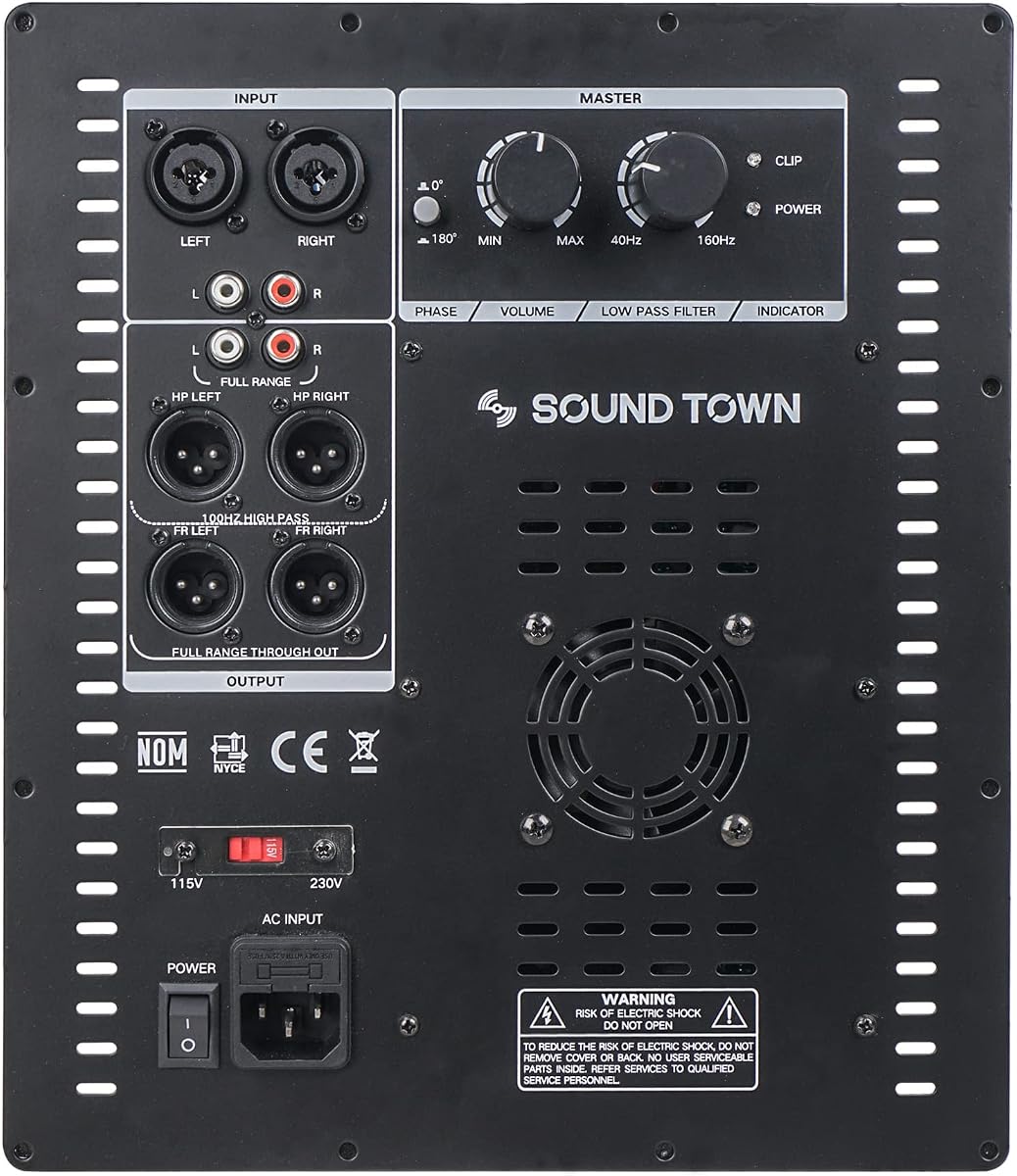
The Sound Town STPAS-G800 is a 700W RMS Class-D plate amplifier designed for PA and DJ subwoofer cabinets. Its 4.1 rating reflects a powerful platform with professional signal routing and substantial cabinet-ready hardware. The separate high-pass outputs make it especially interesting for systems that need to feed full-range speakers as well as a subwoofer.
We may earn a commission when you buy through this link, at no additional cost to you.
Input flexibility is a major strength. Two XLR-1/4-inch combination inputs and two RCA inputs accommodate microphones, mixers, media players, and other sources. Outputs include two XLR positions, including through and 100Hz high-pass options, along with RCA outputs. The built-in second-order IIR low-pass filter, dynamic bass enhancement, and RMS dynamic processor provide additional ways to shape the subwoofer’s behavior.
This level of functionality comes with greater installation demands. A 700W RMS amplifier needs an appropriate enclosure, driver, wiring, power service, and ventilation plan. Users must also understand which outputs are filtered or unfiltered before designing a full-range system. The integrated aluminum heat sink and overcurrent and short-circuit protection support reliability, but they do not remove the need for sensible setup and load matching.
The STPAS-G800 is best suited to mobile PA, DJ, club, or serious permanent subwoofer installations where output and professional routing are priorities. Its high-pass outputs distinguish it from basic single-subwoofer modules. Home users who only need RCA input and basic phase adjustment may find the WAudio SUA-350 easier to operate.
The mix of XLR, quarter-inch, and RCA connections means the amplifier can sit between several kinds of source and speaker systems. This is valuable for live-event work, rehearsal rooms, and installations where one cabinet may need to feed both subwoofer and full-range signal paths.
A 700W RMS rating provides considerably more sustained output than the smaller home-oriented models. It can suit a substantial passive subwoofer when the driver, cabinet volume, wiring, and amplifier settings are all designed to handle that level of power responsibly.
We may earn a commission when you buy through this link, at no additional cost to you.
The Sound Town STPAS-600D is a 350W RMS Class-D plate amplifier aimed at PA and DJ subwoofer cabinets. It combines professional input options with low-pass filtering in a straightforward platform. Its 3.9 rating is lower than most entries here, so buyers should pay particular attention to system compatibility and the manufacturer’s full specifications.
We may earn a commission when you buy through this link, at no additional cost to you.
Two XLR-1/4-inch combination inputs and two RCA inputs allow the amplifier to work with professional mixers, instruments, or consumer sources. Two XLR through outputs provide a route for further signal distribution, while the integrated low-pass filter helps isolate the subwoofer band. Overcurrent and short-circuit protection adds a basic layer of operational security.
Compared with the STPAS-G800, this model offers a lower power tier and a less extensive feature set. The supplied information does not detail a high-pass output, DSP, wireless connectivity, or the same range of dynamic processing. That simplicity can be beneficial in a permanent installation where straightforward low-pass filtering and reliable output are sufficient, although it offers less scope for complex live routing.
The STPAS-600D is a reasonable middle ground for a medium-output PA subwoofer, DJ cabinet, or rehearsal system. It is most attractive to a user who wants XLR flexibility without the feature load of the two-channel STPA11-G900. Confirm the model’s detailed controls, load requirements, and included accessories before committing to a build.
Combination XLR and quarter-inch inputs make the amplifier adaptable to both professional and semi-professional sources. RCA inputs broaden that compatibility further, allowing existing mixers and playback devices to feed the subwoofer without requiring specialized adapters.
The built-in low-pass filter addresses the essential need to remove unwanted high frequencies before they reach the subwoofer driver. It offers a more installation-ready solution than a bare board with no integrated source filtering.
We may earn a commission when you buy through this link, at no additional cost to you.
The Fosi Audio TP-02 is a compact mono subwoofer amplifier with a maximum output of 220W and controls for volume and frequency. Its 4.4 rating is the highest among the home-focused single-subwoofer products here, reflecting a useful combination of output, low distortion, protective circuitry, and approachable installation.
We may earn a commission when you buy through this link, at no additional cost to you.
The TPA7498E amplifier chip and NE5532 op-amp form the core of a design aimed at clean, warm home-audio bass. Its low-pass filter removes high-frequency noise, and the frequency control spans approximately 30Hz to 260Hz. Stated performance includes a frequency response range of 20Hz to 250kHz, total harmonic distortion of no more than 0.04%, and a signal-to-noise ratio of at least 98dB.
Its limits come from the intended format. This is a home-audio unit with a 24V adapter, not a touring PA module with balanced professional I/O, selectable mains voltage, or multiple output routes. It can connect to passive subwoofers and bass shakers according to the supplied description, but its fixed installation ecosystem is less versatile than the Sound Town products. Buyers should still verify the recommended speaker impedance and connection method for their specific driver.
The TP-02 is an excellent budget-oriented choice for a first powered subwoofer, compact home theater cabinet, or dedicated bass enclosure. It offers more control than a completely fixed mini amplifier while remaining simpler than a full rack-style plate unit. Choose it for straightforward home use; choose the WAudio SUA-350 when balanced connections and phase adjustment are important.
A stated total harmonic distortion figure no higher than 0.04% indicates that the design emphasizes linear amplification for low-frequency reproduction. In practical terms, the goal is to preserve clean bass without obvious added distortion, particularly at moderate listening levels.
Separate volume and frequency controls make it possible to match the amplifier to a particular subwoofer and source. The wide frequency adjustment range offers flexibility for home theater, music, and bass-shaker applications where the desired roll-off point may differ.
We may earn a commission when you buy through this link, at no additional cost to you.
The Dayton Audio SPA1000 is a 1000W subwoofer plate amplifier built around a high-power Class-AB output stage. Its 4.0 rating reflects a design focused on clean, controlled output, flexible low-frequency correction, and a substantial power-supply system. It is among the highest-output dedicated plate amplifiers in this comparison.
We may earn a commission when you buy through this link, at no additional cost to you.
Parametric EQ is the distinguishing feature. Instead of offering only a general bass adjustment, the SPA1000 can boost or cut low-frequency regions to tailor the response to a cabinet, room, and source. Its soft-clip circuitry improves headroom and helps protect woofers when the amplifier approaches its limits, while the patented tracking downconverter supply and toroidal transformer support its high-power architecture.
The trade-off is efficiency and infrastructure. A Class-AB stage generally draws more power and produces more heat than a comparable Class-D design, so ventilation and electrical service demand careful attention. Its much larger output rating also makes driver and cabinet matching essential. The amplifier cannot create accurate low-frequency response for a poorly designed enclosure, and excessive level can still cause clipping or excursion.
This model is aimed at serious high-output subwoofer projects where clean power and detailed EQ justify the additional complexity. It can suit a dedicated home cinema, club installation, or large passive subwoofer when the enclosure and driver are designed for the load. More efficient, compact alternatives are easier to integrate when the required output is lower.
Parametric EQ is particularly useful when a subwoofer interacts with a particular wall, floor, seating arrangement, or room mode. Adjusting selected low-frequency bands gives the installer more control than a single fixed bass knob or broad treble control.
The advanced soft-clip circuitry is intended to improve usable headroom and reduce the likelihood of hard clipping as output rises. It does not remove the need to set gain correctly or keep the amplifier within the subwoofer manufacturer’s recommended power range.
We may earn a commission when you buy through this link, at no additional cost to you.
The Hosyond ZK-6001 is a bare mono amplifier board for DIY subwoofer systems, rated at 300W into four ohms and capable of a stated 600W peak output into two ohms. Its 4.1 rating makes it a viable choice for builders who want considerable power and direct frequency and volume adjustment in a board-level format.
We may earn a commission when you buy through this link, at no additional cost to you.
The board accepts 18–50V DC, with 36–48V recommended, and requires a supply rated for at least 10A DC. That flexibility allows it to be used in home, car, or professional-inspired systems when the power source is appropriate. A large heat sink supports heat dissipation, and protection includes undervoltage, overtemperature, overcurrent, and short-circuit safeguards.
Installation is more involved than with an enclosed plate amplifier. The board uses an XH2.54-3P stereo input and includes a matching shielded cable, so it will not accept conventional RCA plugs without an appropriate interface. Most importantly, it has no reverse-connection protection on the speaker terminals; polarity must be checked meticulously. The low-pass setting also needs to be verified against the board’s controls rather than assumed from the listing title.
The ZK-6001 is best for an experienced DIY builder who can provide a proper high-current DC supply, secure the exposed electronics, manage heat, and wire the system correctly. It offers a direct route to strong mono bass without a large prefabricated enclosure. For a ready-made home installation, the Fosi Audio TP-02 or WAudio SUA-350 requires fewer technical decisions.
Supporting a broad DC input range makes the board adaptable to multiple installation concepts, but the minimum current requirement remains important. A capable, regulated supply and appropriately sized wiring are necessary for stable output, particularly when the subwoofer draws substantial bass current.
Undervoltage, thermal, overcurrent, and short-circuit protection help guard against several common installation errors. The stated lack of reverse-polarity protection means installers must confirm positive and negative connections before powering the board.
We may earn a commission when you buy through this link, at no additional cost to you.
The 300W 12V Car Amplifier Board is an exposed dual-channel board intended for vehicle subwoofer and car-audio installations. Its 4.2 rating indicates generally positive customer reception, while the slim construction and exposed aluminum cooling panel distinguish it from larger enclosed home and PA plate amplifiers.
We may earn a commission when you buy through this link, at no additional cost to you.
Its stated 300W output is aimed at giving a vehicle subwoofer stronger low-frequency drive, and the board can operate from a 12V vehicle electrical system. The thickened pure-aluminum panel serves as a heat-dissipation structure, while the slim layout makes it easier to mount in a vehicle enclosure where every centimeter matters. The design is also presented as a straightforward platform for DIY automotive audio work.
The listing provides less objective detail than many alternatives. It does not clearly specify rated versus peak power, supported speaker impedance, frequency-adjustment range, input connector type, protection features, or low-pass configuration. These omissions matter because a board marketed for subwoofers still needs correct filtering, adequate current capacity, and safe wiring. A nominal wattage figure alone is not enough to establish compatibility with a particular driver.
This board is most appropriate for a vehicle builder seeking a thin, exposed module and familiar 12V power. It may also be useful in a custom low-voltage project. Buyers should inspect the board, documentation, and terminals closely before purchase, and avoid using an automotive circuit without appropriate fusing and grounding. A fully documented home unit is the safer recommendation for a first powered-subwoofer project.
The ultra-thin board format reduces the depth needed inside a vehicle enclosure compared with a deep, transformer-based amplifier. It is better suited to a custom installation where the enclosure and mounting area are tightly constrained.
An exposed aluminum panel helps move heat away from the board, but it still requires airflow and secure mounting. Vehicle interiors can become hot, so heat management and electrical isolation remain important parts of the installation.
We may earn a commission when you buy through this link, at no additional cost to you.
The Sound Town STPA11-G900 is a two-channel Class-D plate amplifier rated at 2x600W continuous and 2x1200W peak. Its 5.0 rating distinguishes it as the most favorably rated model in this guide. It is designed for subwoofer and full-range PA applications, combining high output with digital control and flexible connectivity.
We may earn a commission when you buy through this link, at no additional cost to you.
The built-in DSP provides presets plus manual EQ and delay settings, and the easy-to-read LCD gives users a clearer interface for those settings than a collection of small analog controls. Connectivity includes two XLR-1/4-inch combination inputs, an XLR output, a Speakon power output, and TWS Bluetooth. That allows the amplifier to function as the central power and routing hub for a larger PA system rather than only driving one passive subwoofer.
The tradeoff is complexity. Continuous output at 600W per channel requires substantial electrical capability, appropriate speaker wiring, and careful thermal management. Overload and overcurrent protection support durability, but operators still need to understand the DSP, channel routing, and output configuration. TWS Bluetooth is convenient for some workflows, although a wired signal remains preferable when latency, reliability, or consistent professional operation is critical.
The STPA11-G900 is the top premium pick for a serious PA or DJ cabinet builder who wants one module to serve subwoofer and full-range duties. It is also suitable for a permanent installation requiring delay and EQ. For a single home subwoofer, the WAudio SUA-350 offers a more focused feature set with less operational complexity.
DSP presets and manual EQ, delay, and EQ-related controls give an installer tools for aligning a subwoofer with the rest of a PA system. The LCD makes those adjustments more approachable than navigating a bank of unlabeled switches.
Two-channel operation allows the unit to combine subwoofer and full-range applications in a suitable cabinet system. Speakon output supports professional speaker cabling, while XLR and combination inputs accept the source equipment commonly used on stage and in mobile setups.
We may earn a commission when you buy through this link, at no additional cost to you.
The 1000W 12V Amplifier Board is an exposed car-audio board marketed for powerful subwoofer output. Its 4.5 rating makes it one of the better-reviewed items in the guide and gives it appeal to vehicle builders who prioritize headline power and a compact form. The board uses a two-color coil transformer and an aluminum-alloy housing with cooling openings.
We may earn a commission when you buy through this link, at no additional cost to you.
Its listed design includes high-temperature operating support, short-circuit rejection, and cooling openings intended to increase contact with surrounding air. The black capacitor treatment and circulating-coil power design are presented as supporting musical expression, stable output, and efficiency. A slim layout also makes the board potentially easier to position inside a vehicle enclosure than a deep conventional amplifier.
The technical listing lacks enough detail for unqualified inference. A 1000W label does not clarify whether that figure is continuous, maximum, or peak output, and there is no clear impedance rating, input specification, crossover range, or signal-to-noise data. The transformer-based design and high stated output also warrant careful verification of electrical requirements. Users should confirm all terminal functions and protection behavior from the actual documentation before installation.
This board is best considered for an experienced automotive DIY project where the installer can validate the specifications and build a correctly fused, grounded, and ventilated installation. Its 4.5 rating supports shortlisting, but specification ambiguity prevents it from being the leading recommendation. A documented enclosed amplifier offers greater certainty for home and PA users.
The stated 1000W output targets applications in which a subwoofer needs considerable drive from a 12V system. Because the distinction between peak and continuous output is unclear, users should confirm real operating conditions rather than base the design only on the headline figure.
Cooling holes in the aluminum housing increase the board’s contact with ambient air and can help remove heat. The design still benefits from unobstructed airflow and careful mounting, especially inside a hot vehicle installation.
We may earn a commission when you buy through this link, at no additional cost to you.
Choosing the right plate amplifier requires balancing the subwoofer driver, cabinet design, source connections, electrical supply, and intended environment. The most important principle is to match the amplifier to the complete system rather than selecting a model solely by its advertised wattage.
Begin with the subwoofer manufacturer’s recommended amplifier power and the driver’s thermal limits. A plate amplifier that is too weak may clip while trying to produce deep bass, adding distortion and reducing headroom. An amplifier that is far too powerful can be used safely, but only if gain is set correctly and the enclosure is designed for the additional excursion. Compare continuous RMS output at the intended speaker impedance rather than comparing peak-power claims across unrelated products.
Class-D designs are common for compact and high-output subwoofer plates because they are generally efficient and can run cooler than comparable Class-AB stages. The Dayton Audio SPA1000 uses a Class-AB output stage, which may appeal to a user seeking its particular clean-output architecture but can place higher demands on power and cooling. Board-style products may also use efficient switching designs. Since the underlying topology affects heat, size, electrical demand, and potentially system behavior, it should be considered alongside—not separately from—output requirements.
The amplifier’s supported minimum load must match the subwoofer or cabinet configuration. Verify whether the product is specified for four ohms, two ohms, or another load, and avoid assuming that two lower-impedance speakers wired in parallel will produce the same safe result as a single supported driver. Check the manufacturer’s minimum-impedance guidance, use appropriately gauged cable, and keep the load within limits even when the system is not playing loudly.
A low-pass filter is essential for keeping high frequencies away from a subwoofer driver, while gain and phase help establish the correct operating level and phase relationship with main speakers. Some models add bass boost, parametric EQ, delay, or high-pass outputs. More controls are useful only when the installer understands their effect. A model with a modest gain and crossover adjustment may integrate more easily than a complex DSP unit if the simpler functions meet the system’s needs.
RCA inputs are common for home receivers, mixers, and media devices. Balanced XLR connections can reduce interference over longer cable runs and suit professional systems, especially when ground loops are a concern. Combination XLR and quarter-inch inputs offer useful flexibility on a stage or in a rehearsal space. Some boards use small multipin connectors instead, requiring the correct cable or interface. Match the source’s output type to avoid unnecessary adapters and confirm whether the amplifier accepts stereo input for a mono subwoofer.
Home-oriented plate amplifiers generally use a supplied AC adapter or integrated supply and may include a mains-voltage selector. Automotive boards need a suitable 12V source, adequate current capacity, correct fusing, and a low-resistance ground. The Hosyond ZK-6001 accepts a broad DC range but requires at least 10A. High-output PA amplifiers may need dedicated circuit capacity. Check the voltage, current, connector, and grounding requirements before purchasing rather than assuming that a standard outlet or vehicle circuit can support the product.
Clean bass output depends on keeping the amplifier at a stable operating temperature. Integrated heat sinks help, but airflow around the board remains important. Protection features such as overcurrent, overtemperature, overload, and short-circuit handling reduce risk when a fault occurs. They do not prevent every failure and should not be viewed as permission to exceed the load. For exposed boards, also consider condensation, vibration, accidental contact, and whether the enclosure prevents users from touching live connections.
Home theater and music users generally value low-pass filtering, phase, automatic power, and simple integration. PA and DJ systems may require XLR routing, high-pass outputs, Speakon connections, durable controls, and the ability to operate continuously. Vehicle projects require 12V compatibility, compact dimensions, secure mounting, and careful electrical isolation. The best model is not always the one with the most features, but the one whose controls and connections fit the installation without adding unnecessary complexity.
Before installation, disconnect all power and confirm the amplifier’s voltage, speaker impedance, input connections, and required supply. Check the subwoofer manufacturer’s wiring diagram, observe positive and negative polarity, and use cable with suitable gauge and insulation. For boards without reverse-polarity protection, check the speaker terminals twice. Mount the amplifier securely, leave clearance around heat sinks, and ensure no connectors or exposed circuitry can contact conductive surfaces.
Begin with the source disconnected or muted, then set the amplifier gain and subwoofer level controls to their minimum positions. Connect the source, power the amplifier, and set crossover and phase controls to their marked starting positions. Increase source volume gradually, then adjust gain until the subwoofer reaches the intended level without strain. Use automatic power only after the signal path is stable, and avoid using maximum bass boost as a substitute for adequate amplifier or enclosure capacity.
For maintenance, keep the amplifier dry and free of dust, particularly if it is mounted inside a cabinet with restricted airflow. Check connections after the first substantial use and periodically thereafter. Do not operate the amplifier into a disconnected or incorrectly wired subwoofer. If you hear persistent humming, distortion, oscillation, abnormal heat, or intermittent output, reduce power and investigate the grounding, signal, load, and speaker wiring before raising the level again.
The correct output depends on the driver’s recommended amplifier power, enclosure design, and intended listening level. Match continuous amplifier output to the subwoofer manufacturer’s guidance rather than selecting the highest advertised wattage. For a DIY build, also confirm that the amplifier supports the final speaker impedance and that the cabinet can handle the expected excursion.
It can if the combined load remains within the amplifier’s specified minimum impedance and total power rating. Two speakers wired in parallel present a lower impedance than one speaker, which can overload an amplifier that is not designed for that configuration. Check both the wiring diagram and the manufacturer’s multi-speaker guidance before connecting a second driver.
RMS or continuous power describes output sustained over time, while peak power represents a short-term maximum. Peak figures are useful for assessing brief transients but do not tell you how much clean output the amplifier can maintain during demanding bass passages. Compare continuous ratings at the same impedance when comparing different plate amplifiers.
A low-pass filter is highly desirable because it removes high-frequency content that a subwoofer driver cannot reproduce efficiently. Without effective filtering, the driver may waste power on midrange and high frequencies, increase distortion, and potentially suffer damage. Use the onboard filter when available and set the crossover according to the driver and main-speaker recommendations.
Balanced input can help when running longer signal cables, especially in installations where ground-loop hum is troublesome. For a short connection in a typical home system, RCA may be adequate and simpler if the source and amplifier share an appropriate ground reference. The important point is to use supported connectors and avoid mixing signal returns incorrectly.
Only with a correctly rated 12V DC supply and a wiring arrangement that safely meets the board’s current requirements. A wall adapter with inadequate current may cause instability, protection cycling, or damage. The board also needs appropriate enclosure space, cooling, and secure electrical connections before it should be energized.
Check the power supply, input selection, source volume, speaker polarity, and cable connections first, then confirm that the amplifier has entered its active state. Review crossover and gain settings and inspect for a tripped protection circuit or a shorted speaker connection. If the unit is hot, unstable, or smells unusual, disconnect it and have the system inspected rather than repeatedly cycling power.
No. Higher output can be useful for large drivers and high playback levels, but it may be unnecessary for a small subwoofer and can make improper gain setting easier. A correctly matched amplifier with useful filtering, reliable protection, suitable connections, and adequate cooling is generally more valuable than a larger figure on the box.
The WAudio SUA-350 is the most balanced overall recommendation because it combines 350W RMS output with crossover, phase, balanced connectivity, automatic operation, and protection. The Fosi Audio TP-02 stands out as a compact home-audio option, while the Sound Town STPA11-G900 takes the premium position for two-channel PA use, DSP control, and extensive professional connections.
For every other use case, prioritize the driver’s power requirements, amplifier impedance rating, source connections, and installation environment. A small-room subwoofer may need no more than the Dayton Audio SPA100-D, while a large PA cabinet may justify the Sound Town STPAS-G800. Bare boards can be economical and powerful, but only for installers who can provide the correct supply, cooling, fusing, and wiring.
Before purchasing, review the latest manufacturer specifications, included accessories, warranty terms, and current product listing. Prices and availability change, and headline wattage alone cannot reveal fit, sound quality, or installation suitability. The most successful purchase is the amplifier whose output, controls, connections, and electrical requirements align with the subwoofer system already in hand or carefully planned for the build.