
MAXUS Digital Milligram Scale
4.4Editor score
0.001-gram readability
Six selectable measurement units
Dual power options
Our Beam Scale for Reloading guide compares ten mechanical and digital scales for accuracy, capacity, readability, calibration, and reliable powder weighing at
A dependable beam scale for reloading makes small powder and component weights easier to verify, repeat, and troubleshoot. The best choice depends on whether you favor the direct feel of a mechanical balance, the convenience of digital controls, or an integrated dispensing system that can automatically return each charge.
We compared all ten products by stated accuracy, usable capacity, measurement resolution, ease of reading, calibration requirements, included accessories, and practical suitability for a reloading bench. The list includes classic beam balances, digital powder scales, compact milligram scales, and a scale with an automatic powder dispenser.
Each review explains the product’s strongest features, practical limitations, and most suitable user, giving you a clear basis for comparison. Ratings reflect the supplied customer feedback, while specifications are based on manufacturer or listing information. Prices and availability can change, so confirm current details before purchasing.
4.4Editor score

3.9Editor score
4.2Editor score
The comparison below covers both traditional mechanical beam balances and modern digital powder scales, highlighting stated resolution, capacity, power requirements, and the most useful bench-oriented features for each model.




The Redding Model No. 2 is the most purpose-built traditional beam scale in this group, with a listed rating of 3.9. It combines a 505-grain capacity, stated accuracy to 1/10 grain, a powder-pan platform, and a bullet-scale configuration. Its appeal comes from the direct mechanical feedback it provides at the bench and its complete lack of dependence on batteries or electronic controls.
We may earn a commission when you buy through this link, at no additional cost to you.
Magnetically damped movement helps the beam settle quickly, which is valuable when making small adjustments to a powder charge. Hardened knife edges resting in precision stainless-steel seats support stable alignment over time. The over-and-under graduations also give the user a way to interpret movement around the target weight rather than relying exclusively on a single marked line.
The main trade-off is that this is a hands-on instrument rather than a fast electronic display. Weighing requires positioning the pan, allowing the beam to settle, and interpreting its movement. Its 505-grain limit also falls well below several digital options, making it more appropriate for conventional powder charges and bullet components than for unusually large-capacity tasks.
Despite those limitations, the Redding is a persuasive choice for a reloader who values a dedicated mechanical balance, visible sensitivity, and dependable operation without power. It is particularly attractive when the scale will remain on a stable bench and be used to check a measured charge rather than to dispense one automatically. For that kind of workflow, it earns the Editor’s Choice position in this roundup.
The magnetic damping and sensitive beam movement give you immediate visual feedback as a pan gains or loses weight. That direct response can be especially useful for verifying charges and making fine corrections while reloading.
Unlike general-purpose balances, this model emphasizes powder and bullet weighing, with a 505-grain limit, 1/10-grain stated accuracy, and separate counterpoise arrangement.
We may earn a commission when you buy through this link, at no additional cost to you.
The QWORK Triple Beam Mechanical Balance has a 3.8 rating and offers a large 2610-gram capacity with 0.1-gram resolution. It is a general laboratory-style balance rather than a dedicated reloading beam, but its high capacity, no-battery operation, and included weight set can be useful for ammunition components, case quantities, and other bench weighing tasks.
We may earn a commission when you buy through this link, at no additional cost to you.
Three-beam construction provides a more granular reading than a simple two-pan scale. The package includes 1000-gram and 500-gram weights, allowing the stated capacity to be reached, while magnetic damping helps stabilize the pointer. A clear graduation and large platform make it practical for a broad range of objects beyond small powder charges.
The listing includes an important note that transportation can disturb the zero setting, so the balance may need recalibration before use. The zero adjustment knob helps with that process, but it is an additional step compared with a factory-sealed digital scale that calibrates itself through a guided menu. Its 0.1-gram resolution also equals roughly 1.54 grains, making it less appropriate when tenths of a grain matter.
Choose the QWORK when you need a capable general-purpose mechanical balance, especially for larger components or quantities. It is less compelling as a dedicated precision powder scale, but its adjustable zero, long capacity, and included weights make it a flexible bench instrument that can still support reloading work.
The 2610-gram range handles substantially more than a typical charge, making the balance useful for grouped cases, projectile batches, and other items where a higher maximum weight is valuable.
Because transport can affect balance, inspect the pointer at zero and use the adjustment knob before placing material on the platform.
We may earn a commission when you buy through this link, at no additional cost to you.
The MAXUS Digital Milligram Scale carries a 4.4 rating and provides 50-gram capacity with 0.001-gram readability. That fine numeric resolution makes it a compelling low-cost choice for small quantities, accessories, and precision checks. Although it is digital rather than a mechanical beam instrument, it is highly relevant to the broader reloading-scale category because it can display grains alongside several other units.
We may earn a commission when you buy through this link, at no additional cost to you.
The scale includes a tray, tweezers, scoop, USB cable, and two 20-gram calibration weights. Dedicated buttons simplify tare, counting, unit selection, and power control. It can run from batteries or USB power, making it flexible for a stationary bench or a more mobile setup. The grain unit is especially relevant when checking small components, although the product is not described as a dedicated automatic powder dispenser.
Its main constraint is capacity. At 50 grams, it cannot cover the larger ranges offered by 1500- or 2000-grain digital scales. Very small platforms and milligram readability also demand careful handling because air currents, vibration, and stray powder can influence results. A stable, clean surface is important, and the calibration procedure should be followed before precision work.
This is a strong pick for budget-conscious reloaders who want a compact scale for small components and occasional powder checks. Its 0.001-gram display, accessories, and favorable rating make it more versatile than a bare minimal scale, while the modest capacity clearly defines its role. It works best as a precision supplement rather than the sole high-capacity bench scale.
The 0.001-gram display gives a very fine numeric view of lightweight components, helping with tasks where small differences are more important than weighing bulk quantities.
The included tray, scoop, tweezers, cable, and calibration weights cover several common handling needs without requiring separate purchases immediately.
We may earn a commission when you buy through this link, at no additional cost to you.
The RCBS Pocket Digital Scale has the highest supplied customer rating at 4.5, combining a 1500-grain capacity with readings to 0.1 grain. Its compact format and included powder pan make it easy to place on a reloading bench or carry to the range, while its capacity comfortably covers conventional powder charges and many component checks.
We may earn a commission when you buy through this link, at no additional cost to you.
The product listing specifically identifies powder charges, bullet weights, and component weights as intended uses. Batteries and a check weight are included, reducing the need for extra setup items. The scale’s straightforward digital format avoids the interpretation and manual positioning required by a beam balance, which can make repeated verification faster.
Compactness naturally introduces some limitations. A small screen may be less comfortable when making fine comparisons or working in poor light, and batteries must be available when the unit is not connected to a power source. Digital readings can also be affected by movement, drafts, or an unstable platform, so the scale should be placed on a solid bench before taking measurements.
The RCBS is a strong all-around choice for a reloader who wants a portable digital scale with ample capacity and little fuss. Its 4.5 rating, 0.1-grain readings, powder pan, and straightforward operation make it particularly suitable for checking charges and component weights. It bridges the portability of a pocket scale and the usefulness of a dedicated bench instrument.
A 1500-grain maximum leaves ample room for normal reloadable powder charges while keeping the physical unit small enough for a crowded bench.
The compact format makes it feasible to pack the scale with other tools, allowing selected components to be checked away from the loading area when appropriate and safe.
We may earn a commission when you buy through this link, at no additional cost to you.
The MB2610 Triple Beam Balance has a 4.4 rating and combines a 2610-gram capacity with 0.1-gram resolution. Like the QWORK model, it is designed more like a general laboratory and classroom balance than a dedicated powder scale, but the three-beam system and magnetic damping make it a capable mechanical instrument for larger reloading components.
We may earn a commission when you buy through this link, at no additional cost to you.
Two 1000-gram weights and one 500-gram weight are included, allowing attachment weights to be combined to reach the listed maximum. Sliding weights across three beams permit a direct and relatively efficient reading, while magnetic damping reduces pointer movement after a load changes. A sturdy base and clear display support repeatability at a fixed workstation.
For fine-grained powder measurement, its 0.1-gram resolution is too coarse to distinguish many tenths of a grain. It makes more sense for cases, projectile batches, accessories, or other items where a tenth of a gram is meaningful. It may also serve as a useful higher-capacity companion to a finer digital scale, although that depends on the specific components being weighed.
The MB2610 is a good selection when battery-free operation and mechanical stability are priorities, especially for educational, workshop, or general bench use. Its high rating and included weights support dependable ownership, while its limitations become clear when the objective is measuring very small powder adjustments. Choose it for capacity and durability rather than fractional-grain resolution.
Separate beams divide the load into manageable increments, making the listed 2610-gram capacity easier to approach than it would be on a simple two-counterpoise design.
Built-in magnetic damping shortens the wait after the pointer moves, improving workflow when several objects are weighed in succession.
We may earn a commission when you buy through this link, at no additional cost to you.
The TOPWEIGH Reloading Scale has a 4.3 rating and emphasizes practical reloading accessories. Its narrow-spout metal powder pan is designed to reduce sticking compared with plastic pans, while the scale supports both grains and grams. A stated resolution of 0.1 grain, or 0.01 gram, makes the display format familiar to reloaders checking small weights.
We may earn a commission when you buy through this link, at no additional cost to you.
The backlit LCD improves visibility, and tare helps isolate the container’s contribution before weighing powder or other small components. A powder scoop and 50-gram calibration weight are included, so the basic measuring setup is reasonably complete. The product is also described as easy to read and clean, both valuable traits for equipment that may collect fine residue.
The listing does not state a maximum capacity, making it difficult to confirm whether the scale suits unusually large charges. Its automatic power-saving function shuts the display down after 180 seconds of inactivity, which is useful for conserving power but can require another interaction before the next reading. As with any small digital scale, careful placement and clean surfaces are important.
The TOPWEIGH is most attractive to a reloader who values a sensible powder pan, straightforward controls, and grain display more than integrated dispensing or long lists of features. Its 4.3 rating supports the practical appeal, although buyers should consider a model with clearly published capacity if they need to accommodate a broad range of loads.
The narrow metal spout is intended to make controlled transfer easier and reduce the powder clinging associated with some plastic pan shapes.
A backlit screen supports easier reading, while tare lets the user reset the displayed weight before adding material to the pan.
We may earn a commission when you buy through this link, at no additional cost to you.
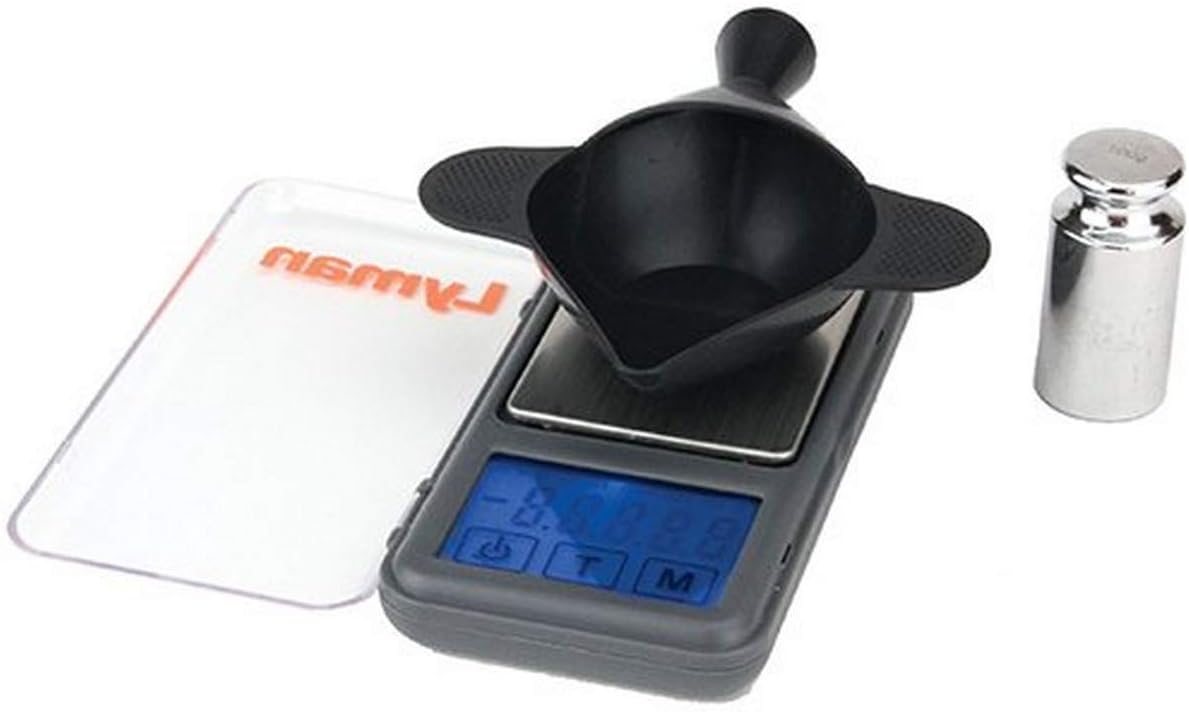
The Lyman Pocket Touch 1500 Scale Kit has a 4.4 rating and packages a 1500-grain scale with several useful reloading accessories. The included funnel pan, powder scoop, calibration weight, and two AAA batteries make it convenient for a new bench, while the powder-oriented pan shape improves its relevance over a general pocket scale.
We may earn a commission when you buy through this link, at no additional cost to you.
Touchscreen controls cover power, tare, calibration, and switching between grams and grains. The display is illuminated for easier viewing in different lighting conditions, and 1500 grains of capacity comfortably covers typical powder-charge work. Together, these features make routine checks less dependent on tiny buttons and reduce the need for separate tools.
The “pocket” designation explains its relatively compact dimensions, which is beneficial for storage but may make the screen less expansive than a dedicated desktop unit. No automatic dispenser is mentioned, so the scale is primarily a checking and measuring tool. Mechanical sensitivity should also be considered when weighing fine powder on a surface exposed to vibration.
This Lyman kit is a well-rounded pick for a reloader who wants a ready-to-use package rather than an individual scale and separate pan. It combines a favorable rating, useful capacity, straightforward touch controls, and the necessary accessories in one bundle. It is especially appealing for new setups and for users who value a complete, familiar reloading-oriented package.
A funnel-style powder pan, scoop, calibration weight, and batteries support the common steps of pan preparation, powder handling, and periodic checking.
Dedicated touchscreen controls make unit selection, zeroing, calibration, and power management accessible without navigating a complex interface.
We may earn a commission when you buy through this link, at no additional cost to you.
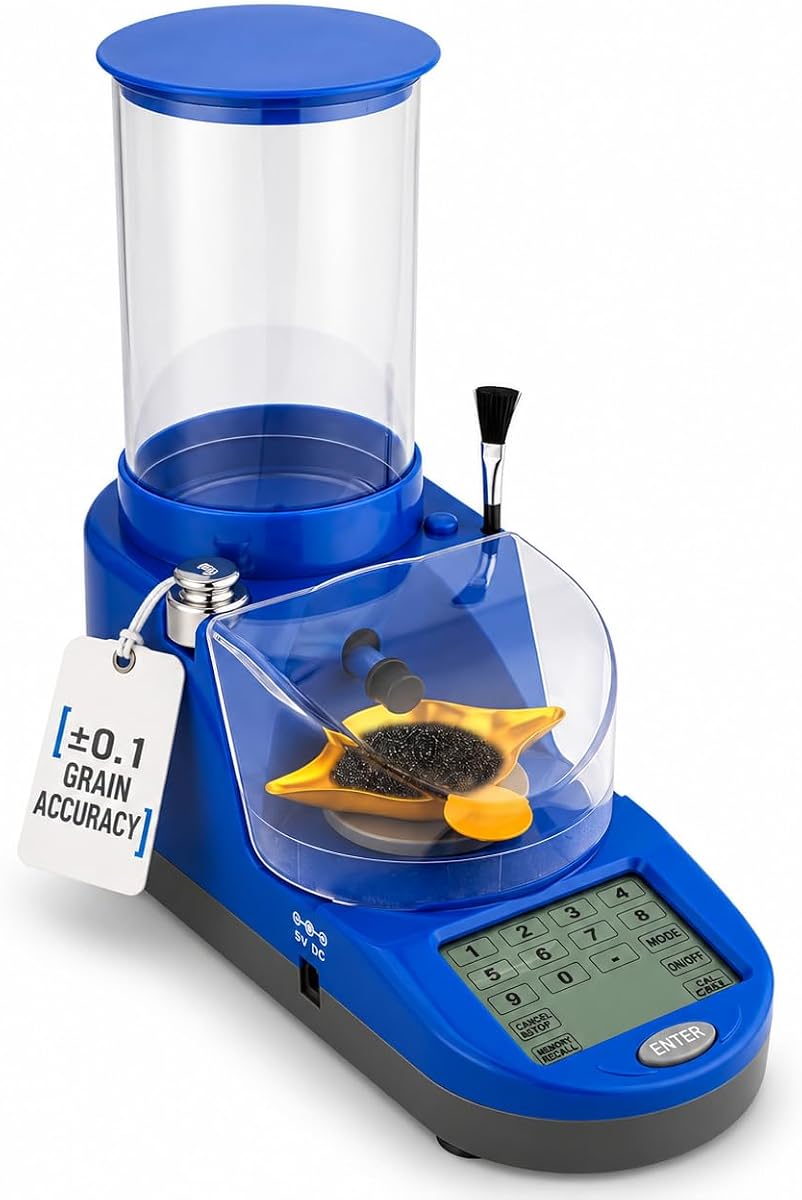
The Digital Powder Scale has a 4.2 rating and stands apart through its integrated automatic powder dispenser. The scale covers a stated range of 0.4 to 1500 grains, provides ±0.1-grain accuracy, and dispenses at up to two grains per second. For a high-volume reloading setup, that automation can reduce the repetitive manual work involved in returning each pan to a target charge.
We may earn a commission when you buy through this link, at no additional cost to you.
An intelligent auto-repeat function is designed to produce consistent charges each time the pan is returned. The anti-static system is intended to block interference from phones and computers, while anti-drift technology is claimed to stabilize readings throughout a session. These features address two common sources of concern around digital bench equipment: nearby electronics and changing readings over time.
The touchscreen and backlit display provide a clear operating interface, and the compact footprint allows it to sit near a press, dies, and other equipment. The trade-off is that this is a more specialized and costly instrument rather than a basic scale. Automated dispensing also depends on consistent powder flow, so users still need suitable components and sound reloading practices.
Choose this model when speed, repeat dispensing, and interference management justify a premium bench setup. Its broad range and automatic function make it particularly interesting for reloaders producing many similar loads. For occasional checks, a simpler scale may be sufficient, but for repeated high-volume charging this model provides the most specialized workflow in the roundup.
Returning the pan to its starting position triggers the automatic function, allowing the same target charge to be dispensed more quickly than with conventional manual trickling.
The stated anti-static shielding is designed to limit interference from nearby phones and computers, a useful feature on a crowded modern workbench.
We may earn a commission when you buy through this link, at no additional cost to you.
The ERS2000 Digital Powder Scale has a 4.3 rating and stands out for its 2000-grain capacity, the highest stated capacity among the reloading-focused digital options here. Its 0.01-gram resolution is equivalent to approximately one-fifth of a grain, and an integrated powder trickler attaches to either side for left- or right-handed placement.
We may earn a commission when you buy through this link, at no additional cost to you.
The attached trickler removes the need to purchase a separate accessory and supports controlled powder flow toward the pan. Grain and gram modes can be changed with one button press, making the scale useful for both reloading tasks and other small-item measurements. A universal AC adapter, cleaning brush, calibration weights, and a pop-out storage tray round out the package.
The stated resolution is less granular than the Redding’s 1/10-grain claim, and the product description does not make the same direct tenth-of-a-grain accuracy promise. Its large capacity is excellent for a wide range of loads, but buyers focused specifically on the finest possible powder adjustment should interpret the resolution specification carefully. Corded bench power also makes it less convenient for mobile use than a battery-powered pocket model.
The ERS2000 is a strong recommendation for someone who wants generous capacity and a built-in trickler in a single instrument. It suits gunsmiths and reloaders who alternate among powders, components, and other small measurements. Its accessory-rich design simplifies setup, while the two-sided attachment makes it adaptable to different bench arrangements.
The integrated powder trickler can attach on either side, allowing the user to orient the scale for a comfortable left- or right-handed workflow.
A 2000-grain maximum provides generous headroom for powder charges and other small components while preserving a compact bench footprint.
We may earn a commission when you buy through this link, at no additional cost to you.
The UNIWEIGH Digital Reloading Scale has a 4.3 rating and combines a 1500-grain capacity with 0.1-grain resolution. Its compact body fits into a pocket or toolbox, yet it offers more capacity than many similarly sized scales. That balance makes it a practical option for reloaders who want to move between a bench and another work area.
We may earn a commission when you buy through this link, at no additional cost to you.
The backlit LCD automatically adjusts its brightness, which helps maintain readability in changing lighting conditions. Tare resets the displayed weight, while a calibration function supports continued accuracy over time. A protective case is included, adding a practical layer for transport and storage in a crowded tool bag or drawer.
Its 0.1-grain resolution is useful for checking charges and components, although it is less fine than milligram-focused scales. Digital readings also depend on a level, vibration-free surface, and accurate calibration. Because the product description does not list a specific automatic dispensing feature, it should be considered a measuring and checking tool rather than a powder-dispensing system.
The UNIWEIGH is best for a mobile, straightforward setup where portability, useful capacity, and basic digital functions matter more than specialized automation. The automatic backlight, tare, calibration controls, and case make it easy to use across different locations. It is a sensible companion scale for selected checks without claiming to replace a higher-capacity bench instrument.
The 1500-grain maximum is generous for a pocket-format scale, allowing it to handle ordinary charges and component checks without feeling underpowered.
Automatic backlight adjustment helps keep the numerical reading visible under different lighting conditions, supporting quick interpretation at the bench.
We may earn a commission when you buy through this link, at no additional cost to you.
The right reloading scale depends on the balance between resolution, capacity, power source, calibration burden, and workflow. A traditional beam balance provides direct mechanical feedback, while a digital model often offers faster readings, unit conversion, tare functions, and a more compact powder pan.
Resolution describes the smallest displayed increment, while accuracy describes how closely a result should agree with a known reference. These are related but not interchangeable, so compare both when selecting a scale. A tenth-grain display may look appropriate for powder checking, yet finer numeric readability is only useful if the platform is stable, the pan is clean, and the scale has been calibrated correctly. General-purpose 0.1-gram balances can be excellent for larger components but are too coarse for many fine powder checks.
Capacity should comfortably exceed the largest charge, component group, or accessory you intend to weigh. The Redding Model No. 2 lists 505 grains, while several digital options reach 1500 or 2000 grains. Higher capacity provides flexibility but can make a small scale less convenient for delicate adjustments because the resolution and platform size may remain the same. Conversely, a very high-resolution milligram scale may have only a small maximum capacity.
A mechanical beam scale offers direct visual movement, no power requirements, and a tactile sense of the weight. It rewards a stable surface and careful balancing. A digital scale can show a number immediately, support tare and unit changes, and often include a small pan designed for powder. Electronic readings are convenient, though they may respond to vibration, drafts, nearby electronics, or an unlevel surface. Neither approach is universally superior; the best choice reflects your workflow and comfort with adjustment.
The pan should be large enough for the intended charge, shaped for controlled transfer, and easy to clean. A narrow spout can help guide powder, while a metal surface may be easier to clean than some plastic pans. A scale with an integrated trickler can support controlled manual flow, while an automatic dispenser can repeat charges with less routine effort. Verify whether the product is designed only to verify powder or actually to dispense it.
Mechanical balances may need zero adjustments after handling or transport, and digital scales may need calibration with the supplied weights. The QWORK listing explicitly warns that its zero setting may be disturbed during transportation. Digital products may offer guided calibration through buttons or a touchscreen, which is convenient but still requires attention. Keep the included calibration masses accessible and learn the correct sequence before beginning a production session.
A readable screen can matter more than the number of functions. Look for adequate contrast, a backlight for dim spaces, visible grain or gram units, and controls you can operate without repeated guesswork. Touchscreens are easy to navigate but require a clean finger, while tactile controls may be preferable in a workshop. Mechanical scales need a clear, graduated beam and stable pointer for their readings to be meaningful.
Battery operation supports portability and protects a critical bench tool from power interruptions, while USB or AC power can reduce battery management. A compact scale is easier to store but may have a smaller display or pan. A larger bench instrument may offer more capacity and accessories while occupying fixed space. Consider where the scale will live, how often it will travel, and whether nearby equipment could interfere with electronic readings.
Begin by placing the scale on a firm, level, clean surface away from vibration, drafts, and direct contact with hot equipment. For a digital model, install or connect the specified power source, switch on the unit, and confirm that the display behaves normally. With a mechanical beam, inspect the pointer and counterpoises, then adjust the zero according to the instructions. Allow a newly positioned scale to settle before trusting its first reading.
Prepare the pan according to the scale’s instructions, and use tare on digital models to exclude the weight of the pan or container. Do not place a component on the platform until the scale reads zero. Add material gradually, allow the display or pointer to settle, and compare the result with the intended charge. For powder trickling, control the flow in small stages rather than attempting to add the full difference at once, and avoid leaning on the pan or bumping the bench while reading.
Keep powder residue from settling into controls, calibration points, and moving components. Brush or wipe the pan and platform according to the manufacturer’s instructions, and do not immerse a scale that contains electronic components. Store mechanical balances away from impacts and digital units away from moisture and excessive heat. Check the zero and perform calibration as recommended, especially after a substantial move, noticeable impact, or change in performance.
A beam scale offers direct mechanical feedback and does not require batteries, which can appeal to reloaders who value simplicity. Digital scales usually read faster, include tare and unit conversion, and may offer a more compact pan or integrated dispensing. The better choice depends on your bench, workflow, and comfort with each style rather than on a universal advantage.
The appropriate target depends on the charge and the consistency required by your process. A scale with 0.1-grain readings may be sufficient for routine checks, while a 0.01-gram or tenth-grain specification offers finer resolution for detailed adjustments. Resolution alone does not guarantee accuracy, so stable placement, clean equipment, and correct calibration remain essential.
A laboratory balance can be useful for cases, projectile groups, and larger components, particularly if it has adequate capacity. A balance with 0.1-gram resolution is generally too coarse for fine powder adjustments, though it can complement a finer scale. Check its platform, maximum capacity, and zeroing process before using it for critical weights.
Common causes include vibration, an uneven surface, air movement, residue on the pan, an improperly seated component, and poor calibration. The scale may also be affected by nearby electronic interference, depending on the model. Move the unit to a stable location, clean the pan, allow the reading to settle, and complete the recommended calibration process.
Not for every reloading workflow. A checking scale is sufficient if you use a reliable powder measure and want to verify individual charges. An automatic dispenser or integrated trickler can save effort and make repeated charging more consistent, but it also adds complexity, maintenance, and cost. Choose it when the volume and repetition of your work justify those features.
Follow the manufacturer’s schedule and calibrate whenever readings appear inconsistent, after a significant impact, or following a move. Digital scales can drift over time, while mechanical balances can lose their zero after transport. Keeping the supplied calibration weights nearby makes periodic checks easier and helps identify an issue before it affects your workflow.
It can be sufficient for checking small components, accessories, and limited quantities, especially when its fine numeric resolution is useful. Its capacity will not cover the same range as a 1500- or 2000-grain scale. A milligram model is often most useful as a supplement to a higher-capacity reloading scale rather than a complete replacement.
Look for a shape that supports controlled transfer, a surface that is easy to clean, and enough capacity for your intended charge. A narrow spout can help guide powder, and a removable pan makes cleaning more convenient. If the scale includes an automatic dispenser or trickler, verify that the flow mechanism works smoothly with the powder and components you use.
The Redding Model No. 2 is the most focused traditional choice, offering a dedicated powder-and-bullet configuration, 505-grain capacity, stated tenth-grain accuracy, and mechanical operation without batteries. The MAXUS Digital Milligram Scale is the best budget-oriented pick for fine small-item work, while the automatic-dispensing Digital Powder Scale earns the premium position for reloaders who value high-volume repeat charging and interference management.
Your priorities should determine the remainder of the shortlist. Choose the RCBS or Lyman for a 1500-grain digital format, the ERS2000 for a larger capacity with an integrated trickler, and the TOPWEIGH for its metal powder pan. A triple-beam model such as the QWORK or MB2610 is most useful for larger components and general bench weighing, where its tenth-gram resolution is appropriate.
Before purchasing, verify the current specifications, included accessories, and seller details, and confirm that the scale meets the precision required by your charges and components. Prices, promotions, and availability change over time, so checking the current listing can prevent surprises and help you select the most suitable instrument for your bench.
