
Decibel Meter, Goldeep Sound Level Meter, Portable SPL Tester-Bright Orange
4.7Editor score
30–130 dB measurement range
Fast and slow responses
MAX and MIN tracking
This Decibel Meter guide compares 10 sound level meters for accuracy, displays, logging features, portability, and everyday noise monitoring.
A decibel meter provides a quick, objective way to measure sound in homes, offices, workshops, classrooms, studios, and outdoor spaces. The best model combines a readable display, useful controls, dependable measurement specifications, and enough portability for measurements wherever noise becomes a concern.
This guide compares ten decibel meters based on their supplied measurement ranges, accuracy, frequency weighting, response modes, displays, recording functions, alarms, power options, and included accessories. It covers general-purpose handheld models as well as meters designed for data logging, computer analysis, or fixed installation.
Each review explains the standout features, practical limitations, and most suitable users of the ten products. The top picks represent strong options for general use, portable monitoring, and advanced data analysis. Availability, features, and prices can change, so readers should confirm current product details before buying.
4.7Editor score

4.5Editor score

4.2Editor score
The comparison highlights each meter's range, accuracy, weighting modes, response controls, display, and standout functions, helping readers match a model to portable checks, detailed monitoring, fixed use, or data analysis.


The TopTes TS-501B in orange combines a 30–130 dB range, stated accuracy of ±1.5 dB, A/C weighting, and a roomy 2.25-inch backlit screen. Its 4.5 rating reflects a well-rounded instrument that is easy to recommend to home users, hobbyists, and workplace monitors who need dependable readings without advanced setup.
We may earn a commission when you buy through this link, at no additional cost to you.
The display is the model’s clearest attraction. It presents decibel values in a format that remains useful in dim workshops, offices, or evening conditions, while the microphone covers 30Hz to 8kHz. A/C weighting lets users move between perceived environmental noise and lower-frequency mechanical sound, and MAX, MIN, and data-hold functions help preserve meaningful results.
Its trade-offs are focused on advanced data work rather than basic measurement. There is no described USB connection, spreadsheet export, temperature reading, or charting capability. It also uses disposable AAA batteries, so a user who wants unattended monitoring will need to consider power management and battery replacement.
This is the strongest general-purpose recommendation in the roundup. It suits anyone comparing neighborhood noise, checking appliances, tuning an audio system, or documenting workshop conditions. The large screen, supplied carry case, batteries, manual, and straightforward controls make it particularly approachable for first-time buyers.
The illuminated 2.25-inch LCD makes the TS-501B easy to consult while the source of noise is still operating. Fast-changing household sounds and steadier equipment noise can both be observed without repeatedly moving the meter close to the display.
MAX and MIN functions identify the highest and lowest values reached during a session, while data hold freezes the current reading. These controls turn the meter from a simple indicator into a more practical tool for comparisons over time.
We may earn a commission when you buy through this link, at no additional cost to you.
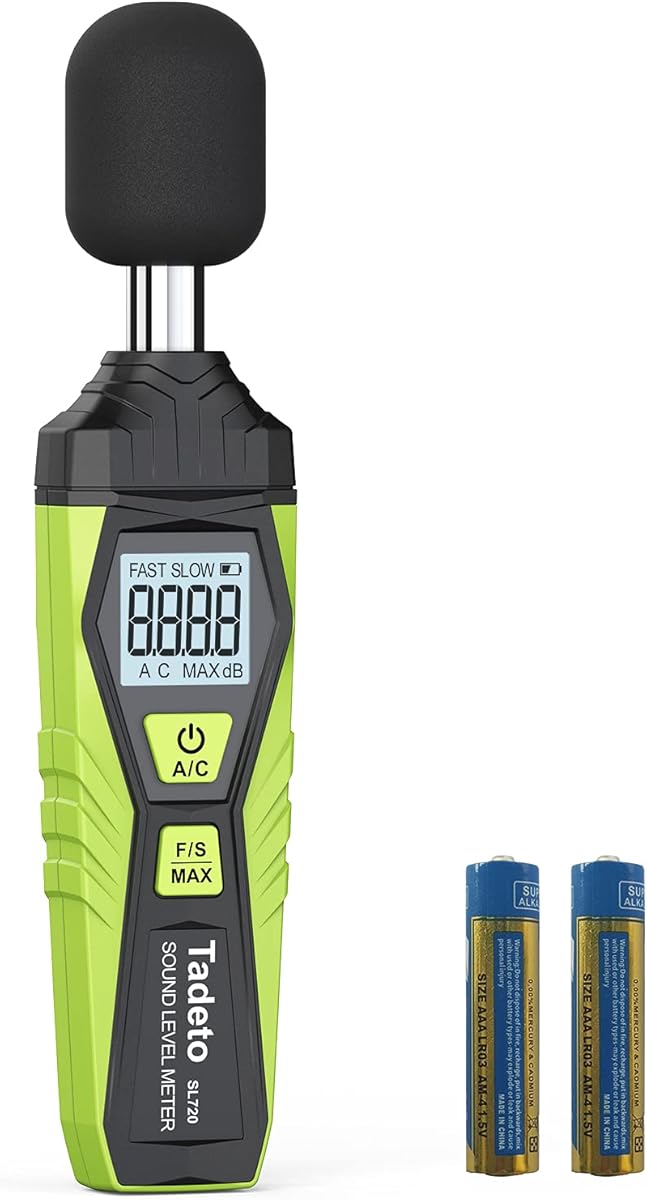
The Tadeto Portable SPL Meter offers a 30–130 dB range, 0.1 dB display resolution, A/C weighting, and both fast and slow response modes. Its 4.5 rating and straightforward digital design make it a practical option for general environmental measurements in homes, vehicles, offices, schools, and light industrial settings.
We may earn a commission when you buy through this link, at no additional cost to you.
Fast response uses a 0.125-second time constant for general environmental measurement, while slow response uses a one-second constant for sound with larger changes over time. The backlit four-digit LCD makes the number legible in dark spaces, and a low-voltage icon provides a practical reminder before readings become unreliable due to depleted batteries.
The principal limitation is its stated ±2.0 dB accuracy, which is less tight than the ±1.5 dB specification listed for several competitors. It also lacks the more advanced tracking, recording, and connectivity features found elsewhere in this guide, making it better suited to immediate checks than long-term analysis.
Buyers who need a simple, portable meter for comparing appliances, room ambience, traffic, or machinery should find this model straightforward. It is especially suitable for users who prioritize a clear display, selectable response speeds, and low-battery awareness without needing computer exports or alarm thresholds.
Fast mode follows sudden changes more closely, while slow mode is better for relatively stable sound. Selecting the appropriate mode can produce a more meaningful snapshot than treating both settings as interchangeable.
The four-digit screen and 0.1 dB resolution give the meter a precise appearance and make direct comparisons easier. Backlighting is useful when checking a dark room, cabinet, workshop, or entertainment setup.
We may earn a commission when you buy through this link, at no additional cost to you.
The DURFICST Sound Level Meter combines a color LCD, 30–130 dB range, ±1.5 dB stated accuracy, and 0.1 dB resolution. Its 4.6 rating makes it one of the stronger general-purpose options, particularly for users who prefer a more colorful and visually engaging display.
We may earn a commission when you buy through this link, at no additional cost to you.
A condenser microphone covers 31.5Hz to 8kHz, and the meter provides A and C weighting plus fast and slow response controls. It can also switch between dB and SONE units, expanding its usefulness for music, instruments, and perceived-loudness checks. MAX, MIN, and data-hold functions support ongoing monitoring.
The color screen is appealing, but it is not a substitute for advanced data tools. There is no described PC connection or chart export, so users who need documented time-series analysis may need a dedicated logger. The SONE scale may also require a learning curve for buyers who are accustomed only to decibels.
This meter is a good fit for musicians, parents, teachers, office workers, and home users who want detailed readings in an approachable format. The soft rubber wrapping, handheld design, windbreak ball, and cloth carrying case also support comfortable use in and around various environments.
The color LCD makes operating state and readings easier to distinguish at a glance. That visual clarity is especially helpful during music checks, classroom monitoring, and repeated household comparisons.
The dB mode is useful for environmental and mechanical measurements, while SONE offers an additional way to evaluate perceived loudness. This makes the model relevant to instrument and audio-system users as well as general noise monitors.
We may earn a commission when you buy through this link, at no additional cost to you.
The Goldeep SL750A provides a 30–130 dB range, ±1.5 dB stated accuracy, A/C weighting, dB and SONE units, and fast and slow response modes. Its 4.7 rating is the highest among the listed products, making it a compelling budget-oriented choice for both general users and sound enthusiasts.
We may earn a commission when you buy through this link, at no additional cost to you.
MAX and MIN tracking allows users to observe peak and minimum levels over a period, while data hold preserves a selected reading. The 31.5Hz–8kHz frequency response is suitable for household, workplace, traffic, construction, classroom, and musical-instrument checks. Its anti-slip grip and windbreak ball also support practical handling.
As with most compact meters in the roundup, advanced documentation is its main limitation. The product data does not mention PC connectivity, spreadsheet export, temperature sensing, or automatic threshold alarms. Disposable AAA batteries are convenient for light use but less attractive for continuous unattended operation.
This is the top pick for buyers seeking strong core specifications without moving into dedicated logging equipment. It suits home projects, appliance comparisons, music practice, and routine workplace checks. The included batteries and manual make it ready for immediate use, although current specifications and accessories should still be confirmed.
MAX and MIN tracking is valuable when the sound being measured changes during a test. It can reveal brief peaks that a single instantaneous reading would miss and provide a better view of the overall range.
A/C weighting, SONE units, and selectable response speeds make the SL750A adaptable to environmental noise, machinery, traffic, instruments, and everyday household checks. Its compact orange body is easy to identify and carry.
We may earn a commission when you buy through this link, at no additional cost to you.
The green TopTes TS-501B adds temperature and humidity readings to the familiar 30–130 dB measurement range and ±1.5 dB stated accuracy. Its 4.5 rating reflects a capable general meter that is especially useful when room conditions matter alongside the sound level.
We may earn a commission when you buy through this link, at no additional cost to you.
The 2.25-inch backlit LCD provides a large, readable display, and A/C weighting makes the meter appropriate for both environmental and industrial-style sounds. MAX, MIN, and data-hold functions help users preserve important readings. Three AAA batteries, a carry case, and a manual are included, while automatic power-off supports battery conservation.
Environmental context is useful, but it should not be confused with laboratory-grade environmental analysis. The supplied information does not identify an external microphone, data logging, charting, or computer connectivity. The meter remains a general-purpose instrument, and its accuracy and calibration claims should be understood within that context.
This model is recommended for users who want more context than a basic decibel display, particularly when checking a room affected by HVAC systems, appliances, or changing weather. It also serves well for neighbors, factories, offices, and home theaters. Buyers who need historical analysis should instead consider the dedicated logger.
Temperature and humidity readings can provide useful context when a room feels unusually noisy or a comfort-related check is underway. These readings complement the sound level without replacing dedicated environmental instruments.
The illuminated screen is easy to inspect in poor lighting, while MAX, MIN, and data hold reduce the need to write down every value. That makes the meter convenient for repeated household or workplace comparisons.
We may earn a commission when you buy through this link, at no additional cost to you.
The RISEPRO HT-80A is a focused handheld meter with a 30–130 dB range, stated accuracy of ±1.5 dB, and a Type A frequency-weighted 125-millisecond response. Its 4.4 rating suits buyers who want familiar noise-meter controls without a large catalog of specialized functions.
We may earn a commission when you buy through this link, at no additional cost to you.
The display includes backlighting, while data hold, MAX, and MIN allow a user to freeze and review readings. Automatic power-off helps preserve battery life during intermittent use. The package is supported by a black carrying pouch and color gift box, giving the product a more polished presentation for gifting or storage.
The main limitation is its narrower measurement configuration. Only Type A weighting and a fast response are identified, so it does not offer the C-weighted, slow-response, or SONE choices available on several other models. Its stated frequency response also tops out at 4kHz rather than the 8kHz range listed for some competitors.
This meter is best for general environmental checks, quick appliance comparisons, classroom or office monitoring, and users who value a simple backlit display. It is less suitable for detailed machinery analysis or music-focused loudness work. For those needs, a model with both weighting modes and fast/slow control offers more flexibility.
Fast response follows environmental changes closely, while the backlit display and data hold make short measurement sessions easier. These features suit a user who wants a number quickly rather than an extended report.
The included pouch provides a simple way to protect and carry the meter. Automatic power-off adds convenience for users who may leave the device on a workbench or in a drawer between checks.
We may earn a commission when you buy through this link, at no additional cost to you.
The DANOPLUS data logger is the most specialized meter in the group, offering 43,000 stored records, PC viewing, Excel export, a color screen, and a three-color alarm. Its 4.2 rating reflects a feature-rich tool intended for users who need a record of changing noise rather than only an instantaneous reading.
We may earn a commission when you buy through this link, at no additional cost to you.
The meter measures 30–130 dB with stated accuracy of ±1.5 dB, supports A and C weighting, and offers adjustable fast and slow response. A line chart and analog bars visualize noise changes, while date and time fields help organize observations. Users can set thresholds and view a three-color indication for low, medium, and high levels.
Its charging and connectivity requirements are less convenient for spontaneous use. USB charging and a 1000mAh battery provide a roughly stated 1.5-hour charge cycle, while Windows 7, 10, and 11 compatibility enables data export, analysis, and printing. A computer is needed to take full advantage of the logging workflow.
This is the premium recommendation for facility managers, acoustics learners, educators, and users conducting structured noise studies. It is less necessary for someone who only wants to compare appliance noise, but it offers the strongest documented path from live readings to organized records.
With up to 43,000 records, the logger can preserve a substantial series of readings for later inspection. Viewing data on the unit and exporting it through Excel makes the information more accessible for analysis, reporting, and comparison.
The three-color light alarm gives immediate visual feedback, and users can manually set the threshold. This is useful when monitoring an area where noise changes should be noticed without constantly watching the display.
We may earn a commission when you buy through this link, at no additional cost to you.
The SW-525A is built around a different use case from most handheld options. Its 30–130 dB range, large red LCD, wall-hanging format, and alarm function make it suitable for fixed monitoring in a workshop, office, classroom, utility room, or another area where a standing display is helpful.
We may earn a commission when you buy through this link, at no additional cost to you.
The large display is the model's defining feature. A wall-mounted meter can remain visible to people moving through the space, and the alarm can provide notification when sound rises beyond an expected level. This approach is more convenient for continuous area monitoring than repeatedly carrying a handheld device around.
The supplied product information is limited, so details such as weighting modes, response speed, accuracy, power requirements, and included accessories are not clearly specified. That uncertainty makes the SW-525A less straightforward to compare with fully specified portable models. It also does not offer the obvious mobility of a handheld instrument.
Buyers should consider this model when they want a visible, stationary reference point rather than a pocket-sized spot check. It may be especially useful for a shared room, production area, or facility where a large display and an alarm can provide passive awareness. Checking the complete manual and installation requirements before purchase is advisable.
Wall placement allows the meter to function as a persistent environmental indicator. People in the area can see the large red display without physically handling the instrument.
The audible alarm is the primary advantage over a basic display-only meter. It can draw attention to a noise event in a location where continuous visual monitoring would be difficult.
We may earn a commission when you buy through this link, at no additional cost to you.
The Tadeto Alarm Meter stands out for its combination of a 30–130 dB range, ±1.5 dB stated accuracy, five adjustable measurement ranges, and both audible and visual alarms. Its 4.3 rating makes it a practical choice for users who want the meter to announce notable noise levels.
We may earn a commission when you buy through this link, at no additional cost to you.
A/C weighting supports both perceived environmental sound and lower-frequency machinery noise, while fast and slow response modes accommodate changing and steadier conditions. The backlit digital display remains visible in dim areas, and a low-voltage icon prompts battery replacement. MAX, MIN, and data hold are also included for comparisons.
Despite the alarm features, the supplied data does not describe event logging, threshold history, PC connectivity, or export capability. The alerts therefore function as immediate warnings rather than a documented record of every event. Its five measurement ranges add flexibility, although the manual is the best place to learn how each range is selected.
This model fits workshops, production areas, offices, schools, family spaces, and anyone who wants stronger notification than a conventional display. It is also useful for temporarily monitoring an appliance or noisy activity while remaining nearby. For long-term analysis, however, a dedicated data logger offers greater documentation.
An audible alarm can be noticed from farther away, while the visual indication helps users who are close to the meter or may have sound muted. Together they make the device more noticeable in a monitored area.
The five adjustable ranges give users more control over how measurements are presented. This can be helpful when working across conditions that vary substantially in level, from quiet indoor spaces to louder mechanical environments.
We may earn a commission when you buy through this link, at no additional cost to you.
The FNIRSI FDM-02 combines a 30–130 dB range, ±1.5 dB stated accuracy, and a two-inch IPS screen with light and dark themes. Its 4.4 rating and polished display make it particularly appealing for home theater calibration, speaker matching, and other audio-focused tasks.
We may earn a commission when you buy through this link, at no additional cost to you.
A condenser microphone supports A and C weighting, and fast and slow response modes can be selected as needed. Curve mode visualizes 30 seconds of sound changes, giving users a more dynamic view than a single number. The rechargeable 1500mAh battery, auto-off, and sleep function are convenient for regular use.
The meter can define high and low thresholds, identify the current noise category, and retain the 30 most recent alarms. That is useful for tracking neighbors, parties, construction, traffic, nearby bars, appliances, and other environmental sources. However, the supplied information does not mention computer export or extended data logging.
This FDM-02 is a good match for parents, musicians, power-tool users, office workers, and home theater enthusiasts. Its small body, carrying case, bright screen, and curve display make it a comfortable everyday companion. Users focused on downloadable records should select the data-logging model instead.
The 30-second curve mode shows how sound rises and falls instead of limiting the display to a single value. It is especially useful when placing a subwoofer, matching speakers, or observing the effect of a nearby appliance.
Light and dark themes make the two-inch IPS display easier to use in a bright living room or a dim studio. The rechargeable battery also removes the routine need to carry spare cells.
We may earn a commission when you buy through this link, at no additional cost to you.
The right decibel meter depends on the sounds being measured, the environment, and whether you need a quick number, tracked peaks, alarms, or exported records. Review the technical specifications and intended use before choosing.
In short, choose a wide range and accuracy of ±1.5 dB when possible, while treating every consumer meter as a general measurement tool rather than laboratory equipment.
In short, A/C weighting is the more versatile choice for varied noise checks, while a Type A-only meter is most appropriate for straightforward environmental measurements.
In short, use fast mode for sudden sounds and slow mode for stable sources, with both options providing the most flexible approach.
In short, prioritize a backlit screen of readable size, with color or curve views added when visual tracking matters more than basic numerical checks.
In short, MAX, MIN, and data hold are inexpensive conveniences that make repeated comparisons considerably more useful.
In short, choose a data logger for formal monitoring, reports, or trend analysis; choose a standard meter for quick spot checks and simpler comparisons.
In short, disposable batteries suit simple grab-and-go use, while rechargeable models are better for frequent sessions and planned monitoring projects.
In short, prioritize a handheld design for active checking and a wall-mounted alarm model for continuous monitoring of one location.
Begin by reading the manual and identifying the microphone, display, power control, weighting button, response control, data-hold control, and any MAX, MIN, curve, or alarm functions. Install or charge the batteries as directed, confirm that the low-battery warning is absent, and allow the meter to settle before taking a reading. Do not cover the microphone or speak directly toward it during a test.
Choose the measurement position carefully. Keep the microphone at a consistent distance from the source, hold the meter steadily, and avoid placing it directly beside a fan, speaker cone, vibrating surface, or other item that could distort the result. For environmental measurements, use A-weighting and fast response for changing sound or slow response for steadier sound. Repeat the measurement several times in different locations to get a more representative picture.
After use, switch off the meter and remove the batteries if it will be stored for an extended period, particularly if using disposable cells. Keep the microphone and wind protection clean and dry, avoid moisture or solvents, and store the device in its case away from extreme heat and impact. Periodic comparison with a trusted reference or a phone-based sound-measurement app can reveal an obvious battery, sensor, or setup problem, although it is not a substitute for certified calibration.
The risk depends on duration as well as level. Prolonged exposure around 85 dB can damage hearing, and higher levels can cause harm more quickly. A decibel meter helps establish how loud an environment or appliance is, but hearing-protection guidance and occupational safety standards should also be followed.
A-weighting reflects the ear's sensitivity to lower-level environmental sound, while C-weighting gives greater emphasis to lower frequencies. General ambient-noise checks often use A-weighting, whereas machinery and intense mechanical noise may be better evaluated with C-weighting. A meter supporting both modes is more versatile.
Fast response follows sudden changes and is useful for traffic, impacts, and irregular environmental noise. Slow response gives the display more time to react and is often easier to interpret for steady sounds such as ventilation or machinery. When available, use the mode that matches the source and repeat measurements for comparison.
Consumer meters are generally useful for comparing similar sources, identifying unusually loud equipment, and tracking noise trends. Their stated accuracy does not make them substitutes for certified laboratory or occupational measurement instruments. Microphone protection, placement, background noise, and calibration can also affect results.
Place it at the location where the sound matters, such as a seat near a television or a desk in an office. Keep it several feet from obvious reflective surfaces, position it away from the microphone of another device, and hold it consistently during comparisons. Do not place it directly against a vibrating appliance.
They are useful when a single reading could be missed, especially during short noise events or appliance tests. MAX identifies the highest level reached, MIN records the lowest, and data hold freezes a selected value. None is essential for every task, but all three make repeated measurements easier to document.
A sound level meter focuses on showing a current or recently captured reading, while a logger preserves a timestamped history for later analysis. The DANOPLUS model in this roundup supports up to 43,000 records, PC viewing, and Excel export, making it better for formal monitoring than a basic handheld meter.
Factory calibration and stated accuracy provide a useful starting point, but microphones can drift over time or be affected by impact, moisture, and residue. Users who require dependable results should follow the manufacturer's calibration guidance and seek professional calibration when measurements will be used for compliance, health, or formal acoustic decisions.
The TopTes TS-501B in orange is the most balanced general recommendation, offering a large backlit display, 30–130 dB range, A/C weighting, and useful peak controls. The Goldeep SL750A stands out as the budget pick with strong stated accuracy, SONE support, and the highest listed rating, while the DANOPLUS data logger is the premium choice for recorded and exported measurements.
Most buyers should prioritize the features that match their actual environment rather than extra controls they will never use. A large backlit display, both weighting modes, fast and slow response, MAX/MIN, and a secure grip cover most home and workplace needs. Repeated measurements, a consistent position, and a protected microphone are just as important as the headline specifications.
Features, package contents, ratings, and prices can change, so check the current listing and manual before making a final purchase. A slightly less expensive model may be entirely adequate for appliance comparisons, while dedicated logging or fixed alarms become worthwhile when a user needs continuous evidence, trend analysis, or a visible monitoring point.