
SwitchBot Smart Desk Fan
4.4Editor score
Smart-home automations
Corded and cordless operation
22dB minimum noise
AI Desk Fan guide comparing tracking, airflow, noise, battery life, controls, portability, and smart-home features for home and office use.
An AI desk fan combines targeted personal cooling with automated features that respond to your presence or movement. The best models track faces or head movement, offer fine airflow control, and remain quiet enough for work, study, or sleep. Important differences include tracking range, oscillation, battery life, display quality, noise level, and smart-home compatibility.
This guide compares ten products using the specifications and features listed in their supplied product information. It covers face-tracking and head-tracking models alongside conventional air circulators with digital displays, voice control, rechargeable batteries, and wide oscillation. Each review highlights the strongest use case, practical advantages, limitations, and ideal buyer.
The list reveals three standout approaches: the DREO model leads in connected circulation, the SwitchBot model offers extensive automation, and the Honeywell model delivers straightforward value. Other picks specialize in high-resolution speed adjustment, face recognition, portability, or premium construction. Product availability and prices can change, so confirm current details before buying.
4.4Editor score

4.7Editor score

4.6Editor score
The comparison below organizes every model by its most important strengths, including automated tracking, circulation range, sound level, power options, and control methods.




The Desk Fan with AI Tracking Head Movement Follow 200 Speeds Digital Display is a compact personal fan built around automatic head tracking. Its 3.7 rating is the lowest among the rated models in this list, but its listed features make it a compelling option for anyone who changes position while working or resting. The motorized tracking head eliminates much of the need to manually redirect the fan.
We may earn a commission when you buy through this link, at no additional cost to you.
Its tracking system follows movement within a stated range of 20 centimeters to 2 meters and covers 150 degrees horizontally. The digital display presents the active wind speed and battery level, while 1–200 speed settings allow very precise adjustment. A 5000mAh rechargeable battery provides a listed runtime of up to 6–8 hours, and USB-C power expands placement options when an outlet is inconvenient.
The main drawback is the comparatively modest 3.7 rating, which may reflect concerns beyond the feature set described in the supplied information. Tracking is also stated to work best in daylight, so buyers should not assume identical responsiveness in a dim bedroom. The fan weighs 1.32 pounds and measures 5.9 by 8 by 4.4 inches, making it more suitable for personal cooling than broad room circulation.
This is a strong match for desk workers, students, readers, and anyone who wants a fan to follow them rather than remain fixed. Its high-resolution controls, cordless design, and ambient light add convenience, although the uncertain customer rating and daylight limitation deserve attention. Choose it when automated positioning matters more than conventional oscillation.
The defining benefit is the 150-degree motorized tracking range. It is particularly useful when you shift between a keyboard, notebook, and nearby seat, because the fan can redirect its airflow without manual repositioning.
With 200 speed levels and a visible digital readout, this model offers a high degree of control. The display also shows remaining battery information, reducing the uncertainty that often accompanies compact rechargeable fans.
We may earn a commission when you buy through this link, at no additional cost to you.
The ciciglow AI Smart Desk Fan with Head Tracking, 3000mAh is a compact fan for users who value automated positioning and detailed airflow adjustment. No customer rating is supplied, so its market reception cannot be evaluated from the available information. Its feature set is nevertheless well defined, particularly for desks, nightstands, and other small surfaces.
We may earn a commission when you buy through this link, at no additional cost to you.
The head-tracking system operates within 20 centimeters to 2 meters and offers 150 degrees of horizontal movement. Its 1–200 speed range and digital display make it easy to select a soft breeze or stronger airflow while monitoring battery status. A 3000mAh rechargeable battery is rated for up to 6–8 hours of cordless operation after a listed four-hour charge.
Its 3000mAh battery is smaller than the 5000mAh pack in the first-ranked model, so the two do not offer identical expectations for extended unplugged use. The lack of a published rating also means buyers have no visible customer feedback to help interpret long-term satisfaction. Nevertheless, the compact 5.9 by 8 by 4.4-inch body and color-changing LED make the product appealing for personal spaces.
Consider the ciciglow when desk space is limited and you specifically want motorized tracking. It is well suited to bedroom, office, kitchen, and study use, particularly for someone who values a digital display and ambient lighting. The absence of a rating and smaller battery make it less certain as a general recommendation than the best-rated connected alternatives.
The small footprint preserves room for keyboards, notebooks, and other desk essentials. Despite its size, the motorized head and digital controls add functionality normally associated with larger desk fans.
The stated six-to-eight-hour runtime covers a typical workday at moderate output, while USB-C compatibility permits use with a laptop, power bank, or car charger. It offers more placement freedom than a permanently plugged-in fan.
We may earn a commission when you buy through this link, at no additional cost to you.
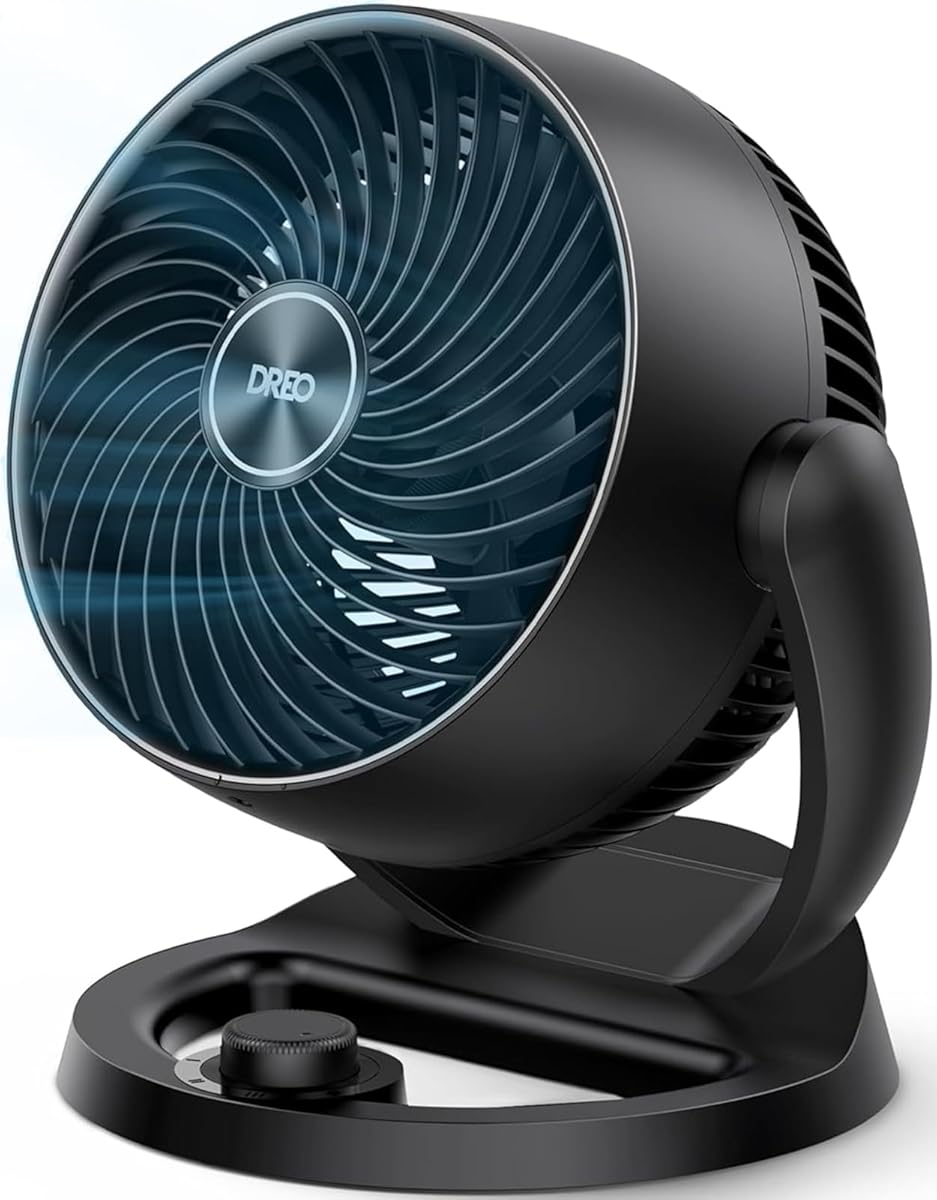
The DREO Fan for Bedroom is a 12-inch tabletop circulator with a 4.6 rating and a conventional design that emphasizes air movement over artificial intelligence. It sends air up to 70 feet, making it more capable of distributing airflow around a room than the small personal tracking models near the top of the list. Its three-speed knob control also keeps operation straightforward.
We may earn a commission when you buy through this link, at no additional cost to you.
The fan uses a deep-pitched blade and aerodynamic design within its WingBoost system to propel air across the room. NACA-inspired aerodynamics and bionic design are credited with reducing noise to 25dB. A 120-degree adjustable head directs the stream, while the removable base and handle allow tabletop use, wall placement, or movement between rooms.
Its main limitation is the absence of AI tracking, app control, or exceptionally fine speed selection. Buyers looking specifically for face recognition or autonomous head movement should choose one of the tracking models instead. On the other hand, the three-speed setup is easier to understand, and the listed airflow reach makes this fan useful for bedroom, office, and kitchen circulation.
This DREO model is a strong choice for users who want a quiet circulator that can influence a larger area from a table or wall position. It suits anyone who values simple controls, 70-foot reach, and easy maintenance over automated personalization. It is not the literal AI choice, but it is one of the strongest general-purpose desk fans in the comparison.
The 70-foot stated reach distinguishes this model from compact personal fans. That makes it useful for pushing air between a desk, bed, kitchen area, or other locations where consistent circulation matters.
A physical knob provides direct access to three speeds without navigating menus. Removable parts simplify cleaning, while the handle and optional wall mounting make the fan more versatile around the room.
We may earn a commission when you buy through this link, at no additional cost to you.
The Coolhill USB Desk Fan provides adjustable personal airflow, a readable display, and flexible cordless power. Its 4.2 rating places it behind the highest-rated models, but the 100 speed levels and 120-degree oscillation offer more control than a basic three-speed desk fan. It is designed for bedrooms, home offices, kitchens, campers, and outdoor gatherings.
We may earn a commission when you buy through this link, at no additional cost to you.
Short presses move through preset increments of 1, 20, 40, 60, 80, and 100, while a long press increases speed continuously. Its digital screen can be checked even in low light. Turbocharging produces a stated maximum airflow speed of 6 meters per second, and noise reduction is credited with bringing operation down to 28dB for sleep or focused work.
The built-in 3000mAh battery charges in about 2.5 hours and provides a listed three-to-ten-hour operating range. It can also run from a USB port, laptop, power bank, or car charger. Unlike the face-tracking and head-tracking products, it does not detect a person or automatically alter its position, so buyers must accept conventional oscillation.
This is a practical pick for someone who wants many speed choices without a subscription, complex app, or dedicated hub. The digital display makes the fan particularly useful at a nightstand or office desk. It is best for personal cooling and directional airflow rather than large-room circulation, and its moderate rating suggests checking recent customer feedback before purchase.
The 100-level adjustment provides meaningful differences between very soft airflow and stronger cooling. Preset jumps make the controls approachable, while continuous long-press adjustment helps users find a precise personal setting.
The rechargeable battery and broad USB-C compatibility make the fan suitable for travel, camping, a camper, or a hot room without accessible power. The listed runtime varies with output, which is normal for this type of fan.
We may earn a commission when you buy through this link, at no additional cost to you.
The DREO Smart Fan for Bedroom, TurboPoly Table Fan 565S, is the strongest all-around recommendation in this guide. Its 4.7 rating is the highest among the featured products with published ratings. It combines 85-foot airflow, 20dB low noise, nine speed settings, six modes, and two-axis oscillation, while also supporting app and voice control.
We may earn a commission when you buy through this link, at no additional cost to you.
TurboWind technology is credited with producing up to 950 CFM and sending air as far as 85 feet. The brushless DC motor supports quiet operation and is described as improving energy savings by up to 20%. Users can control the fan through the DREO app, Alexa, or Google Home, and the listed convenience features include a 12-hour timer, child lock, power-off memory, and an automatic screen-off function.
This is not a face-tracking fan. It does not detect your body or direct itself toward you; instead, its broad 90-degree vertical and horizontal oscillation distributes air across a room. Smart-home setup may also require suitable devices and compatible services. Despite those qualifications, the combination of quiet operation, strong circulation, and multiple control methods is unusually complete.
The DREO 565S is ideal for a home office, dorm, bedroom, or connected living space where a user wants strong room circulation with minimal noise. It is a particularly good choice for people already invested in smart-home control. Choose it over a face-tracking model when whole-room air movement and remote automation matter more than following a person around a desk.
The 950 CFM claim and 85-foot reach give this model more circulation potential than the compact personal fans. A 20dB minimum operating level also makes it appropriate for nighttime use when lower output is selected.
App and voice control make it convenient to adjust airflow from elsewhere in a room. The timer, child lock, screen timeout, and power-off memory support a more polished everyday experience than a basic mechanical fan.
We may earn a commission when you buy through this link, at no additional cost to you.
The SwitchBot Smart Desk Fan is built for connected homes and stands out through its three control methods: a touch panel, included remote, and SwitchBot app. It has a 4.4 rating and a 3600mAh rechargeable battery, allowing it to operate plugged in for extended cooling or cordlessly around the home. Alexa, Google Home, and Apple Home support can be enabled through a SwitchBot Hub.
We may earn a commission when you buy through this link, at no additional cost to you.
The fan's brushless DC motor operates at a stated minimum of 22dB, making it suitable for sleep, a nursery, focused work, or study. Nine speed settings, a nine-hour timer, and app scheduling offer more control than a conventional desk fan. Its three-dimensional movement includes 90-degree horizontal and 90-degree vertical oscillation, with airflow reaching up to 39 feet.
The strongest reason to choose this model is automation. Paired with a SwitchBot Hub and SwitchBot Meter, it can respond to temperature or humidity conditions and be incorporated into routines. The trade-off is cost and complexity: hub and meter compatibility add dependencies, while users without a smart-home ecosystem may not use the advanced functions at all.
This is the premium pick for buyers who want a desk fan to become part of a broader automated household. It also works well in bedrooms, offices, dorms, RVs, patios, and kitchens. For a simple user, the app and remote still work without deeper automation, but the model makes the most sense when compatible SwitchBot hardware is already part of the home.
Keeping it plugged in supports continuous cooling, while the 3600mAh battery extends use to locations without outlets. That flexibility is useful for moving between a home office, bedside table, balcony, or campsite.
With the specified hub and meter, the fan can be tied to temperature or humidity readings. These features distinguish a true automation-oriented appliance from a portable fan that merely has an app.
We may earn a commission when you buy through this link, at no additional cost to you.
The Titanium Alloy USB Desk Fan stands out with metal construction, folding capability, and a 4.3 rating. Instead of AI recognition, it uses a three-dimensional physical design: 360-degree horizontal rotation, 180-degree vertical tilt, and a height range that allows it to function as a desk fan, indoor circulator, or portable USB fan.
We may earn a commission when you buy through this link, at no additional cost to you.
The aluminum alloy body is described as shatterproof, corrosion-resistant, and fingerprint-proof. A brushless DC motor and IDSP technology support operation at a stated 23dB. The seven-blade turbine and aerodynamic duct propel air up to 33 feet, while 10 speed settings and a front-mounted LED display provide visible control information.
Its 5000mAh battery offers up to eight hours in ECO Mode on Speed 01, and the universal USB Type-C port supports convenient charging. The 2.7-pound weight is substantial for a portable fan, although the fold-down height of 6.7 inches improves storage. The 12-month warranty and stated expert support also add reassurance compared with minimalist models.
Choose the Yibest when build quality, foldability, and a flexible metal design matter most. It is well suited to office, sleep, travel, and fitness setups, where a stable, directional fan may be preferable to automated tracking. It cannot follow a user, so buyers should value adjustability and durability over facial recognition.
The aluminum body gives the fan a more durable feel than typical plastic desk models. Its folding structure reduces the stated height to 6.7 inches, making it easier to place in a drawer, bag, or travel setup.
The advertised eight-hour runtime applies to ECO Mode and Speed 01 rather than maximum airflow. That distinction matters because output and battery life naturally trade places, but the low setting is useful for overnight or desk use.
We may earn a commission when you buy through this link, at no additional cost to you.
The F08 AI Smart Face Tracking Fan is the most direct interpretation of the AI desk fan concept. Its 5.0 rating is the highest published score in the list, although that rating should be considered alongside the limited amount of supplied specification. The fan uses an intelligent sensor to detect and follow a user's face in real time.
We may earn a commission when you buy through this link, at no additional cost to you.
As you move while working, studying, reading, or taking a video call, the fan redirects airflow toward your face. Six wind-speed settings cover gentle and stronger output, and a simple touch panel provides control. A digital display shows room temperature, adding useful context without requiring a separate thermometer.
The rechargeable design supports cordless use at a desk, bedside, dorm, or vanity table, and an included USB-C cable makes recharging convenient. Its footprint is listed as 150 by 203 by 112 millimeters, while five ABS blades and a minimalist appearance suit compact modern interiors. Compared with 100- or 200-level models, however, its six settings offer less fine-grained control.
This is an appealing choice for a home office, study area, or personal vanity where face-following airflow is the priority. It is especially relevant to users who move frequently during video calls but do not want to adjust a conventional oscillating fan. Confirm the current specification and rating history before purchase, because the available listing information is comparatively brief.
The face-detection sensor distinguishes this product from models that merely oscillate through a fixed arc. It aims to keep personal airflow directed toward the user as position changes around the desk.
Showing room temperature at a glance helps users judge whether they need stronger output or better ventilation. The compact dimensions preserve valuable space while supporting bedside and countertop placement.
We may earn a commission when you buy through this link, at no additional cost to you.
The Honeywell TurboForce HT900 is a straightforward tabletop and wall-mountable air circulator with a strong 4.6 rating. It lacks artificial intelligence, but it delivers the fundamentals shoppers often care about: a powerful aerodynamic design, three speeds, a pivoting head, and a stated ability to move air from as far as 25 feet away.
We may earn a commission when you buy through this link, at no additional cost to you.
Its turbo design is intended to maximize air movement and cooling. The adjustable head tilts through 90 degrees, allowing users to aim airflow toward a chair, bed, or another part of a small or medium room. Honeywell describes the model as 25 percent quieter than comparable fans, though exact sound levels are not supplied.
The absence of a digital display, rechargeable battery, and app-based control makes this a simpler choice than several premium picks. On the positive side, there is no complex setup and no need to learn a smart-home ecosystem. Its physical controls and stable tabletop design suit a user who values dependable operation and recognizable brand quality.
The HT900 is our best budget selection for a home office, bedroom, or study. Choose it when basic circulation, adjustable direction, and ease of use matter more than face tracking or voice control. It is also a sensible secondary fan for a room where a larger circulation appliance is unnecessary.
The 90-degree pivoting head gives users control over where the airflow travels without a motor-driven tracking function. That makes it a useful option for a fixed workstation or sleeping position.
Three speeds and straightforward controls reduce the learning curve. The trade-off is that users lose displays, timers, voice commands, battery portability, and automatic person detection.
We may earn a commission when you buy through this link, at no additional cost to you.
The Fabater Desk Fan with AI Tracking Head Movement Follow, 200 Speeds is a feature-rich alternative for shoppers who want automatic directional cooling without paying for a broad room circulator. No rating is supplied, so customer feedback is not available for evaluation. Its core strength is a 150-degree tracking head that follows movement within 20 centimeters to 2 meters.
We may earn a commission when you buy through this link, at no additional cost to you.
Controls are designed around a power slider, a button for oscillation, and a long press for tracking mode. A digital screen displays the current wind speed and battery level, while the 1–200 speed range offers highly detailed airflow adjustment. The fan is also equipped with a color-changing ambient light for nighttime or dim-room use.
The 3000mAh rechargeable battery provides a stated six-to-eight-hour runtime after a four-hour charge. USB-C operation works with laptops, power banks, and car chargers, allowing flexible use where outlets are unavailable. As with the first-ranked model, tracking is stated to work best in daylight, which limits confidence in low-light conditions.
Fabater is a good fit for desk workers, students, and bedroom users who want automatic tracking, a digital readout, and ambient lighting in a compact format. It is less compelling than a highly rated option when buyer confidence and published specifications are the main concerns. Its detailed controls, however, make it competitive within the personal tracking category.
Tracking is helpful when a user alternates between reading, typing, and leaning back. The two-meter range and 150-degree movement provide meaningful coverage around a compact workstation.
Two hundred speed levels allow fine changes to the breeze, while the adjustable ambient light provides a secondary benefit at night. The digital battery and speed display keep both operating information visible.
We may earn a commission when you buy through this link, at no additional cost to you.
The right AI desk fan depends on whether you value person-following airflow, connected automation, room circulation, low noise, battery freedom, or simple mechanical control. Compare these factors against your desk size, typical environment, and tolerance for setup.
AI tracking comes in two principal forms within this list. The F08 uses face recognition to detect and follow a person's face, while the first, second, and tenth products track head movement through a stated two-meter range. These systems are intended to keep personal airflow directed toward the user as they shift position. Tracking is a convenience rather than a substitute for sufficient overall airflow, so consider it alongside reach and output.
Choose automatic tracking when you frequently move at a desk or need hands-free directional adjustment. Check daylight limitations carefully if the fan will be used mainly in a dark bedroom.
Airflow reach indicates how far the fan is intended to move air, but it does not mean every cubic foot of a room becomes equally cool. The DREO 565S leads this group with a stated 85-foot reach, the standard DREO model reaches 70 feet, the SwitchBot reaches 39 feet, and the Yibest reaches 33 feet. Smaller personal models focus more directly on the user at the desk.
Choose greater reach for bedrooms, dorms, and shared rooms. Choose a compact model when a concentrated personal breeze and small footprint are the main priorities.
Lower minimum noise is generally preferable in a bedroom, nursery, study, or quiet office. Listed minimum levels range from 20dB for the DREO 565S to 28dB for the Coolhill model, with the SwitchBot at 22dB and Yibest at 23dB. The standard DREO and Honeywell models are also designed for quiet use, although they do not provide the same numerical figure.
Pay more attention to low-speed noise than maximum-output sound. A fan that is pleasant at its quietest setting can still become distracting when pushed to maximum for rapid cooling.
Rechargeable operation is valuable for hot rooms, travel, camping, and outdoor use where a nearby outlet is inconvenient. The first-ranked model and Yibest use 5000mAh batteries, SwitchBot uses 3600mAh, and the ciciglow, Coolhill, and Fabater models use 3000mAh. Stated runtimes commonly fall between several and eight hours, depending on output and operating mode.
For a full workday away from a socket, favor a larger battery and a model that also accepts USB-C power. Confirm whether the fan can operate while charging if uninterrupted use is important.
Control options range from physical knobs to touch panels, digital displays, remotes, apps, and voice assistants. The DREO 565S supports its app along with Alexa and Google Home, while SwitchBot offers app, remote, and touch-panel control and can work with Alexa, Google Home, and Apple Home through a hub. Some connected features also require additional meters or other ecosystem accessories.
Choose smart controls when remote operation and automation are meaningful benefits. If you only need reliable airflow, simpler models can offer less setup, fewer compatibility concerns, and a more straightforward experience.
Oscillation broadens coverage, while manual pivoting lets you aim a fixed stream. The DREO 565S and SwitchBot provide 90-degree horizontal and 90-degree vertical movement, the Coolhill offers 120-degree oscillation, and the standard DREO has 120-degree tilt. The Yibest adds 360-degree manual rotation and 180-degree tilt with a foldable frame.
Choose two-axis movement for broad room distribution. Choose a fixed or tracking head for personal cooling, especially when a stable, concentrated breeze is preferable to an oscillating stream.
Portability depends on size, weight, battery support, and the ability to operate without a cable. The ciciglow and first-ranked tracking fans measure 5.9 by 8 by 4.4 inches, while the F08 has a 150 by 203 by 112-millimeter footprint. The Yibest weighs 2.7 pounds but folds down to 6.7 inches and uses a more durable aluminum alloy body.
Favor a lightweight plastic model for frequent carrying, or a rigid metal model for a permanent desk setup. Foldability, a handle, and wall mounting can provide added flexibility.
More speed levels can make it easier to find a comfortable personal setting. Models with 100 or 200 levels offer finer adjustments than those with six or three. A digital display removes guesswork by showing the active speed and, on several models, battery status. The F08 instead displays room temperature, while the standard DREO and Honeywell use simple physical controls.
Choose fine speed resolution and a display for frequent personal adjustment. Choose a knob and fewer speeds when simplicity, easy readability, and minimal electronics are more important.
Place the fan on a stable, level surface with adequate clearance around its air inlets and outlet. For a tracking model, keep your face or head within the stated two-meter range and make sure the room is sufficiently illuminated if tracking performance depends on daylight. Use a wall mount only when the product supports it and the installation is secure.
Begin at the lowest speed and increase output gradually. For a personal desk, position the fan within comfortable reach of the intended work area; for room circulation, use a model with broad oscillation and place it where its outlet is not blocked. Smart models should be configured through the appropriate app or hub, while timers and schedules can reduce unnecessary operation.
Unplug the fan before cleaning it. Remove loose dust from the housing and blades according to the manufacturer's instructions, and do not immerse the motor or rechargeable battery. Keep the charging port dry, use the specified USB-C cable, and avoid leaving the battery in extreme heat. Review the tracking sensitivity, noise, and battery performance periodically to ensure the fan remains effective.
AI tracking uses sensors and programmed movement to recognize or follow a person's face or head. The fan then redirects its airflow toward the user as they move, reducing the need for manual adjustment. In this list, the F08 focuses on face recognition, while three other models use stated head-movement tracking over a 150-degree horizontal range.
Not automatically; noise depends on the motor, blade design, operating speed, and model. The DREO 565S lists a 20dB minimum, SwitchBot lists 22dB, and Yibest lists 23dB, making them strong options for sleep and quiet work. Maximum output will generally be louder than the minimum level.
No desk fan is equivalent to a dedicated air conditioner for lowering the temperature of an entire room. Air circulators improve airflow and can make an existing cooling system feel more effective, while personal fans concentrate comfort around one seated person. They are best viewed as complements to room cooling and ventilation.
It depends on the tracking technology. The head-tracking models in this list specifically state that tracking works best in daylight, so performance may be reduced in a dark bedroom. The F08 uses an intelligent sensor for face detection, but the supplied information does not make the same daylight limitation, so lighting conditions should still be checked.
The listed models generally provide between three and eight hours, depending on battery capacity, speed, and operating mode. The Yibest is rated for up to eight hours in ECO Mode on Speed 01, while several 3000mAh tracking models list up to six to eight hours. Maximum airflow generally consumes power more quickly.
It depends on the model and desired control method. The DREO 565S supports app control and voice platforms without the SwitchBot hub requirement described for that product. SwitchBot's app, remote, and touch controls are available, but voice control and some temperature- or humidity-based automations require the specified SwitchBot Hub and may also require a SwitchBot Meter.
A higher speed count provides finer adjustment, which is useful for personal comfort and quiet nighttime use. It is less meaningful for basic room circulation, where a strong low setting may be sufficient. The F08 has six speeds, the Honeywell has three, the DREO 565S has nine, and two tracking models offer as many as 200 levels.
Yes, and most are designed specifically for tabletop use. The standard DREO also supports wall placement, while the Coolhill listing describes a desktop and wall-mounted format. Confirm the included base, handle, and mounting details before attaching any model to a wall.
The DREO Smart Fan 565S is the strongest overall choice because it combines a 4.7 rating, 85-foot airflow, 20dB low noise, two-axis oscillation, and app or voice control. The SwitchBot model takes the premium automation category with extensive smart-home integration, while the Honeywell TurboForce HT900 is the simplest and best budget circulation option.
Your priority should determine the most useful alternative. Choose a face- or head-tracking fan for personal airflow that follows you, a high-reach circulator for bedroom or dorm-wide movement, or a rechargeable model for locations without outlets. Fine speed controls, displays, ambient lighting, and premium materials can refine the experience, but they should not replace the need for adequate reach, quiet operation, and reliable power.
Finally, verify current specifications, compatibility, availability, and customer feedback before purchasing, as product details and prices can change. The linked listings are the best starting point for checking the latest version of each fan and confirming that its size, controls, and tracking behavior fit your space.