
Tenergy Sorbi
4.4Editor score
True HEPA particle filtration
Up to 750ml daily extraction
Auto shutoff water sensor
Rated for spaces up to 200 square feet
Our low wattage dehumidifier guide compares ten compact models for moisture control, quiet operation, tank capacity, safety features, and small-space use.
Low wattage dehumidifiers offer a practical way to reduce excess moisture in bedrooms, bathrooms, closets, RVs, and other compact spaces without the operating demands of larger compressor-based machines. The right model balances useful extraction, quiet operation, safety, tank capacity, and a footprint that suits the area where you need it most.
This guide compares ten thermoelectric and Peltier dehumidifiers using the specifications and product information supplied for each model. We looked at extraction claims, tank size, sound levels, operating modes, timers, lighting, portability, automatic shutoff, defrost protection, and room coverage, while noting where manufacturer claims leave room for interpretation.
The list reveals that no single design wins every category. Compact models suit closets and RVs, higher-capacity units fit family spaces, and the Tenergy Sorbi adds true HEPA filtration for buyers who also want particulate capture. Ratings and specifications reflect the available listings, while current availability and promotional offers can change.
4.4Editor score

4.3Editor score

4.2Editor score
The comparison below highlights the major differences among ten low wattage dehumidifiers, including extraction performance, collection capacity, operating controls, safety functions, and the spaces each model is designed to serve.



The TABYIK 35 Oz Dehumidifier for Bedroom RV is a compact thermoelectric model built for spaces where a large machine would be inconvenient. It carries a 3.9 rating, and its most persuasive feature is a stated 28 dB operating level, making it a sensible option for bedrooms, offices, closets, bathrooms, and RVs. Its small tank and portable format reinforce that it is designed for targeted humidity control rather than whole-home dehumidification.
We may earn a commission when you buy through this link, at no additional cost to you.
The product information claims maximum collection of 16 ounces, or 450 milliliters, in 24 hours when the unit operates in a closed room at 86 degrees Fahrenheit and 80% relative humidity. That is a useful laboratory-style benchmark, although actual results depend on temperature, starting humidity, room size, airflow, and whether doors and windows remain closed. The 1,000 milliliter transparent tank lets owners monitor accumulation without opening the unit.
Its strength is the combination of quiet operation, automatic shutoff, and a separate seven-color light control. The light can be turned off when its ambient effect is not wanted, which is helpful in a bedroom. The tank shuts the unit down at approximately 700 to 800 milliliters, and the red flashing indicator provides a clear reminder to empty and properly reseat it. This makes unattended operation more practical, provided ventilation openings remain clear.
The trade-offs are inherent in the small format. A 35-ounce reservoir may require more frequent emptying than larger alternatives, and the 3.9 rating is lower than most of the field. It is best for buyers who want a discreet, low-output unit for a small, enclosed area rather than a family-room solution. For those priorities, the TABYIK remains one of the most compact and thoughtfully controlled entries in the guide.
The stated 28 dB operation is the TABYIK's defining advantage. It makes the model easier to place beside a bed or desk than a louder alternative, while the independently controlled light can be disabled when a completely dark environment is preferred.
A transparent 1,000 milliliter tank makes the water level easy to see. Automatic shutoff near the stated tank range helps guard against overflow, although the reservoir still needs regular checking if the unit is expected to run unattended.
We may earn a commission when you buy through this link, at no additional cost to you.
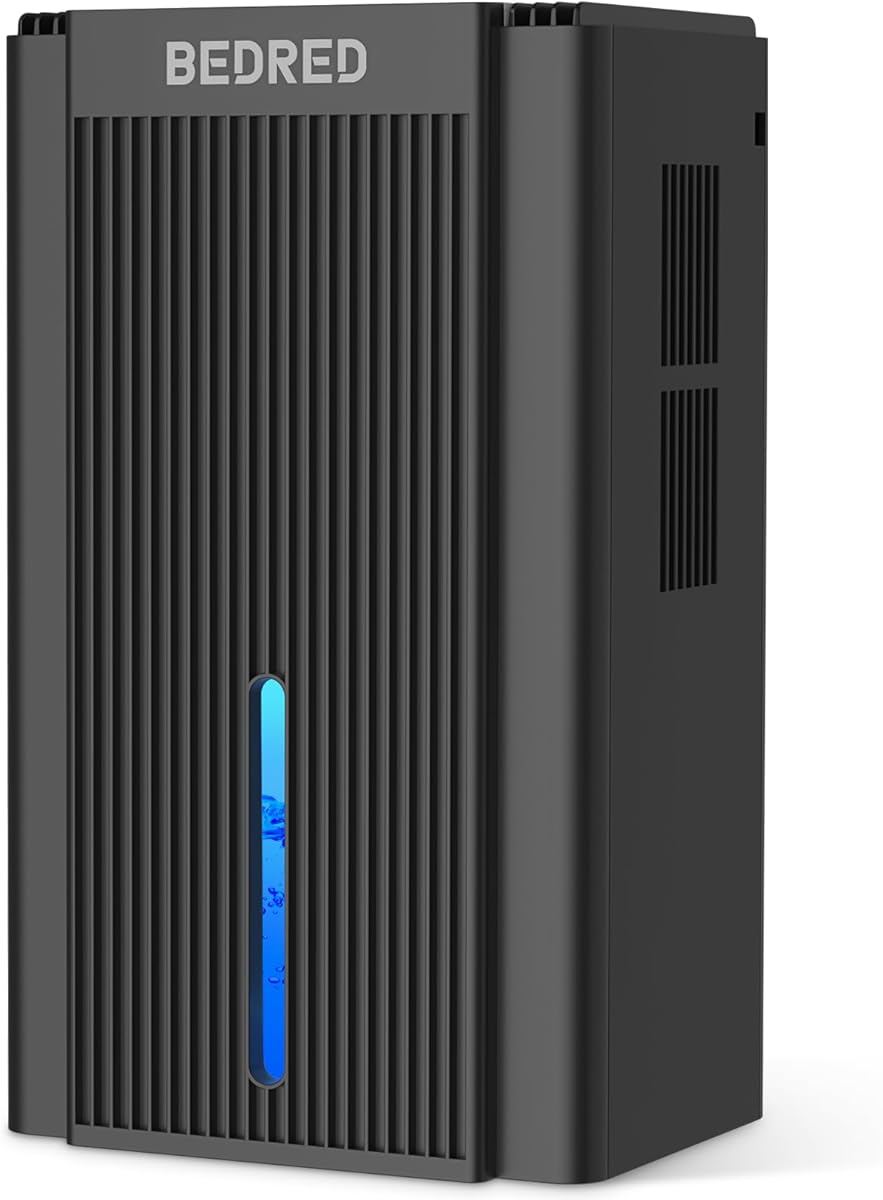
The BEDRED 95 Oz Dehumidifier for Home is a large-tank thermoelectric model with a 4.3 rating. It is aimed at buyers who want fewer emptyings than a compact bathroom or RV unit requires. The product is positioned for spaces up to 1,000 square feet, although its supplied information does not provide a daily water-collection figure, so capacity claims alone should not be treated as a performance measurement.
We may earn a commission when you buy through this link, at no additional cost to you.
Its 95-ounce reservoir is the most prominent physical advantage. A larger tank can support longer operating periods, reducing the frequency of manual emptying in humid conditions. Intelligent automatic shutoff stops the unit when the water tank is full, helping prevent overflow. The seller also describes a streamlined, compact appearance intended to blend into living rooms, bedrooms, basements, bathrooms, and RVs.
Nighttime convenience is addressed with a dedicated sleep mode. According to the product details, the ambient lighting turns off and the noise fades to a whisper during this setting. Seven selectable colors remain available for normal operation, allowing the unit to function as a subtle accent light without interfering with sleep mode. This combination of controls makes the BEDRED appealing for a bedroom or living area where appearance matters.
The main uncertainty is the lack of a stated extraction rate and sound measurement. A large tank improves convenience, but it does not independently prove how quickly the unit reduces humidity. Buyers should also consider that a larger reservoir means a larger cleaning task if water is allowed to stand. Overall, the BEDRED is a strong choice for capacity-conscious shoppers who prioritize sleep mode, styling, and fewer interruptions for tank emptying.
The 95-ounce reservoir separates this model from most of the compact options in the guide. It is especially useful when continuous operation is expected, provided the tank is drained and cleaned regularly rather than left to stand for long periods.
Sleep mode disables the ambient lighting and reduces operating noise. The listing describes this as a whisper level without providing a decibel figure, so buyers who are especially sound-sensitive should investigate independent customer feedback.
We may earn a commission when you buy through this link, at no additional cost to you.
The OWAAE Dehumidifier for Home with Auto Shutoff Sleep Mode earns a 4.3 rating and stands out for its low-noise design. It is positioned as a flexible moisture-control option for bathrooms, bedrooms, nurseries, closets, RVs, and similar enclosed areas. The stated 1,000-square-foot coverage sounds expansive for a compact thermoelectric device, so the practical scope should be judged by room conditions rather than the headline figure alone.
We may earn a commission when you buy through this link, at no additional cost to you.
Its most concrete selling point is sleep mode, which operates below 30 dB. That quiet level supports use near a bed, nursery, or workspace where constant fan noise would be unwelcome. A seven-color integrated light adds visual appeal and can provide a gentle night-light effect. The lightweight housing and built-in handle make the unit easy to reposition as humidity moves between parts of a home.
Safety is handled comprehensively for a compact model. Automatic shutoff occurs when the water tank is full or improperly positioned, reducing spill risk. The listing also emphasizes suitability for bathrooms and enclosed areas, where condensation from showers and daily activities can create persistent humidity. These features make the OWAAE straightforward to integrate into a room without constant supervision.
The supplied details do not state tank volume or a daily extraction claim, which makes direct performance comparisons difficult. The large coverage claim also requires attention to airflow, temperature, and initial humidity. Even so, the combination of under-30 dB sleep operation, a carry handle, and thoughtful shutoff protection gives this model strong all-around value. It is our Editor's Choice for buyers who prioritize quiet, flexible use in enclosed spaces.
The stated sleep-mode level places the OWAAE among the quietest options here. It is well suited to a bedside position or enclosed space where a higher fan noise level would be distracting during sleep or focused work.
Automatic shutoff when the reservoir is full or mispositioned adds confidence around bathrooms and other unattended settings. The indicator makes it easier to notice when the unit needs attention before moisture can spill.
We may earn a commission when you buy through this link, at no additional cost to you.
The 1657ML 58OZ Small Dehumidifier is a feature-heavy compact model with a 3.9 rating. It is designed for bathrooms, bedrooms, living rooms, and other closed spaces, with a stated coverage area of 230 square feet. The defining attraction is control variety: three operating modes, five timer choices, and ten atmospheric light colors give users more ways to adapt the unit to different schedules.
We may earn a commission when you buy through this link, at no additional cost to you.
The 1,657 milliliter tank is larger than many similarly compact competitors. It also includes a transparent water tank, so the current collection level is visible. Three modes—sleep, normal, and performance—cover quiet operation, general use, and periods of elevated humidity. The sleep mode is described as producing no more than 40 dB, which is quieter than many conventional appliances but not as discreet as sub-30 dB alternatives.
Safety features extend beyond the usual full-tank switch. Defrost technology is included to remove frost from the semiconductor, and the unit stops when the tank is full, separated, tilted, or fallen. A flashing red light communicates these conditions. The timer can be set for 24, 48, 72, or 96 hours, as well as continuous operation, allowing the appliance to run within a defined period instead of always running continuously.
The main drawback is the less precise 3.9 rating, along with the absence of a daily extraction figure in the supplied details. It also does not include a humidity target or humidity display, which limits direct control over the indoor environment. Still, for buyers who value timers, visible water levels, lighting choices, and robust physical safeguards, this is a versatile option for a small enclosed room.
Five timer choices provide unusually broad scheduling control. The 24-, 48-, 72-, and 96-hour settings can match a planned absence, while continuous operation offers maximum flexibility when humidity is consistently troublesome.
Automatic defrost is particularly relevant in cooler conditions where condensation can collect on the semiconductor. Shutdown after a tilt, fall, or tank separation helps prevent the unit from continuing to operate in an unsafe orientation.
We may earn a commission when you buy through this link, at no additional cost to you.
The 60 OZ Dual-Semiconductor Dehumidifier is a 4.2-rated compact model distinguished by its pair of semiconductor condensers. The product information says this design almost doubles the effect of other small dehumidifiers and can absorb up to 700 milliliters of moisture per day under the stated test conditions of 86 degrees Fahrenheit and 80% relative humidity. That claim makes it one of the stronger contenders for small rooms that need more extraction than a miniature unit can provide.
We may earn a commission when you buy through this link, at no additional cost to you.
Its 1.8-liter, or 60-ounce, reservoir reduces the need for frequent emptying. When the tank reaches capacity, automatic shutoff stops the unit and a red light signals that it needs emptying. A built-in handle makes the larger tank manageable, while the defrost function is intended to maintain performance by removing frost that forms on the semiconductors.
The sleep mode operates at a stated 35 dB, making this quieter than many standard household fans but louder than the sub-30 dB models in the guide. A seven-color adjustable light adds an ambient effect, and the timer offers 12-, 24-, 36-, and 48-hour settings. These options make it practical for bathrooms, cloakrooms, kitchens, RVs, and bedrooms where controlled operating periods are useful.
The listed 48-watt consumption and claimed 1.15 kilowatt-hour use over 24 hours are higher than the lowest-power option here, so it is not the absolute energy minimizer. Against that, the dual-condenser arrangement and large reservoir may provide stronger practical moisture removal. It is a balanced choice for a buyer who wants more extraction and capacity than the smallest models while retaining portability and timer-based convenience.
Two semiconductor condensers distinguish this model from single-condenser compact units. The supplied claim of up to 700 milliliters collected per day is promising for bathrooms and RVs, subject to temperature and starting humidity.
A 1.8-liter tank provides more room between emptying than the 35-, 44-, and 50-ounce options. Automatic shutoff remains essential because even a large reservoir can fill during extended operation in humid conditions.
We may earn a commission when you buy through this link, at no additional cost to you.
The 44oz Small Dehumidifier is a 4.2-rated model built around low energy use, compact dimensions, and an unusually broad set of controls. It claims collection of up to 11.8 ounces, or 349 milliliters, in 24 hours at 86 degrees Fahrenheit and 80% relative humidity. Its 24-watt operating claim makes it one of the most efficient selections here, particularly appealing for a closet, RV, bathroom, or bedroom.
We may earn a commission when you buy through this link, at no additional cost to you.
Three modes give the appliance a useful range. Sleep mode reduces noise for rest and concentration, normal mode handles everyday conditions, and performance mode is intended for more humid environments. The timer includes continuous use and automatic stopping after 24, 48, or 72 hours. Ten light colors with three brightness levels add visual flexibility, and users can turn the light off when a purely functional appearance is preferred.
Safety features include automatic shutoff when the 1,300 milliliter reservoir is full and an intelligent defrost function for colder conditions. The unit measures 5.91 by 5.91 by 8.46 inches and weighs 2.6 pounds, allowing it to fit in confined spaces without becoming difficult to move. Its stated coverage of 215 square feet is more realistic for a compact thermoelectric design than some broader room claims.
The main limitation is the modest collection rate compared with the 60-ounce dual-condenser model and the larger 95-ounce units. The 44-ounce tank also needs regular attention during sustained humid conditions. Nevertheless, this model offers the most balanced expression of low power, portability, operating flexibility, and useful safety features. It is our Best Budget pick for targeted humidity control in a small room.
The stated 24-watt operating requirement supports the low-wattage focus of this guide. It is well suited to shoppers who want moisture control without operating a larger compressor-based appliance continuously.
Sleep, normal, and performance modes make it easy to change output according to the room and the time of day. The three brightness levels and ten colors are useful extras, while the timer provides predictable shutoff periods.
We may earn a commission when you buy through this link, at no additional cost to you.
The ToLife Dehumidifier with Sleep Mode and Auto Shutoff is a 4.3-rated, large-tank model that balances quiet operation with practical capacity. Its semiconductor condensation technology is designed to extract moisture with less noise than many conventional dehumidifiers. The 95-ounce reservoir and stated ability to cover up to 1,000 square feet give it more reach than a typical bedroom or closet unit.
We may earn a commission when you buy through this link, at no additional cost to you.
Two operating modes keep the controls straightforward. Powerful mode focuses on faster humidity reduction, while a low-speed sleep mode operates below 30 dB. This makes the ToLife suitable for a room where daytime moisture needs prompt attention but overnight sound matters. The low noise level also helps it fit more comfortably beside a bed than models whose sleep modes operate near 35 or 40 dB.
Seven color options can change automatically or be locked on a selected color, and the listing positions the lighting as a cozy night-light. Automatic shutoff activates when the reservoir is full or not seated correctly. For moving the unit between a bedroom, bathroom, basement, living room, or closet, built-in handles make the larger form less cumbersome than its tank size might suggest.
The supplied specifications do not provide a daily extraction figure, which limits direct comparison with models offering measured collection claims. Only two modes are offered, but this simplicity can be an advantage for users who do not want to manage a complicated panel. Overall, the ToLife offers the strongest balance of large capacity, sub-30 dB sleep operation, straightforward modes, and portability, making it a leading choice for a multi-room household.
The 95-ounce tank can run for longer periods than the smaller reservoirs in this comparison. It is a meaningful upgrade for humid environments where a 35- or 44-ounce tank would require frequent attention.
Powerful mode addresses elevated humidity, while sleep mode prioritizes quiet operation below 30 dB. With only two choices, the appliance remains approachable even for first-time dehumidifier owners.
We may earn a commission when you buy through this link, at no additional cost to you.
The Tenergy Sorbi 1000ml Air Dehumidifier is the 4.4-rated leader in this guide and the only model with a clear air-purification advantage. It combines Peltier moisture removal with true HEPA filtration, allowing it to address both airborne humidity and particulates. The seller states that the filter captures 99.97% of particles, making this a compelling option for closets, bathrooms, small offices, and basements where clean air matters as much as dry air.
We may earn a commission when you buy through this link, at no additional cost to you.
The removable one-liter tank and claimed extraction of up to 750 milliliters per day are practical figures for a compact unit. Performance is specified under 80% humidity and 86 degrees Fahrenheit, so conditions outside that range can change results. A water-level sensor, LED indicator, and automatic shutoff help manage the tank safely, while the plug-and-play design avoids a complicated initial setup.
Touch controls allow the air speed to be adjusted, which gives users some control over the balance between extraction and noise. The stated operating range is 35 to 42 dB, making it less quiet than the best sub-30 dB sleep-mode competitors. At seven pounds, it is also heavier and less compact, but the added filtration and more substantial construction may justify the size for a dedicated location.
The Tenergy is ETL and CARB certified and includes a one-year warranty, with a possible two-year extended warranty through registration. The manufacturer recommends Tenergy-branded Sorbi filters for best performance, which makes replacement planning part of the ownership experience. With the highest rating and the only true HEPA feature, this is our Best Premium pick for buyers seeking both moisture and particle control.
The combination of Peltier condensation and true HEPA filtration distinguishes the Sorbi from every other model here. It is a better fit for a closet or bathroom where airborne dust and other particulates are additional concerns.
Touch controls let owners choose a lower or higher fan setting as conditions change. This offers a compromise between the very quiet sleep modes of compact alternatives and the stronger airflow of a performance setting.
We may earn a commission when you buy through this link, at no additional cost to you.
The 44 Oz Gentle-Control Dehumidifier is a 3.9-rated model designed around gradual humidity adjustment. Rather than promising maximum extraction, its product information emphasizes stability, lower energy use, and less noise from frequent start-stop cycling. That approach may appeal to occupants who dislike abrupt changes in perceived comfort or who want a machine designed for a small enclosed area.
We may earn a commission when you buy through this link, at no additional cost to you.
The 44-ounce reservoir and lightweight 2.56-pound housing make the unit easy to place on a shelf, countertop, or narrow surface. Its listed dimensions are 5.91 inches in depth by 8.46 inches in height, which supports use in bedrooms, bathrooms, closets, and RVs. The portable format is more important than raw tank size for many buyers who intend to move the dehumidifier between locations.
Auto defrost is included to prevent frost buildup and maintain operation in cooler conditions. Automatic shutoff responds to a full, detached, tilted, or fallen tank, reducing spill risk. Users can select continuous, 24-, 48-, or 72-hour timers and choose among sleep, auto, and performance modes. Ten colors with three brightness levels provide a wide range of ambient lighting choices.
The supplied details do not state a daily extraction rate, so it is difficult to compare its moisture-removal power directly with the models that provide laboratory-style collection figures. Its 3.9 rating also trails much of the field. Even so, the gentle-control philosophy, low 2.56-pound weight, and full suite of safety and scheduling features make this a credible option for small, enclosed spaces.
The product is positioned for gradual humidity improvement instead of rapid extraction. This may be useful in occupied rooms where a steadier operating pattern is preferred over aggressive cycling.
At only 2.56 pounds, the unit is one of the easiest models to reposition. That mobility makes it useful for responding to seasonal dampness in different closets, bathrooms, or RV compartments.
We may earn a commission when you buy through this link, at no additional cost to you.
The DY501 50 Oz Dehumidifier is a 4.1-rated compact model designed for bedrooms, RVs, closets, bathrooms, and other enclosed spaces. The product information identifies a maximum collection of 400 milliliters in 24 hours at 86 degrees Fahrenheit and 80% relative humidity, along with energy use of no more than one kilowatt-hour per day. It offers a middle ground between the smallest tanks and the larger-capacity models.
We may earn a commission when you buy through this link, at no additional cost to you.
Its transparent 1,500 milliliter reservoir allows the water level to remain visible, and a groove at the base is designed to make the tank easier to grip, remove, pour, and clean. The larger 50-ounce capacity means fewer emptyings than the 35-ounce TABYIK, but it remains narrow enough for compact spaces. The stated dimensions are 5.91 by 4.72 by 9.84 inches.
At a claimed 30 dB, operation is quiet enough for a bedroom, office, or RV sleeping area. A separate button controls seven ambient colors, so the light can be disabled when unnecessary. Automatic shutoff occurs when the tank reaches approximately 1,300 to 1,500 milliliters, and a flashing red light signals that the reservoir requires attention.
The claimed coverage of up to 300 square feet requires unobstructed airflow, and the seller specifically notes that the top inlet and rear outlet must remain open. It also lacks a digital humidity display, so owners must rely on the water level and general comfort rather than a numerical humidity reading. With a moderate tank, quiet operation, and straightforward safety, the DY501 is a well-rounded selection for compact-room moisture control.
The stated 30 dB operation suits bedrooms and RV sleeping spaces. A transparent reservoir lets users check collected water without removing the tank, making routine maintenance more convenient.
The unit performs best when its top inlet and rear outlet are unobstructed. Leaving clearance around the appliance helps it draw in humid air and release drier air effectively.
We may earn a commission when you buy through this link, at no additional cost to you.
A low wattage dehumidifier should fit the space, match the moisture level, and provide enough control and safety for unattended use. The most useful comparisons begin with extraction and tank capacity, followed by noise, energy use, coverage, placement, and maintenance.
Daily extraction provides the clearest indication of how much water a unit is designed to collect under specified test conditions. The TABYIK claims up to 16 ounces, the dual-semiconductor 60-ounce model up to 700 milliliters, the Tenergy Sorbi up to 750 milliliters, and the DY501 up to 400 milliliters. These figures are useful only when their test conditions are understood: 86 degrees Fahrenheit and 80% relative humidity create warm, humid conditions that many real rooms may not match. A lower stated rate can still be appropriate for a closet or RV, while a bathroom with persistent shower moisture may justify a stronger model. Look for clear units, conditions, and collection periods rather than treating the number as a guarantee in every environment.
Tank capacity determines how long a machine can operate before the reservoir needs attention. The guide includes tanks from 35 ounces to 95 ounces. A compact tank is easier to carry and clean but can fill quickly in humid conditions, while a 60- or 95-ounce tank reduces interruptions during extended operation. The BEDRED and ToLife offer the largest reservoirs, while the TABYIK provides the most compact 35-ounce format. Always pair capacity with automatic shutoff. The larger tank still needs regular cleaning, and a full reservoir can leave a machine inactive until someone notices the red indicator.
Sound is especially important for bedrooms, nurseries, offices, and RVs. The TABYIK is rated at 28 dB, the OWAAE sleep mode operates below 30 dB, and the ToLife sleep mode is also below 30 dB. The dual-semiconductor unit specifies 35 dB, while the Tenergy operates across a stated 35-to-42 dB range. Lower figures generally favor sleep, but sound can vary with fan speed, floor vibration, and placement. Put a unit on a stable surface, keep it away from walls when clearance is required, and use its lowest practical setting overnight.
Low wattage matters when the appliance will run for long periods, but the lowest wattage does not automatically mean the fastest moisture removal. The 44 oz Compact model states 24 watts, the dual-semiconductor model uses 48 watts, and the TABYIK and DY501 each describe daily energy use of no more than one kilowatt-hour. Sleep, normal, auto, and performance modes change the balance between noise, energy use, and output. A homeowner with steady humidity may prefer an automatic cycle, while a temporary damp period may justify a performance mode or timer. Compare both the power claim and the mode structure rather than judging by wattage alone.
Room size is only one part of fit. The compact 44-ounce model measures 5.91 by 5.91 by 8.46 inches, while the ToLife is substantially taller at approximately 13.78 inches. Portability is aided by built-in handles on many models, and the Tenergy's seven-pound weight makes it less convenient to move despite its built-in handle. Measure the intended surface, check the clearance around vents, and consider whether the tank can be removed without shifting the whole unit. A door or cabinet opening also needs to be wide enough for the appliance and its reservoir.
Automatic shutoff should be considered essential. It is especially important when the tank is full, removed, tilted, or not seated correctly. Every product in this guide provides some form of automatic shutdown, with many using a red flashing light to indicate attention. Auto defrost is also useful in basements, closets, and cooler rooms where frost can form on a semiconductor. It helps preserve operation but does not make any thermoelectric unit suitable for outdoor use. Always follow the manual's environmental and placement instructions, and never place a powered unit where water can enter the electronics.
Coverage claims range from 215 square feet to 1,000 square feet, but they are not directly equivalent extraction measurements. Warm, humid air and poor circulation increase the workload, while a closed room allows more effective concentration of the unit's output. The DY501 requires the top inlet and rear outlet to remain unobstructed, a requirement that should apply to every installation. Low-wattage models are generally most realistic for bedrooms, bathrooms, closets, RVs, and other confined spaces. Large room claims should be viewed as guidance rather than proof that a unit can maintain a target humidity throughout an entire open area.
Ambient lighting is common in this category, with options ranging from seven to ten colors. It can be a useful night-light, but buyers who value a minimal appearance should confirm that the light can be switched off. The 44 oz Compact and 44 Oz Gentle-Control models also offer multiple brightness levels. Maintenance is equally important: empty the tank before it becomes a breeding ground for odors or microorganisms, wipe the removable reservoir, and keep the air inlet and outlet free. A larger tank reduces emptying frequency but makes cleaning heavier, so consider both together.
Begin by placing the dehumidifier on a level surface with the required clearance around its air inlet and outlet. Do not position it against a wall, inside a closed cabinet, or beneath furniture if that blocks airflow. Use the unit in an enclosed area with doors and windows closed when the goal is to address localized humidity, and remove the tank from its shipping position before the first use.
Select the mode that matches the situation. Begin with normal or automatic operation in a room with persistent humidity, use performance mode when conditions are temporarily severe, and choose sleep mode overnight when low noise is the priority. Set the timer for the period in which the unit should operate. If the reservoir reaches its automatic shutoff threshold, empty it, wipe it clean, and return it firmly to its correct position before restarting.
Routine care should include checking the water level, cleaning the tank, and inspecting the vents for dust. Do not pour hot water or harsh cleaners into a reservoir unless the manufacturer specifically permits them. Keep the appliance away from water splashes, and stop using it if the plug, cord, housing, or controls show damage. Allow the semiconductor assembly to defrost automatically rather than opening or modifying the cooling system.
Low wattage thermoelectric models are most effective in small, enclosed spaces such as closets, bathrooms, bedrooms, RVs, and compact offices. Coverage claims vary widely, but actual performance depends heavily on temperature, initial humidity, airflow, and whether doors or windows remain open. A targeted unit used consistently in one room is generally more useful than a small machine expected to manage an entire open home.
Thermoelectric and Peltier dehumidifiers are often quieter because they use a small cooling module and fan rather than a large compressor. The models here state sound levels ranging from 28 dB to 42 dB, depending on the model and setting. Actual noise also depends on the surface, vibration, and selected operating mode, so sleep-mode specifications deserve particular attention.
The amount depends on the unit, room temperature, starting humidity, airflow, and whether the area is closed. Published figures in this guide range from about 11.8 ounces to 16 ounces per day, while the Tenergy states up to 750 milliliters under its specified test conditions. These are controlled or stated test results, not guaranteed outputs in every home environment.
Automatic shutoff stops the cooling and fan system when the reservoir is full or is not properly seated. This reduces the chance of water spilling from the unit. Many models also flash a red light, but the owner still needs to empty and clean the tank before operation can continue.
A low wattage unit can be useful in a cool indoor space, but very low temperatures can cause condensation to freeze on the semiconductor assembly. Models with automatic defrost are better suited to those conditions because they periodically remove frost. Keep the appliance within its permitted indoor temperature range, and do not use it outdoors or as a substitute for a dedicated cold-weather dehumidifier.
A display is helpful but not essential. A unit without a digital reading relies on the visible water level and the user's perception of comfort, so a hygrometer can provide useful confirmation. If precise monitoring matters to you, consider pairing a compact dehumidifier with a separate hygrometer and comparing readings over time.
A larger tank means less frequent emptying, which is useful in humid rooms or during unattended operation. It can also be heavier, more difficult to clean, and less convenient in very tight spaces. The best balance depends on where the unit will sit and how often someone can empty the reservoir safely.
A thermoelectric model performs best when concentrated in a small enclosed area because cool indoor surfaces can already affect nearby humidity. Moving it between rooms can help distribute effort, but it is rarely as effective as allowing one unit to operate continuously in the area with the greatest moisture problem. Doors and open floor plans also make a larger compressor-style unit more suitable in many homes.
The ToLife 95 Oz model stands out as the most balanced overall choice because it combines a large reservoir, a sub-30 dB sleep mode, two straightforward operating modes, and convenient handles. The OWAAE 1000 Sq Ft model is another strong option for quiet use in enclosed spaces, while the Tenergy Sorbi is the clear premium choice for buyers who also want true HEPA particle filtration.
For a more compact or energy-conscious setup, the 44 oz Compact model provides three modes, ten lighting colors, four timer options, automatic defrost, and a stated 24-watt operating requirement. Smaller buyers may favor the TABYIK for its especially quiet 28 dB operation. Prioritize extraction conditions, tank capacity, shutoff protection, airflow clearance, and noise according to the exact room that needs attention.
Before making a final selection, verify the dimensions, current listing details, replacement requirements, and operating guidance. Product information and availability can change over time, so checking the live listing helps ensure that the features, coverage, and included accessories still match your needs. The right low wattage dehumidifier is the one that can run consistently in its intended space and be maintained without inconvenience.