
5-Pack A4988 Stepper Motor Driver
4.5Editor score
Five-step microstepping selection
Adjustable current potentiometer
Five included heat sinks
This guide compares the best stepper motor driver for 3D printer options, covering noise, current, compatibility, protection, and setup ease.
A stepper motor driver translates commands from a 3D printer controller into the precise current pulses that move each axis. A capable driver improves print quality, noise levels, reliability, and the overall experience of operating a machine. The right choice depends on your motors, control board, firmware, build complexity, and tolerance for adjustment.
We compared the supplied modules by driver technology, supported voltage and current, microstepping options, protection features, interface support, heat management, and compatibility with common 3D printer electronics. The list covers budget A4988 boards, versatile DRV8825 modules, and quieter TMC2208 and TMC2209 options for both beginners and advanced builders.
Each review explains the strongest reasons to choose a module, along with the setup limitations or compatibility considerations that deserve attention. The selections also show how a five-piece bundle differs from a smaller pack and why UART support can matter. Product availability and prices change, so check the current listing and your printer specifications before buying.
4.5Editor score
4.7Editor score

4.6Editor score
The table below compares all ten modules by their core technology, current capability, microstepping, communication method, and package size. These distinctions help identify the simplest drop-in option and the most capable choices for quieter or sensorless-homing builds.


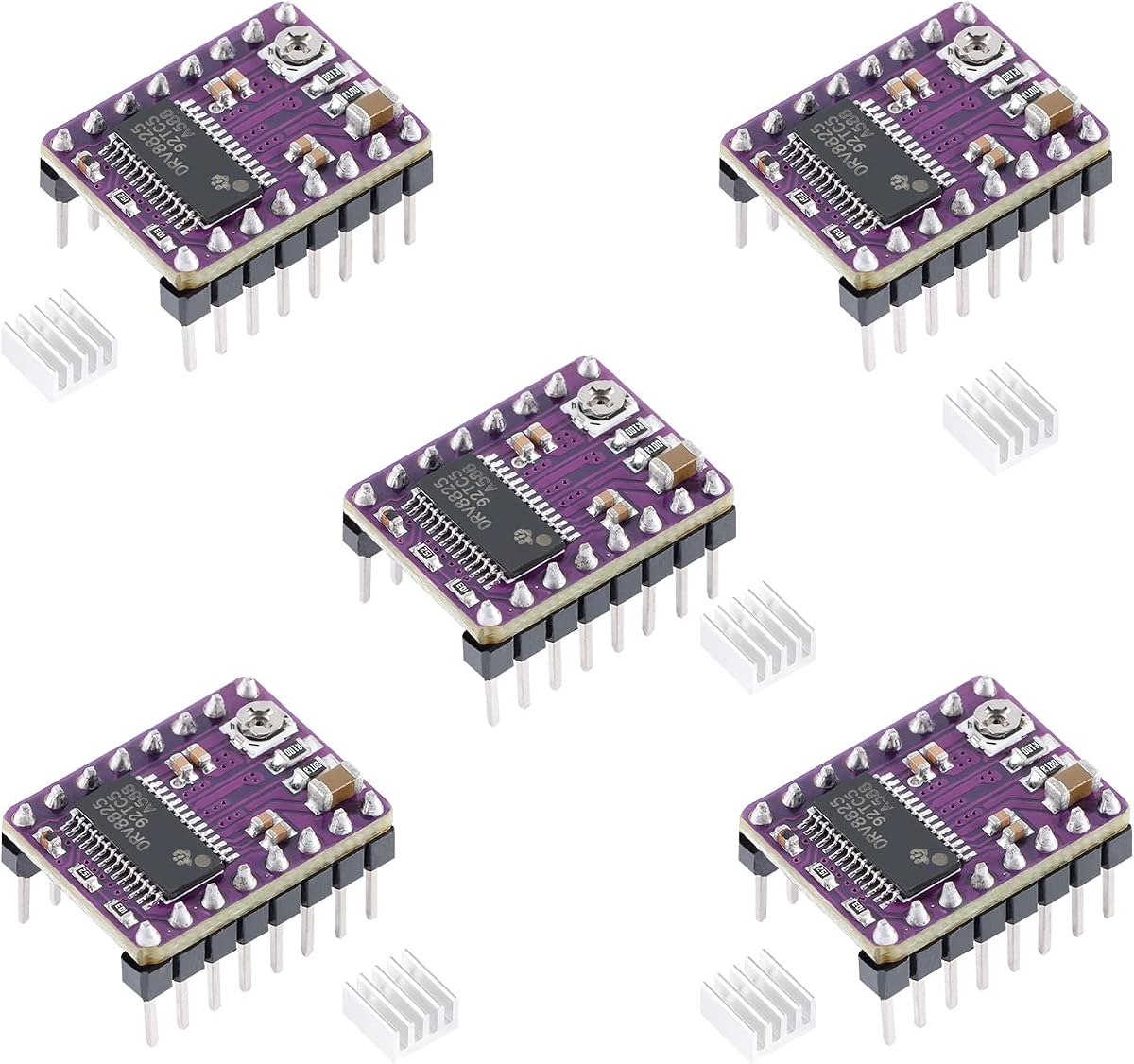


The HiLetgo A4988 five-pack is a conventional stepper driver bundle aimed at builders who want a dependable, straightforward upgrade. Its 4.4 rating reflects a generally favorable user history, while its main appeal is the combination of five modules, heat sinks, and a familiar step-and-direction interface. It is particularly useful for repairing or assembling more than one printer.
We may earn a commission when you buy through this link, at no additional cost to you.
The modules support full-step through sixteenth-step operation, giving users several practical levels of motion refinement. An onboard potentiometer provides adjustable current control, while intelligent chopping automatically chooses between fast and slow decay. Thermal shutdown, under-voltage lockout, and crossover-current protection add useful safeguards around a relatively exposed stepper-driver board.
Its limitations are important for modern builds. It has no UART configuration, and the older A4988 architecture generally produces more audible movement than StealthChop2-based TMC drivers. The listed 1.2A continuous capacity and 35V maximum may also be limiting for high-current motors, large printers, or unusually fast acceleration. Current must be set correctly rather than simply turning the potentiometer to maximum.
This package makes the most sense for a beginner restoring a RAMPS-style printer, a hobbyist assembling several machines, or an owner who values broad familiarity over silence and advanced diagnostics. The included heat sinks and five-module quantity offer convenience, but users comfortable with UART tuning will usually find a TMC2209 or TMC2208 more rewarding in daily operation.
The onboard potentiometer makes motor-current calibration straightforward without UART software. It remains important to measure the driver and motor temperature after a test print because the module's advertised current is not a substitute for a safe, application-specific setting.
Thermal shutdown, under-voltage lockout, and crossover-current protection help guard the electronics against common electrical faults. These protections do not eliminate the need for a sound power supply, correct wiring, and adequate cooling.
We may earn a commission when you buy through this link, at no additional cost to you.
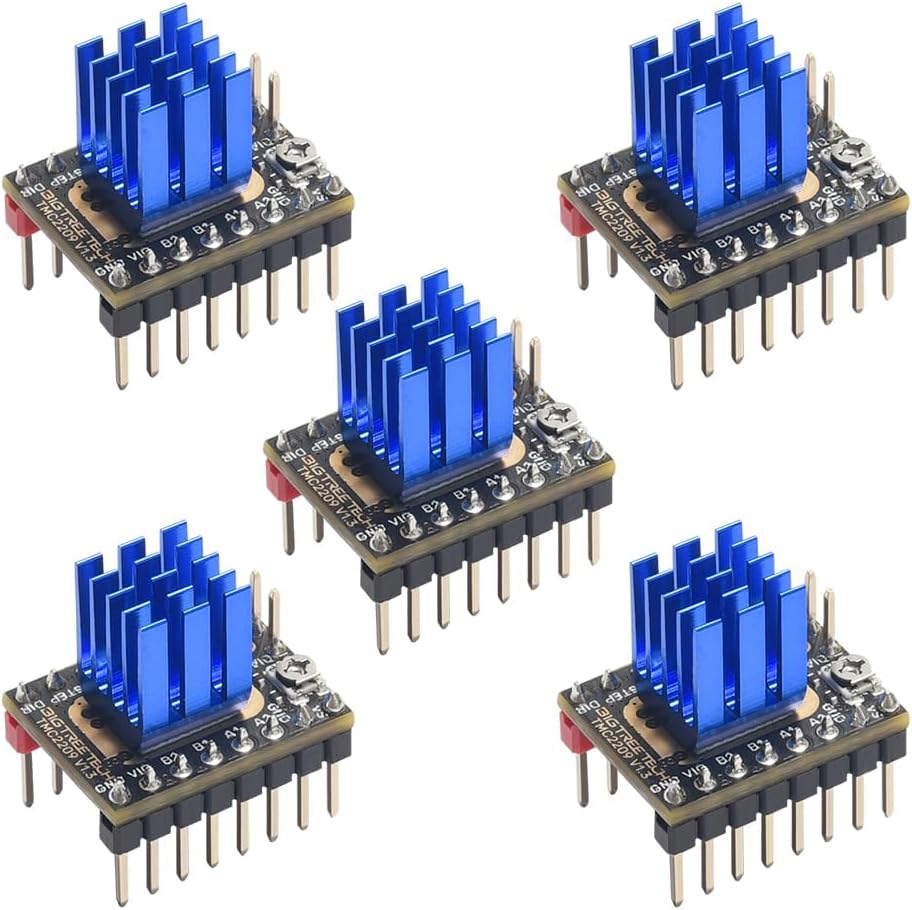
This BIGTREETECH TMC2209 V1.3 bundle combines a 4.7 rating with the practical advantages of a four-module set. It is designed for two-phase bipolar stepper motors and gives a typical Cartesian printer one module for each axis, often with a spare available. StealthChop2 is its defining feature, helping reduce the constant mechanical hum associated with many entry-level drivers.
We may earn a commission when you buy through this link, at no additional cost to you.
The module supports 2.0A continuous current and peaks of 2.8A within a 4.75V to 28V operating range. Flexible microPlyer interpolation supports as many as 256 microsteps, while CoolStep dynamically manages current and is described as reducing energy use by 75%. UART and STEP/DIR operation broaden compatibility, although selecting the desired mode requires the appropriate firmware changes.
Stallguard4 adds another practical advantage: it monitors motor-current changes to identify a stalled or blocked axis. That supports sensorless homing, which can simplify a printer design that otherwise needs physical limit switches. It is not a substitute for careful tuning, and users should understand how StallGuard behaves with their motors, loads, acceleration, and printer configuration.
The four-pack is well suited to owners of common boards such as BIGTREETECH Octopus and SKR models, Manta boards, and MKS Gen L. It is a compelling balance of quiet operation, useful diagnostics, and multi-axis value for a new build or a full upgrade. Users wanting even more current and finer resolution may prefer the six-pack TMC2209 offered elsewhere in this guide.
StealthChop2 changes how the driver controls motor current, making the module especially attractive for users bothered by constant printer noise. The effect is most noticeable during slow positioning and low-speed movements, where traditional microstepping can sound rough.
UART provides configuration access, while STEP/DIR remains available for simpler setups. The listed compatibility with widely used printer boards is valuable, but firmware support, pin assignments, and module configuration still need to match the exact printer.
We may earn a commission when you buy through this link, at no additional cost to you.
The DRV8825 five-pack is a high-current, broadly applicable driver package with a 4.2 rating. It combines a 45V maximum output capability with a listed 2.5A current rating, making it suitable for a wide assortment of bipolar stepper motors. The four-layer PCB and included heat sinks are designed to improve thermal performance.
We may earn a commission when you buy through this link, at no additional cost to you.
Its microstepping choices extend from full-step to 1/32 step, offering finer control than the traditional A4988. The module measures 1.5 by 2 centimeters and retains the familiar form factor associated with A4988-style carriers. This makes it relevant to robotics, CNC equipment, scanners, printers, office automation, and other motion-control projects.
The principal tradeoff is acoustic performance and configuration simplicity. It does not offer the StealthChop2 or microPlyer approach of the TMC options, and it has no UART mode for software-level tuning. Its 2.5A rating also requires careful attention to cooling, motor specifications, and current selection. A high current capability does not mean every motor or heat sink should be operated at that limit.
This five-pack is a sensible choice when a project needs more current and finer microstepping than an A4988 but does not need modern quiet-operation features. It is especially useful for multi-axis 3D printer builds, CNC conversions, and motion projects where the driver form factor and broad application support matter more than sensorless homing.
The listed 2.5A output capability gives builders more headroom than a standard 1.2A A4988 module. Actual usable current still depends on the motor rating, supply voltage, board wiring, cooling, and the current set on the module.
Support for up to 1/32 stepping can improve motion smoothness compared with a module limited to 1/16. Additional subdivisions do not guarantee a perfect print, but they can help reduce mechanical harshness when the rest of the printer is properly tuned.
We may earn a commission when you buy through this link, at no additional cost to you.
The BIGTREETECH TMC2209 V1.3 is the strongest all-around recommendation in this roundup, combining a 4.7 rating with a strong feature set. It is built for two-phase bipolar stepper motors and brings modern current control, high microstep resolution, and multiple operating modes to a compact printer module.
We may earn a commission when you buy through this link, at no additional cost to you.
StealthChop2 is the primary reason most builders notice the TMC2209. Its 256-step microPlyer capability can produce smoother movement than a conventional A4988, while the PWM chopper approach helps reduce jitter and irregular motion. The driver supports 2.0A continuous and 2.8A peak current across a 4.75V to 28V range, offering a useful balance for common printer motors.
UART configuration allows advanced settings to be managed by compatible firmware, while STEP/DIR operation supports more conventional installations. Stallguard4 detects changes in motor current and can support sensorless homing. The module is listed as compatible with many popular boards, including Octopus, SKR, Manta, and MKS models, although the exact board version and firmware remain important.
This is the right choice for most builders who want quieter operation, smooth motion, and modern diagnostics without moving to a completely different controller ecosystem. It is less convenient for someone unwilling to learn basic firmware configuration, and it does not remove the need to set current safely. For the best balance of capability, broad relevance, and user reception, it earns the Editor's Choice recommendation.
StealthChop2 and flexible microPlyer interpolation work together to smooth motor current transitions. This can reduce the familiar buzz of entry-level drivers, making the printer more pleasant in a home or shared workspace.
UART mode exposes settings that can be tailored to individual motors and operating conditions. This control is a major benefit for experienced users, though beginners should start with conservative values and change only one setting at a time.
Stallguard4 can use motor-current changes to identify the end of an axis stroke. It can simplify a new printer design, but dependable homing depends on suitable motor load, travel distance, deceleration behavior, and firmware configuration.
We may earn a commission when you buy through this link, at no additional cost to you.
The DORHEA TMC2208 V1.2 five-pack provides a middle ground between classic A4988 modules and higher-current TMC2209 boards. Its 4.5 rating and five-module format make it attractive for complete printer rebuilds, with enough units to cover multiple axes and an extruder.
We may earn a commission when you buy through this link, at no additional cost to you.
The TMC2208 supports 1.4A continuous current and 2A peaks over a 4.75V to 36V range. It can deliver up to 256 subdivisions through flexible microPlyer interpolation and uses StealthChop2 for quieter two-phase motor operation. This combination makes it well suited to improving the sound and smoothness of common Reprap-style printers.
The package includes a heat sink, screwdriver, and stackable headers, which simplifies physical installation. Its adapter can also be used to test or flash a SilentStepStick through a USB-to-serial converter, and the tester is described as preconfigured for standalone use when the VIO-VM jumper is closed. These conveniences are useful but also add more configuration considerations than a basic A4988.
Choose this five-pack when quiet motion and 256 microsteps matter, but 2.0A continuous current is more than the application needs. It can replace TMC2100, A4988, DRV8825, or LV8729-style modules in compatible systems, though users should confirm board layout, headers, firmware, and current requirements before making the change.
StealthChop2 provides a clear upgrade in perceived noise for users moving from a basic A4988 setup. The 256-subdivision microPlyer unit also helps create smoother motion when the printer's mechanics and firmware support it.
Five modules cover the core axes of a typical printer and can simplify coordinated upgrades. The included screwdriver and heat sinks reduce the need to source separate installation accessories.
We may earn a commission when you buy through this link, at no additional cost to you.
The five-pack A4988 module is the budget-focused selection for printers that need a simple, established driver without advanced configuration. It carries a 4.5 rating and includes five modules with heat sinks, making it especially convenient for assembling or repairing a complete multi-axis machine.
We may earn a commission when you buy through this link, at no additional cost to you.
Its step-and-direction interface is easy to understand, and the current limit is adjustable through an onboard potentiometer. Five resolutions from full-step to sixteenth-step provide basic control over motion smoothness. Intelligent chopping selects between fast and slow current decay automatically, reducing the need for manual decay-mode configuration.
The module supports motor power up to 35V and continuous current up to 1.2A per phase. Thermal shutdown, under-voltage lockout, and crossover-current protection are included. Its limitations are its 1/16 microstepping ceiling and lack of UART mode. The older design also tends to be noisier than TMC modules equipped with StealthChop2.
This is a strong budget choice for a RAMPS-equipped or similar printer, a first stepper-driver replacement, or a user who wants five inexpensive modules with familiar wiring. It is less suitable for someone prioritizing silence, very high current, sensorless homing, or extensive firmware-level motor tuning. Correct current calibration and adequate cooling remain essential.
The standard A4988 footprint and step-and-direction interface are familiar across many open-source printer designs. Compatibility still depends on the board's pinout, voltage, and driver configuration rather than the physical shape alone.
Matching heat sinks are included for all five modules, making the package more complete than a loose collection of driver boards. Good contact between the driver and heat sink remains important during sustained or high-current operation.
We may earn a commission when you buy through this link, at no additional cost to you.
This A4988 five-pack combines a perfect 5.0 rating with a straightforward set of classic driver features. It targets users who want a dependable multi-module package for DIY printers, CNC projects, and automation builds without needing the advanced configuration offered by modern TMC modules.
We may earn a commission when you buy through this link, at no additional cost to you.
The listed 1.2A continuous capacity is supported by an onboard potentiometer for adjustment. The description also notes a maximum of 2A when using the included heat sink, though actual safe operation should be determined from motor ratings, board conditions, and thermal testing rather than from a headline current figure alone.
Five selectable resolutions cover full-step through sixteenth-step. Intelligent chopping automatically selects a suitable current decay mode, while thermal shutdown, under-voltage lockout, and crossover-current protection guard against common faults. These features make the modules adaptable to different loads without requiring constant decay-mode adjustments.
The package includes five A4988 modules, pins, and five matching heat sinks, along with stated documentation and technical support. It is a strong choice for a new build using common driver sockets or a multi-printer workshop. Users seeking near-silent movement, high-resolution microstepping, or UART-based diagnostics will be better served by a TMC2208 or TMC2209.
The potentiometer provides a direct method for adjusting the maximum output current to the motor's requirements. A meter and thermal check should still be part of setup because board layout, supply voltage, and cooling affect the practical operating limit.
Automatic selection of fast or slow decay helps the driver manage current transitions without constant manual intervention. This is especially helpful for users who are already comfortable with basic A4988 wiring but do not want to fine-tune every decay parameter.
We may earn a commission when you buy through this link, at no additional cost to you.
The BIGTREETECH TMC2209 six-pack is the premium choice for a complete multi-axis build or a printer that needs every axis upgraded. Its 4.6 rating reflects strong reception, while six modules and matching heat sinks offer a more comprehensive package than the smaller TMC2209 listings in this guide.
We may earn a commission when you buy through this link, at no additional cost to you.
Each module uses StealthChop2 and supports up to 256 microsteps through flexible microPlyer interpolation. Continuous current is listed at 2.0A, with peaks up to 2.8A, and the operating voltage range extends from 4.75V to 28V. The package is positioned as a direct replacement for several older TMC, A4988, DRV8825, and LV8729-style modules in compatible electronics.
The driver also provides SpreadCycle for high-precision cycle-by-cycle current control, while StealthChop2 handles the quiet-operation role. As with other modern TMC boards, UART setup and current calibration must be handled carefully. The six-piece count can also exceed what a standard three-axis printer needs, although extra modules are useful for an extruder, dual feeder, or future expansion.
For a builder who wants a full quiet upgrade in one purchase, this package delivers the strongest combination of module count, current capability, and modern motion control. It suits experienced users comfortable with firmware and heat management. A single-module buyer or someone with very basic electronics needs may find the four-pack or individual TMC2209 more economical.
Six matching modules can modernize every motion axis while keeping driver type and configuration consistent. This consistency can simplify tuning compared with mixing several driver technologies in the same machine.
SpreadCycle offers cycle-by-cycle current control, complementing StealthChop2's quiet operation. Precise current regulation can improve repeatability, but safe settings still depend on the motor, voltage, and cooling.
We may earn a commission when you buy through this link, at no additional cost to you.
The individual BIGTREETECH TMC2209 V1.3 is useful when only one motor needs upgrading, such as a particularly noisy extruder or a single failing axis. Its 4.2 rating is lower than the highest-rated TMC2209 listings, but the underlying features remain well suited to modern 3D printer motion control.
We may earn a commission when you buy through this link, at no additional cost to you.
StealthChop2 provides the quiet current-control approach associated with the TMC2209, and flexible microPlyer interpolation supports up to 256 microsteps. The module handles 2.0A continuous and 2.8A peak current over a 4.75V to 28V voltage range. That makes it a capable option for common bipolar stepper motors used in desktop printers.
CoolStep dynamically controls current to reduce heat and energy use, which can lower cooling requirements when configured correctly. Stallguard4 can support sensorless homing by detecting changes in motor current. The module also supports UART and STEP/DIR modes, though firmware changes are required to use the intended mode.
This single-module format is ideal for a targeted repair or a cautious first upgrade. It is less convenient for replacing all axes at once, and buyers should not assume it includes a heat sink unless the current package provides one. Confirming the package contents and comparing a multi-module bundle is important for a complete printer conversion.
Replacing the module on the most audible axis can deliver a noticeable improvement without rebuilding the whole motion system. Similar results across all axes require matching hardware and comparable firmware settings.
CoolStep reduces unnecessary energy use by dynamically managing motor current. Proper current calibration, motor-to-driver temperature matching, and adequate airflow remain important even when the driver can operate with reduced heat.
We may earn a commission when you buy through this link, at no additional cost to you.
The DORHEA TMC2208 two-pack provides a compact way to upgrade selected printer axes with a modern silent driver. Its 4.5 rating and inclusion of two modules, heat sinks, and a screwdriver make it a practical choice for repairs and partial conversions.
We may earn a commission when you buy through this link, at no additional cost to you.
The TMC2208 supports 1.4A continuous current and peaks of 2A across a 4.75V to 36V range. StealthChop2 and the flexible microPlyer unit provide quiet operation and up to 256 subdivisions. The module is presented as a replacement for TMC2100, A4988, DRV8825, and LV8729-style drivers in compatible existing electronics.
Stackable headers simplify use on a printer board, while the adapter can test or flash a SilentStepStick with a USB-to-serial converter. The tester is also described as preconfigured for standalone operation with the VIO-VM jumper closed. These functions are helpful for experimentation, though they can make the learning process more involved than using a basic STEP/DIR-only A4988.
Choose the two-pack for an extruder and one axis, a two-axis machine, or a selective upgrade where higher-current TMC2209 modules are unnecessary. It does not provide enough modules for a typical four-axis full rebuild, and its feature set does not include the TMC2209's Stallguard4 sensorless homing function.
Two matching TMC2208 modules can reduce noise on the axes users notice most. The 256-subdivision capability also supports smoother movement when the firmware and mechanics are configured to take advantage of it.
The adapter can be used to test or flash a SilentStepStick through a USB-to-serial converter. That makes it easier to validate driver communication before committing the modules to a working printer board.
We may earn a commission when you buy through this link, at no additional cost to you.
The right driver depends on electrical limits, printer hardware, firmware support, and the level of quietness or tuning you want. Compare these factors before choosing a package, especially when replacing modules in an existing machine.
Begin with the rated voltage and phase current of the stepper motors already installed in the printer. A driver must tolerate the motor supply and provide enough current for the motor's rated specification. The listed limits are maximum capabilities rather than a recommendation to operate continuously at the highest figure.
A4988 modules are listed at up to 35V and 1.2A continuous current, DRV8825 at up to 45V and 2.5A, TMC2208 at up to 36V and 1.4A continuous, and TMC2209 at up to 28V and 2.0A continuous. Match these figures to the motors, then reduce the setting when thermal conditions require it.
Traditional A4988 and DRV8825 modules use step-and-direction control and microstepping to smooth motor movement, but TMC modules add StealthChop2 current control. That technology is especially effective at reducing the familiar buzz and hiss of low-speed printer movement. TMC2208 and TMC2209 are therefore attractive when low noise is a priority.
Quietness also depends on mechanics, belt tension, motor resonance, speed, and frame rigidity. A silent driver can improve the result, but it cannot correct a loose belt or an unbalanced axis. Choose a TMC model when the printer's firmware supports it and you value a materially quieter machine.
More available microsteps can create smoother motion, although the exact microstep pattern and firmware configuration influence the result. The A4988 selections offer up to 1/16 resolution, DRV8825 up to 1/32, and the TMC2208 and TMC2209 products up to 1/256 through microPlyer interpolation.
High microstepping does not automatically produce better prints. Excess smoothing can reduce acceleration or torque, and printer firmware may implement interpolation differently. Check the board and firmware's supported microstep settings before ordering.
STEP/DIR is the familiar basic interface used by classic printer boards. UART adds a communication channel for reading and changing driver settings through compatible firmware. TMC2208 and TMC2209 products support both approaches, while the A4988 and DRV8825 listings are primarily STEP/DIR modules.
Using UART usually means adding or editing the correct configuration section in printer firmware. Users who do not want to manage that process may prefer a well-supported STEP/DIR configuration, while advanced builders may value UART diagnostics and current-control options.
The physical driver footprint is only one part of compatibility. The control board must provide the required pins, adequate supply, appropriate driver configuration, and firmware support. TMC2209 listings specifically mention several BIGTREETECH, Manta, and MKS board families, while the A4988 and DRV8825 products are associated with numerous classic open-source printers.
Check the board revision, existing jumpers, pin assignments, and firmware before replacing modules. A module can fit perfectly and still be misconfigured. Look for the manufacturer's configuration or GitHub instructions when a board and driver combination is not well documented.
Stepper drivers dissipate energy as heat, especially when operating near their current ceiling. Every listed multi-module package includes heat sinks, but proper attachment and airflow still matter. A heat sink that is not seated correctly cannot remove heat effectively, and a warm driver may trigger thermal protection.
For high-current motors, check motor and driver temperatures after sustained printing. Use conservative current settings during initial calibration, confirm that the heat sink matches the driver package, and avoid enclosing the electronics in a space with no ventilation.
A full Cartesian printer commonly needs drivers for the X, Y, Z, and extruder axes, while a dual-extruder machine can need more. Two- and three-module packs fit targeted upgrades, whereas four-, five-, and six-module bundles are more convenient for complete builds. Extra modules are useful for future expansion but should be counted before purchase.
Also check whether the package includes heat sinks, pins, headers, screwdrivers, or testing adapters. The accessory details differ between listings even when the driver family is the same, and those differences can affect the assembly process.
Stallguard4 in the TMC2209 can detect motor-current changes and provide an abnormal signal when an axis is blocked. This supports sensorless homing and can reduce the need for physical endstop switches in a suitable new design. The TMC2208 products in this roundup do not advertise that feature.
Sensorless homing is not automatic or universally reliable. It depends on motor characteristics, axis load, travel distance, deceleration, and firmware behavior. Builders with proven endstops may not need the added configuration, while a new compact printer could value the design flexibility.
Before installation, disconnect the printer's power and confirm the replacement module matches the control board's footprint, voltage, current rating, and interface. Check the board documentation for driver jumpers or straps, and consult the driver's instructions if UART configuration is planned. Do not install a module while the power supply is energized.
Seat the module carefully, inspect the pins for alignment, and secure the matching heat sink to the driver chip. Connect the motor and step-and-direction wiring according to the board and driver documentation. Set the current conservatively, enable the correct driver type in firmware, and perform a low-speed movement test before restoring normal print settings.
After installation, verify that the motor turns freely, the axis moves in the intended direction, and the driver does not become unusually hot. If UART is enabled, check the reported settings and establish conservative StallGuard values if using sensorless homing. Keep airflow around the electronics, clean dust from heat sinks, and retest current and temperature after any motor, driver, or firmware change.
For most builders seeking quiet, smooth motion, the BIGTREETECH TMC2209 V1.3 is the strongest overall option because it combines StealthChop2, UART and STEP/DIR modes, 256-step interpolation, and Stallguard4 support. A simple or older printer may work perfectly with an A4988, while the TMC2208 provides a quieter alternative at a lower current rating.
A TMC2209 is generally quieter, offers finer interpolation, supports UART configuration, and can provide sensorless-homing capabilities. An A4988 is simpler, less expensive, and appropriate for a straightforward repair where advanced configuration is unnecessary. The better choice depends on printer firmware, electrical limits, and the user's comfort with tuning.
You can sometimes reuse a driver, but you must verify its physical footprint, pinout, maximum voltage, current capability, and required configuration. The board's firmware and jumpers must also support that driver type. Never assume a module will work solely because it fits into the same socket.
Use the motor's rated phase current as the upper reference, then account for the driver's cooling and the manufacturer's configuration instructions. A conservative initial setting is safer than immediately using the maximum. Monitor both the motor and driver during a sustained test because board layout and heat-sink quality affect the practical operating limit.
No. Both driver families can operate through STEP/DIR, although UART is needed for software configuration and detailed status information. UART mode requires compatible firmware, correct communication settings, and sometimes changes to the printer configuration. STEP/DIR operation can be simpler for a straightforward drop-in replacement.
Sensorless homing uses the driver's motor-current monitoring to identify when an axis reaches a stall instead of relying on a physical limit switch. The TMC2209's Stallguard4 supports this function. Reliable results depend on correct motor load, deceleration, travel distance, and firmware tuning, so it is not suitable for every machine without testing.
Noise can come from the driver, microstepping setting, motor resonance, belt tension, frame movement, acceleration settings, or incorrect current. If silence was expected from a TMC module, confirm that StealthChop2 is enabled and the firmware is using the correct driver configuration. Mechanical problems can remain audible even with a quiet driver.
A typical Cartesian printer requires four drivers for the X, Y, Z, and extruder axes. Some designs need fewer, while dual-extruder or multi-motor systems may require more. A five-module bundle provides useful spare capacity, while a two-module pack is better for a targeted upgrade.
The BIGTREETECH TMC2209 V1.3 stands out as the best overall choice because it combines strong user feedback with StealthChop2, flexible 256-step interpolation, UART and STEP/DIR support, and Stallguard4. The six-pack version is ideal for a full multi-axis upgrade, while the A4988 five-pack remains the best budget selection for a simple, familiar installation.
Prioritize electrical compatibility first, then decide how much quiet operation and configuration access you need. A4988 and DRV8825 modules serve conventional STEP/DIR builds well, while TMC2208 and TMC2209 options suit users seeking smoother, quieter axes. Account for the number of drivers, included accessories, current settings, cooling, and firmware support before ordering.
Finally, check the current product listing and latest product documentation when you are ready to buy. Package contents, driver revisions, firmware compatibility, availability, and prices can change, and the newest listing details should be treated as the final source for what is included and how the module should be configured.