
QWORK RC Battery Capacity Checker
4.7Editor score
Supports 2–7S lithium packs
Displays individual cell voltages
Highlights maximum and minimum cells
Compact field-ready design
Explore the best Li Ion Battery Tester options, comparing capacity, voltage, chemistry support, displays, balancing, charging, and portability for every user.
A Li Ion battery tester can reveal far more than a battery’s resting voltage, helping you evaluate capacity, internal resistance, cell balance, and overall pack health. The right device depends on whether you work with individual cylindrical cells, consumer batteries, or multi-cell RC packs, so matching the tester to your battery format is essential.
The products in this guide were compared by supported battery chemistries, cell counts, measurement functions, display information, connection methods, and specialized features such as balancing, discharge testing, and power-bank output. The list includes compact voltage meters, multi-channel capacity analyzers, universal household battery checkers, and advanced diagnostic tools for RC applications.
Each review explains the product’s strongest capabilities, practical trade-offs, and ideal user. Ratings reflect the supplied customer feedback, while technical details come from the listed product information. Availability and pricing can change, so check the current listing and connector requirements before purchasing.
4.7Editor score

4.7Editor score
4.6Editor score
The comparison below highlights the most important distinctions among these ten testers, including supported formats, measurement depth, connector requirements, and whether a device checks a single cell, a complete pack, or general-purpose household batteries.


The DWEII 4-Channel Capacity Tester is built for users who need more than a simple voltage reading from an 18650 cell. It has a 4.3 rating and combines capacity, internal resistance, voltage, current, power, and battery-level information on a 1.77-inch screen. Its four-channel arrangement is particularly useful for comparing cells collected from different devices.
We may earn a commission when you buy through this link, at no additional cost to you.
Automatic charge-and-discharge testing is the model’s defining feature. The stated capacity range extends from zero to 99,999 mAh, while the discharge load is 10 watts. Real-time readings let the user follow changes during a cycle rather than relying only on a final result. Internal resistance measurement adds another layer of information that is valuable when assessing cell quality or comparing batteries of different ages.
The main limitations relate to specialization and accuracy. It is designed around 18650 batteries rather than household cells or multi-cell RC packs, and the stated measurement error is approximately 10%. Charge and discharge testing also creates heat, so the unit should be used in a ventilated workspace and monitored according to the supplied instructions.
This is a strong choice for electronics hobbyists, battery recyclers, builders, and anyone regularly sorting loose 18650 cells. Buy it when simultaneous capacity analysis and visible real-time data are priorities. If you only need a quick voltage check or own other battery formats, a simpler meter may be more convenient.
Four independent channels allow several 18650 cells to be handled at once. This is more useful than testing cells one after another when you want to compare capacity, internal resistance, or charging behavior across a group.
Combining automatic charge and discharge functions removes much of the repetitive setup normally associated with capacity analysis. The display keeps voltage, current, power, and other live measurements visible throughout the process.
We may earn a commission when you buy through this link, at no additional cost to you.
The Dlyfull-DB1 Magnetic Battery Tester is a general-purpose option for people who want one device for a drawer full of mixed batteries. Its 4.5 rating reflects a useful combination of broad compatibility and simple operation. It supports AA, AAA, C, SC, D, N, 9-volt, button cells, CR123A, CR2032, LR44, 18650, and other common formats.
We may earn a commission when you buy through this link, at no additional cost to you.
Chemistry support covers 1.2-volt Ni-MH and Ni-Cd, 1.5-volt alkaline, 3-volt lithium, 3.7-volt Li-ion, and 9-volt cells. A digital LCD reports voltage and provides a good, weak, or poor health indication, making it practical for sorting batteries before use. The magnetic slider holds the cell firmly in place and allows one-handed testing.
This tester is less elaborate than a capacity analyzer. Its focus is voltage and health status rather than controlled charge-discharge cycles or internal resistance. It also includes a USB-C cable but no adapter, so users may need a compatible USB-C power source. The rechargeable design offers up to 15 hours of operation per full charge.
Choose the DB1 for household maintenance, remote controls, flashlights, toys, and a general collection of rechargeable or disposable cells. It is particularly handy for avoiding accidental reuse of weak batteries. Users seeking true capacity measurements or balanced multi-cell analysis should choose a more specialized instrument.
The broad size and chemistry support is the primary advantage. Instead of maintaining separate instruments for cylindrical cells, 9-volt batteries, coin cells, and lithium packs, users can perform quick checks in a single workflow.
Sliding the battery into a magnetic holder helps maintain a secure connection. This is especially helpful with shorter cells, where maintaining firm contact is important for a dependable reading.
We may earn a commission when you buy through this link, at no additional cost to you.
The RC Cellmeter 8 provides a practical middle ground between a basic voltage reader and a sophisticated smart battery analyzer. It has a 4.4 rating and measures voltage and capacity for LiPo, Li-ion, NiMH, and NiCd batteries. Its large LCD and one-click measurement button make it approachable for new users and field checks.
We may earn a commission when you buy through this link, at no additional cost to you.
The eight-in-one format is useful for RC hobbyists who move among several battery types. The listed minimum operating voltage is 1.2 volts, which supports common NiMH and NiCd configurations as well as lithium packs. Because the meter puts voltage and capacity in one simple display, it offers more information than a basic indicator without requiring a complex menu-driven device.
The supplied information is less specific about connectors, supported cell counts, internal resistance, and automatic balancing than it is for the more advanced products in this list. Those omissions matter if you need detailed cell-level diagnostics or individual internal resistance readings. You should also verify that your battery connector and cell configuration match the device requirements.
The Cellmeter 8 is best for RC vehicle, aircraft, or other hobby packs where quick voltage and capacity information is the priority. It suits users who appreciate a large display and uncomplicated controls. Buyers needing balance connectors, protocol analysis, or advanced power-bank functions should examine the premium smart meters instead.
A large LCD and one-button measurement workflow keep setup straightforward. That makes the meter convenient for checking a pack in a workshop or at the field without navigating through complicated settings.
Adding capacity measurement means the tester can provide a more useful view of pack condition than voltage alone. That helps when comparing a pack before committing it to an RC vehicle or other demanding device.
We may earn a commission when you buy through this link, at no additional cost to you.
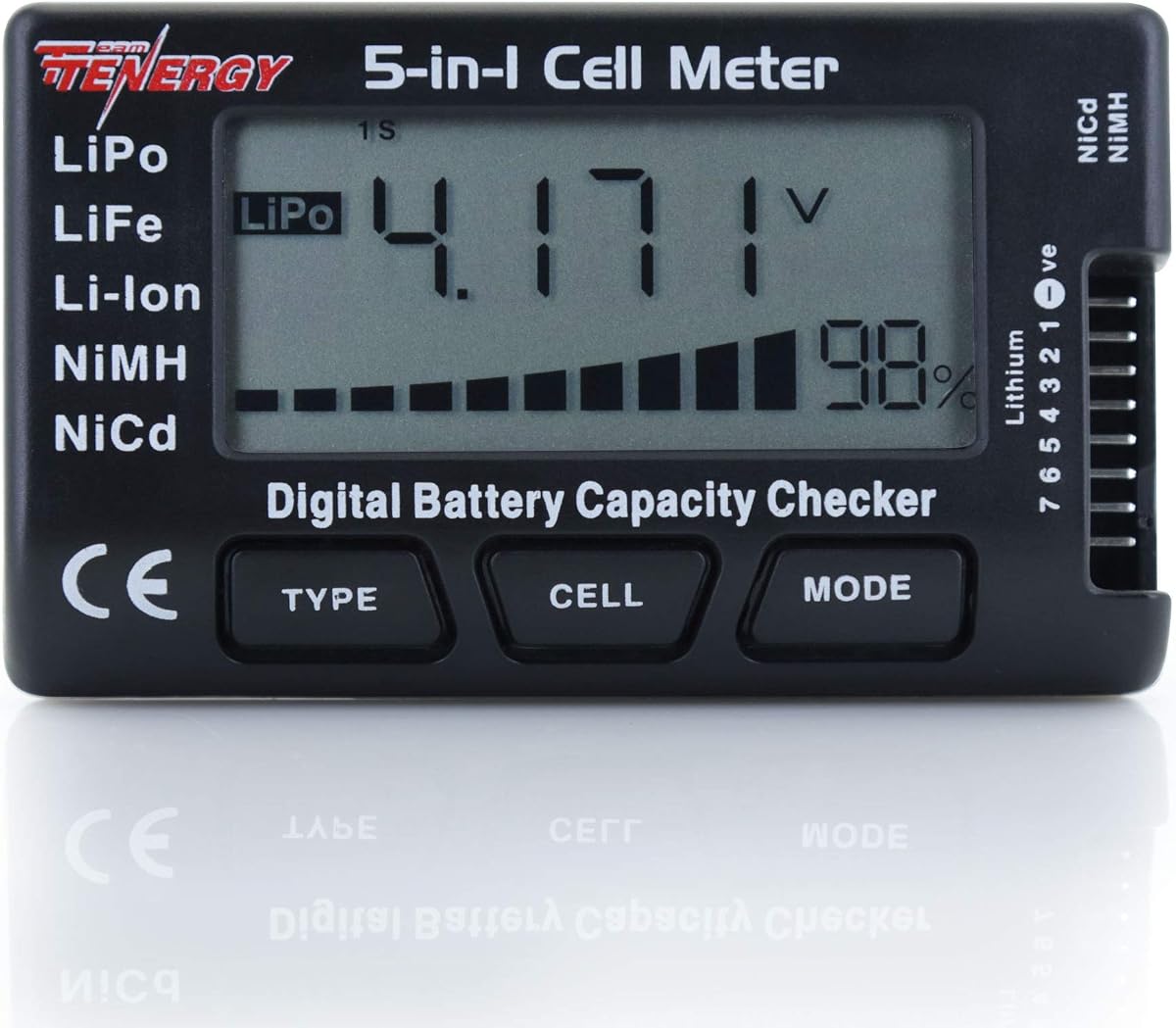
The Tenergy 5-in-1 Battery Meter is among the most complete conventional RC diagnostic tools in this guide. Its 4.6 rating reflects a useful combination of voltage checking, capacity evaluation, balancing, controlled discharge, and per-cell internal resistance measurement. It supports LiPo, LiFePO4, Li-ion, NiCd, and NiMH packs.
We may earn a commission when you buy through this link, at no additional cost to you.
It accepts lithium packs with balance connectors and NiCd or NiMH packs equipped with Hitec or Futaba connectors. For lithium-based packs, it displays internal resistance for each cell, helping identify a weak or inconsistent cell. The balancer/discharger operates at 180mA and can discharge a lithium pack to an adjustable threshold before charging, a process described as helping improve runtime.
The meter draws power from the connected battery pack and does not turn on by itself. Lithium packs must expose a balance connector, while transmitter and receiver packs need the appropriate supported connector. Li-ion and lithium-based pack support extends from two to seven cells for the listed types, although the exact upper limit for every Li-ion format is not specified in the supplied details.
This is a compelling choice for serious RC hobbyists, repair technicians, and anyone maintaining multiple battery packs. It offers deeper diagnostics than a basic cell-voltage meter while remaining focused on pack maintenance. Choose it when balancing, discharge control, and cell-level resistance data justify a more specialized tool.
Individual internal resistance readings can reveal differences that a total pack voltage may hide. Comparing cells is useful when diagnosing a pack that performs inconsistently or is nearing retirement.
The integrated balancer helps keep cells at similar voltages. Its controlled 180mA discharge function also allows a user to assess a pack under load and discharge it before the next charging cycle.
We may earn a commission when you buy through this link, at no additional cost to you.
The FLY RC Cellmeter 7 is a compact voltage-analysis meter designed for checking multi-cell RC batteries. It has a 4.6 rating and supports two-to-seven-cell lithium packs along with four-to-seven-cell NiCd and NiMH packs. It covers LiPo, LiFe, and Li-ion formats, giving it broad relevance across common hobby batteries.
We may earn a commission when you buy through this link, at no additional cost to you.
Its display includes individual cell voltages, total pack voltage, the lowest cell, the highest cell, the voltage gap between those extremes, and estimated remaining capacity. Showing the difference between the strongest and weakest cell is particularly valuable. A pack can look acceptable at its connector while still containing a cell that is much weaker than the others.
The product is positioned around quick checking rather than full pack servicing. The supplied information does not identify an internal resistance mode, automatic balancing function, controlled discharge, or power-output capability. It is therefore best viewed as a portable cell-voltage diagnostic tool rather than a complete battery laboratory instrument.
Choose the Cellmeter 7 for field inspections of RC aircraft, cars, and other multi-cell packs. Its compact construction and clear array of voltage information make it useful for owners who want to identify imbalance without carrying a larger device. Users who need balancing or resistance readings should look to a premium analyzer.
The explicit high-to-low voltage gap makes imbalance easier to recognize. Rather than studying every cell number separately, users can see the variation at a glance and investigate the pack further.
Support for lithium and nickel-based RC formats makes the meter adaptable to common hobby collections. Its broad pack range and compact form are well suited to quick checks in the field.
We may earn a commission when you buy through this link, at no additional cost to you.
The ISDT BG-8S Lipo Battery Checker combines smart diagnostics, automatic balancing, and portable output in one device. It carries a 4.4 rating and supports LiHv, LiPo, Li-ion, LiFe, NiMH, NiCd, and BEC output measurements. When connected through XT60i and used with BattGO, it can present cell voltages, battery cycles, and working parameters.
We may earn a commission when you buy through this link, at no additional cost to you.
The advanced auto-balancing algorithm is designed to bring individual cells closer to one another. After balancing, the unit enters a low-power mode. Connection flexibility includes XT60 and XT60i, an XH2.54 1–8S balance lead, XH2.54 three-pin, and JST options, giving it an advantage when working across different RC battery systems.
It can also become a portable power source for an RC vehicle, drone, car, or compatible mobile device. Qualcomm Quick Charge 2.0 and 3.0 are supported, along with BC1.2 and Apple devices. Maximum output is 12 volts at 2 amperes, so it is useful for moderate loads but not a substitute for a high-output bench supply.
This BG-8S is well suited to RC users who want more than a passive voltage meter. It is particularly attractive when balancing and portable charging are both important. Users who mainly need cell balancing, simpler maintenance, and broad connector support can find a capable feature set in one package.
The advanced matching algorithm helps bring cell voltages into closer alignment. Automatic operation and low-power mode after completion make the function convenient for regular pack maintenance.
A maximum 12-volt, 2-ampere output turns the checker into a portable power source. This is helpful for selected electronics, although supported charging protocols should be checked before connecting a device.
We may earn a commission when you buy through this link, at no additional cost to you.
The ISDT BG-8S Battery Meter is the most feature-rich and highest-rated selection in this guide, earning a 4.7 rating. It combines smart battery analysis, automatic balancing, portable power output, broad connector support, and receiver signal testing. That combination gives it the strongest appeal for RC users who want a single diagnostic platform.
We may earn a commission when you buy through this link, at no additional cost to you.
Through XT60i and BattGO, the display can show cell voltage, battery cycle count, working parameters, and other detailed information. The auto-balancing algorithm is intended to bring cells closer together and extend pack performance by improving consistency. The device automatically enters power-saving mode when balancing is complete.
Connector support includes XT60 and XT60i, an XH2.54 1–8S balance lead, XH2.54 three-pin, and JST. It also measures BEC output and analyzes PWM, PPM, and S.Bus protocols, with additional protocol support planned through firmware updates. Its portable output reaches 12 volts and 2 amperes and supports Qualcomm Quick Charge 2.0 and 3.0, BC1.2, and Apple devices.
The BG-8S is ideal for serious drone, aircraft, and RC vehicle owners who maintain multiple battery systems. It is the editor’s choice because it covers diagnostics, balancing, protocol checks, and useful output in one device. Casual users who only check household batteries may find a simpler tester easier to operate.
Cycle count and working parameters provide context beyond a momentary voltage reading. This information helps owners judge pack history and compare batteries more intelligently when selecting a pack for demanding equipment.
BEC voltage checks and support for PWM, PPM, and S.Bus analysis extend the device beyond battery inspection. Protocol support may also expand with future firmware updates, making it adaptable to evolving RC systems.
We may earn a commission when you buy through this link, at no additional cost to you.
The Advanced 8-Channel Battery Tester is designed for technicians, workshops, and serious enthusiasts who need to process multiple 18650 cells. It supports eight independent channels that can operate simultaneously or separately, along with automatic charge, discharge, and repeated charging cycles. A 2.4-inch color screen presents real-time voltage and current data.
We may earn a commission when you buy through this link, at no additional cost to you.
Its laboratory and workshop positioning is reinforced by active heat dissipation, adjustable voltage settings, and reverse-connection protection. These features make the unit more appropriate for repeated testing than a basic handheld meter. Users can monitor cycles and internal resistance through the color display while working with a group of cells.
There is no customer rating shown in the supplied data, so it does not have the same feedback history as the other selections. Its specialized 18650 focus also makes it less useful for household batteries, coin cells, or conventional RC packs. The exact capacity range and cell-size tolerances are not detailed in the listed information.
Buy this tester when eight-channel throughput and real-time monitoring are central to your workflow. It is a promising option for battery sorting, cell evaluation, and repeated laboratory-style analysis. Those wanting a customer-rated, broadly compatible household tool may receive more reassurance from a better-established model in the guide.
Independent or simultaneous operation allows users to organize large groups of 18650 cells efficiently. This is the key advantage for workshops that need consistent results across many batteries.
Reverse-connection protection reduces risk from incorrect setup, while active heat dissipation helps manage heat during charge-discharge cycles. Adjustable voltage settings support different testing configurations.
We may earn a commission when you buy through this link, at no additional cost to you.
The QWORK RC Battery Capacity Checker delivers focused voltage diagnostics in a lightweight format. It has a 4.7 rating and supports two-to-seven-cell LiPo, Li-ion, and LiFe packs, as well as four-to-seven-cell NiMH and NiCd packs. The display shows total voltage, individual cell readings, maximum and minimum cell voltage, and the difference between them.
We may earn a commission when you buy through this link, at no additional cost to you.
This information is enough to spot a pack whose cells are unevenly charged or whose weakest cell may limit performance. The digital screen makes readings accessible without menus, while the compact body suits field checks. It is designed for drones, RC cars, and aircraft, where quickly confirming pack condition is valuable.
It is important to note the limitations. The product requires a two-to-seven-cell port and a balance connector, does not test a single cell, and does not charge batteries. It is therefore a pack-level checker rather than a complete maintenance station. It also does not claim internal resistance, balancing, or controlled discharge in the supplied information.
The QWORK checker is a strong budget choice for RC hobbyists who want fast imbalance information without carrying a larger analyzer. It is particularly useful for comparing packs in a field. If your work requires single-cell capacity testing or active balancing, invest in one of the more specialized multi-channel or smart meters.
Showing the highest cell, lowest cell, and their voltage difference helps users identify inconsistent packs quickly. That makes it practical for pre-flight or pre-use checks in the field.
The lightweight, compact design is excellent for mobile use. Keep in mind that the checker reads multi-cell packs through a balance connection and does not perform charging or single-cell tests.
We may earn a commission when you buy through this link, at no additional cost to you.
The ZTS Mini Multi-Battery Load Tester is a simple, fast option for checking common household batteries under load. It has a 4.5 rating and uses patented pulse-load technology to assess charge and remaining life, providing a more informative result than relying on resting voltage alone.
We may earn a commission when you buy through this link, at no additional cost to you.
The tester works automatically without switches or settings. A two-second test is enough to identify weak or failing cells. Supported formats include 1.5-volt AAA, AA, C, D, and N batteries; 1.2-volt NiMH and NiCd; 3.6-volt Li-ion; 3-volt photo lithium; and 9-volt alkaline batteries.
Its scope is intentionally focused. It does not balance multi-cell packs, analyze individual cell imbalance, or perform the detailed 18650 charge-discharge cycling offered by specialized analyzers. It also focuses on household formats rather than presenting the advanced connector and protocol tools found in smart RC meters. Its strength is speed and accessibility.
The Mini-MBT is well suited to households, offices, and travel kits where many batteries need a rapid health screen. Probe and lead storage in the case seam helps keep the package compact. It is made in the United States and includes a one-year warranty, making it a practical choice for everyday battery sorting.
A pulse load gives a battery a realistic challenge before the result is reported. This can distinguish a cell that appears normal at rest but lacks the strength needed under use.
The two-second, no-settings process makes it easy to test many batteries in succession. A digital result and automatic operation keep the workflow simple for nontechnical users.
We may earn a commission when you buy through this link, at no additional cost to you.
The right Li Ion battery tester depends on the battery format, level of detail, and maintenance tasks you need. Start with your actual cells and connectors, then compare measurement depth, compatibility, safety features, and portability.
Battery format is the first filter because a tester designed for one cell configuration may not accept another. The DWEII and Advanced 8-Channel products focus on individual 18650 cells. The FLY, QWORK, Tenergy, RC Cellmeter 8, and ISDT devices primarily handle connected multi-cell RC packs. The Dlyfull and ZTS products cover broader household collections.
A single-cell analyzer is useful for sorting loose cylindrical batteries, while a balance-connected pack meter is better for drones, aircraft, and RC vehicles. If you need both, choose a versatile smart meter or maintain separate tools for each workflow. Confirm the physical cell dimensions, number of cells, and connector before buying.
A voltage checker tells you the electrical level of a battery or pack at a moment in time. A capacity tester estimates how much charge it can deliver through a defined charge-discharge process. The Tenergy adds balancing and internal resistance, while the DWEII performs automatic cycling and the RC Cellmeter 8 lists both voltage and capacity measurement.
For a quick family battery check, voltage or load-based testing may be enough. For battery packs used in demanding equipment, cell-level information, capacity, and imbalance readings provide a more useful picture. Match the depth of testing to your decisions rather than paying for functions you will never use.
Cell-count support is critical because a pack meter may not recognize a configuration outside its rating. The FLY and QWORK support two-to-seven-cell lithium formats, with specified four-to-seven-cell support for NiMH and NiCd. The Tenergy supports two-to-seven-cell LiPo, LiFePO4, and Li-ion packs and four-to-seven-cell NiCd and NiMH packs.
Chemistry support should also match your collection. Li-ion naming can be inconsistent, while LiFe, LiFePO4, LiHv, LiPo, NiMH, and NiCd represent different voltage and performance characteristics. Check both chemistry and cell count rather than assuming all lithium packs are electrically interchangeable.
The connection method can determine whether a tester is convenient for your setup. The QWORK requires a two-to-seven-cell port and a balance connector. The Tenergy accepts balance-equipped lithium packs and Hitec or Futaba connectors for NiCd and NiMH packs. ISDT offers XT60, XT60i, XH2.54, and JST options.
Balance access is especially useful because it lets the tester read each cell rather than only the pack’s total voltage. If your battery lacks a balance lead, you may need an adapter or another method. Confirm connector type, pin arrangement, and cell count, and never force an unfamiliar connector.
Balancing helps bring individual cell voltages into closer alignment, while internal resistance can help identify a cell that is not performing like the rest of the pack. The Tenergy includes balancing, controlled discharge, and per-cell internal resistance for lithium packs. The ISDT BG-8S models add automatic cell balancing, with the newer listing also emphasizing detailed cycle and parameter data.
These features are most valuable for owners who maintain reusable RC packs. They add more insight than a fixed voltage meter but may not justify their complexity for occasional household battery checks. Choose balancing and resistance data when pack longevity and consistent performance are central concerns.
A good display should make the useful information easy to interpret. The FLY shows individual cells, total voltage, highest and lowest readings, their difference, and estimated remaining capacity. The QWORK uses a similar focused approach, while the DWEII uses a 1.77-inch screen to show resistance, capacity, voltage, current, power, and battery level together.
The ISDT models add smart battery data, cycle counts, working parameters, and protocol analysis when connected appropriately. More data is not automatically better, however. A large, clear display with a few decisive measurements may be more useful than a complex interface filled with features you do not understand.
Where you will use the tester affects the practical choice. The QWORK and FLY are compact for field checks, while the Dlyfull offers a magnetic holder and up to 15 hours of operation from one charge. The ISDT devices also function as power banks, with maximum output of 12 volts and 2 amperes, and can charge compatible mobile devices.
Extra functions can be helpful, but they also add connectors, menus, and compatibility considerations. A portable output is not a replacement for a high-current bench supply. Review battery life, storage, connector availability, and power needs to ensure the device fits your actual routine.
Any tester that charges, discharges, or loads a battery can generate heat and carries a greater responsibility than a passive meter. The Advanced 8-Channel unit includes active heat dissipation, adjustable voltage settings, and reverse-connection protection. The DWEII has a 10-watt discharge load and an indicated measurement error of about 10%.
Use the correct battery type, correct cell count, and appropriate voltage range. Do not short terminals, and work with ventilation when cycling batteries. Reversing polarity, exceeding a channel’s limits, or leaving a pack unattended can create hazards. Review the current product instructions and use suitable protective practices whenever testing.
Begin by identifying the chemistry, cell count, physical format, and connector of the battery you intend to test. Compare those details with the tester’s supported configurations. For a balance-connected pack, inspect the lead and plug it in only when the tester is off or in the appropriate setup state. Never connect a pack whose voltage exceeds the device’s supported range.
For a simple voltage or load check, select the correct battery type, seat the battery securely, and wait for the displayed result. For capacity analysis, configure the matching cell count and voltage, connect the appropriate leads, and allow the automatic charge-discharge cycle to finish. Keep the battery and tester on a stable, ventilated surface, and monitor heat, current, and voltage throughout the process.
After testing, disconnect the pack only after the cycle has ended and readings have stabilized. Store the tester in a dry place away from extreme heat, direct sunlight, moisture, and combustible materials. Keep connector leads free of damage, clean contacts gently, and consult the manual for battery-specific limitations, calibration details, and error indications.
Not usually. General-purpose models such as the Dlyfull and ZTS support several chemistries and sizes, while many RC-oriented meters focus on specific pack voltages and connectors. Check the supported chemistry list carefully because nominal voltage alone may not distinguish every battery type. A device that reads a 3.7-volt Li-ion cell may not perform capacity cycling on that cell.
A voltage meter reports the battery’s current voltage and may compare cells for imbalance. A capacity tester estimates available charge through a controlled test, often involving charging and discharging. Capacity testing generally takes longer but provides more information about usable energy. The right choice depends on whether you need a quick condition check or deeper pack diagnostics.
For many pack testers, yes. A balance connector provides access to individual cell voltages, which supports imbalance analysis and balancing. The QWORK specifically requires a balance connection, while the Tenergy requires one for supported lithium packs. The ISDT models accept several balance-lead options. Verify the connector type and cell count before ordering an adapter.
A tester can reveal warning signs such as unusual cell imbalance, low capacity, high internal resistance, or weak voltage under load, but no single reading guarantees future safety. If a cell is swollen, physically damaged, unusually hot, leaking, or shows erratic readings, discontinue use and handle it through an appropriate battery-recycling channel. Continue following the battery manufacturer’s safety guidance.
Internal resistance tends to increase with age, heat, and certain forms of cell wear, so a high reading may justify further investigation or replacement. Comparisons are most meaningful between similar cells measured under comparable conditions. The Tenergy and newer ISDT BG-8S listing offer internal resistance information, but readings should be interpreted alongside voltage, capacity, and the product instructions.
Some models can, while others are diagnostic tools that do not charge. The DWEII includes an integrated automatic charge-discharge process, and the ISDT BG-8S models can act as power sources for connected devices. The QWORK explicitly does not charge batteries. Always match charging behavior to the specified chemistry and cell configuration.
The Dlyfull magnetic tester is designed for broad household compatibility, supports many cylindrical and button-cell formats, and secures the battery with a magnetic slider. The ZTS Mini-MBT is another convenient option for a quick load-based test across common disposable and rechargeable batteries. The Dlyfull provides a broader format list, while the ZTS emphasizes rapid testing under load.
Check a pack before use and whenever it has been stored for an extended period, exposed to unusual conditions, or delivered noticeably less runtime than usual. Looking at total voltage, individual cell readings, and the difference between the highest and lowest cells can reveal imbalance early. For packs used heavily, periodic capacity and resistance checks provide a more complete condition record.
The QWORK RC Battery Capacity Checker is the best budget option for portable pack voltage analysis, while the ISDT BG-8S stands as the editor’s choice for its detailed diagnostics, automatic balancing, protocol analysis, and power-bank capability. The Tenergy 5-in-1 Battery Meter is the best premium traditional RC pick, combining balancing, controlled discharge, and per-cell internal resistance measurements.
Prioritize the battery format and connector first, because even a capable tester is ineffective if it cannot connect safely or read the intended cell configuration. Then choose between quick voltage assessment, load-based screening, capacity cycling, cell balancing, and advanced pack data. More features are valuable only when they match the way you maintain and use your batteries.
Before purchasing, review the current listing, supported accessories, cell ranges, and instructions, and compare them with the batteries you already own. Ratings and product availability can change over time, as can pricing and included accessories. Verify the latest details so the tester you choose remains suitable for your battery collection.