
Uvital Big Button Phone
4.1Editor score
Ringtone volume up to 120dB
Eight photo speed-dial buttons
Corded power-free operation
Compare 10 hearing impaired landline phone options for captions, amplification, loud ringers, visual alerts, ease of use, and reliable home calling.
A hearing impaired landline phone should do more than simply ring loudly. The most useful models combine stronger incoming audio, adjustable tone controls, visual alerts, large displays, and simple controls so a caller can comfortably receive, identify, and respond to calls with less strain.
This guide compares ten corded, cordless, hybrid, and captioned home phones using the information supplied for each product. It considers amplification, ringer visibility, speech clarity, answering-machine functions, accessibility features, handset flexibility, service requirements, and the compromises involved in each design.
The list reveals how different households can prioritize different needs, from real-time captions to photo-dial buttons and powerful visual ringers. Ratings and specifications reflect the supplied product data, while prices and promotions can change, so readers should verify current availability and terms before purchasing.
4.1Editor score

4.3Editor score
4.3Editor score
This side-by-side comparison covers the ten phones in the guide, highlighting their form factors, accessibility features, amplification, alert systems, and convenience functions so buyers can identify the most suitable home calling setup.




The Hamilton CapTel 2400iSPNBT is a large-screen captioned telephone built for people who may struggle to understand speech on conventional calls. Its supplied rating is 4.3, and its defining advantage is the ability to display incoming and outgoing conversations as real-time text while the caller continues listening. That combination of audio and captions gives users two ways to follow the same conversation and reduces the stress associated with unclear words.
We may earn a commission when you buy through this link, at no additional cost to you.
The phone can provide fully automated captions or assisted captions with live operator support. Captions can be adjusted for size, making the screen more useful to someone with low vision as well as hearing loss. It also offers up to 40dB of amplified gain, tone controls, and hearing aid compatibility, so it addresses several dimensions of hearing accessibility rather than relying on volume alone.
The built-in answering machine is another meaningful advantage because voicemail appears as captions on the large screen. That makes it possible to review a message at a comfortable pace and avoids relying entirely on audio playback. The principal trade-offs are dependence on high-speed internet, electrical power, and sometimes telephone service, plus the need to register for captioning. Eligibility is also restricted to US residents with hearing loss.
This is the strongest overall recommendation when captions are the most important requirement. It is less suitable for a household wanting a simple, self-contained analog phone, but for a user who benefits from text support, the combination of captions, amplification, tone adjustment, and captioned voicemail is unusually comprehensive. Verify service availability and registration requirements before ordering.
Buyers should also confirm that the large touchscreen, caption size, speaker volume, and operator-assisted mode work comfortably for the intended user. The accessibility benefit comes from being able to modify the presentation of a call, not merely making the handset louder. Once those requirements are confirmed, it remains an excellent all-around choice for anyone who needs multiple ways to understand incoming conversations.
Real-time captions provide a visual record of a conversation as it happens. This is especially helpful when acoustic conditions are poor, the speaker uses an unfamiliar voice, or the user experiences different levels of hearing loss throughout the day.
Large screen controls, adjustable caption size, tone settings, hearing aid compatibility, and amplification work together. The result is a telephone that can adapt to different listening environments instead of forcing every user into one fixed audio profile.
We may earn a commission when you buy through this link, at no additional cost to you.
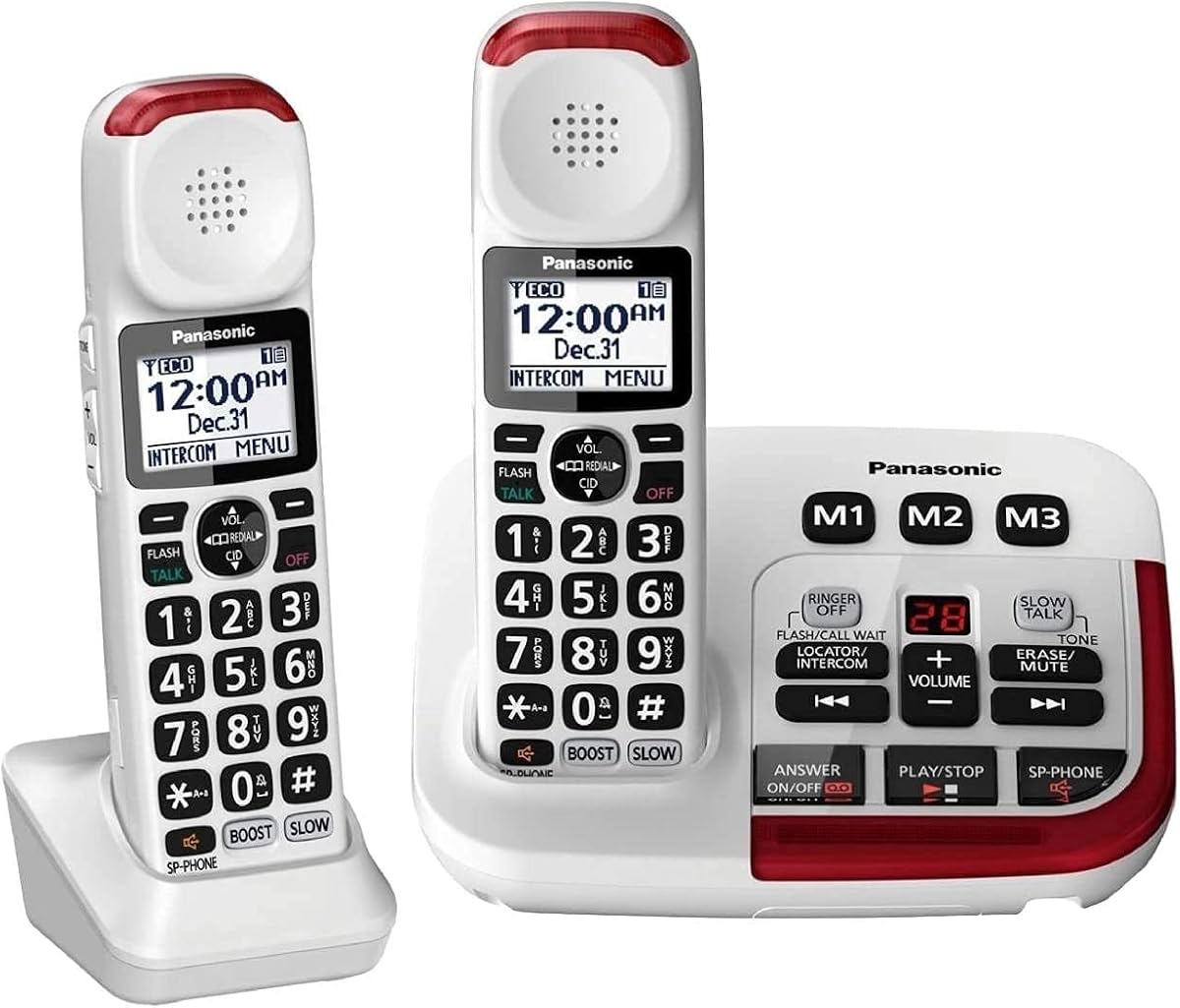
The Panasonic KX-TGM420W combo is a two-handset amplified cordless system with a supplied rating of 4.3. It sits near the top of the guide because it combines powerful accessibility controls with the convenience of using a phone in different rooms. A complete system is included with a base unit and a second handset, while additional compatibility makes it suitable for larger homes.
We may earn a commission when you buy through this link, at no additional cost to you.
Incoming caller voice can be amplified by as much as 40dB, and six voice tone settings offer a way to make speech easier to distinguish. Slow Talk is a particularly useful feature because it reduces the speed of speech during live calls and voicemail playback. Noise Reduction can also make conversations more comfortable when background sound interferes with the caller's voice.
Accessibility is not limited to the audio controls. The large white backlit display, enlarged touch-dial keys, loud base-unit ringer, and bright red LED visual ringers support users who have difficulty hearing, seeing, or quickly locating a conventional phone. The digital answering machine adds another layer of convenience, while speakerphone, talking caller ID, talking keypad and phonebook, nine speed dials, and call blocking make the system practical for everyday household use.
The trade-off is complexity. This is not merely a basic amplified handset, and users may need time to configure the answering system, contacts, and preferences. Cordless operation also introduces charging and possible range considerations, neither of which affects a corded model in the same way. Nevertheless, the benefits justify the premium position for buyers who need comprehensive sound and visibility features.
This system is a good recommendation for a household with a user who benefits from slow speech, strong amplification, and visible incoming-call alerts. It is also attractive to families who want more than one handset without relying on separate phone systems. Confirm that the included handset count and expansion options align with the rooms where calls need to be answered.
Slow Talk can reduce the rate of speech during real-time conversation and when listening to messages. It is especially valuable for users who can hear the caller but have difficulty processing rapid or complex language.
Two included handsets provide immediate flexibility, and the system can expand to six. This makes it easier to keep a phone near the bed, kitchen, living room, or another frequently used location without managing unrelated devices.
We may earn a commission when you buy through this link, at no additional cost to you.
The Panasonic KX-TGM450S is a one-handset amplified cordless phone with a supplied rating of 4.3. Its most prominent specifications are a caller-voice boost of up to 50dB and a stated 112dB loud visual ringer, making it an appealing option for users who need stronger incoming sound and a highly noticeable call alert.
We may earn a commission when you buy through this link, at no additional cost to you.
Six voice tone settings help users adjust how speech sounds, while Slow Talk can reduce speaking speed in real time and during voicemail playback. The large white backlit LCD, enlarged memory-dial buttons, and bright red LED visual ringer improve visibility. Hearing aid compatibility broadens its usefulness for users who rely on assistive listening equipment.
The phone includes several everyday conveniences: noise reduction, power backup, speakerphone, talking caller ID, talking keypad and phonebook, nine speed dials, call blocking for up to 250 numbers, intercom, and expansion to as many as six handsets. The one-inch-class supplied display is explicitly listed as 1.8 inches, which may be less generous than the screen-focused models in this guide.
Its main limitation is that only one cordless handset is included. Households seeking two complete phones may prefer the KX-TGM420W combination, while users who only need one mobile handset may find this model more focused. Cordless convenience also requires regular charging, and reception can vary with walls and home layout.
This Panasonic is a solid recommendation for a person who wants a powerful cordless phone with slow-speech support, a high-output visual ringer, hearing aid compatibility, and room to add more handsets later. It works particularly well for users who can benefit from the maximum 50dB caller boost but do not need real-time captions.
The 50dB caller boost is the model's defining feature. Adjusting it alongside six tone levels allows the user to balance increased volume with a more comfortable voice profile rather than relying on volume alone.
The 112dB visual ringer and bright red LED indicators offer a way to notice incoming calls in a noisy room or from across the home. This redundancy is important when a user may not hear a conventional ring reliably.
We may earn a commission when you buy through this link, at no additional cost to you.
The VTech SN5147 is a hybrid amplified senior phone with a supplied rating of 4.0. It includes a corded base and one cordless handset, giving users the outage resilience of a wired connection while also gaining the freedom to carry a handset around the home. The design is specifically oriented toward seniors and users with hearing or vision challenges.
We may earn a commission when you buy through this link, at no additional cost to you.
Its central accessibility feature is one-touch Audio Assist, which can boost sound by up to 50dB. The ringer can reach 90dB and is paired with a flashing visual indicator, giving users both audible and visual alerts. A full-duplex speakerphone is available on both the base and handset, and the 22-minute digital answering machine includes remote access and slow playback.
The interface is thoughtfully designed for accessibility. Oversized, high-contrast buttons and an extra-large display improve dialing and caller-ID reading. Four photo speed-dial slots let a user identify loved ones with one touch, while a smart call blocker can reject up to 1,000 robocalls and unwanted numbers. The base and handset speakerphones can also make hands-free conversations more comfortable.
The corded base is a meaningful advantage during power outages, although the cordless handset still depends on its rechargeable battery. The system can expand to four handsets with the SN5307, so it is flexible but does not provide as many included or possible expansion points as the Panasonic combination in second place. Its 4.0 rating is slightly below the leaders, though its feature balance is strong.
This phone is well suited to a household seeking a hybrid system, easy photo dialing, strong visual and audible alerts, and a useful answering machine. It is a particularly good fit when reliable basic calling during an outage matters. Buyers should think about whether a single cordless handset is enough or whether additional compatible handsets will be needed.
The corded base remains available during power interruptions, while the included cordless handset adds mobility. This balance makes the system more versatile than either a basic corded model or a single cordless phone.
Four photo speed-dial slots give users a visual way to reach familiar contacts. This can reduce the need to remember phone numbers and makes the system easier for users with memory, dexterity, or vision limitations.
We may earn a commission when you buy through this link, at no additional cost to you.
The Clarity P300 is a straightforward corded phone designed for seniors and people with mild to moderate hearing loss. Its supplied rating is 4.0, and its primary strengths are simplicity, reliable connectivity, and adjustable sound rather than a broad collection of advanced calling features.
We may earn a commission when you buy through this link, at no additional cost to you.
Incoming sounds can be amplified by as much as 26dB. The ringer offers separate pitch and volume adjustment, which is useful because some users hear low-frequency sounds better than high-frequency sounds or need a different alert depending on the room. Large buttons on the base and handset are easier to identify and press for people with limited dexterity or vision.
The phone uses a standard telephone jack and does not depend on batteries or a wireless signal. That makes it a practical option for basic home calling and reduces the number of components that need charging or maintaining. The bundle includes the phone, a 25-foot telephone line cord, and a user guide, which helps with initial setup.
The trade-offs are functional limitations. The supplied information does not identify a visual ringer, answering machine, caller-ID display, or cordless mobility. The 26dB amplification level is also below the highest boosts offered by several Panasonic and VTech options, making it better suited to mild to moderate hearing loss than to every level of impairment.
Choose the P300 when the priority is a dependable, easy-to-operate corded telephone that can amplify sound and customize the ringer. It is a sensible choice for a bedroom, kitchen, or other location where a wired phone is acceptable. Users with more demanding hearing needs may prefer a model with stronger amplification, visual alerts, or a text display.
Adjustable pitch and volume let the user select an alert that is easier to detect. This is more useful than simply making the ringer louder, particularly for people with frequency-specific hearing loss.
A standard wired connection keeps the phone ready for basic calling without batteries or wireless pairing. It is an uncomplicated option for users who value reliability and straightforward setup.
We may earn a commission when you buy through this link, at no additional cost to you.
The Uvital Big Button Phone is a simple corded landline with a supplied rating of 4.1. It focuses on the essentials for users who need to be reached and to reach family easily: an exceptionally loud ringer, very large photo-labeled speed-dial buttons, hands-free calling, and a flashing LED call alert.
We may earn a commission when you buy through this link, at no additional cost to you.
Its ringtone can reach 120dB, while the earpiece reaches 90dB. Three independent volume settings allow adjustments for the ringer, earpiece, and speakerphone. Eight one-touch speed-dial buttons can be customized with family and friends' photographs, and a separate emergency button provides a clearly identified route for urgent calls.
The speakerphone offers a comfortable alternative to holding the receiver, which can help users with limited mobility. The bright red flashing LED provides visual notification in noisy surroundings or at night. Because this is a corded PSTN phone, it needs neither batteries nor external power, reducing both the cost and complexity of ownership.
There are important limitations. The model does not support internet calling, an answering machine, voicemail, caller ID, or a display screen. Wall mounting is not recommended, so it is better suited to desk or tabletop placement. Its stated feature set is narrower than that of the hybrid systems higher in the guide, but the highest listed ringer output and eight photo buttons make it highly focused.
This is a strong budget recommendation for someone who needs an unmistakable incoming-call alert, one-touch access to family, and uncomplicated corded operation. It may be particularly useful in a home, care setting, or other location where a loud ringer and visual signal matter more than caller information or message recording.
The 120dB ringer and flashing red LED provide two ways to notice a call. This combination is particularly useful in noisy rooms, during sleep, or whenever the user is not close enough to see a conventional display.
Eight customizable photo buttons let users recognize the person they want to call. The dedicated emergency button adds another clearly identified contact option for peace of mind.
We may earn a commission when you buy through this link, at no additional cost to you.
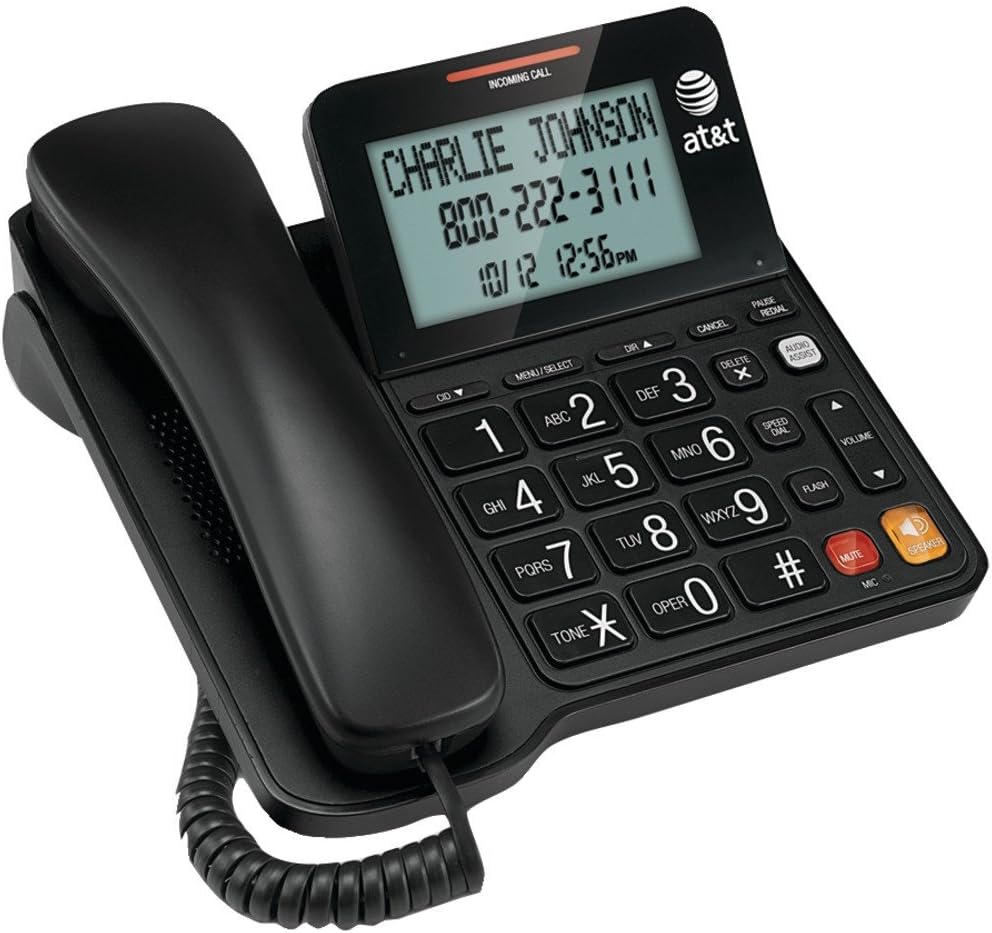
The AT&T CL2940 is a corded desktop phone with a supplied rating of 4.2. It occupies a practical middle ground in this guide, combining Audio Assist amplification, an extra-loud ringer, large controls, a tiltable caller-ID display, and a speakerphone without requiring an internet connection.
We may earn a commission when you buy through this link, at no additional cost to you.
Audio Assist boosts incoming sound for users with hearing difficulty, while the adjustable extra-loud ringer helps make incoming calls easier to notice. Extra-large buttons and a tiltable display make dialing and reading the incoming number or name more manageable for seniors and people with vision challenges.
The corded phone supports basic calls without AC power, which is valuable during outages and emergencies. Caller ID and Call Waiting can display incoming information, and the supplied data notes a 50-name and number history for call screening. The speakerphone allows hands-free conversations without holding the receiver.
Caller ID requires four AA batteries, although the batteries are not included and basic calling remains usable without AC power. The phone does not offer the captioning, photo-dial, answering-machine, or advanced tone functions found elsewhere in the guide. That makes it a more conventional phone enhanced for accessibility rather than a comprehensive communication system.
The CL2940 is a good recommendation for a buyer who wants familiar corded calling plus better sound, larger controls, and caller information. It works well for everyday household use where a screen and call history add value. Users who primarily need captions, more advanced amplification, or extensive memory features should look farther up the list.
The tiltable display is designed to make caller information easier to see from different positions. With a 50-entry history, users can also review recent calls when screening unfamiliar contacts.
The phone supports basic calls without AC power. That reliability is useful for emergencies, although the caller-ID function has its own four-battery requirement.
We may earn a commission when you buy through this link, at no additional cost to you.
The Clarity XLC3.4+ is a DECT 6.0 amplified cordless phone with a supplied rating of 3.7. Its appeal lies in a relatively compact feature set centered on cordless freedom, an extra-loud ringer, large buttons, and Digital Clarity Power technology rather than an elaborate collection of senior-focused functions.
We may earn a commission when you buy through this link, at no additional cost to you.
DECT 6.0 technology operates on the 1.9GHz band and is described as providing interference-free reception and a wide range. That makes the handset practical for moving between rooms without relying on a wired handset. An amplified design and extra-loud ringer support users who have difficulty hearing incoming calls, while large buttons improve everyday operation.
Talking Caller ID provides spoken caller information, which can be useful when visual identification is difficult. The included dual power battery system is designed to maintain an option for keeping the phone available, while the supplied data also highlights a 30% improvement in battery life. These features support a practical, mobile home-phone setup.
The lower 3.7 rating should prompt buyers to consider the limited detail available in the supplied information. Unlike several higher-ranked models, the data does not specify a precise amplified gain, answering-machine capacity, call-blocking options, photo dialing, or power-backup behavior. Those omissions make direct comparison more difficult, so expectations should be based on the confirmed features rather than assumed additions.
The XLC3.4+ is worth considering for someone who wants a straightforward amplified cordless phone with a strong ringer and no need for captions, a display-heavy senior interface, or numerous specialized calling tools. Buyers should check the current package details, handset controls, and compatibility with their telephone service before purchase.
DECT 6.0 provides a wide-range cordless connection for moving around the home. It is a good fit for users who value mobility more than text-based call information.
Talking Caller ID announces incoming information, adding an audio identification method. It complements the large buttons and loud ringer in a phone designed around accessible operation.
We may earn a commission when you buy through this link, at no additional cost to you.
The SWISSVOICE Premium 3355 is a corded and cordless senior phone with an answering machine. Its supplied rating of 3.4 is the lowest in the guide, so prospective buyers should examine the final package and current user feedback carefully. Even so, its confirmed accessibility features make it a viable option for particular needs.
We may earn a commission when you buy through this link, at no additional cost to you.
The base includes a corded handset and an additional cordless handset, giving the user two ways to answer calls. Each base unit is compatible with up to three additional handsets according to the supplied data. An adjustable ringer reaching 90dB, hearing aid compatibility, and a built-in call-blocking function support users with hearing loss and unwanted-call concerns.
Four large photo memory buttons are included, one of which is designated as an SOS button. The additional dialing keys are also extra large, helping users with low vision or unsteady hands. This visual and oversized control layout may be particularly helpful for older adults who benefit from a direct, recognizable way to contact family.
The principal weakness is the lower rating, combined with the absence of a specified caller-voice amplification level. While the phone is described as loud and hearing aid compatible, buyers should not assume the same 40dB or 50dB boosts offered by the Panasonic models. The supplied data also does not detail visual ringer behavior or answering-machine playback features.
This phone is best considered by households that specifically want a corded base, an extra cordless handset, photo speed dialing, and an SOS button in one system. It is less compelling for a buyer who prioritizes captioned conversations or very high call amplification. Checking the included components and confirming the precise accessibility functions is essential before ordering.
Large photo buttons help users identify familiar contacts without relying entirely on memory. The included SOS button gives an additional, clearly marked option for emergency calling.
A corded base handset remains at the station, while the additional cordless handset can travel around the home. This is useful for users who want the resilience of a wired phone without giving up mobility.
We may earn a commission when you buy through this link, at no additional cost to you.
The Clarity E814CC is an amplified corded and cordless combo with an answering machine, dual keypad configuration, and dual-SIM language in its full product title. Its supplied rating is 4.1. Because the available information is brief, this model requires more verification than the other picks before a buyer can confidently judge every feature.
We may earn a commission when you buy through this link, at no additional cost to you.
The confirmed format combines corded and cordless operation, which gives the user flexibility between a stationary base and a mobile handset. An integrated answering machine is a useful addition for households that still depend on voicemail. The dual keypad and dual-SIM references also suggest a system designed to offer more than one line or connection arrangement, but the supplied data does not explain the specific configuration.
The product is described as amplified and carries a 4.1 rating, which places it within the middle of the comparison. Its physical dimensions are listed as 8.90 by 5.50 by 7.50, and the model number is 53727.000. These details are useful for identifying the correct unit, though they do not establish its precise gain level or detailed alert specifications.
Because the product data is sparse, buyers should not assume features such as photo dialing, a visual ringer, hearing aid compatibility, a precise amplification figure, or slow-speech controls. Nor should they infer the number of included handsets, expansion capacity, or exact answering-machine functions. Those details should be confirmed with the seller or manufacturer before purchase.
The E814CC is a reasonable choice for someone specifically seeking a Clarity corded and cordless system with an answering machine. Its format may appeal to households that want wired reliability and cordless mobility in one package. It is best suited to buyers who are comfortable confirming the dual-SIM, keypad, and handset details before ordering.
The combination can serve as a fixed home phone while also providing cordless mobility. Buyers should confirm the included handset count and intended placement of each unit.
An integrated answering machine is useful for users who rely on voicemail. Its exact playback and remote-access functions should be verified because the supplied product data does not describe them.
We may earn a commission when you buy through this link, at no additional cost to you.
The best hearing impaired landline phone depends on the user's degree of hearing loss, communication style, home layout, and tolerance for setup. Comparing captions, amplification, ringer alerts, controls, and calling features is more useful than focusing on a single loudness specification.
Real-time captions are the most transformative option for a user who cannot reliably understand speech from audio alone. The Hamilton CapTel 2400iSPNBT is the only phone in this list confirmed to display both incoming and outgoing conversations as real-time text, and it also provides captioned voicemail. Other models rely on amplification, tone control, slower speech, visual caller announcements, or reduced noise.
Prioritize captions when ordinary conversation is still difficult even at a comfortable volume. If speech is generally understandable but becomes tiring in noisy conditions, a boosted ringer, strong amplification, and a visual alert may be sufficient. Captions also require internet access and an eligible captioning service, so they should be considered alongside connection requirements rather than as a universal upgrade.
Amplification increases incoming audio, but maximum volume alone does not guarantee better comprehension. The Panasonic KX-TGM450S offers a stated 50dB caller boost, while the VTech SN5147 offers 50dB Audio Assist. The Panasonic KX-TGM420W and Hamilton CapTel support up to 40dB, and the Clarity P300 supports 26dB.
Tone settings are equally important because some users hear certain frequencies more clearly than others. Look for several tone levels, Slow Talk, noise reduction, and hearing aid compatibility. Test the controls with a family member when possible, and ensure that increased volume does not create distortion or force the listener closer to the speaker than is comfortable.
A loud ringer helps when the user is awake and nearby but may do little during sleep, across the home, or in a noisy environment. Visual alerts provide a second notification method, and several models combine them with a flashing LED. The Uvital phone has the highest listed ringer output at 120dB, while the Panasonic KX-TGM450S has a stated 112dB visual ringer.
Check whether the visual alert is on the base, handset, or both. A base light may be effective in a living room but less useful in a bedroom. Buyers should also consider where calls are regularly answered and select a system that can be placed in that location, whether through a cordless handset, a corded base, or a separate extension.
Corded phones provide a stable connection and often keep basic calling available during outages. They remain tied to a fixed location, which can be an advantage in a bedroom, kitchen, or care room. The AT&T CL2940 and Uvital phone are examples of straightforward corded designs, while the VTech SN5147, SWISSVOICE Premium 3355, and Clarity E814CC combine wired bases with cordless handsets.
Cordless models add mobility and may be easier to carry around the home, but they require charging and depend on radio coverage through walls. The Panasonic systems also support expansion, though the number of included handsets varies. Decide first whether uninterrupted mobility is more important than a permanently ready wired connection.
Large, high-contrast buttons and a legible display help users with low vision, arthritis, or unsteady hands. Photo speed-dial buttons reduce memory demands and make familiar contacts easier to identify. The Uvital phone provides eight photo buttons, while the VTech SN5147 and SWISSVOICE Premium 3355 include four. A tiltable display, as on the AT&T CL2940, can also improve viewing angles.
Do not overvalue a display if it is small or difficult to read. Consider whether the user mainly needs to recognize a person, hear a caller name, check a number, or simply reach a familiar contact. The best interface is the one that matches the user's actual calling habits and can be operated without guessing.
An answering machine is useful for users who are away from the base when a call arrives or who cannot answer a ringing phone. The VTech SN5147 includes a 22-minute digital answering machine with remote access and slow playback, while the SWISSVOICE Premium 3355 and Clarity E814CC also include answering machines. The Hamilton CapTel offers captioned voicemail, providing a distinct advantage when speech playback is difficult.
Corded carrier voicemail can work through an ordinary phone, but it is not the same as a locally stored answering machine. The Uvital phone does not include an answering machine, and the AT&T CL2940 relies on telephone-service features for voicemail. Confirm how messages are stored, how long they remain available, and whether playback can be slowed before making a final choice.
Some phones need only an RJ11 connection, while others require power, handset charging, registration, internet access, or telephone service. The Uvital and AT&T models emphasize straightforward corded operation. The Hamilton CapTel needs high-speed internet, electrical power, and possibly telephone service, so it involves more setup and an ongoing service relationship.
Consider who will maintain the system. A person with limited vision, dexterity, or technical confidence may benefit from fewer controls, clear photo labeling, and a straightforward installation. It is also worth asking whether the product will be in the user's home, a bedroom, a care facility, or a relative's house, because the best location depends on how clearly calls and alerts can be detected there.
Noise reduction, slow speech, caller ID, call blocking, speakerphone, intercom, and expansion can make a system much more practical. The Panasonic KX-TGM420W offers a particularly broad collection, including Slow Talk, noise reduction, a digital answering machine, call blocking, intercom, and expansion to six handsets.
Prioritize features that solve a daily problem rather than adding a long list of rarely used options. A user who receives many unwanted calls may value blocking more than a second handset, while someone who rarely leaves a room may prefer a larger display. The best choice is the one whose specialized features align with the actual communication barriers in the home.
Begin by installing the phone in a location where the user can notice its ringer and visual alert, reach the controls comfortably, and safely use a full-length handset. For corded models, connect the telephone line securely and route the cord away from walkways. For cordless systems, place the base in a central area, insert the supplied rechargeable batteries, and allow the handset to charge fully before relying on it for an important call.
Next, personalize the accessibility settings. Increase the ringer to an appropriate level, select a tone that is easiest to distinguish, enable the visual alert, and test the speakerphone at a comfortable volume. On models with photo buttons, insert and label every family photograph carefully. Users who benefit from captions should complete registration, check internet connectivity, and place test calls to verify the caption display and operator-assisted option before relying on the phone for urgent conversations.
For ongoing care, clean the handset, buttons, speaker grille, and charging contacts with a dry or lightly dampened cloth, avoiding harsh liquids that could enter the openings. Check cords for damage, replace cordless handset batteries according to the manufacturer's guidance, and keep the answering system adequately provisioned with storage space. Periodically test an incoming call, an outgoing call, the speakerphone, the ringer, and any caption or voicemail features so problems are discovered before they become critical.
The best choice depends on whether the core problem is low volume, unclear speech, or complete difficulty following conversations. The Hamilton CapTel 2400iSPNBT is the strongest option when real-time text is essential, while the Panasonic KX-TGM450S and VTech SN5147 offer the highest stated caller boosts among this group. A hearing professional or familiar family member can help assess which adjustment produces the clearest speech.
Most corded and cordless models in this guide are designed for conventional home telephone service, although exact line requirements should be checked. The Hamilton CapTel additionally requires high-speed internet, electrical power, registration, and in some cases telephone service. The Uvital phone is specifically for PSTN landline service and does not support internet calling.
No. A very loud ringer can help but may not work during sleep, from another room, or in a noisy environment. Visual alerts, stronger call amplification, tone adjustment, and captions can be more useful. The Uvital phone and several Panasonic and VTech models provide visual notifications in addition to loud ringers.
Amplification makes the caller's voice louder and can sometimes be combined with tone controls or noise reduction. Captions turn speech into visible text during the call. The Hamilton CapTel combines both approaches, while the other models primarily rely on audio, visual, and speech-processing features.
Corded phones generally have an advantage because basic calling can continue without AC power or a rechargeable handset battery. The AT&T CL2940 and Uvital phone are simple corded examples, while hybrid systems such as the VTech SN5147 keep a corded base for outage reliability. Caller ID and other electronic functions may still require batteries, so buyers should read the specific requirements.
Yes, when the model includes large controls, photo speed-dial buttons, spoken caller information, or visual alerts. The Uvital phone offers eight photo buttons, the VTech SN5147 offers four, and the AT&T CL2940 has a tiltable display. These features reduce the need to remember numbers or find a small screen, although users with advanced conditions may still need supervision.
Choose corded for fixed-location use, simple setup, and reliable basic calling without charging. Choose cordless for mobility and fewer location restrictions. A hybrid system offers both, making it suitable for homes that want a dependable base and a portable handset. The best choice also depends on building materials, room coverage, charging habits, and how many rooms need phone access.
Start with a moderate level and test several real calls, including one from a familiar person with a typical speaking voice. Adjust the tone, volume, and slow-speech controls as needed without introducing distortion. A family member can listen at a normal distance and provide feedback, but the user should make the final choice based on comfort rather than simply using the maximum output.
The Hamilton CapTel 2400iSPNBT is the leading recommendation for users who benefit most from visible text because it combines real-time call captions, amplification, hearing aid compatibility, a large touchscreen, and captioned voicemail. For a more conventional premium system, the two-handset Panasonic KX-TGM420W provides strong boost, Slow Talk, noise reduction, visual alerts, and an answering machine. The Uvital Big Button Phone is the focused budget option, combining an exceptionally loud ringer, eight photo-dial buttons, and a flashing LED without batteries or external power.
The right phone should match the specific barrier to communication. Real-time captions matter when speech cannot be understood through volume alone. A loud and visible ringer matters when incoming calls are missed. Large controls, photo buttons, a tiltable display, and talking caller information help users who also have memory or vision limitations. Corded models provide dependable fixed calling, cordless systems add mobility, and hybrid units offer the most placement flexibility.
Before ordering, verify the current package contents, service requirements, connection type, included handsets, answering-machine functions, and accessibility settings. Prices, promotions, and product availability can change, so the current listing should be checked for the most recent offer. Above all, choose a phone that the intended user can comfortably hear, see, operate, and understand without assistance whenever possible.