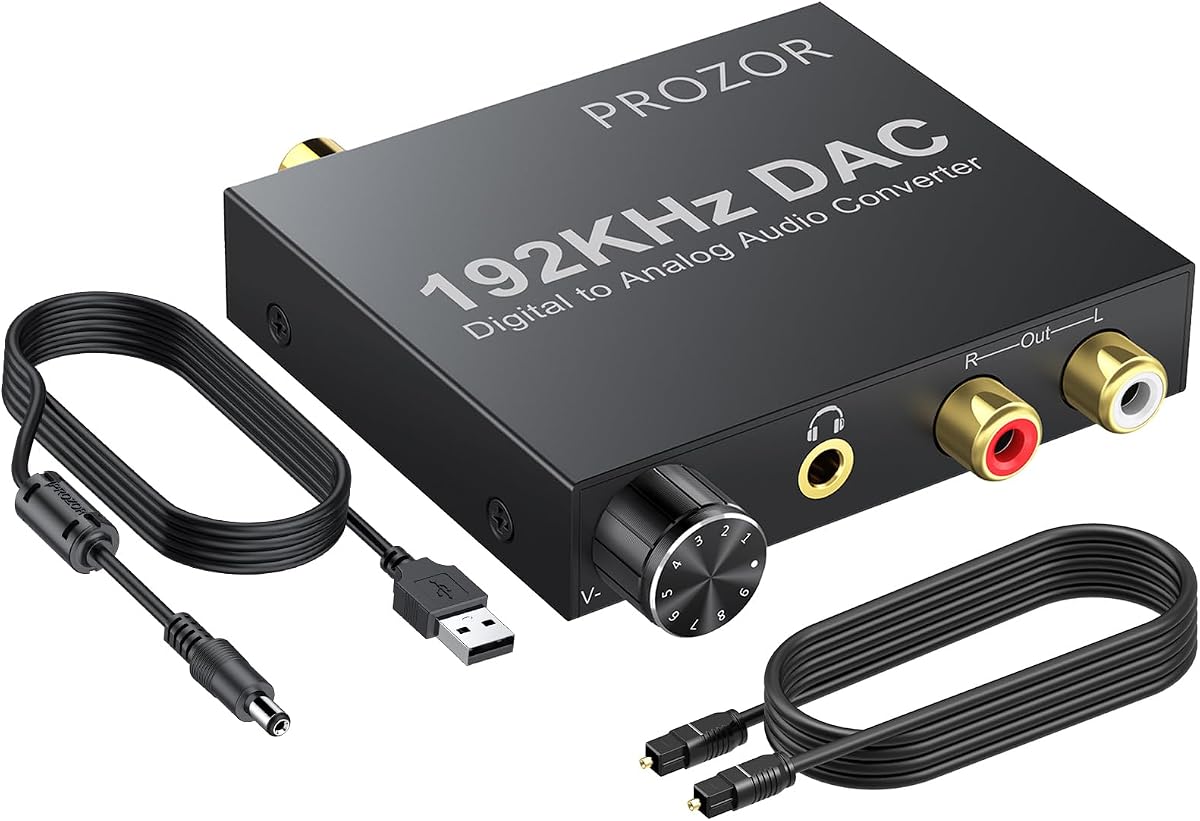
PROZOR 5.1CH Optical to RCA Converter
4.5Editor score
Dolby AC-3 decoding
DTS 5.1 input support
Adjustable analog output
Discover the best Toslink to RCA Converter options, comparing PCM support, 5.1 decoding, sample rates, outputs, build quality, and setup ease today.
A Toslink to RCA converter makes it possible to connect a modern television, game console, Blu-ray player, or set-top box with optical digital audio to an older amplifier or pair of speakers using analog RCA inputs. The right unit should provide clean stereo conversion, accept the digital formats used by your source, and offer connections that suit your setup.
This guide compares ten converters based on input and output options, supported audio formats, sampling rates, amplifier features, included cabling, housing design, and practical compatibility. It covers straightforward PCM converters as well as models that decode Dolby AC-3 or DTS 5.1 signals and units with manual output-volume control.
Each review highlights the strongest reason to consider a particular converter and also identifies limitations that could affect another buyer. The three featured selections represent our best overall, premium, and budget options. Product availability and prices can change, so readers should verify current specifications and offers before purchasing.
4.5Editor score

4.4Editor score

4.8Editor score
The comparison below highlights the most important differences among these converters, including digital input support, surround decoding, output flexibility, sampling capability, amplifier control, and installation convenience.


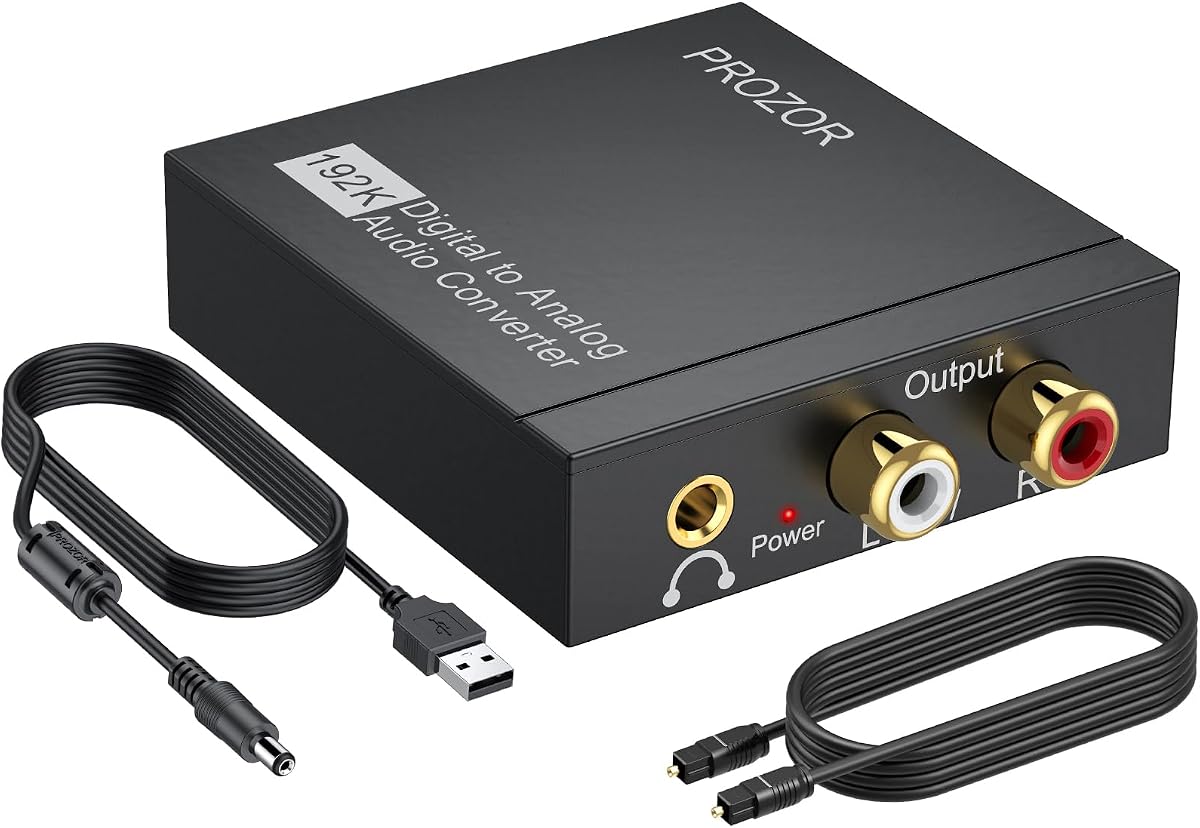


This PROZOR converter earns the Editor's Choice position because it balances broad connection support with a straightforward installation. It has a 4.4 rating and accepts both Toslink optical and coaxial digital input, then sends analog audio to left and right RCA jacks and a 3.5mm output simultaneously. That makes it a practical bridge between newer source components and older stereo equipment.
We may earn a commission when you buy through this link, at no additional cost to you.
The converter supports uncompressed two-channel PCM or LPCM, as well as sampling rates of 32KHz, 44.1KHz, 48KHz, 96KHz, and 192KHz. Its updated amplifier chipset and dual-channel operational amplifier are intended to improve clarity and reduce distortion, while the aluminum alloy housing offers better heat dissipation and electromagnetic shielding than typical plastic enclosures. Gold-plated RCA connectors and a detachable converter box add flexibility when arranging cables.
The main limitation is format support. It is designed for two-channel PCM rather than Dolby AC-3, DTS, or other 5.1 streams, so the source must be configured to output PCM or LPCM. A suitable 5V 1A power adapter is also needed because one is not included. In some television setups, volume adjustment must be performed in the TV menu rather than with the television remote.
This is the strongest all-around recommendation for someone who wants flexible outputs, reliable high-resolution PCM support, and a more substantial housing than the simplest stick-style converters. It is especially suitable for connecting a television to an older amplifier, provided the source can be changed to PCM and the user is comfortable supplying the required power adapter.
The combination of optical, coaxial, RCA, and 3.5mm connections gives this converter broad practical value. It can feed amplified speakers, an analog stereo receiver, or a wired headphone setup without requiring separate adapters.
The detachable box and aluminum housing are useful in entertainment centers where cable strain, heat buildup, and nearby electrical interference are concerns. The enclosure is designed for steady operation alongside other powered devices.
We may earn a commission when you buy through this link, at no additional cost to you.
This PROZOR model is a 4.4-rated converter designed for users who need more flexibility than a basic PCM-only adapter provides. It accepts digital optical and coaxial signals, including Dolby AC-3, DTS 5.1, LPCM, and PCM modes, while providing left and right RCA outputs plus a 3.5mm jack for headphones or other analog connections.
We may earn a commission when you buy through this link, at no additional cost to you.
Its most notable feature is surround-format handling. The converter decodes 5.1 digital input but outputs a 2.0-channel analog signal because traditional RCA and 3.5mm connections cannot preserve six separate channels. It supports sampling rates up to 192KHz and 24-bit SPDIF streams across the left and right channels. An adjusted amplifier chipset and magnetic-ring power cord are intended to promote stable, low-noise transmission.
The trade-off is that its extra format support does not create a true multichannel analog home theater system. The unit downmixes surround information into stereo, and actual channel balance depends on the incoming mix and decoding behavior. Buyers who only need ordinary PCM may find that simpler converters are easier to operate.
Choose this model when a television, console, or disc player commonly outputs Dolby or DTS and you want the converter to handle those streams instead of requiring a permanent change to PCM. It is most appropriate for someone connecting decoded surround content to a stereo amplifier, powered speakers, or headphones and accepting a downmixed result.
Support for AC-3, DTS, LPCM, and PCM reduces the chance that a source will remain silent because it is configured to send an unsupported surround stream. This makes the converter useful for mixed entertainment setups.
The magnetic-ring power cord is a worthwhile detail for installations near televisions, game systems, and audio equipment. It is intended to help maintain a cleaner power path and more consistent operation.
We may earn a commission when you buy through this link, at no additional cost to you.
This PROZOR converter offers a compact, cable-friendly alternative for users who want minimal setup. It has a 4.4 rating, accepts optical SPDIF audio, and provides an integrated RCA output cable. A 7-foot, 2.1-meter cable is identified in the product title, making it suitable for reaching a stereo amplifier or powered speakers without assembling several separate leads.
We may earn a commission when you buy through this link, at no additional cost to you.
A built-in audio amplifier chipset and dual-channel operational amplifier are designed to address the low RCA output level that can occur with some inexpensive digital-to-analog adapters. The unit supports 32KHz, 44.1KHz, 48KHz, 96KHz, and 192KHz sampling rates, along with 24-bit SPDIF streams. It works with HD televisions, set-top boxes, DVD and Blu-ray players, and compatible game consoles.
Its primary limitation is format rigidity. It does not support 5.1 signals such as Dolby AC-3, so the source must be set to PCM or LPCM. The integrated RCA cable is also non-pluggable, which makes replacement less convenient if the lead is damaged or if a different cable length is required. A certified 5V 1A wall adapter is recommended for stable operation.
This is a strong option for a simple television-to-stereo-system connection, especially when minimal visible cable clutter matters. It also suits listeners who find ordinary converter output too quiet and need amplification, provided they can set the source to two-channel PCM.
The integrated RCA output keeps the installation visually clean and reduces the chance of a loose connection. Its stated 7-foot length also gives users more freedom in placing the converter near the source or destination.
The integrated chipset is specifically intended to improve output level and clarity. It is especially relevant when driving analog speakers through an amplifier with a modest input gain.
We may earn a commission when you buy through this link, at no additional cost to you.
The LiNKFOR Digital Optical SPDIF Toslink to Analog RCA DAC Converter is a direct solution for connecting an optical source to legacy analog speakers. It carries a 4.3 rating and includes an integrated 1.1-meter, 3.6-foot RCA cable, reducing installation time and avoiding the need for a separate male-to-male RCA lead.
We may earn a commission when you buy through this link, at no additional cost to you.
The converter's built-in audio amplifier chip is designed to raise the RCA output level and produce a clearer signal. It handles sampling rates of 32KHz, 44.1KHz, 48KHz, 96KHz, and 192KHz, with 24-bit SPDIF input for the left and right channels. Compatibility extends to HD televisions, set-top boxes, DVD and Blu-ray players, and game consoles.
Users must set the digital output to PCM or LPCM because the converter is not compatible with Dolby AC-3, DTS, or other 5.1-channel signals. It needs 5V 1A USB power, and there is no manual volume control. As a result, the television's output menu or the downstream amplifier must handle level adjustment.
This converter makes the most sense for a basic stereo connection where source compatibility is already under the user's control. Its integrated cable and compact body simplify the setup, while the amplifier chip helps compensate for low output. It is a practical alternative for anyone who does not need surround decoding or adjustable analog gain.
The small body is useful behind a television or beside a compact amplifier. Because the RCA lead is already attached, installation is reduced to plugging in the optical cable, connecting the RCA outputs, and applying power.
Support for the common set of sampling rates and 24-bit streams makes the converter appropriate for many modern television and media-source configurations, provided those devices are set to send compatible PCM audio.
We may earn a commission when you buy through this link, at no additional cost to you.
This PROZOR converter combines broad input selection with both RCA and 3.5mm analog outputs. Its 4.4 rating reflects a generally well-received product, and its main appeal is flexibility: Toslink and coaxial digital signals can be converted to left and right RCA or sent to a 3.5mm headphone connection.
We may earn a commission when you buy through this link, at no additional cost to you.
The unit supports uncompressed two-channel LPCM and PCM audio at sampling rates of 32KHz, 44.1KHz, 48KHz, 96KHz, and 192KHz. A professional audio amplifier chipset is included to improve output level, and the converter offers gold-plated RCA connectors. Its USB power cable includes a ferrite core intended to limit electromagnetic and radio-frequency interference.
As with other basic PCM converters, it cannot decode Dolby AC-3, DTS, or 5.1 audio. The source therefore needs to be changed to PCM or LPCM. The 5.5mm USB power lead requires a 5V 1A plug, which is not included, and volume changes made with a television remote may not affect the optical signal unless the television offers that control.
This product is well suited to listeners who want to feed several kinds of analog equipment from one converter. It works particularly well for a television connected to both powered speakers and headphones, although only one output needs to be active at a time. Choose it for broad PCM support and connector flexibility rather than surround decoding.
The simultaneous RCA and 3.5mm outputs make the converter useful for comparing a headphone setup with a stereo amplifier or moving between listening configurations without changing converters.
Gold-plated RCA contacts and a ferrite-core USB lead are intended to preserve signal quality and reduce interference. These details are particularly useful in crowded entertainment centers where several powered devices operate together.
We may earn a commission when you buy through this link, at no additional cost to you.
The YGiTK 192KHz DAC Converter is a 4.5-rated option focused on straightforward optical-to-RCA conversion. Its small, lightweight body is easy to position around a television or amplifier, and the included digital audio optical cable helps with initial setup.
We may earn a commission when you buy through this link, at no additional cost to you.
An integrated amplification chipset raises the RCA output level for better compatibility with analog stereo equipment. The converter supports optical sample rates of 32KHz, 44.1KHz, 48KHz, 96KHz, and 192KHz, along with 24-bit streams. It is designed for HD televisions, set-top boxes, DVD and Blu-ray players, and game consoles, making it a broadly useful source bridge.
The television or other source must be set to optical output and PCM mode. Dolby AC-3 and other 5.1-channel signals are not supported, and there is no onboard volume adjustment. Users must control output level through the source device or the connected amplifier.
This converter is a good option for a first optical-to-RCA installation, particularly when a small footprint and a straightforward set of supported functions are priorities. It is less suitable for users who need surround decoding, a 3.5mm output, coaxial input, or manual analog volume control, but for compatible stereo PCM equipment it provides a clear and easy path.
The converter's compact enclosure avoids occupying the visual space associated with larger audio components. That makes it easy to conceal behind a television or place near a small set of powered speakers.
The built-in amplification stage addresses the sometimes-low output level associated with simple optical adapters. It improves compatibility with amplifiers that have limited input gain, although final level control still occurs elsewhere.
We may earn a commission when you buy through this link, at no additional cost to you.
The PROZOR volume-adjustable DAC stands out from simple stick converters because it includes a physical output-level control. It has a 4.4 rating, accepts Toslink and coaxial digital audio, and provides simultaneous left and right RCA plus 3.5mm analog outputs.
We may earn a commission when you buy through this link, at no additional cost to you.
The built-in knob is valuable when a television's optical output has a fixed or inconvenient volume level. It can also help optimize the signal sent to an amplifier with its own gain setting. The converter supports 32KHz, 44.1KHz, 48KHz, 96KHz, and 192KHz sampling rates, with 24-bit SPDIF streams across both channels.
Its aluminum metal shell is designed to resist heat and provide a durable enclosure. Gold-plated input and output interfaces are intended to reduce signal-transmission loss, and a one-meter optical cable is included. The unit still requires a 5V 1A USB power source, and its input direction cannot be reversed.
This is the preferred choice when direct analog volume control is the deciding factor. It is particularly useful with older amplifiers that lack convenient source-level adjustment. It remains a PCM converter rather than a surround decoder, so users should not choose it for Dolby AC-3 or DTS 5.1 content unless the source can be changed to a compatible format.
A front-panel knob provides a direct way to raise or lower the analog signal. This is more reliable than depending exclusively on television menus, which may not affect the optical output.
The aluminum housing and plated interfaces give the converter a more substantial feel. They also serve practical purposes involving heat resistance, shielding, and connection longevity.
We may earn a commission when you buy through this link, at no additional cost to you.
The Musou RCA Analog to Digital Optical Toslink Coaxial Audio Converter is included because it solves the opposite conversion problem from most entries in this guide. It takes a stereo RCA analog input and produces digital coaxial and Toslink optical output simultaneously. Its 4.1 rating makes it the lowest-rated product here, but its directionality remains useful for a specific setup.
We may earn a commission when you buy through this link, at no additional cost to you.
The converter supports uncompressed two-channel LPCM digital output and operates at a 48KHz output sampling rate. It includes an optical cable and is designed for straightforward installation with a one-year manufacturer warranty. Simultaneous coaxial and optical outputs make it possible to feed different components from one analog source.
Its limitations are significant for anyone seeking an optical-to-RCA bridge. The signal flow cannot be reversed, the output sampling rate is fixed at 48KHz, and the analog source does not support Dolby audio. The final digital stream contains only two channels rather than a multichannel mix.
This product is appropriate for someone with an older amplifier or tape-era component that has only RCA output but needs to connect to a newer television, soundbar, or digital speaker. It should not be selected for the common task of connecting optical output to analog speakers. Its specialized direction makes it a useful supplement rather than a primary recommendation for this category.
Older amplifiers, CD players, and other stereo components often lack modern digital outputs. This adapter lets those sources feed compatible contemporary audio equipment without replacing the original component.
Providing both coaxial and Toslink outputs increases compatibility with a wide range of receivers and speaker systems. A single analog source can feed whichever digital connection is more convenient at the destination.
We may earn a commission when you buy through this link, at no additional cost to you.
The PROZOR 5.1 Decoder DAC is the premium selection in this guide because it combines broad digital-input support with automatic surround decoding and manual analog-level adjustment. It has a 4.5 rating and accepts optical, SPDIF, and coaxial signals carrying Dolby AC-3, DTS 5.1, or PCM 2.0 audio.
We may earn a commission when you buy through this link, at no additional cost to you.
The converter sends the decoded content to left and right RCA outputs and a 3.5mm jack. A physical knob adjusts both analog output paths at the same time, giving users more control than a basic PCM adapter. Its 192KHz, 24-bit capability and high-performance converter chip are designed to preserve clarity while handling compressed surround formats.
The essential caveat is that the output remains stereo. Surround information is downmixed because RCA and 3.5mm connections cannot carry six discrete analog channels. The volume knob also controls RCA and 3.5mm output together rather than allowing independent levels. The signal direction is one-way and does not support optical output.
This is the most capable choice for someone whose television or console sends Dolby or DTS by default and who wants to avoid continually changing the source to PCM. It is well suited to a stereo amplifier, powered speakers, or headphones, as long as the buyer understands that the result is a downmixed 2.0 presentation.
The automatic conversion of AC-3 and DTS streams removes a common setup obstacle. Users no longer need to enter television or console menus every time they want to use the analog stereo system.
The physical volume knob and broad input selection make the converter easier to integrate into a serious analog audio setup. It can serve both amplified speakers and headphones while accepting several types of digital sources.
We may earn a commission when you buy through this link, at no additional cost to you.
The LiNKFOR 192kHz DAC Converter earns the Best Budget designation because it combines a 4.8 rating with a simple, compact design and broad PCM compatibility. It converts optical Toslink audio from a television or other source into analog left and right RCA output, allowing newer digital equipment to work with older speakers or amplifiers.
We may earn a commission when you buy through this link, at no additional cost to you.
Its built-in audio amplifier chip is designed to increase RCA output level and improve clarity. The converter supports 32KHz, 44.1KHz, 48KHz, 96KHz, and 192KHz sampling rates with 24-bit SPDIF input. The product title identifies a six-foot, 1.8-meter optical cable, while the compact body includes a 1.1-meter, 3.6-foot RCA cable for convenient installation.
It is a PCM-only converter and will not accept Dolby AC-3, DTS, or other 5.1-channel signals. Users must configure the source to output digital PCM or LPCM and control volume through the source or downstream amplifier. A 5V 1A USB cable supplies power.
This is a strong budget-oriented recommendation for a uncomplicated television-to-stereo connection. The long included optical cable gives users room to position the source and speakers without immediately buying another lead, while the integrated RCA lead minimizes setup friction. It is best for PCM users who do not need surround decoding or onboard volume adjustment.
The six-foot optical cable provides useful placement flexibility around furniture, wall-mounted televisions, and amplifier shelves. It also makes the package more self-contained for a new installation.
The integrated RCA lead and small converter body keep the setup tidy. Once the source is changed to PCM, connecting the optical, RCA, and power leads is all that is required.
We may earn a commission when you buy through this link, at no additional cost to you.
The most important choice is whether the converter must decode surround formats or only handle two-channel PCM. Beyond that, buyers should consider output connections, volume control, sampling support, cable arrangement, power requirements, and the condition of the equipment they intend to connect.
Choose PCM-only for the simplest and most stable stereo setup, or choose decoding support when changing source settings is inconvenient.
Prioritize a stereo RCA pair, and treat coaxial input or a 3.5mm output as useful additions when your existing equipment needs them.
Choose a knob when the television cannot control optical volume, and look for amplification when the intended amplifier has low input gain.
Look for 192KHz and 24-bit support when connecting modern media equipment, but ensure the source can emit a compatible PCM stream.
Choose attached cables for minimal setup and detachable connectors for flexible routing, then ensure the supplied length reaches both components.
Use a dependable 5V 1A adapter and confirm that the source is set to PCM or LPCM for the cleanest result.
Confirm the source has a working optical output and the destination accepts stereo RCA before purchasing.
Verify that the device is labeled digital-to-analog; the Musou exception in this guide is intentionally reverse-direction.
Begin by identifying the source and destination. Connect the source's optical output to the converter's Toslink input, then connect the converter's left and right RCA outputs to matching inputs on the amplifier, powered speakers, or sound system. If the converter has a 3.5mm output, it can feed compatible headphones or compact speakers. Connect the specified USB power lead only after the audio paths are secure.
On the source device, select optical or SPDIF audio output and change the digital format to PCM or LPCM. If a surround-capable converter is used, AC-3 or DTS may also be accepted, but the analog result will be stereo. Check the television's advanced sound settings for digital output volume. If the remote's volume buttons have no effect, adjust the source menu or use the converter's physical knob if one is present.
For care, keep the optical plug clean and avoid bending the fiber cable sharply near its connector. Route RCA and USB leads away from interference sources, provide ventilation around a box-style converter, and use the specified 5V 1A power supply. If there is no sound, verify the selected source input, output format, cable connections, and power indicator before changing any other settings.
The most common cause is an incompatible digital output format. Set the television or source device to PCM or LPCM rather than Dolby AC-3, DTS, or another encoded surround mode. Also confirm that the optical cable is connected to the correct port, the source is switched to optical output, and the converter's power light is on. Some televisions also need their digital output volume raised in the advanced sound menu.
Only if your source sends Dolby AC-3 or DTS audio and you do not want to change that setting. A basic PCM converter may remain silent with those encoded streams, while a decoding model can convert them to stereo. Remember that RCA and 3.5mm outputs carry two channels, so a 5.1-capable converter downmixes the surround mix rather than preserving six separate channels.
Its main purpose is compatibility rather than a guaranteed audible upgrade. A good converter can provide a stable analog signal and sufficient output level for an external amplifier or speakers. Actual sound quality also depends on the source, the quality of the digital stream, the cables, the amplifier, and the speakers. Using a converter does not create lossless analog audio from a compressed source.
No. It means the converter can accept digital input at those sampling rates, including 192KHz, rather than that it creates a native 192KHz analog recording. The television, game console, player, and content must all support the relevant format, and many home-theater sources still output 48KHz PCM in ordinary use.
The television remote may not control the volume of a digital optical output, especially on older models or certain home-theater configurations. A converter knob directly adjusts the analog output level, allowing it to be matched to an external amplifier. A physical knob is therefore useful when the source menu offers no reliable output-volume control.
Yes, but only if the selected model includes a 3.5mm output. Products with RCA-only outputs require a separate 3.5mm-to-RCA breakout or appropriate adapter, with correct left and right channel mapping. A converter with an integrated amplifier chip or volume knob generally offers more practical control over headphone level.
A dedicated certified 5V 1A USB power adapter is generally the safer choice. Some television USB ports may provide unstable power, particularly when the television is switched off, and this can contribute to noise, delay, or intermittent operation. Follow the converter's specified voltage and current requirements and use the connector type it calls for.
Both carry digital audio, but optical uses light through a Toslink connector while coaxial uses an electrical connection through an RCA-style socket. A converter with both inputs can accept either source connection. The selected input must correspond to the cable connected, and the source's output format still needs to be compatible with the converter's decoding capability.
The PROZOR 192KHz DAC Converter is the best overall choice because it combines optical and coaxial inputs, RCA and 3.5mm outputs, multiple sampling rates, and a durable aluminum housing. The PROZOR 5.1 Decoder DAC is the premium option for Dolby AC-3 and DTS sources, while the LiNKFOR 6ft DAC Converter delivers the strongest budget package for straightforward PCM use.
Most buyers should prioritize correct format support, the output connections they actually need, dependable power, and a cable arrangement that suits their room. A manual volume knob matters when a television cannot control optical output, while 5.1 decoding matters when the source remains on encoded surround audio. Integrated cables and compact bodies are useful when simplicity and neatness matter most.
Before buying, confirm that the converter sends digital audio to analog RCA output, rather than performing the reverse conversion. Check the source settings, required power specification, and whether the included cables reach the intended equipment. Prices and product details can change, so compare current offers and verify the latest compatibility information before making a final purchase.