
PONNOR AL-12
4.8Editor score
Dual UV and backlight
Full-size inspection panel
USB and rechargeable power
Smart automatic sleep
Broad document compatibility
A counterfeit bill detector machine helps cash handlers identify suspicious currency through features such as ultraviolet markings, magnetic ink, infrared signals, watermarks, size checks, and document inspection. The right machine depends on how often you accept cash, which currencies you handle, and how much workflow disruption you can tolerate.
We compared all 10 featured machines by authentication methods, supported currency, screening speed, bill orientation, portability, displays, power options, and practical countertop use. The guide includes automatic feeders, compact UV inspection stations, multi-function tools, and portable models rather than treating every detector as the same type of device.
Each review explains the strongest reasons to consider a particular model, along with its practical limitations and ideal setting. Ratings and product details reflect the supplied information, while availability, features, and pricing can change, so readers should confirm the current listing before purchasing.
4.8Editor score

4.0Editor score

4.2Editor score
As an Amazon Associate we earn from qualifying purchases.
The comparison covers automatic counterfeit detectors, portable UV inspection stations, multi-test readers, and document verifiers, with each model evaluated against the capabilities that matter most in real cash-handling environments.




The Kolibri KCD-1000 combines ultraviolet, magnetic, infrared, size, and double-note detection in a portable automatic reader. Its 4.2 rating reflects a capable machine for US currency, and the most appealing feature is the combination of several verification methods without requiring the operator to learn a pen-based testing routine.
We may earn a commission when you buy through this link, at no additional cost to you.
Four-way orientation means cashiers do not have to straighten or rotate every bill before feeding it into the unit. The simple pass or fail indicator communicates the result directly, while the stated checking time of less than two seconds suits retailers, market vendors, and other settings where cash volume makes speed important. The field-tested accuracy claim is qualified by results varying according to currency and condition.
The primary limitation is currency scope. This model reads only US currency, so a business accepting euros, Canadian dollars, Mexican pesos, pounds, or other notes needs a more flexible detector. It also depends on a power source rather than offering the cordless convenience of some rechargeable models. Those constraints are reasonable for US-focused operations but may narrow its appeal elsewhere.
We recommend the KCD-1000 for businesses that want a fast, automatic, multipurpose reader and primarily handle US bills. It offers a strong balance of detection coverage, operating simplicity, and portability, making it the most complete all-around choice in this group.
Using UV, magnetic, infrared, size, and double-note sensors allows the machine to examine more than one characteristic during each pass. This reduces the need to move a bill among several separate tools and keeps the verification process focused.
Four-way bill orientation reduces preparation at the register, and the stated sub-two-second verification time supports quick customer transactions. The straightforward pass or fail display also makes the unit approachable for staff with limited counterfeit-detection experience.
We may earn a commission when you buy through this link, at no additional cost to you.
The Cassida InstaCheck is a compact automatic counterfeit detector designed for fast, conclusive bill checks. Its 4.0 rating is supported by a simple operational proposition: feed a bill, wait for a clear pass or fail indication, and move on with the transaction. It suits cashiers who need dependable throughput without complicated controls.
We may earn a commission when you buy through this link, at no additional cost to you.
The machine scans against infrared, magnetic, and ultraviolet marking information. Its compact and lightweight enclosure is particularly useful where counter space is constrained, such as small retail registers, service counters, offices, or temporary cash-handling stations. A one-year warranty and US-based support add practical reassurance for business buyers.
This is a focused authentication tool rather than a cash-counting or value-management system. It does not offer the denomination totals, historical records, or display flexibility found in models such as the Aneken AL-139 or PONNOR AL-135T. It also appears intended for wired operation, which is less convenient at mobile or temporary stalls.
The InstaCheck is a strong choice for a small business that wants a simple automatic answer in less than a second. Its compact footprint, quick result, and three detection categories make it a dependable counter companion, though users who also need totals, multiple currencies, or cordless flexibility should look farther down the list.
The prominent pass or fail indication eliminates guesswork for operators. Because the result is designed to be conclusive, a cashier can keep the customer flow moving without comparing the bill against a separate reference chart.
The stated dimensions and lightweight construction make the InstaCheck easy to accommodate on a crowded counter. Its automatic feed also provides a more consistent process than a handheld pen when multiple notes need to be screened.
We may earn a commission when you buy through this link, at no additional cost to you.
The Aneken AL-17 is a portable ultraviolet inspection station for banknotes, identity documents, and payment cards. Its 4.6 rating is among the strongest in this roundup, while the combination of a UV LED and a four-leaf-clover watermark backlight gives users two ways to examine a note's security features.
We may earn a commission when you buy through this link, at no additional cost to you.
A sensor-equipped detection table starts the inspection when a banknote is placed on it and returns to a dormant state when the table is empty. The product information says this energy-saving behavior can extend equipment life by more than three times. The bright UV illumination is also designed to reveal security features in fluorescent light, sunlight, or other distracting conditions.
Unlike automatic feeders, the AL-17 requires the operator to place and visually inspect the note. Its US currency guide focuses on five denominations, which helps users know where to look, although the broader currency claims concern general security-feature inspection rather than a complete automatic pass or fail decision for every currency. The watermark backlight and UV system are most useful when a trained eye compares the visible result with an authentic reference.
This detector is best for owners, market vendors, travelers, and small businesses that need a flexible inspection lamp rather than a wired automatic reader. It can check several types of currency and documents, but users who want an automatic authenticity decision, denomination totals, or traceable records should choose a powered-feeder model.
Ultraviolet illumination exposes hidden markings, while the dedicated watermark backlight reveals embedded patterns in a different way. Using both areas provides a more complete visual inspection than a pen or a single small UV lamp.
The inspection surface can also be used with passports, identification cards, credit cards, and other secure documents. That makes the AL-17 useful for retail, travel, offices, and situations where more than one kind of security item must be examined.
We may earn a commission when you buy through this link, at no additional cost to you.
The PONNOR AL-135T stands out by combining denomination and total-value functions with a dedicated pass or fail authentication mode. Its 4.4 rating reflects a versatile feature set, and the 3-inch digital display gives users more information than a simple indicator light while remaining straightforward to operate.
We may earn a commission when you buy through this link, at no additional cost to you.
The machine can be switched between a mode that identifies denominations and accumulates value and a faster mode intended to provide a pass or fail result. Its four-way feed orientation and adjustable inward or outward exit adapt to different counter layouts. A 500 mAh rechargeable battery also allows cordless use, while the plug-in option suits fixed locations.
Currency support covers USD, EUR, CAD, and MXN, which is broader than several US-only readers. However, the list is still limited compared with devices that can be programmed for more currencies. The product description also refers to up to 10 advanced authentication checks but does not identify each one in the supplied information, so buyers should not assume every advertised internal method is independently documented in the listing.
The AL-135T is a strong option for restaurants, retailers, and market stalls that want a value counter and counterfeit screening in one device. It is especially appealing when accepting several of the four listed currencies and needing mobile operation without giving up the option to use a wired power connection.
Value and denomination tracking can support end-of-batch reconciliation, while pass or fail mode offers a faster screening workflow. Keeping both functions in one machine reduces the need for separate counting and authentication equipment.
The built-in rechargeable battery supports cordless use at stalls, tables, or temporary counters, while plug-in operation fits permanent checkout stations. Four-way feeding and a selectable exit direction help the device work around different layouts.
We may earn a commission when you buy through this link, at no additional cost to you.
The PONNOR AL-135 is an automatic US currency reader that emphasizes straightforward operation and cordless flexibility. Its 4.2 rating reflects a capable multipurpose detector, while the checkmark and cross display gives staff an immediate indication of whether a bill has passed.
We may earn a commission when you buy through this link, at no additional cost to you.
Detection combines ultraviolet, magnetic, infrared, size, and double-note sensing. That range provides more ways to flag inconsistencies than a simple UV lamp or magnetic pen. Four-way orientation lets operators insert a note in any direction, and the adjustable output chute makes it possible to direct accepted bills toward either side of the machine.
Its 500 mAh rechargeable battery means the detector can be used away from a wall outlet, which is useful at market stalls, mobile checkout counters, or event booths. The anti-jam limiter is another practical feature for a device expected to process a steady stream of bills. US currency is the only supported currency in the supplied information.
The AL-135 is best for US-only operations that want automatic authentication without a display complex enough to distract cashiers. It lacks the value tracking and multiple currencies of the AL-135T, but it offers a lighter feature set, a highly visible result, and the convenience of cordless operation.
A checkmark for genuine notes and a cross for suspected counterfeit bills is immediately understandable. This simple visual language makes the model suitable for employees who may not have extensive counterfeit-detection training.
The rechargeable battery and adjustable output chute make the unit adaptable to different workspaces. It can be positioned where customer transactions occur without requiring a nearby outlet or forcing notes to eject in one fixed direction.
We may earn a commission when you buy through this link, at no additional cost to you.
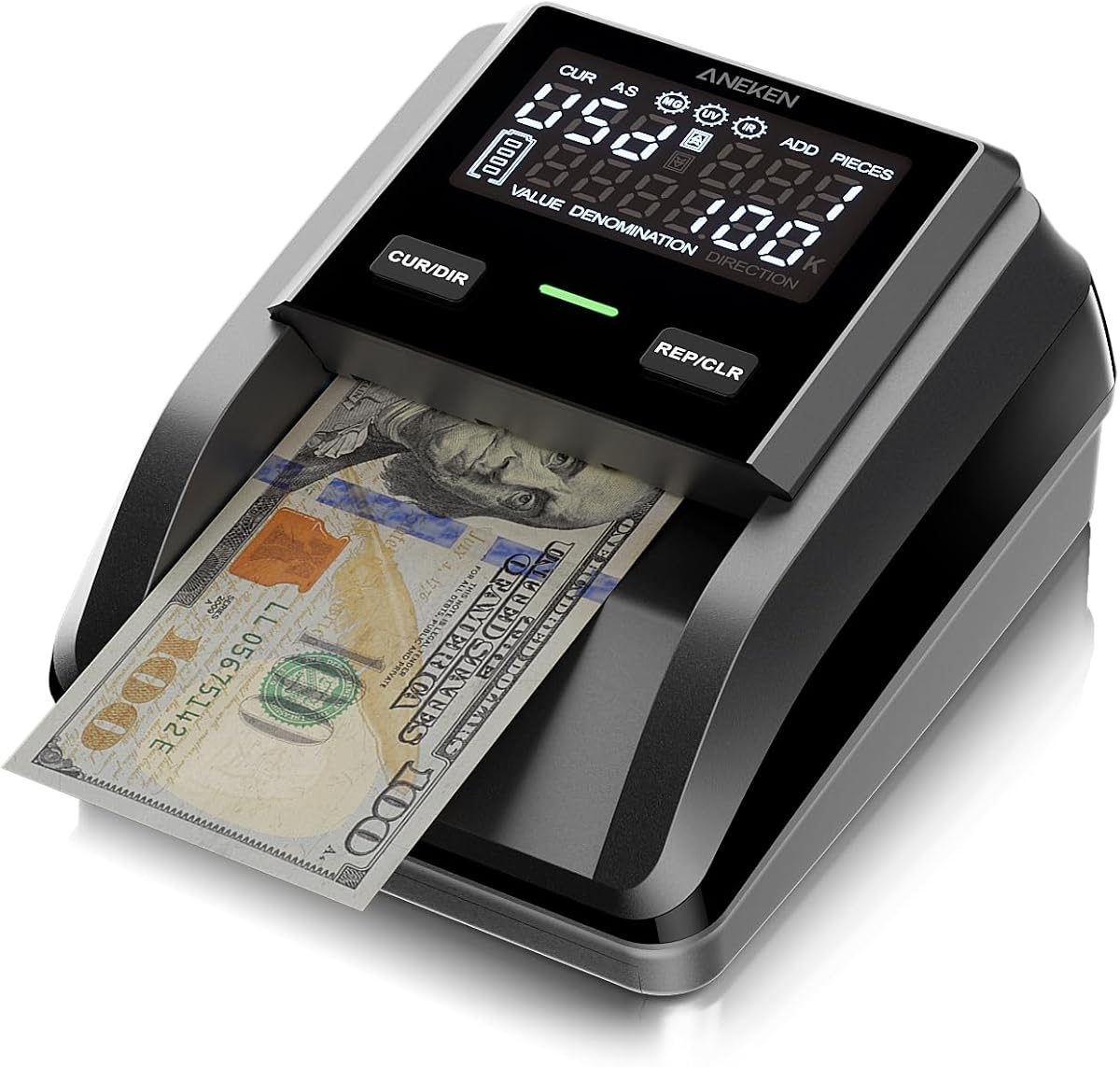
The Aneken AL-139 combines counterfeit detection, denomination counting, and traceable records in a compact automatic machine. Its 4.2 rating reflects a useful balance of transaction speed and information, and the 2.8-inch digital screen gives the user more visibility than a basic pass or fail lamp.
We may earn a commission when you buy through this link, at no additional cost to you.
The device uses UV, magnetic, infrared, and image detection, accepts bills in four orientations, and can identify a bill in approximately 0.5 seconds. It displays total value and the number of detected notes, while the records function lets users review different denominations and their quantities. These features make it more suitable for batch reconciliation than a simple authentication-only reader.
Currency flexibility requires a caveat. US dollars and euros are preinstalled, while other supported currencies require the manufacturer to upgrade the program before use. It weighs 1.3 pounds, helping with portability, and its compact design should fit many service counters. A buyer handling another currency should confirm availability of the upgrade rather than assume it is immediately ready.
The AL-139 is a compelling choice for multi-currency businesses that also want totals and a record of processed bills. It is more capable than a UV inspection lamp and more informative than a basic pass or fail feeder, making it well suited to small retail operations, offices, and market vendors with moderate cash volume.
The screen shows the total value and number of detected banknotes, reducing the need to count a batch manually. Recorded denomination and quantity information can also help staff reconcile a till at the end of a shift.
The machine starts with US dollar and euro support, and the supplied information says other currencies can be enabled through a program upgrade. This creates a path for growing operations while requiring an extra verification step before purchase.
We may earn a commission when you buy through this link, at no additional cost to you.
The Aneken AL-18 is a portable inspection kit that brings together UV light, watermark viewing, magnetic ink detection, magnification, ordinary LED lighting, and size checks. Its 4.5 rating is strong, and the range of tests makes it useful for owners and operators who want more than a single-purpose UV lamp.
We may earn a commission when you buy through this link, at no additional cost to you.
Two 2800-lumen UV lights cover the bill and are designed to reveal hidden security threads. An 18 by 7 centimeter backlit platform helps users inspect watermarks, while built-in measurement scales assist with size and placement checks. The magnetic detector head provides audible and green-light feedback when rubbed over the magnetic ink area, making it particularly useful for US notes.
Five-times and ten-times magnifiers support detailed checks of bills, checks, invoices, passports, and other documents. The smart infrared sensor wakes the unit when a bill is present and puts it to sleep after 30 seconds of inactivity, which the product information says can triple LED life compared with a standard counterfeit bill light.
The AL-18 is most appropriate for a small business or individual who prefers direct control over the inspection process. It can handle multiple currencies and cards, but it does not make automatic pass or fail decisions, and its numerous physical features make it larger and more involved than a simple counterfeit pen.
A suspicious note can be evaluated from several angles using ultraviolet light, the watermark panel, the magnetic sensor, magnification, and physical dimensions. A cross-check is often more informative than depending on one visible feature alone.
The 5x and 10x lenses make the device useful beyond banknotes. They can help users examine fine printing, security marks, identification documents, checks, and invoices without purchasing several separate optical tools.
We may earn a commission when you buy through this link, at no additional cost to you.
The PONNOR AL-12 is a compact visual detector that combines an ultraviolet LED with a full-size white-light backlight. It carries the highest rating in this roundup at 4.8, and its two-stage inspection method makes it an accessible option for businesses seeking more capability than a counterfeit pen.
We may earn a commission when you buy through this link, at no additional cost to you.
The white-light panel measures 6.5 by 2.8 inches, matching US bill dimensions so watermarks can be viewed without precise alignment. Integrated rulers help with size and placement checks, while US security-strip guide lines indicate where important features should appear. High-intensity UV illumination is designed to remain useful in fluorescent, natural, or low-light surroundings.
An infrared sensor powers the unit when a bill is placed and puts it to sleep after 20 seconds without activity. The product information says this can triple LED lifespan. USB power and a built-in rechargeable battery provide flexible options, although the device remains a manual inspection station rather than an automatic feeder with a pass or fail decision.
The AL-12 is a compelling budget-oriented choice for a cash register, office, market table, or travel kit. It can inspect US dollars from $5 through $100, euros, CAD, MXN, GBP, RMB, INR, and other currency, along with passports, identification cards, and credit cards. Users who want automatic results should instead consider one of the powered-feed models.
The edge-to-edge backlit panel allows a note to lie flat without being carefully centered. Integrated measurement guides make it easier to compare the watermark's location and dimensions with the expected position.
The automatic infrared activation removes the need to switch the unit on manually for every note. Entering sleep after inactivity helps conserve the LEDs, which is especially useful for mobile or intermittently used setups.
We may earn a commission when you buy through this link, at no additional cost to you.
The Dri Mark Flash Test is a compact manual counterfeit detector built around three familiar checks: watermark, ink, and security strip. Its 4.4 rating reflects a well-regarded option for retailers that need a small, dependable inspection tool beside the register without investing in an automatic feeder.
We may earn a commission when you buy through this link, at no additional cost to you.
The user holds a bill over the lighted panel to inspect its watermark, passes the front over the ink sensor, and places it beneath the UV light to locate the security strip. These familiar steps make the product approachable, and the stated goal of completing a full three-part check in less than a second supports efficient customer service.
The device is smaller than a smartphone, includes an AC power plug and USB cord, and does not require batteries. A sensor automatically switches the UV function for one-handed operation, while the construction is described as rugged and maintenance free. It was initially developed for high-traffic 7-11 stores, where a compact tool could serve several registers.
The Flash Test is best for cashiers who want direct visual control and a familiar three-step routine. It does not automatically judge a note or count its value, and it may be less convenient for a business accepting many currencies with different security structures. It remains a focused, space-efficient tool for everyday counter screening.
Watermark, ink, and security-strip checks cover several security layers while keeping the process easy to learn. Staff can move quickly through the same sequence for every questionable note.
No batteries, bulb replacements, or routine maintenance are required, and the unit can sit close to a cash register without taking up much room. Automatic sensor switching further reduces the number of steps during an inspection.
We may earn a commission when you buy through this link, at no additional cost to you.
The K410 is a portable ultraviolet verifier for checking banknotes, passports, credit cards, and identification documents. Its 4.6 rating is among the highest in the group, and the combination of a high-intensity LED, smart activation sensor, and US currency guide makes it a focused tool for visual security inspection.
We may earn a commission when you buy through this link, at no additional cost to you.
The smart sensor activates the industrial-grade UV LED when the user brings a bill or document close, allowing quick repeated checks without operating a switch. An integrated US currency ruler helps indicate whether the UV marks appear in the correct area. The included guide covers the $5, $10, $20, $50, and $100 denominations and explains what markings to look for.
One micro USB cable supports four charging methods: a main socket, vehicle, computer, or power bank. This gives the K410 exceptional mobility for owners who inspect money away from a fixed counter. It does not automatically make a pass or fail determination, however, and it has no feeder, total display, or automatic value counting.
The K410 is best for a business, traveler, or property manager who wants a bright UV verifier for multiple document types. It is less appropriate for a high-volume register that needs automatic decisions and totals, but its simple activation, detailed guide, and flexible charging make it a dependable portable inspection tool.
The built-in ruler and denomination-specific guide reduce uncertainty about where UV marks should appear. This is particularly valuable for operators who know the UV principle but need a quick visual reference during each check.
Charging from a wall outlet, vehicle, computer, or power bank makes the K410 adaptable to mobile work. A single included micro USB cable supports all four approaches, simplifying packing for travel or off-counter use.
We may earn a commission when you buy through this link, at no additional cost to you.
The right detector depends on cash volume, currency mix, staff experience, and whether you need a quick visual inspection or an automatic verification result. These factors help separate a simple inspection lamp from a full-featured automatic counterfeit reader.
Automatic counterfeit bill detector machines feed notes through internal sensors and return a clear result, making them more suitable for busy retail counters, restaurants, and other high-volume environments. Manual UV stations place the bill on a backlit platform or hold it under a lamp, allowing the operator to inspect security strips, watermarks, magnetic ink, and dimensions directly. The automatic format demands less visual knowledge and creates a more consistent workflow, while the manual format tends to offer more visible detail and greater flexibility for examining documents.
Choose an automatic feeder when speed, repeatability, and straightforward staff operation matter most. Choose a manual inspection tool when you need broad document compatibility, detailed visual review, or a compact setup without a fixed power connection.
A credible detector should examine more than one characteristic. Ultraviolet light reveals fluorescent markings, magnetic detection identifies magnetic ink, and infrared sensors can detect features not visible to the naked eye. Some machines add size and double-note sensing, image analysis, watermark viewing, ordinary LED lighting, and magnification. The number of technologies matters less than whether they are integrated into a usable process and appropriately support the currencies you accept.
Look for a combination that includes the security features of your currency. For frequent operational use, multiple automatic sensors and a clear result are particularly useful; for occasional inspection, a UV and watermark platform may be sufficient.
Currency compatibility is one of the most important filters. Some featured units read only US currency, while others accept several currencies or offer upgradeable software. Advertising that a device can inspect foreign notes does not always mean it can authenticate them automatically, so buyers should distinguish manual security-feature viewing from a machine-supported pass or fail decision. A business with a mixed cash flow may need USD, EUR, CAD, and MXN, while an international operation may require pound sterling, renminbi, Indian rupee, or additional programming.
Confirm that the listed currency is supported in the exact mode you need. If an upgrade is required, verify its availability and process before purchase rather than assuming it is included.
High-volume operations benefit from fast results, ideally about one second or less. Four-way orientation is another important convenience because it removes the need to turn every note before insertion. Automatic devices may also offer a jam-resistant limiter, adjustable exit direction, or selectable inward and outward output. These details are especially valuable when notes vary in condition or when several employees share the same counter.
Prioritize speed only after confirming adequate detection coverage. A fast result that omits relevant checks is less valuable than a reliable process, but among equally capable machines, faster output and flexible feeding are strong workflow advantages.
A simple pass or fail light is sufficient when the only goal is to decide whether a note should be accepted. A digital display can add denomination identification, running totals, bill counts, and denomination-level records. These features are useful for reconciling a cash drawer or summarizing a batch, but they also make the device more complex and may not be necessary at a small counter. Reviewers who need a basic authenticity answer should avoid paying for features they will not use.
Choose a checkmark or cross for simplicity, or a screen with totals and records for cash management. Consider programmable currency only if the additional records and software support create enough daily value.
Permanent checkout stations can prioritize an automatic reader with a straightforward power connection, while market vendors, travelers, and event workers may value rechargeable or battery-powered equipment. USB power, vehicle charging, and power-bank compatibility increase flexibility for portable units. A full-size backlight is useful for visual inspection, but it takes more room than a pen-style detector. Cordless operation is a meaningful advantage only if the battery capacity and charging method suit the number of hours the device will be used.
Match the power design to the work environment. A fixed counter benefits from consistent wired operation, while mobile use calls for a rechargeable battery and a practical charging routine.
Some counterfeit detectors are designed only for banknotes, while others illuminate passports, identification cards, credit cards, checks, and invoices. Magnification is useful when a document contains fine printing or small security marks. A full-size illuminated platform can reveal watermarks and help with dimensional comparisons. These additional capabilities do not automatically make a machine better for cash authentication, but they can make it more valuable for offices, travel, luxury retail, or document-heavy environments.
Prioritize currency detection first, then consider broader document features. Choose a multi-use tool when it will regularly inspect several kinds of secure material rather than adding unused functions.
A warranty can protect against manufacturing defects and makes ownership less uncertain, particularly for an automatic machine with moving parts, screens, and sensors. Support based in the United States may be helpful for troubleshooting setup or operation. Warranty terms should be considered alongside detection capabilities rather than used as a substitute for them. A visual UV light may require little technical support, while an automatic feeder with configurable currency modes may benefit more from accessible assistance.
Check the stated warranty period and support availability before ordering. For business use, dependable coverage and clear operating documentation add meaningful long-term value.
Before the first transaction, read the included instructions, connect or charge the detector as directed, and identify the controls, indicators, bill path, and exit direction. Confirm the selected currency and, for an automatic unit, place the machine on a stable counter with enough clearance for notes to enter and leave. Manual models should be positioned where the operator can examine the full bill without twisting or blocking the illuminated surface.
For an automatic reader, select the appropriate currency and verification mode, then feed one bill at a time in the permitted orientation. Keep the path free of receipts, clips, and damaged notes. Wait for the displayed result before accepting the bill. With a manual UV detector, place the note on the backlight to inspect the watermark, expose the correct area to the UV lamp, and use the magnetic or magnifying features when relevant. Compare the result with a trusted reference rather than assuming every fluorescent mark is proof of authenticity.
Clean the exterior with a soft, dry cloth and avoid spraying liquid directly onto the machine. Keep the sensor window, bill path, magnifiers, and UV surface free of dust, adhesive residue, and currency residue. If a note jams, switch off or unplug the unit as directed in its manual before clearing the obstruction. Recharge portable models before long shifts, keep them away from excessive heat and moisture, and periodically verify known authentic notes and any training materials used to teach staff.
Reliability depends on the currency and the quality of the inspection process. Automatic units that combine ultraviolet, magnetic, infrared, size, and other sensors are convenient for high-volume counters, while manual stations can provide better visual detail for watermark and security-strip inspection. No detector should be treated as infallible, so suspicious notes should also be compared with known security features or sent for additional verification.
No single model in this guide has unrestricted, automatic support for every currency. Some read only US currency, others list USD, EUR, CAD, and MXN, and some can be programmed for additional currencies. A product may also be able to illuminate foreign notes without providing an automatic pass or fail result, so buyers should distinguish visual inspection from fully supported currency modes.
A UV detector can be valuable when it is used to examine multiple security features and when staff know what to look for. The best portable models add a white backlight, watermark platform, magnetic sensor, magnification, or measurement guides. A single UV light should not be the only control in a business process, and staff should periodically check that they recognize authentic marks and common counterfeit indicators.
That depends on whether the register already counts cash. A counterfeit-only machine answers whether a bill appears genuine, while counting models add denomination totals and records. For a busy register, automatic verification with a clear pass or fail result may be more valuable than extra counting features. For batch reconciliation, a model with totals and traceable denomination records can be more useful.
Fast results, four-way bill orientation, a clear pass or fail indicator, and a jam-resistant design are especially useful. A stable exit path and a readable display also help employees maintain customer service. If the counter is crowded, compact dimensions may matter as much as the sensor list, particularly if a separate cash-counting device is already in use.
Do not return the note to the customer or accept it solely because the machine produced a result. Follow the business's written procedure, compare the visible features with a known authentic note, and involve a supervisor when appropriate. If a note remains suspect, refuse it according to local policy and follow the applicable counterfeit-currency reporting process.
It depends on the model. The K410 supports wall, vehicle, computer, and power-bank charging, while the PONNOR AL-12 accepts USB power and includes a rechargeable battery. Some automatic readers are designed for a fixed power connection. Check the current product listing and instructions, and allow time for a full charge before using a portable detector at a mobile stall or event.
Maintenance needs are light for most listed models, but the bill path, sensor windows, and illuminated surfaces should be kept clean and free of debris. Keep the unit dry, follow the charging and storage instructions, and avoid abrasive cleaners. Periodic checks with known authentic notes and reference materials can also confirm that staff still understand the correct security features.
The top choices serve different needs. The PONNOR AL-12 offers a budget-friendly manual inspection platform with UV and white-light illumination, the Cassida InstaCheck provides a fast automatic pass or fail result in a compact footprint, and the Kolibri KCD-1000 combines five detection categories with four-way feeding for US currency operations.
Prioritize the features your workflow actually requires. A high-volume US counter may benefit most from fast automatic verification, while an international operation should confirm currency support before choosing a machine. Multi-currency, value-tracking, and record-keeping models provide more information, and portable or manual detectors make sense when detailed visual inspection and mobility matter more than automated results.
Before ordering, review the current listing for currency compatibility, power requirements, dimensions, included accessories, warranty terms, and any firmware or program upgrades. Prices and availability can change, so checking the current listing ensures that the selected counterfeit bill detector machine still fits the intended daily cash-handling process.