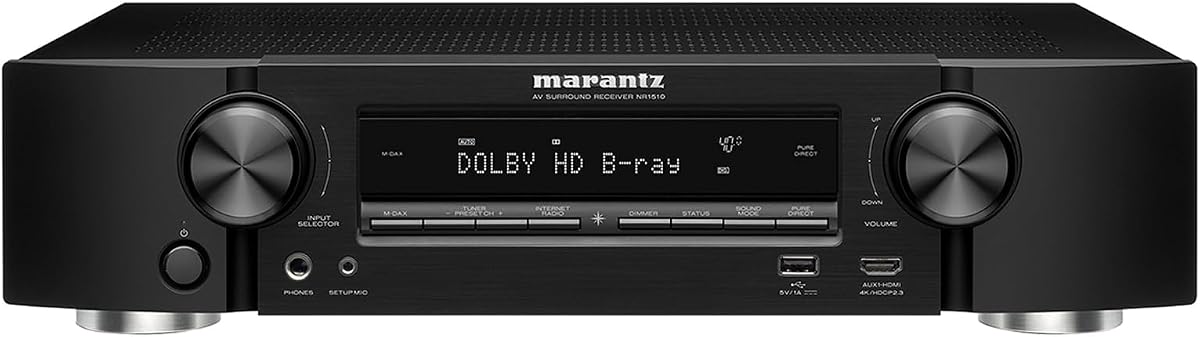
Marantz NR1510
4.4Editor score
Half-height traditional design
Five-channel discrete amplifier
HEOS whole-home streaming
Our Slimline AV Receiver guide compares ten space-saving models for surround sound, 4K or 8K video, streaming, gaming, room calibration, and everyday use.
A slimline AV receiver brings cinema-style sound and video control to a home without requiring a large, full-size chassis. The best models balance amplifier power, surround formats, HDMI capabilities, room calibration, streaming functions, and a practical footprint that suits media cabinets, shelves, and compact living spaces.
We compared the ten featured receivers by examining channel configuration, power, supported audio and video formats, HDMI connectivity, wireless music functions, calibration tools, and physical design. The list includes traditional home theater receivers, two-channel stereo models, and compact options designed to pair modern televisions with better sound.
Each review identifies the receiver's strongest use, practical trade-offs, and ideal owner. Product details and ratings reflect the supplied information, while availability and pricing can change, so readers should verify current specifications and offers before making a final purchase decision.
4.4Editor score

4.0Editor score

4.5Editor score
The following comparison shows how the featured slimline receivers differ in channel count, amplification, surround processing, streaming, and modern video support, helping narrow the field for a compact home entertainment system.



The Yamaha RX300A is a 5.2-channel home theater receiver built for listeners who want modern cinema features in a relatively compact package. Its 4.0 rating may be modest compared with the other featured products, but the specification set is notably current. It combines Dolby Atmos, DTS Virtual:X, 4K120 and 8K60 HDMI support, advanced dynamic-range formats, gaming features, and Bluetooth Multipoint.
We may earn a commission when you buy through this link, at no additional cost to you.
Its main strength is balanced capability. Seventy watts per channel provide a useful foundation for a conventional living-room theater, while flexible speaker arrangements include a 3.1.2-channel configuration with up-firing or in-ceiling height speakers. The included measurement microphone lets the receiver analyze room acoustics and speaker characteristics, while four customizable scene presets provide convenient starting points for movies, television, music, and gaming.
The main limitation is its 5.2-channel architecture. A full 5.2 setup can deliver excellent surround effects, but the receiver does not provide the seven built-in channels found in more ambitious systems. The supplied information also does not identify a built-in HEOS platform or Wi-Fi streaming service, so buyers wanting broad streaming-service integration may need to confirm their preferred source device's capabilities.
Despite those considerations, the Yamaha RX300A is a strong all-around choice for a modern 4K or 8K television system. It is particularly appealing when Dolby Atmos, high-frame-rate gaming, HDMI return-channel convenience, and two-device Bluetooth switching matter more than a larger number of amplification channels. It is our Editor's Choice for the most balanced feature package in the guide.
We may earn a commission when you buy through this link, at no additional cost to you.
The Marantz NR1510 combines a genuine 5.2-channel home theater receiver with a half-height chassis, making it one of the clearest examples of the slimline category. It carries a 4.4 rating and emphasizes musical refinement, versatile connectivity, and discreet design. Its five discrete amplifier channels deliver 50 watts each, while the receiver supports Dolby TrueHD and DTS-HD Master Audio.
We may earn a commission when you buy through this link, at no additional cost to you.
Connectivity is one of the model's strongest aspects. Six HDMI inputs make it practical to connect a television, game console, streaming device, disc player, and other sources without constantly rearranging cables. Analog, digital, and phono inputs broaden its appeal to music listeners, while HEOS built in provides access to services such as Spotify, TIDAL, and Amazon Music HD. Audyssey MultEQ analyzes the room and applies precision filters to individual channels.
Its limitations reflect the emphasis on a slim footprint and classic audio priorities. Fifty watts per channel may be less persuasive in a large room or with demanding speakers, especially when compared with the 70-, 75-, 80-, or 100-watt alternatives here. The stated 4K capability also lacks the specific 4K120, 8K60, VRR, and ALLM language found on the newest models in the list.
The NR1510 is best for buyers who want a full surround receiver but need half the usual cabinet height, appreciate Marantz's musical tuning, and want integrated HEOS music. It is also a natural choice for mixed entertainment systems because of its phono input and broad source support. For those priorities, it earns the Best Premium designation in this roundup.
We may earn a commission when you buy through this link, at no additional cost to you.
The Denon AVR-S570BT is a 5.2-channel receiver that places 8K video and contemporary gaming features at the center of its design. Its 4.2 rating reflects a capable, approachable package, with 70 watts per channel, four HDMI 2.1 8K inputs, one HDMI output, and eARC support rated at up to 40 Gbps. That input count is particularly useful for owners of multiple current-generation consoles.
We may earn a commission when you buy through this link, at no additional cost to you.
The specification list covers Dolby Vision, HDR10+, Dynamic HDR, HLG, VRR, and Quick Frame Transport. Audio support includes DTS-HD Master, Dolby TrueHD, immersive audio, and 5.1 surround. For music, built-in Bluetooth enables wireless playback, and the supplied information notes compatibility with streaming platforms such as Spotify and TIDAL, although the description does not explicitly identify a built-in HEOS platform.
Setup and control are approachable. The on-screen HD Setup Assistant walks users through connecting the television and sources, while specific equalization settings help optimize sound for movies, television, music, and games. It can also work with a compatible Smart TV remote, and the Denon Remote App provides iOS and Android control. The trade-off is that the receiver has only one specified HDMI output, limiting some projector and multi-display arrangements.
This model is a convincing match for gamers who want 8K/60 and 4K/120 support across several consoles without moving to a larger, more costly category. It also suits viewers seeking broad HDR support and a straightforward guided setup. Those priorities make the AVR-S570BT one of the strongest gaming-focused choices in this slimline roundup.
We may earn a commission when you buy through this link, at no additional cost to you.
The Sony STRDH190 is a compact two-channel receiver built around music amplification rather than home theater processing. It has a 4.5 rating, the highest among the featured products, and supplies 100 watts per channel into 8-ohm speakers. Its 5.25-inch height makes it considerably easier to accommodate than a conventional full-size surround receiver.
We may earn a commission when you buy through this link, at no additional cost to you.
The feature set is well suited to stereo listening. A phono input allows direct turntable connection, four stereo RCA inputs support analog components, and a 3.5 mm input offers another convenient option. Bluetooth handles wireless music, while a full-size quarter-inch headphone jack, FM radio with 30 presets, and A/B speaker switching extend the listening options.
The important limitation is that this is not a 5.2-channel home theater receiver. It does not decode surround sound, provide height-channel effects, or offer the HDMI gaming and dynamic-video features seen elsewhere in the list. Its value therefore lies in power, compactness, analog flexibility, and straightforward two-speaker performance rather than cinematic processing.
For a reader building a two-channel music system or seeking a simple amplifier-and-control center for a television, the STRDH190 is a very practical recommendation. It is also attractive for larger rooms where 100 watts per channel is helpful, provided multichannel cinema is not a requirement. Those needs justify its Best Budget place among the top three.
We may earn a commission when you buy through this link, at no additional cost to you.
The Sony STRDH590 is a low-profile 5.2-channel receiver aimed at modest home theater systems. Its 4.3 rating is supported by a familiar mix of surround decoding, 4K HDR video pass-through, Bluetooth, and flexible source connections. The supplied specifications also note four HDMI inputs, one HDMI output, audio return channel support, and an S Force PRO virtual front-surround mode.
We may earn a commission when you buy through this link, at no additional cost to you.
S Force PRO is especially useful for owners with only two physical speakers, providing a wider sound field without requiring a complete surround installation. When a 5.2 setup is available, the receiver can deliver conventional multichannel theater audio. Four stereo RCA inputs and both optical and coaxial digital outputs offer useful options for older components and varied entertainment systems.
Its main limitation is the older video feature set compared with the newest receivers here. The listed support centers on 4K HDR and HDCP 2.2 rather than explicit 8K60, 4K120, VRR, or ALLM capabilities. The product information also does not identify a full room-calibration system, so buyers who want automatic acoustic correction may need to consider another model.
The STRDH590 is a sensible fit for buyers who want more than stereo, need a cabinet-friendly receiver, and do not require the newest gaming-video standards. It is especially useful for a 5.1 setup or a two-speaker system that will benefit from virtual surround. Its restrained feature set keeps the focus on practical home theater performance.
We may earn a commission when you buy through this link, at no additional cost to you.
The Denon AVR-X1700H is the most capable conventional surround receiver in the lineup, with seven amplified channels and 80 watts per channel. Its 4.4 rating reflects a mature feature set that includes 8K60 and 4K120 pass-through, 8K upscaling on all six HDMI inputs, Dolby Atmos, DTS:X, and Dolby Atmos Height Virtualization Technology.
We may earn a commission when you buy through this link, at no additional cost to you.
It is the only model here with a full 7.2-channel amplifier layout, making it relevant to buyers who want rear and height effects without adding external amplification. The video section supports HDR10, HDR10+, Dolby Vision, HLG, 4:4:4 color, and HDCP 2.3. The setup guide and color-coded rear connections make configuration easier despite the broad array of options.
Smart-home and music functionality is also extensive. HEOS, Wi-Fi, AirPlay 2, and Bluetooth support multi-source, multi-room use. The receiver works with major voice agents, supports external and IP control, and can integrate with home automation systems. Two pre-outs allow additional subwoofer flexibility, while digital, analog, coaxial, and phono inputs broaden source compatibility.
Although it may require more cabinet depth than the most space-conscious models, the AVR-X1700H is the best fit here for serious surround cinema and a large television or projector. It suits listeners who prioritize channel count, object-based audio, 8K readiness, automation, and multi-room functions. Its breadth makes it a strong premium-class home theater hub.
We may earn a commission when you buy through this link, at no additional cost to you.
The Denon AVR-S670H delivers a modern 5.2-channel receiver feature set with 75 watts per channel. Its 4.3 rating aligns with a versatile package supporting 8K60 and 4K120 pass-through, 8K upscaling of 4K content, ARC and eARC, HDCP 2.3, and HDMI switching for several source devices.
We may earn a commission when you buy through this link, at no additional cost to you.
Modern display and gaming standards are major strengths. The receiver supports HDR10+, HLG, HDR, Dolby Vision, Dynamic HDR, VRR, ALLM, and Quick Frame Transport. Audio features include Dolby TrueHD, Dolby Pro Logic II, and the DTS Neo:6 Upmixer, giving it a good foundation for mainstream surround content and compatible height-virtualization experiences.
HEOS, Wi-Fi, and Bluetooth make it convenient to stream music throughout the home, while voice-agent compatibility allows hands-free volume adjustment, track changes, and input switching. The trade-off is that only five channels are amplified, so buyers seeking a seven-speaker or 7.2-channel cinema system must look farther up the list.
The AVR-S670H is a strong match for a modern 4K or 8K television, current game console, and 5.2 speaker arrangement. It is particularly appealing when a buyer wants gaming features and whole-home streaming without moving to a larger seven-channel model. It serves as a versatile, well-rounded center for contemporary entertainment.
We may earn a commission when you buy through this link, at no additional cost to you.
The Yamaha R-S202BL is a straightforward two-channel receiver designed primarily for music rather than home theater. It carries a 4.4 rating and focuses on a simple brushed-aluminum design, speaker selection, radio tuning, and wireless playback. It can power two separate speaker systems through its speaker selector, making it especially useful in a multi-room or multi-zone listening arrangement.
We may earn a commission when you buy through this link, at no additional cost to you.
Its wired and wireless functions cover common listening needs. Bluetooth connects to favorite streaming services, while 40 FM and AM presets provide an alternative to online audio. A headphone terminal allows private listening, and an automatic power-standby function helps reduce unnecessary energy use when the receiver has been inactive.
This is not the right choice for Dolby Atmos, DTS:X, surround processing, or modern television video. Its strengths are simplicity and focused stereo operation, and trying to use it as a full home theater hub would mean accepting a much narrower feature set than the Denon, Sony, Marantz, and Yamaha surround receivers in this guide.
The R-S202BL is best for a dedicated two-speaker music system, a small apartment setup, or a household that wants one compact receiver capable of switching between two speaker pairs. It also works for casual television sound when the priority is simple amplification rather than cinematic processing. At that level of needs, it remains a focused and approachable choice.
We may earn a commission when you buy through this link, at no additional cost to you.
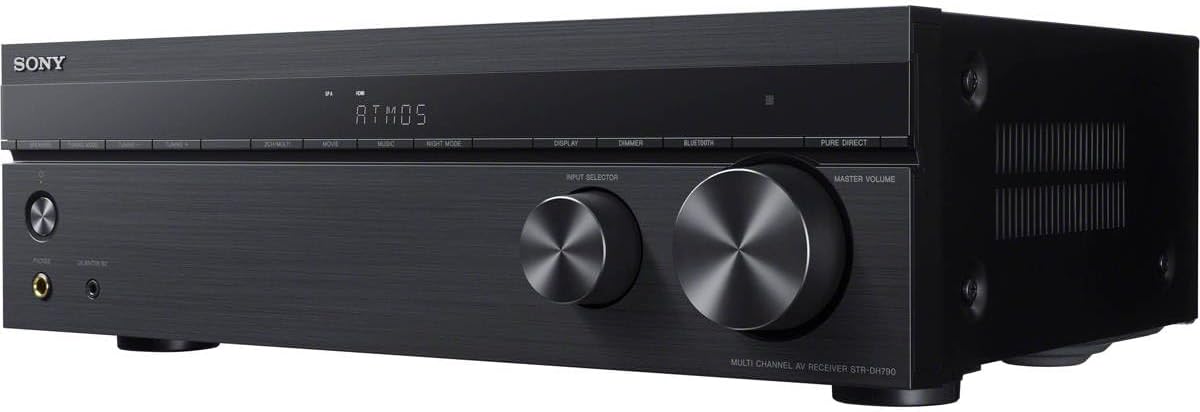
The Sony STR-DH790 combines a low-profile 5.25-inch chassis with 7.2-channel home theater processing. Its 4.2 rating makes it a practical option for buyers who want more surround channels and object-based audio than a conventional 5.2 receiver without moving to a full-height model. Dolby Atmos and DTS:X are the headline audio formats.
We may earn a commission when you buy through this link, at no additional cost to you.
The four HDMI inputs and one HDMI output support 4K HDR pass-through with Dolby Vision, HDR10, and Hybrid Log Gamma. Optical, coaxial, and analog connections provide flexibility for existing equipment. Sony's Advanced D.C.A.C. calibration analyzes the room and adjusts the audio, which is particularly valuable when the speakers are positioned in a less-than-ideal media cabinet.
Compared with the latest 8K-capable receivers, its video specification is clearly dated, and the product information does not mention VRR, ALLM, or 4K120. The Pure Direct function can suppress front-panel noise for higher-fidelity playback, while Bluetooth Standby allows the receiver to be awakened from a phone.
The STR-DH790 is ideal for a low-profile cabinet and a seven-speaker surround installation where Dolby Atmos and DTS:X are priorities. It also suits owners who want automatic correction but do not need the newest gaming standards. Its combination of channel count, calibration, and reduced height remains one of the more useful configurations in the guide.
We may earn a commission when you buy through this link, at no additional cost to you.
The Marantz Stereo 70s is an unusual combination of compact two-channel design and serious home theater connectivity. Its 4.4 rating reflects a well-equipped 75-watt discrete Class A/B amplifier with a height of only 4.1 inches. Although it is primarily a stereo receiver, the supplied information notes support for two subwoofers and HDMI source switching.
We may earn a commission when you buy through this link, at no additional cost to you.
Six HDMI inputs, including 8K support and an ARC output, make it possible to connect numerous source devices while keeping the system visually uncluttered. The Marantz Sound Master tuning emphasizes warmth, detail, dynamics, and spaciousness. A phono input, wired and Bluetooth headphone outputs, Zone 2 audio, and Speaker A+B connectivity make it useful beyond a single listening room.
HEOS adds Spotify Connect, AirPlay 2, Bluetooth, TIDAL, TuneIn, and other streaming options. The stated high-resolution support extends to 192 kHz/24-bit audio and DSD. Its principal limitation is clear: it does not decode a true surround-sound channel layout, so Dolby Atmos, DTS:X, and multi-speaker cinema are outside its core function.
For a buyer seeking a slim, elegant audio component with extensive HDMI and streaming functions, the Stereo 70s is one of the most compelling options. It is particularly well suited to a two-speaker living room where a slim receiver must coexist with a modern television, game console, and turntable. It prioritizes music and stylish simplicity over surround processing.
We may earn a commission when you buy through this link, at no additional cost to you.
A good slimline receiver should fit the available space while providing the channels, power, video support, and connectivity required by the rest of the system. Comparing those needs before shopping prevents a compact design from becoming a compromise in performance or convenience.
Begin with the cabinet opening, ventilation clearance, and depth required for cables. Some models emphasize height reduction while retaining a conventional width and depth, whereas others are genuinely compact in several dimensions. Check the receiver's measurements rather than assuming every slim model occupies the same footprint, and leave room behind it for HDMI and power connections.
In short, measure first, then compare dimensions and ensure that the chosen model can be properly ventilated.
A 5.2 receiver powers five speakers and two subwoofer outputs, making it the common choice for conventional surround systems. A 7.2 receiver adds two powered channels for rear or height effects, while a two-channel receiver is intended primarily for music. Virtual height or surround processing can create effects with fewer speakers, but it does not reproduce the same output as additional physical channels.
In short, choose the channel count that matches your actual speaker plan rather than the largest specification available.
Power ratings are most useful when compared under similar conditions, but the listed wattages across this guide use different configurations and measurement approaches. A receiver with higher stated output may have more headroom in a larger room or with less efficient speakers. Two-channel designs often devote all available amplification to each speaker, which can benefit music systems.
In short, consider room size, speaker sensitivity, and channel count together instead of treating wattage as the only measure of quality.
For a new television or game console, look for the required maximum video resolution, refresh rate, HDR formats, and copy-protection standard. Models supporting 4K120 or 8K60 are better prepared for newer consoles and high-refresh displays. VRR and ALLM improve gaming, while ARC or eARC simplifies television-audio connection and control.
In short, match HDMI features to current and planned source devices before choosing the receiver.
Dolby Atmos and DTS:X support immersive object-based sound, but their usefulness depends on the speaker arrangement and the supplied content. Dolby TrueHD, DTS-HD Master Audio, and other lossless formats preserve high-quality soundtrack detail. Virtualization can provide a convincing expansion with two or four speakers, although dedicated height channels usually offer more precise effects.
In short, prioritize the formats your content uses and the speaker positions your room can support.
HEOS, AirPlay 2, Bluetooth, and compatible apps determine how easily music and services can be integrated with the receiver. Bluetooth Multipoint is useful for switching quickly between phones, while Bluetooth Standby offers convenient remote activation. Voice-agent compatibility and Smart TV remote support can reduce the need to handle a separate controller.
In short, select the control ecosystem that already matches your television, phone, music services, and smart-home devices.
A measured setup microphone can analyze speaker placement, listening distance, and room characteristics before applying corrective filters. Yamaha's included microphone, Denon's guided EQ process, Sony's Advanced D.C.A.C., Marantz's Audyssey MultEQ, and Denon's on-screen Quick Setup all support more consistent playback. Calibration is particularly helpful when a slim receiver sits in a cabinet with nearby walls or furniture.
In short, use available calibration tools to improve consistency, but still place speakers carefully and follow the setup instructions.
A feature-rich receiver is not automatically the best choice for every room. Dedicated music listeners may value phono inputs, headphone outputs, radio tuners, and two-speaker switching more than surround decoding. Cinema-focused users may prioritize height effects, gaming features, and multiple HDMI inputs. The best slimline model is the one that supports the intended sources without adding controls that create unnecessary setup complexity.
In short, prioritize everyday usability and relevant features rather than the longest specification list.
Place the receiver on a stable, level surface with clearance around its vents. Connect speakers and subwoofers according to the channel labels, then attach the display with the appropriate HDMI cable. Power the television and receiver before running the guided setup so the receiver can recognize the display and present the correct connection options.
Run the included calibration microphone from the primary listening position, or complete the receiver's on-screen adjustment process. Set channel levels, speaker distances, and crossover choices, then test several source types. If the unit is placed inside a cabinet, avoid blocking ventilation and verify that the chosen equalization and room measurements reflect the speakers' actual boundaries.
For ongoing care, keep the chassis free from dust and liquids, use gentle power-off procedures, and avoid repeatedly changing input cables. Update the receiver's software when updates are offered, review connected-device settings when replacing a television or console, and check the manual before adding external amplification, additional subwoofers, or unverified control accessories.
A slimline AV receiver uses a reduced-height or otherwise compact chassis while retaining functions such as HDMI switching, surround decoding, amplification, and streaming. A standard receiver may offer more amplification, ventilation space, internal features, or physical connections. The right choice depends on cabinet size, speaker count, and the video and audio features actually needed.
A 5.2-channel receiver can decode Dolby Atmos and provide immersive processing, but it has fewer dedicated height and rear channels than a 7.2 configuration. Virtual height effects can improve a smaller setup, while a seven-channel receiver can create more precisely positioned objects. The ideal arrangement depends on room size, speaker placement, and the content being played.
Most of the featured receivers provide HDMI inputs, HDMI return-channel support, and firmware features designed for television use. Gaming capability depends on whether the selected model supports the required resolution, refresh rate, VRR, and ALLM. Connect the console to a suitable HDMI input and use the receiver's quick menu to enable the appropriate television and game features.
A slimline stereo receiver can be ideal for a two-speaker system because it combines amplification, source selection, wireless playback, and sometimes radio and phono support in a compact unit. The Sony STRDH190 and Yamaha R-S202BL are stereo designs, while the Marantz Stereo 70s adds modern HDMI and HEOS functions. A full surround receiver is unnecessary unless multichannel audio is a priority.
Room calibration measures the listening environment and speaker characteristics, then applies filters intended to improve tonal balance, clarify dialogue, and create a more consistent sound field. The included systems differ in method, but all can reduce common placement problems. Calibration cannot compensate for incorrect channel assignments, poorly placed speakers, or unrealistic expectations, so correct setup remains essential.
4K support remains sufficient for many current televisions and source devices, while 8K support offers more headroom for compatible future equipment. The larger practical question is whether the receiver supports the desired refresh rates and gaming features. Models with 4K120, 8K60, VRR, and ALLM are especially relevant to current high-performance game consoles.
A phono input is valuable if the system includes a turntable that lacks a built-in phono preamplifier. It applies the gain and equalization needed for low-level cartridge output. If the turntable already includes a preamp, or the listener uses streaming and other line-level sources, the feature may have little practical effect on daily use.
A compact receiver still needs airflow around its vents, particularly during sustained high-volume playback. Follow the manufacturer's placement instructions and avoid enclosing the unit in a completely sealed compartment. If it must sit inside a cabinet, use an open shelf or ventilated panel, leave clearance where directed, and make sure the cabinet does not block infrared remote signals or Wi-Fi connectivity.
The Yamaha RX300A is the strongest all-around selection, combining Dolby Atmos, modern 8K and 4K120 video, gaming features, room correction, and Bluetooth Multipoint. The Marantz NR1510 stands out for its genuinely slim full-receiver design, musical tuning, HEOS integration, and high-resolution audio support, while the Sony STRDH190 is a capable budget stereo option with ample power and a very small footprint.
The right priorities should determine the remaining choice. Buyers needing seven amplified channels and extensive automation should examine the Denon AVR-X1700H, while Sony STR-DH790 and Sony STRDH590 provide low-profile surround options. The Marantz Stereo 70s and Yamaha R-S202BL suit two-channel listening, and the Denon AVR-S670H is a balanced 5.2 model for contemporary gaming and streaming.
Before purchasing, verify the receiver's dimensions, required speaker configuration, current video standards, and available source connections. Product features, configurations, ratings, and availability can change over time, and pricing also varies by retailer and date. Checking the latest listing and manufacturer guidance will help ensure that the final slimline receiver still matches the intended room and entertainment system.