
Qidoe 200W Car Charger Splitter
4.4Editor score
Useful digital voltmeter
Twelve-volt accessory socket
Compact illuminated design
Our 200W USB Car Charger guide compares power allocation, ports, cables, compatibility, safety features, and ideal use cases.
A 200W USB car charger is most useful when a road trip involves more than one phone, or when a laptop must be charged alongside cameras, tablets, audio equipment, and other accessories. The best models combine high peak output with sensible power sharing, broad charging protocols, stable connections, and effective heat management.
We compared the ten chargers in this guide by examining total output, individual port ratings, supported fast-charging protocols, built-in cables, port counts, safety features, lighting, vehicle compatibility, and practical design. The list includes conventional three-port models, multi-port stations, and chargers with permanently attached cables.
Each review identifies the circumstances in which its charger stands out, along with any limitations revealed by its specifications. Ratings and configurations can change over time, and product prices fluctuate, so readers should confirm the latest listing details before making a purchase.
Every option offers a distinct way to handle mobile charging, though the most suitable choice ultimately depends on the number of devices, whether a laptop is involved, and how much control you want over power allocation.
4.4Editor score

4.6Editor score

4.7Editor score
This side-by-side overview compares the ten chargers by port layout, maximum output, cable arrangement, compatibility, and practical features, making it easier to identify the model that fits your devices and vehicle.
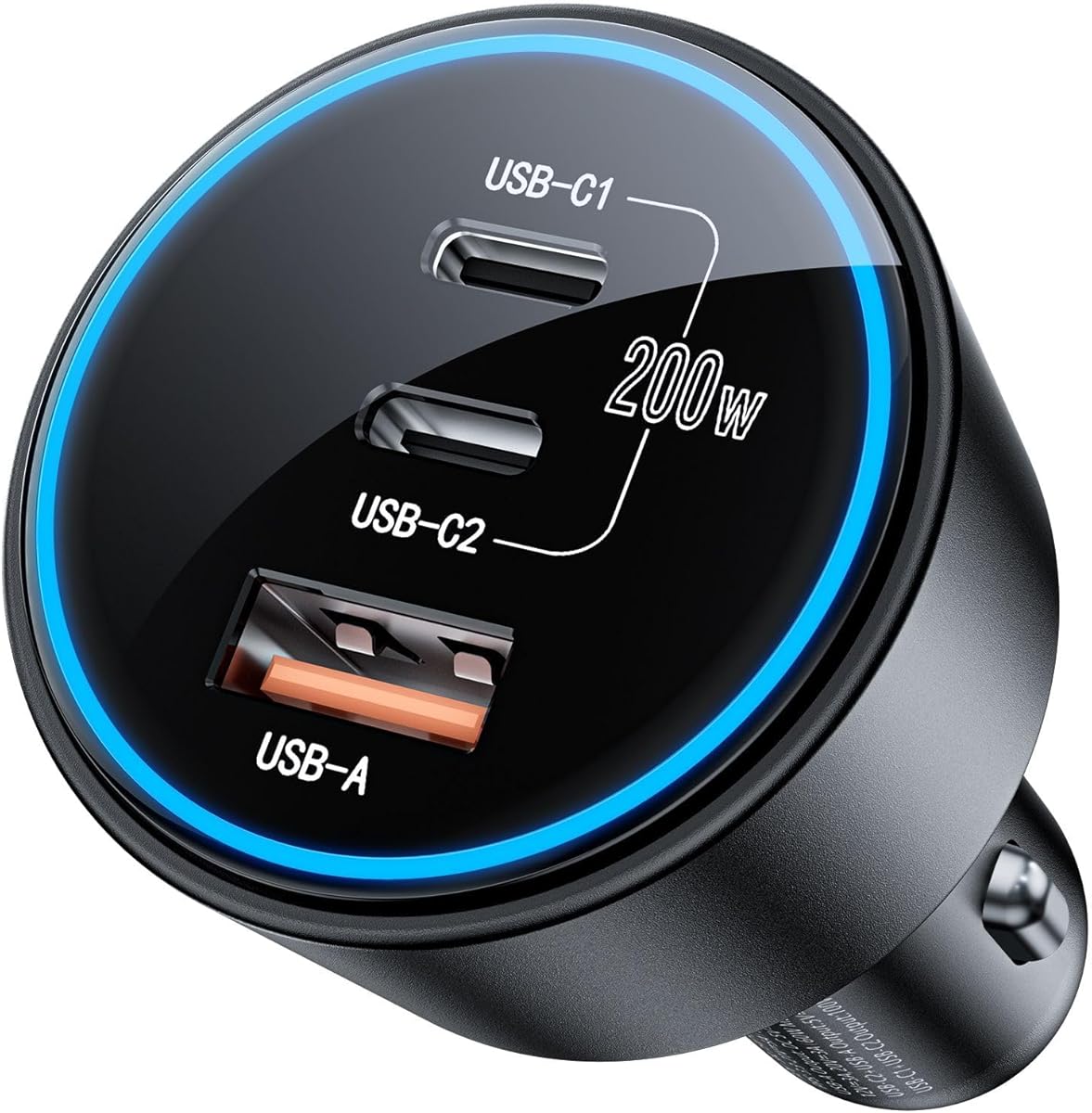

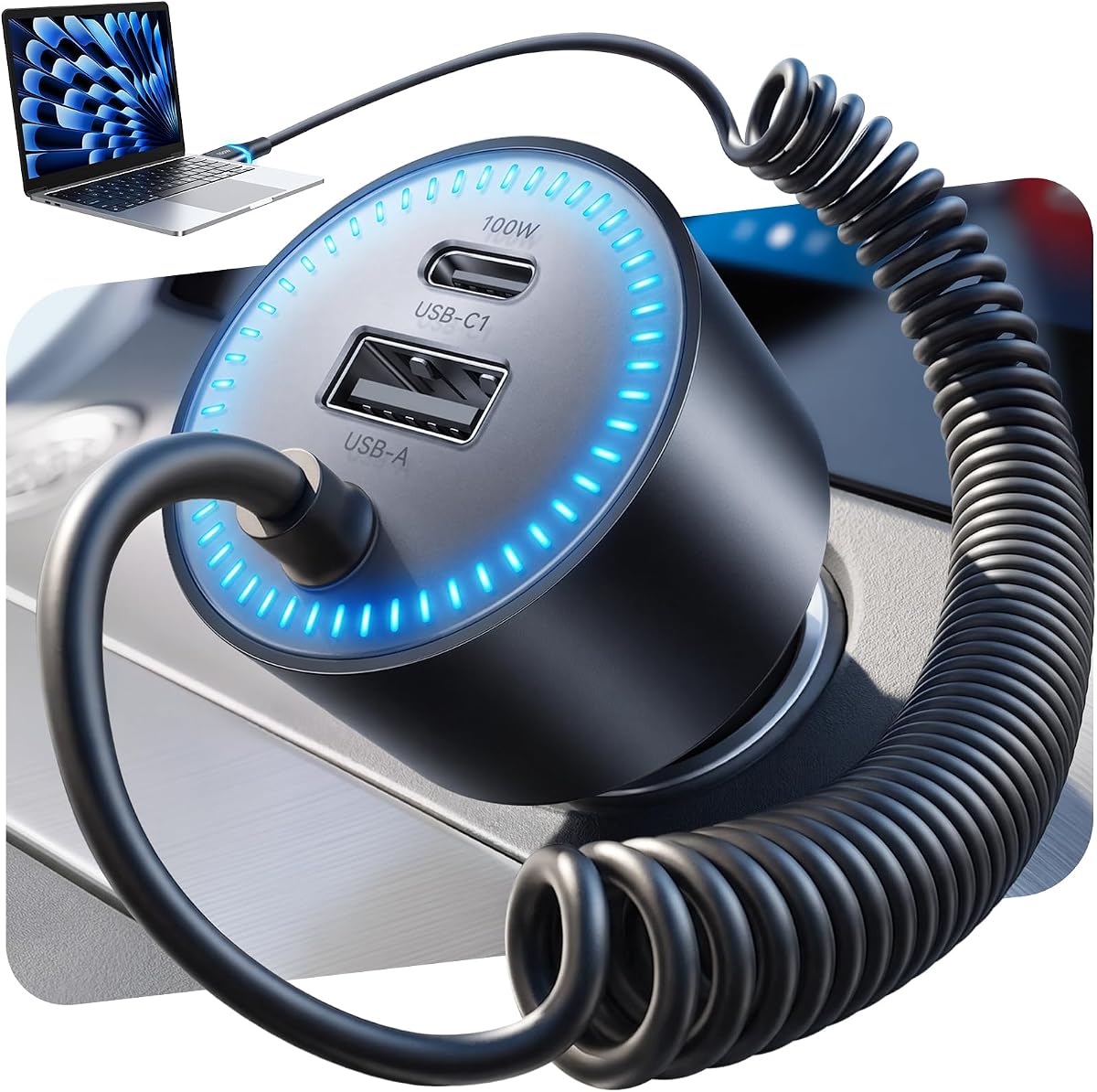
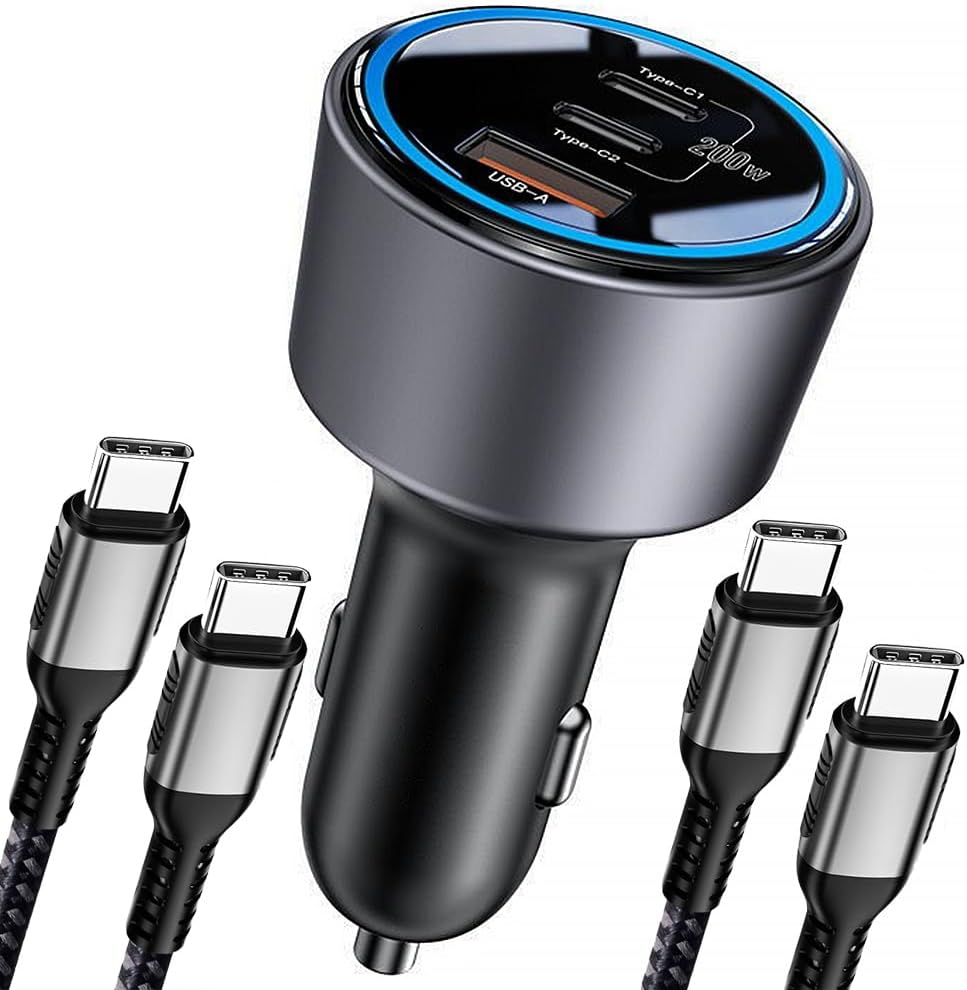


The ROADRESS 200W Car Charger is a balanced three-port model for drivers who need meaningful laptop-level output and several smaller devices connected at once. Its 4.6 rating reflects a capable specification list, including two USB-C ports rated at up to 100W each and a USB-A port rated at up to 60W. The design avoids an attached cable, leaving the connector choice entirely in your hands.
We may earn a commission when you buy through this link, at no additional cost to you.
Its principal strength is flexible power distribution. One Type-C connection can deliver 100W for a demanding notebook, while the second Type-C and USB-A ports can serve phones, tablets, cameras, or other USB-powered accessories. Compatibility includes PD3.0, PPS, QC4.0, QC3.0, SCP, FCP, and AFC, making it a broad option for mixed Android, Apple, and USB-C ecosystems. The listed device examples include MacBook Pro Air, iPads, recent iPhones, Galaxy flagships, AirPods Pro, Steam Deck, and Nintendo Switch.
The product also describes a new heat-dissipation process, over-current, over-voltage, and over-temperature protection, plus an intelligent trickle mode intended to reduce the risk of continued full-output charging. An ice-blue ring makes the ports easier to find at night, while UL, CE, FCC, and RoHS certifications are listed. These are meaningful details for a compact device that draws significant power, although actual charging speed still depends on the connected device, cable, and vehicle socket.
This is a strong recommendation for a family that wants one charger to cover a laptop, two phones, and smaller accessories without carrying separate adapters. It is less attractive for buyers who want a ready-made cable or for anyone whose vehicle has very limited clearance around the socket. With two strong Type-C outputs, broad protocol coverage, and useful nighttime lighting, it remains one of the most flexible conventional options in the guide.
Overall, the ROADRESS stands out because it offers the rare combination of two 100W Type-C ports, a high-output USB-A port, and extensive compatibility in a straightforward three-port format.
The two independent 100W Type-C outputs make this charger useful when a notebook and a phone need power at the same time. The 60W USB-A output adds capacity for older accessories without reducing the headline 200W maximum.
Over-current, over-voltage, and over-temperature protection help manage sustained high-power use. The illuminated ring provides practical visibility when plugging in a cable during a dark stop.
We may earn a commission when you buy through this link, at no additional cost to you.
The LISEN 200W Car Charger is the most compelling laptop-first option in this roundup. It carries a 4.6 rating and combines a 140W USB-C output with two 30W secondary ports, all within an advertised 200W maximum. That emphasis makes it a natural fit for drivers who need to replenish a MacBook or another USB-C notebook while keeping two smaller devices connected.
We may earn a commission when you buy through this link, at no additional cost to you.
The primary port supports PD 3.1 up to 140W, and the product claims a MacBook Pro can move from zero to 50 percent in approximately 35 minutes. It also lists an iPhone 18 Pro Max reaching 90 percent in 28 minutes. Separate 60W Super Fast Charging 3.0 support is highlighted for recent Samsung Galaxy models, while QC 4.0+, PPS, PD 3.1, and Apple Fast Charge broaden device compatibility. Smart device identification is used to match output to connected hardware.
Thermal design receives equal attention. The full-metal housing is intended to dissipate heat quickly, while GaN technology is said to improve efficiency and reduce heat by up to 30 percent compared with standard chargers. The charger also includes over-voltage, over-current, and short-circuit protection, carries UL, FCC, and CE certification, and is backed by a 24-month replacement warranty. A soft LED port indicator, 240W USB-C cable, and stated eligibility for Amazon Business bulk orders round out the package.
The trade-off is that only the primary port approaches laptop-charger power. The other USB-C and USB-A outputs are limited to 30W each, so this model prioritizes one demanding device over two high-wattage ones. It also remains larger and more specialized than a basic phone charger. Buyers wanting the highest single-port output, a good included cable, and laptop charging will find those priorities especially valuable.
It is our Editor's Choice because its 140W PD 3.1 output, GaN thermal design, and intelligent three-device allocation form the most complete high-performance package for mobile professionals.
A 140W primary port provides substantially more headroom than ordinary phone chargers. That makes the LISEN more useful when a MacBook or other demanding USB-C notebook is part of the travel kit.
GaN semiconductors and a full-metal shell address heat in a category where sustained output matters. The listed protections and certifications add confidence for long drives and repeated high-power sessions.
We may earn a commission when you buy through this link, at no additional cost to you.
The FLYLEAD 200W Car Charger is designed around convenience: it includes a permanently attached, five-foot coiled USB-C cable as well as a separate USB-C port and USB-A port. With a 4.6 rating, it offers an appealing mix of high output and reduced cable clutter for drivers who regularly travel with a phone, notebook, or passenger.
We may earn a commission when you buy through this link, at no additional cost to you.
Its two USB-C paths can each provide 100W, allowing a MacBook Pro and an iPhone to charge together according to the product's stated configuration. When a third device is added, the smart chip changes the allocation to 100W plus 24W, with the USB-A path also offering up to 60W in another operating arrangement. PD3.0, QC4.0, and PPS support covers major phone, tablet, and notebook standards, while the listed compatibility includes MacBook, iPad, recent iPhone and Galaxy models, AirPods, GoPro cameras, and other USB devices.
The attached cable extends to a dashboard-mounted phone and retracts when no longer needed. Three widened, thickened metal contacts are designed to maintain power through bumps and vibration. Safety features include V0-grade flame-retardant PC, temperature control, 360-degree ventilation, and protection against overcurrent, overvoltage, overload, overheating, and short circuits. A 24-month warranty and responsive support are also stated.
Its main limitation is that the integrated cable cannot be detached or replaced. That is helpful for a common Type-C phone but less suitable if the attached connector becomes damaged or if your primary device uses a different interface. Three-device charging also entails lower output than the headline total, as is common with shared-power designs. Nevertheless, the combination of dual 100W performance, a ready-made cable, and a 12-to-24V vehicle fit makes this a strong option for family road trips and frequently connected vehicles.
FLYLEAD is especially compelling when reducing forgotten-cord problems and keeping the cabin tidy matter as much as raw power.
The coiled five-foot cable reaches a mounted phone without hanging across the cabin. Its retractable form is a strong advantage for people who dislike loose charging leads.
Widened metal contacts are intended to resist interruption from road vibration. Ventilation and temperature monitoring complement the charger’s over-temperature and overload protections.
We may earn a commission when you buy through this link, at no additional cost to you.
The Rocoren 200W Car Charger has the highest listed rating in the group at 4.8 and pairs that strong reception with a 5.2-foot attached USB-C cable. Its two independent USB-C paths can each deliver 100W, while the USB-A port peaks at 30W. The result is a flexible charger with particular appeal to drivers who need either two USB-C devices or a phone, laptop, and smaller accessory.
We may earn a commission when you buy through this link, at no additional cost to you.
Power allocation changes with the number of connected devices. Two Type-C devices can receive 100W plus 100W, while the built-in cable and USB-A combination deliver 100W plus 30W. If the standalone Type-C port and USB-A port are used without the attached cable, they share a 5V, 4A output. In three-port mode, the distribution becomes 100W, 20W, and 20W. The listing states that an iPhone 16 can reach 60 percent and a Galaxy S25 Ultra 65 percent in 30 minutes, subject to device and cable compatibility.
Safety is addressed through FCC, CE, and RoHS certifications, flame-retardant PC, a smart identification chip, and protection against overvoltage, overcurrent, overcharging, overheating, and short circuits. The charger fits 12-to-24V vehicles, including sedans, SUVs, vans, and trucks. The unusually broad accessory list covers a Nintendo Switch, AirPods, watches, dash cameras, GPS units, vacuums, power banks, phone mounts, refrigerators, air pumps, massagers, and speakers.
A fixed cable is the most obvious compromise. It cannot be replaced if damaged and is only useful for USB-C devices, although the independent Type-C port provides flexibility. The shortened outputs in three-device mode are also important to understand, particularly for high-power laptops. Even so, the 4.8 rating, long cable, dual Type-C output, and extensive accessory support make this one of the strongest all-round choices for family travel.
Rocoren is particularly well suited to buyers who value one long cable for a mounted phone and need a second high-power USB-C port for a notebook.
At 5.2 feet, the coiled Type-C cable is among the longest attached leads featured here. It can comfortably reach a dashboard or rear passenger area and retracts for storage.
The stated accessory support extends well beyond conventional USB devices. This makes the charger practical for road-trip equipment that needs a dependable 12V power source.
We may earn a commission when you buy through this link, at no additional cost to you.
This 200W USB C Car Charger is appealing because it includes two 100W USB-C cables in addition to two 100W Type-C ports and a USB-A port. It holds a 4.8 rating and provides a straightforward route to powering up to three devices. The two included 3.3-foot cables make it a more self-contained option for buyers who do not want to pack separate charging leads.
We may earn a commission when you buy through this link, at no additional cost to you.
The charger supports PD3.0, QC4.0, QC3.0, SCP, AFC, and PPS. The listed USB-C output reaches 100W, while the USB-A path supports up to 60W under the product's stated configuration. The listing also claims that a 16-inch MacBook Pro can charge fully in approximately 90 minutes. That claim should be treated as a best-case result dependent on the notebook, its power requirements, battery state, thermal conditions, and the specific cable connection.
The bundled cables are described as using anti-break reinforcement and hard-wearing TPE, with testing cited for more than 30,000 bends. An E-Marker chip is included to support 100W USB-C charging and protection. This matters because a cable without adequate power handling can prevent a charger or device from reaching the intended rate even when both products support high output.
The product supports 12-to-24V vehicles and is listed as compatible with Galaxy S24 devices, iPhone 15 and 14 series phones, iPad Air, MacBook Pro, Dell and HP laptops, ThinkPad X1 Carbon, and MateBook systems. The trade-off is that two stored cables add bulk to a travel bag, and real-world results will depend on how demanding the connected devices are. Overall, the package feels generous for families and mobile workers who want capable ports plus ready-to-use Type-C leads.
Its clearest advantage is the reduction of missing-cord frustration: two substantial cables are supplied, and each of the two Type-C ports can support the headline class of output.
Including two 3.3-foot USB-C-to-USB-C leads reduces the need to carry separate cables for a phone and laptop. Their reinforced construction is intended to withstand repeated bending.
PD3.0, PPS, QC, SCP, AFC, and other listed protocols allow the charger to negotiate suitable output for a broad range of modern phones, tablets, and notebooks.
We may earn a commission when you buy through this link, at no additional cost to you.
The Dzytnsy 200W Charging Station is the port-count specialist in this list, with six outputs: three USB-C ports and three USB-A ports. Its 4.6 rating and 200W total maximum make it a natural choice for large families, shared work vehicles, or anyone who wants to leave room for every passenger's device.
We may earn a commission when you buy through this link, at no additional cost to you.
The primary Type-C port can supply 100W, while the other two Type-C ports are rated at 25W each. The three USB-A ports provide 18W, 15W, and 15W. Those values reveal the central compromise: this is a high-port-count charger, but not one where every port offers laptop-class power. The most sensible arrangement is to reserve the 100W port for the most demanding device and use the others for phones, accessories, and secondary electronics.
The product lists extensive compatibility with MacBook Pro and Air models across M1 through M5 generations, several iPad sizes, Dell XPS, HP, Lenovo ThinkPad, Microsoft Surface, recent iPhone and Galaxy families, Google Pixel phones, AirPods, watches, dash cameras, GPS units, car vacuums, and power banks. A soft blue LED assists with port identification in darkness. The body uses PC and fireproof material and is described as scratch-resistant.
Safety features include protection against overvoltage, overcurrent, heat, short circuits, surges, and overload, with a smart chip adjusting output. The charger works with 12-to-24V cars, trucks, SUVs, and pickup trucks. The downside is physical bulk compared with three-port models, and the secondary ports cannot match the primary port. Even so, no other product here provides six charging positions, making it the clear choice when device count takes priority over equal high output.
Choose this station when the central problem is having enough places to plug in, especially across a family trip or a vehicle used by several people.
Three Type-C and three USB-A ports cover modern and legacy devices without requiring a second charger. It is especially useful for passengers who carry different connector types.
The 100W primary Type-C output gives the station a clear role for USB-C notebooks. Lower-rated secondary outputs are better matched to phones, tablets, and accessories.
We may earn a commission when you buy through this link, at no additional cost to you.
The 200W Four-Port Car Charger offers an unusual combination of four connections and a relatively compact format. Its 4.2 rating is the lowest among the ten products, but the specification sheet remains practical for travelers who want several device types connected without carrying multiple wall chargers.
We may earn a commission when you buy through this link, at no additional cost to you.
There are two USB-C ports and two USB-A ports. The primary Type-C port is rated at 100W, the second at 65W, and one USB-A port at 35W; the remaining port is not given a separate headline wattage in the supplied information. PD3.0, PPS, and QC are supported. The listing states that an iPhone 17 Pro Max can reach 90 percent in 30 minutes, provided the phone, cable, and charging conditions support that result.
Four independent smart chips are intended to maintain stable output while multiple ports are active. That distinction matters because a charger with four sockets but shared circuitry can lose considerable speed when several devices are connected. GaN semiconductors and full-body heat dissipation are used to control heat, while overcurrent, overvoltage, overload, overheating, and short-circuit protection provide the stated safety layer.
The charger works with 12-to-24V sockets in cars, trucks, and RVs, and the compatibility list includes iPhone 17, 16, and 15 models, Galaxy S26 and S25 devices, Google Pixel phones, MacBook, iPad, Switch, cameras, and other USB-powered equipment. Its 12-month warranty is shorter than the 24-month coverage offered by several alternatives. The lower rating and unspecified output on one port are additional reasons to compare specifications carefully, but the four-port value proposition is solid.
This is a sensible choice for a mixed-device household that values port count and compactness more than the strongest possible laptop output on every connection.
Dedicated smart chips help the adapter negotiate output for each connection. This design is preferable to a basic splitter when several phones are charging during the same drive.
GaN components and body-wide heat dissipation help a four-port charger operate with less heat. The approach is useful for long journeys with sustained multi-device demand.
We may earn a commission when you buy through this link, at no additional cost to you.
The UYUXIO 6-in-1 Car Charger is less focused on the 200W laptop-charging market and more oriented toward maximum connection count with battery monitoring. It has a 4.1 rating and a 250W stated maximum, but the supplied information does not provide the same detailed port-by-port power allocation found in the leading 200W models.
We may earn a commission when you buy through this link, at no additional cost to you.
Its defining feature is the integrated voltage display, which continuously shows the vehicle battery status while the adapter is plugged into the socket. That can help a driver notice an unexpected voltage drop. The unit also includes six charging positions, allowing up to six phones or a broader mix of phones, tablets, watches, and accessories to be connected without occupying multiple 12V sockets.
Charging compatibility receives considerable emphasis. The listing highlights up to 100W for supported Huawei devices, SuperVOOC for OPPO, Warp Charge for OnePlus, 27W output for recent iPhone models, and ultra-fast charging for Samsung, Vivo, and Google products. The use of manufacturer-specific protocols may be valuable for compatible Android phones. It also says the charger resists heat during long, fast charging sessions.
Compared with the other options, the 6-in-1 adapter offers less transparent power allocation and a lower rating. Some device combinations may therefore charge more slowly than the headline output implies. Its strongest case is a large group traveling in one vehicle, particularly when the built-in voltage display is valued. The fact that six USB charging positions are consolidated into one socket also reduces clutter compared with separate adapters.
For a buyer who needs many low-to-medium-power phone connections, this model makes sense. A laptop-focused driver should favor a charger with a clearly stated 100W or 140W Type-C allocation and documented heat-management design.
The integrated voltmeter offers a quick way to monitor the vehicle electrical system during a journey. It is a useful feature for long-distance drivers and older vehicles.
Six charging positions reduce the need for separate adapters and power extenders. This is helpful for families, tour groups, and drivers carrying several passenger devices.
We may earn a commission when you buy through this link, at no additional cost to you.
The 200W Super Fast Car Charger combines dual 100W Type-C outputs with a 60W USB-A port, giving it a balanced three-device configuration. Its 4.7 rating is the second highest in the roundup. The defining premium feature is its claimed cooling system, which combines patented aluminum heat-dissipation fins with an air-cooled design said to run 35 percent cooler than standard car chargers.
We may earn a commission when you buy through this link, at no additional cost to you.
The charger supports PD3.0, QC4.0, SCP, FCP, AFC, and PPS. The product description says a 16-inch MacBook Pro can reach 41 percent in 30 minutes while two phones continue receiving power. It also states that an iPhone 16 Pro Max can move from zero to 80 percent in 30 minutes. An automatic trickle mode switches to gentler charging around 90 percent, which the manufacturer associates with reduced overcharging and improved battery longevity.
A six-point protection system covers overcurrent, overvoltage, temperature, short circuits, surges, and overload, with UL and FCC certification listed. The 12-to-24V design works across sedans, SUVs, and trucks, including Toyota Camry, Ford Explorer, and RAM 1500 examples. An ice-blue LED ring helps locate the sockets in darkness, while extended 12-millimeter contact pins and an anti-slip grip are designed to reduce disconnections over uneven roads.
The tradeoff is size and the more elaborate construction required for the cooling system. It may protrude farther than a basic adapter, and the examples in the supplied data focus on certain vehicles rather than every possible socket. Actual battery-health benefits from trickle charging can vary by device and its own battery-management system. Even so, the dual 100W outputs, high rating, and detailed thermal design make this a refined option for demanding users.
It earns the Best Premium designation because it goes beyond adding ports by emphasizing sustained thermal performance, connection stability, and automatic battery-care behavior.
Aluminum fins and an air-cooled layout address the heat generated by continuous high-power output. This is particularly relevant when a notebook and two phones remain connected for a long drive.
Extended contact pins and an anti-slip grip help the adapter remain seated. The design targets the common problem of charging interruptions caused by bumps and vibration.
We may earn a commission when you buy through this link, at no additional cost to you.
The Qidoe 200W Car Charger Splitter serves two distinct roles. It provides a 12V accessory socket for car equipment and includes USB charging with a maximum 30W Type-C port plus two 18W QC3.0 USB-A outputs. Although its title references 200W, that figure applies to the auxiliary socket rather than the USB-C connection, so it should not be compared directly with chargers capable of delivering 100W to a laptop.
We may earn a commission when you buy through this link, at no additional cost to you.
The additional socket is the model's most useful feature. It can support compatible accessories such as GPS devices, dash cameras, vacuum cleaners, car refrigerators, heated seats, and navigation equipment. The stated maximum is 120W for 12V vehicles and 200W for 24V vehicles. A digital voltmeter monitors the vehicle battery and electrical system, and the description notes a flashing warning when voltage falls below 12V.
For phones and tablets, the Type-C port is compatible with recent iPhone models, iPads, AirPods, Galaxy devices, and other USB-powered products. The listing claims a compatible phone can charge from zero to 80 percent in approximately 35 minutes. Smart IC protection covers short circuits, overcharging, and overheating, while charging is said to stop automatically when the connected battery is full.
The 90-millimeter body is designed to reach deep cigarette-lighter sockets, and a bottom rubber ring helps maintain its position on rough roads. A soft blue LED makes the socket easier to locate at night. Its limitations are significant for anyone seeking true 200W USB output: the Type-C path tops out at 30W, the USB-A outputs at 18W each, and it cannot serve as a high-power MacBook charger.
This is the best budget option for a driver who mainly charges phones and wants a convenient extra accessory socket plus battery-voltage monitoring. Those wanting a notebook should select one of the dual-100W models instead.
Its value lies in versatility rather than raw charging speed, making it a practical addition to vehicles with limited dashboard space and few accessory outlets.
The added 12V socket turns the adapter into a small power hub for compatible car accessories. It reduces the need to carry a separate splitter when several low-power devices are needed.
A slim 90-millimeter profile suits recessed sockets, while the blue light improves nighttime visibility. The rubber ring helps the plug resist movement and disconnection on uneven roads.
We may earn a commission when you buy through this link, at no additional cost to you.
The right charger depends on device count, power demands, connector habits, vehicle dimensions, and tolerance for shared power. Review the following factors before choosing a model.
A 200W label describes the maximum combined output, not necessarily the output available from every port. Some models offer two 100W Type-C ports, while others reserve 140W for one laptop and limit secondary ports to 30W. A six-port unit may provide only 18W to some USB-A connections. Compare the exact output of each socket and determine which device needs the most power. This prevents an attractive headline figure from producing disappointing charging speeds in the configuration you actually need.
Count the devices you expect to charge together, then leave a little room for passengers or accessories. Three-port chargers suit a typical driver with a phone and laptop, four-port models add flexibility, and six-port hubs accommodate larger groups. Remember that adding devices usually reduces individual output through power sharing. A charger with fewer but stronger ports may serve demanding notebooks better than a larger charger whose extra sockets are low-powered.
USB-C connectors alone do not guarantee fast charging. Look for PD3.0 or PD3.1, PPS, and the QC family, along with SCP, FCP, and AFC where relevant to your phones. Proprietary fast-charge support can further improve results on selected Huawei, OPPO, OnePlus, and Samsung devices. Your vehicle supplies the power, but the charger negotiates the rate, and the connected device ultimately decides whether to use the available output.
Many compact USB-C devices accept less than 100W, while some notebooks require close to the full 140W available from the LISEN model. A properly rated USB-C cable is also necessary for high-speed laptop charging. If you need a tablet to charge at maximum speed, verify both its protocol and the cable specification. Do not assume that a phone's maximum wattage equals the maximum output of the phone's own factory adapter.
An attached cable is convenient for a dashboard-mounted phone and eliminates the risk of leaving a cable behind. It is also fixed, cannot be replaced if damaged, and only benefits devices using that connector. Separate ports are more adaptable, particularly when one driver alternates among USB-C phones, older accessories, and different cable lengths. Some products include a high-wattage cable without permanently fixing it, providing a useful middle ground.
Sustained high output creates heat, making thermal design and protective circuitry important. Look for overcurrent, overvoltage, overtemperature, overload, and short-circuit protection. GaN semiconductors, metal bodies, ventilation, and heat-dissipation fins are positive signs, as are relevant UL, FCC, CE, or RoHS certifications. These features cannot guarantee identical results across every vehicle, cable, or device, but they provide a stronger safety framework than an unregulated basic splitter.
Most adapters support 12-to-24V vehicle systems, but physical clearance varies. Deep recessed sockets may favor the slim Qidoe design, while larger housings can provide room for cooling fins. Check whether the socket has a switch or accessory power arrangement and whether the charger blocks nearby controls. A stable plug and extended contact pins are particularly helpful on rough roads, where ordinary adapters can disconnect.
A blue LED ring or port light makes cables easier to find at night, while a digital voltmeter can provide a quick view of the vehicle battery status. These extras are useful but should not replace a sound power-delivery design. Built-in accessory sockets, included cables, replacement warranties, and customer support can further improve convenience. Judge them according to your actual travel habits rather than treating extra features as proof of better charging performance.
Start by confirming that the charger is compatible with your vehicle's 12-to-24V electrical system and that the socket is clean and properly seated. Insert the charger without forcing it, then connect the most power-hungry device first. For the best chance of high-speed output, use a cable rated for the device and the port's advertised wattage. A cable rated only for standard charging can prevent a phone or notebook from receiving the full available power.
When adding a second or third device, understand that the charger may redistribute output. A model with two 100W Type-C ports may deliver close to 100W to each while only two devices are connected, but its three-device mode may reduce the secondary output. Monitor the charging screen on each device rather than assuming every port remains at its maximum. For a long drive with a laptop, prioritize the highest-rated port and use the secondary ports for phones and lower-power accessories.
Keep the charger and socket free from drinks, sand, snow, and debris, and avoid using it if the plug, casing, or attached cable is damaged. Do not force incompatible connectors or leave the adapter under a heavy object. If the charger becomes unusually hot, smells odd, stops charging, or shows a voltage warning, unplug it and inspect the socket. Periodic cleaning and cautious use help maintain stable connections and reduce avoidable electrical stress.
Yes, provided the MacBook supports USB-C Power Delivery and the charger includes a sufficiently powerful port and compatible cable. A 100W or 140W Type-C output is more appropriate than a 30W phone-focused port. Charging speed also depends on the battery level, thermal conditions, and the laptop's power demand while running.
No. The 200W figure generally represents total maximum output across all connected ports. A charger may provide 140W from one Type-C port, 30W from another, and 30W from USB-A, while other models split their power differently when several devices are connected.
The included models support between three and six simultaneous connections, depending on the charger. Actual fast charging for every device is less likely when many high-power devices are connected, so compare the multi-device power-allocation figures before buying.
Modern chargers negotiate an appropriate rate with compatible devices, and the featured products include various overcharging, overcurrent, overvoltage, and temperature protections. Charging behavior also depends on the phone's own battery-management system. Using a reputable charger with an undamaged cable and a suitable protocol is the practical approach.
An attached cable is convenient for a phone mounted near the driver and helps prevent forgotten cords, but it cannot be replaced if damaged. Separate USB-C ports are more flexible for different devices and cable lengths. A product that includes but does not permanently attach a high-wattage cable offers a practical compromise.
Most chargers share limited total power among connected ports. Adding a second or third device can reduce the output assigned to each one, particularly when a laptop is connected. The allocation tables in the product descriptions reveal which combinations provide the strongest results.
The products in this guide generally specify 12-to-24V compatibility, which covers many common cars, trucks, SUVs, vans, and recreational vehicles. Confirm the charger’s voltage range and socket design for your specific vehicle. A deep or recessed socket may also affect physical fit.
It displays the vehicle’s electrical-system voltage while the adapter is connected. This can help indicate a low battery or unusual electrical condition, particularly in older vehicles. It is an informational feature, not a substitute for vehicle diagnostics, and readings can fluctuate as the engine starts or electrical loads change.
The LISEN 200W Car Charger stands out for demanding users because its 140W primary Type-C output, included 240W cable, GaN construction, and intelligent three-device allocation cover the broadest high-power use cases. The Rocoren offers a similar dual-100W foundation with a longer attached cable, while the FLYLEAD is especially attractive for drivers who want a tidy cabin and two strong Type-C connections without packing a separate lead.
Prioritize the output of the port your most demanding device will use, followed by multi-device allocation and protocol support. Phones and small accessories need far less power than a USB-C notebook, so a six-port hub may be better for a large group than a premium three-port model. If your vehicle needs an auxiliary socket, the Qidoe splitter is a practical budget choice, although its USB-C output is not intended for laptop charging.
Finally, verify the current listing, port ratings, included accessories, vehicle fit, and warranty before buying. Product configurations and prices can change, and the advertised headline wattage alone does not tell the whole story. Matching the charger to your actual device mix will provide the most useful and satisfying result.
