
Leviton VPT24-1LW Astronomical Timer
4.4Editor score
Astronomical sunrise sunset control
Ten daily on-off events
Single-pole or 3-way
Supports motors and lighting
Explore the best automated light switch timer options, compared for scheduling, installation, load support, astronomical controls, and overall convenience.
An automated light switch timer adds dependable scheduling to lighting, fans, and compatible appliances, reducing forgotten switches and unnecessary energy use. The best unit depends on your wiring, schedule, and desired control method, from simple mechanical outlets to sophisticated astronomical wall switches.
We compared the ten options in this guide across programming flexibility, installation requirements, supported loads, manual overrides, backup functions, and useful safety modes. The list includes in-wall digital timers, astronomical controls, plug-in outlet timers, and compact mechanical alternatives for different household needs.
Each review explains the most practical use for that model, along with the compromises that matter before installation. Ratings reflect the supplied marketplace feedback, while product details and links may change over time. Compare current listings carefully, especially when confirming electrical compatibility.
4.4Editor score

4.7Editor score

4.4Editor score
The comparison below highlights each timer's form factor, scheduling method, electrical requirements, and most useful control features. Read the short specifications alongside the full reviews because similar names do not always indicate identical installation rules or load limits.


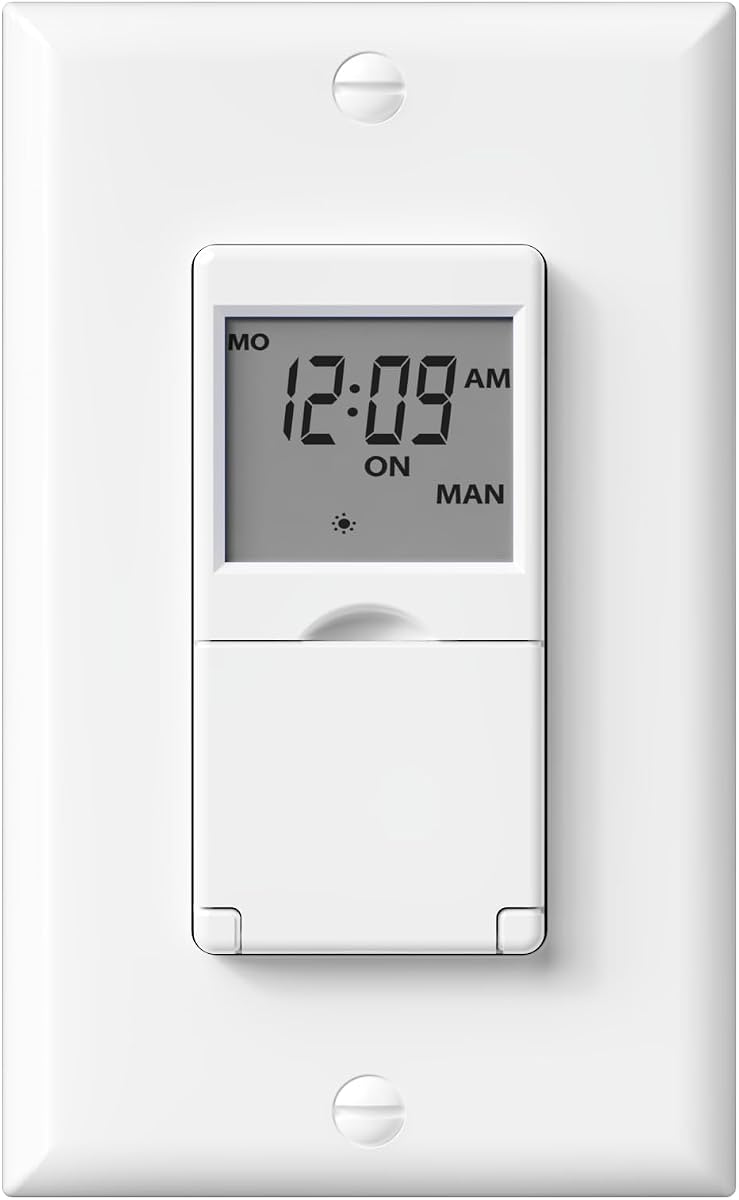


The BN-LINK 7-Day Wall Timer combines flexible daily programming with a familiar in-wall installation, earning a 4.3 rating from the supplied feedback. It supports up to 18 on-off events, individual days, and preset day combinations, making it well suited to households where lighting needs vary throughout the week.
We may earn a commission when you buy through this link, at no additional cost to you.
Its one-minute minimum interval gives it more precision than many basic timers. A blue backlight makes the display easier to see while programming, while the included wall plate helps the finished switch look deliberate. The rechargeable backup battery is especially useful because it can preserve settings during a temporary loss of power.
The switch also includes automatic and manual operating modes, daylight saving time adjustment, and a random vacation mode. That last feature changes the lighting pattern to create the appearance of occupancy. It works with single-pole or 3-way configurations, although a neutral wire is required and 3-way setups must use compatible SPDT switches.
This is a strong choice for homeowners who want more than a simple daily schedule and do not need astronomical sunset tracking. The trade-off is a more involved setup than a mechanical timer or button-based controller. Choose it when detailed programming, outage retention, and multi-location control outweigh installation complexity.
It is especially appropriate for porch lighting, hallways, garages, patios, entryways, and compatible ceiling fans. Buyers should verify the existing wiring, load type, and switch arrangement before purchase. For those who can accommodate the neutral-wire requirement, it delivers a broad and practical feature set at an accessible tier.
With as many as 18 on-off programs and one-minute intervals, the timer can distinguish between weekday and weekend routines. This granularity is valuable when a household needs a brief entry light, an evening exterior light, and a longer fan schedule on different days.
Random mode adds variety to programmed lighting while the home is unattended, and the backup battery helps retain settings during power interruptions. Automatic and manual modes also make it possible to override the schedule when normal control is needed.
We may earn a commission when you buy through this link, at no additional cost to you.
The GE 7-Day Timer Switch offers a straightforward way to automate lighting while accounting for seasonal daylight changes. Its 4.2 rating reflects positive marketplace feedback, and the defining feature is SunSmart technology, which automatically adjusts sunrise and sunset behavior throughout the year.
We may earn a commission when you buy through this link, at no additional cost to you.
The device supports up to seven on-off programs each week. That is enough for many common household routines without requiring the denser programming found on higher-capacity models. Users can assign programs to different days, while the random security feature alters timing by as much as 30 minutes to produce a more natural lived-in appearance.
It is designed as a replacement for single-pole or three-way switches that have a neutral wire. Compatible lighting includes LED, CFL, incandescent, and halogen bulbs, as well as other permanently installed fixtures. The optional daylight saving time setting accommodates clock changes without forcing the user to reprogram the timer.
The main limitation is its smaller program allowance compared with the BN-LINK models that support 18 events per day. It also requires a neutral wire, and anyone planning a 3-way installation should confirm that the existing wiring and switch arrangement meet the product requirements.
Homeowners who want outdoor lights to follow darkness automatically will find the astronomical behavior particularly valuable. It is a sensible recommendation for someone who prefers fewer programs but wants seasonal lighting changes, random away-mode behavior, and broad bulb compatibility.
SunSmart adjusts the astronomical timing for changing daylight conditions, reducing the need to revise a fixed evening schedule. This makes the switch particularly useful for porch, entry, and landscape lighting where operating after dark is more important than at a fixed clock time.
The random security feature shifts programmed timing by up to 30 minutes. Rather than following an identical pattern every evening, the connected fixture can appear to operate naturally while residents are away.
We may earn a commission when you buy through this link, at no additional cost to you.
The BN-LINK Astronomical Wall Timer is built for users who want their lights to respond automatically to local sunrise and sunset times. It carries a 4.4 rating and combines astronomical operation with up to 18 daily programs, seven-day scheduling, and intervals as short as one minute.
We may earn a commission when you buy through this link, at no additional cost to you.
After setup, the switch calculates sunrise and sunset based on the selected time zone. Six preset zones are listed in the supplied information: PAC, MOU, CEN, EAS, HAW, and ALA. This automatic behavior is especially useful for exterior lights that should operate in darkness rather than according to a fixed time that becomes inappropriate as seasons change.
Program users can select individual days or convenient combinations, while daylight saving time mode reduces seasonal clock adjustments. A random vacation mode varies the lighting pattern during absences. The built-in backup battery helps preserve settings if power is interrupted, and a press-and-hold control shifts between automatic and manual operation.
Unlike the more flexible BN-LINK wall timers in this list, this model is designed for single-pole use only. A neutral wire is still required, so it is not a solution for older wiring that lacks one. Users must also choose the correct time zone during setup for reliable astronomical calculations.
The combination of astronomical control and high program capacity makes this a strong option for a household that wants both darkness-based operation and detailed manual schedules. It is best for a single-location installation where accurate location setup can be completed and where neutral wiring is available.
Astronomical operation automatically follows local sunrise and sunset, avoiding the need to repeatedly revise a conventional clock schedule. The correct time zone remains essential because the timer relies on that setting to calculate the appropriate lighting periods.
Despite the astronomical focus, the timer supports 18 daily programs and one-minute intervals. This makes it possible to combine darkness-based operation with scheduled entry lighting, exterior accents, or compatible fan operation.
We may earn a commission when you buy through this link, at no additional cost to you.
The BN-LINK Programmable Wall Timer offers extensive scheduling in a standard in-wall format and holds a 4.2 rating. It supports up to 18 on-off programs across seven days, with intervals that can be as short as one minute, giving users considerable control over lighting and fan routines.
We may earn a commission when you buy through this link, at no additional cost to you.
Daylight saving time mode simplifies seasonal changes. A press-and-hold action switches between automatic scheduled operation and manual control, while the built-in rechargeable battery helps preserve programming during outages. For households seeking more natural activity while away, the random vacation mode varies the operating pattern.
Single-pole and 3-way configurations are supported, making the timer useful in stairways, halls, garages, large rooms, and entryways. The supplied information notes compatibility with SPDT switches and includes a wall plate. Electrical ratings are listed at 15A/1875W resistive, 10A/1250W tungsten, 10A/1250W ballast, and 1/2HP.
Its main omission is astronomical tracking. Lights will follow the programmed clock rather than automatically following darkness, so a user interested in seasonal sunset behavior should choose the astronomical version instead. Installation also requires a neutral wire, which is the most important limitation to verify before buying.
Despite that limitation, the timer is a well-balanced choice for users who want extensive weekly programming, manual overrides, and outage retention without paying for a model with astronomical controls. It is especially useful for porch, patio, hallway, garage, entryway, and compatible ceiling-fan installations.
Individual-day selection and preset day combinations make it easier to align lighting with workdays, weekends, and family routines. One-minute intervals provide precision for short welcome lights or other brief operations.
Single-pole and compatible 3-way arrangements give the timer broader placement options than a basic digital wall switch. Neutral wiring and compatible SPDT switches must be confirmed before installation.
We may earn a commission when you buy through this link, at no additional cost to you.
The Leviton Decora VPT24-1LW is the most feature-oriented choice in this guide, combining a 24-hour schedule with astronomical operation and a countdown function. Its 4.4 rating reflects generally favorable feedback, while the load support and versatile programming distinguish it from simpler wall timers.
We may earn a commission when you buy through this link, at no additional cost to you.
Users can program 10 on-off events by individual day or by combinations of days. The astronomical clock adjusts for sunrise, sunset, and daylight saving time, allowing outdoor-facing schedules to follow changing daylight. A countdown timer adds another layer of control, and randomized timing can create a more natural lived-in appearance during absences.
The switch works in single-pole or 3-way configurations when paired with a suitable 3-way switch. It supports up to 600W of LED or CFL loads, 1800W of incandescent or halogen loads, 15A of resistive or inductive loads, and motor loads up to 1 HP. That range makes it suitable for lighting, ceiling fans, exhaust fans, pumps, and other permanently installed equipment.
A preset six-hour countdown is included to meet CA Title 24 Part 6 and IECC requirements, although local codes and project conditions should always be checked. The switch is intended for indoor installation, requires a neutral wire, and is not described as weatherproof even though it can control outdoor-facing fixtures installed within a suitable enclosure.
This is the premium pick for a homeowner who wants more than a basic schedule, especially if a ceiling fan, pump, or other motor load must be automated. The trade-off is added complexity, a neutral-wire requirement, and an indoor-use limitation, but the range of timing and load controls is unusually broad.
Support for one-horsepower motor loads sets this model apart from many light-focused timers. It can manage compatible fans and pumps in addition to LED, CFL, incandescent, and halogen fixtures, making it useful for broader whole-home automation.
Astronomical adjustment, daylight saving time support, daily event programming, randomized timing, and a countdown function provide several ways to control connected equipment. The six-hour countdown preset can also help with lighting requirements in applicable jurisdictions.
We may earn a commission when you buy through this link, at no additional cost to you.
The BN-LINK 2-Pack Outlet Timer is a convenient alternative for people who want programmable automation without replacing a wall switch. It has a 4.4 rating and includes two digital outlet timers, each with two grounded outlets controlled together.
We may earn a commission when you buy through this link, at no additional cost to you.
Each timer supports as many as eight on-off programs, with intervals as short as one minute. Users can select individual days or convenient preset combinations for a seven-day schedule. A button activates daylight saving time mode, and a long-lasting backup battery is included to help preserve settings if the power is interrupted.
The outlet format makes it useful for lamps, coffee machines, fans, and other compatible equipment. It also has a red LED that indicates when the controlled outlets are on, providing an immediate visual status check. Random vacation mode can vary programmed operation while the home is unoccupied.
Both outlets on each timer are controlled simultaneously, so separate scheduling for individual devices is not possible. Users should also follow the indoor product designation and verify that the load is appropriate for the listed 120V, 60Hz, 15A/1725W rating.
This two-pack is best for renters, older homes without suitable neutral wiring, or anyone seeking a plug-in solution for multiple locations. It sacrifices the clean in-wall appearance of a switch timer and independent outlet control, but it gains simple installation and flexible daily programming.
Because the timers connect to standard grounded outlets, they can be moved between locations without wall-switch replacement. This makes the two-pack useful for temporary seasonal lighting, appliances, fans, and rooms where hardwired control is inconvenient.
A red LED shows when the outlets are active, while the backup battery helps retain programmed settings during a power interruption. The random mode can also make daily operation appear less predictable when the home is empty.
We may earn a commission when you buy through this link, at no additional cost to you.
The BN-LINK Backlit Wall Timer emphasizes ease of programming with a blue backlight and 18 available on-off events. Its 4.3 rating indicates solid marketplace feedback, and the display visibility makes it easier to configure schedules in dim hallways, garages, and utility areas.
We may earn a commission when you buy through this link, at no additional cost to you.
Daily programs can be set for individual days or preset combinations, with intervals as short as one minute. Daylight saving time functionality reduces seasonal clock adjustments. The timer includes a rechargeable backup battery, automatic and manual modes, and a random vacation mode for creating a less predictable pattern while the home is occupied only intermittently.
It is designed for lights and fans in single-pole or compatible 3-way installations. The listed ratings cover 15A/1875W resistive, 10A/1250W tungsten, 10A/1250W ballast, and 1/2HP at 125VAC and 60Hz. A wall plate is included, and the stated operating range is minus 15 to 50 degrees Celsius.
The trade-offs are the familiar requirements of this product class: a neutral wire is mandatory, and the number of available programs can overwhelm a first-time user. It also lacks the automatic sunrise and sunset adjustment found in the dedicated astronomical models.
This timer is a good middle ground for someone who values a highly visible interface and extensive scheduling but does not need astronomical behavior. It is particularly useful for porch lights, entryways, hallways, garages, patios, and ceiling fans that fall within the stated electrical ratings.
The blue backlight illuminates the programming interface, which can be helpful in hallways, garages, and entryways where ambient light is limited. Clear visibility reduces the chance of overlooking active or selected programs.
Eighteen programs and one-minute intervals make it possible to create detailed daily routines. Individual-day control and preset combinations provide flexibility without requiring the same settings to apply to every day.
We may earn a commission when you buy through this link, at no additional cost to you.
The myTouchSmart 26893 stands out with a 4.7 rating, the highest supplied rating among these products. Its button-oriented design makes automation more approachable than a dense digital programming screen, while four schedule buttons and two override buttons offer useful everyday flexibility.
We may earn a commission when you buy through this link, at no additional cost to you.
The four programmable on-off buttons create daily lighting or appliance cycles, and the two additional on-off buttons let users operate the connected fixture outside scheduled periods. Blue LED indicators beside the buttons show which programs are active or selected, providing clear feedback at a glance.
It is compatible with LED, CFL, incandescent, and halogen bulbs, including dimmable LED and dimmable CFL models. The connected load can include ceiling lights, ceiling fans, exhaust fans, patio lights, and other compatible indoor or outdoor lighting or appliances. Screw-terminal installation is designed to provide better space efficiency than flying leads when replacing an existing switch.
A neutral wire is required, and the wall plate is not included. The timer follows 24-hour daily cycles rather than offering the multi-day distinction found on many digital switches, so users who need separate weekday and weekend programming should consider another model. Electrical ratings are listed as 120VAC, 60Hz, 15A general or resistive, 1200W tungsten, 1200VA ballast, and one-half horsepower.
The backup battery is another meaningful advantage because it helps maintain settings during a power outage. For people who want a clear interface, immediate manual control, and uncomplicated daily scheduling, the myTouchSmart 26893 is the most approachable overall choice in this guide.
Dedicated program buttons make common schedules easier to activate and adjust than navigating a densely packed digital menu. The blue indicators clarify the current selection, helping users understand which program controls the fixture.
Two non-programmed on-off buttons allow a household to bypass the schedule whenever necessary. This is valuable for a guest visit, a longer working evening, or any moment when the connected light or fan should remain under direct control.
We may earn a commission when you buy through this link, at no additional cost to you.
The BN-LINK U47 delivers the essential function of an automated light switch timer with no digital menu, battery, or wall wiring. Its 4.4 rating shows that many buyers appreciate its straightforward operation, and the two-pack allows scheduling in more than one location.
We may earn a commission when you buy through this link, at no additional cost to you.
Programming is based on a 24-hour mechanical dial with up to 24 on and off settings per day. Intervals can be as short as 30 minutes. Once configured, the schedule repeats every day, making it a good fit for lamps, small appliances, Christmas trees, and other electrical devices that follow the same routine.
The pins-down setting means the device is on, while pins up means it is off. New timers arrive with the pins pressed down, so users must pull them upward before making a schedule. This convention is different from some mechanical timers, but the supplied instructions make it clear.
The compact three-prong format fits more readily into crowded wall outlets than a bulky digital plug-in timer. Each unit is rated for 125 volts at 60Hz, 15 amps and 1875W resistive, 8 amps and 1000W tungsten, and 5 amps of ballast. Compatibility includes compact fluorescent lighting, LED bulbs, and most small appliances.
This is the best budget option for a user who wants dependable daily automation without an app, display, or electrical work. The trade-offs are coarse 30-minute intervals and the inability to create distinct weekday and weekend schedules. It is better for simple recurring routines than nuanced control.
The mechanical dial has no software, network connection, or battery to maintain. Once the pins are set, the timer repeats the same daily pattern, which can be ideal for a lamp or appliance with a stable routine.
The two-pack provides independent timers for different rooms or devices. Their small three-prong bodies are useful where outlet space is limited, and the 30-minute minimum interval covers many common lighting applications.
We may earn a commission when you buy through this link, at no additional cost to you.
The Honeywell PLS750C1000 is a permanent in-wall timer switch built around sunrise and sunset control. Its 4.6 rating is among the strongest in the supplied feedback, indicating generally favorable customer reception, although the available product information is more limited than for the other models.
We may earn a commission when you buy through this link, at no additional cost to you.
The listing identifies both single-pole and 3-way configurations, giving it flexibility for controlling a fixture from one or multiple locations. Its astronomical focus is the most useful differentiator: outdoor-facing lights can follow darkness rather than relying on a fixed clock schedule that becomes seasonally inaccurate.
Because the switch replaces a standard wall control, it is a better long-term choice than a plug-in timer for a main entrance, porch, garage, or landscape-lighting circuit. It also avoids the need to reserve an outlet for a bulky timer. The permanent format produces a cleaner, more integrated result in frequently used rooms.
The principal drawback is the lack of detailed programming, load, wiring, and feature information in the supplied listing. Buyers should verify the neutral-wire requirement, supported bulb and motor loads, astronomical setup process, and precise 3-way switch compatibility on the current product documentation before installation.
This Honeywell is best considered by someone seeking a high-rated, astronomical in-wall timer who is comfortable confirming electrical specifications before purchase. Its headline features and rating are attractive, but the limited documentation makes careful compatibility checks more important than with the better-explained digital models in this list.
Sunrise and sunset control is particularly useful for entrance and outdoor-facing fixtures. A wall-mounted timer avoids occupying an outlet and keeps automated lighting available continuously.
The supplied information does not detail the timer's load ratings, programming controls, or neutral-wire configuration. Current documentation and the existing switch arrangement should be reviewed to confirm safe, compatible installation.
We may earn a commission when you buy through this link, at no additional cost to you.
The most suitable timer depends on wiring, control preferences, connected loads, and the pattern you need to automate. Use the following factors to narrow the field before comparing installation manuals or current listings.
An in-wall switch timer replaces a conventional switch and looks integrated into the room, while an outlet timer plugs into an existing receptacle. In-wall models suit frequently controlled lights, fans, and permanent fixtures but require compatible electrical wiring. Plug-in models are easier to move and useful for lamps, seasonal decorations, coffee makers, and other devices that do not have a dedicated switch.
Mechanical timers usually repeat one 24-hour schedule and may use coarse 30-minute intervals. Digital timers can offer multiple daily events, one-minute precision, and separate programs for different days. Models supporting 18 events provide room for nuanced routines, while seven or eight programs are sufficient for many households. Consider whether weekday and weekend behavior truly needs to differ before paying for the highest program capacity.
Clock-based timers activate lights at programmed times, which works when routines remain constant. Astronomical timers calculate sunrise and sunset and adjust throughout the year, making them better for porch, landscape, and exterior lights. Some astronomical models also let you create additional manual programs. Remember that the correct location or time zone must be selected for dependable calculations.
Most digital in-wall timers require a neutral wire, which is separate from the hot and load conductors. Homes with older or unusual wiring may not have a neutral at the selected switch box. Three-way installations also require the correct companion switch and wiring arrangement; some models support only single-pole configurations. Confirm the existing wiring before buying, and use a qualified electrician when the installation is unfamiliar.
A light timer may specify separate limits for resistive loads, tungsten or halogen fixtures, fluorescent or electronic ballasts, LED and CFL bulbs, and motors. A motor rating matters if the switch will control a ceiling fan or pump. Never assume that the general amperage figure applies equally to every load type. Compare the fixture label and the timer's detailed rating table, particularly for LED, halogen, and motor installations.
A backup battery or rechargeable power source helps the timer retain its schedule during an outage. This is especially useful when a powered fixture is expected to resume correctly after electricity returns. It does not necessarily keep the connected light operating during the outage, and battery life can diminish over time. Check whether replacement is required and how the memory behaves after a prolonged power loss.
A schedule should not prevent normal operation when someone needs immediate control. Manual overrides, automatic and manual modes, and clearly illuminated indicators make the timer easier to use. Random or vacation modes vary the lighting pattern while the home is empty, which can create a more natural appearance than an identical schedule every evening.
Some in-wall models are rated for indoor use even when they control an outdoor-facing fixture. A suitable exterior-rated enclosure or installation method may be required. Plug-in timers are generally easier to reposition, while mini models can fit crowded receptacles. Consider where the switch will be used, how visible the display must be, and whether children or guests will interact with the controls.
Begin by identifying the load, switch arrangement, and required neutral wire. Read the current installation guide, turn off the circuit breaker, and verify the wiring before touching any conductors. For a plug-in timer, simply plug it into a suitable grounded outlet; for an in-wall model, follow the supplied wiring diagram exactly and use appropriate electrical safety practices.
Program the timer in a clear order. Set the current day and time first, select the correct astronomical location or time zone where applicable, and then create each on-off event. Assign the desired days, check every interval, and activate the automatic mode. Manual or override controls should be tested before relying on an unattended schedule.
For care, use a lightly damp cloth to clean the display and housing, avoid spraying cleaner directly into the device, and keep the controls free of dust and debris. Review the schedule seasonally, especially after daylight saving time or a location change. Check backup-battery behavior periodically and confirm that bulbs, fans, and other loads remain within the stated electrical ratings.
Most digital in-wall timer switches require a neutral wire, although the exact requirement should be confirmed in the product documentation. A neutral wire provides a continuous power path for the timer's electronics and is separate from the switched hot wire. If your switch box lacks one, a plug-in outlet timer may be easier than modifying the existing wiring.
A programmable timer follows clock-based on and off events that you enter manually. An astronomical timer also calculates sunrise and sunset from the selected location, so exterior lights can operate with changing daylight. Astronomical models are particularly useful for porches, paths, gardens, and other fixtures that should switch on after dark.
Several models in this guide are rated for compatible motor loads, while others list a half-horsepower rating. Check the exact fan motor, wattage, and speed requirements against the timer's load specifications. A timer rated only for certain lighting loads may not be appropriate for every fan, especially in a 3-way installation.
Models with a backup battery or rechargeable battery can retain programmed settings when power is interrupted. The connected light or appliance will not necessarily remain powered during the outage, and the timer may pause until electricity returns. Battery longevity and any required battery replacement should be checked as part of routine maintenance.
The BN-LINK U47 mechanical timer is listed as compatible with LED bulbs, compact fluorescent lighting, and most small appliances. Compatibility does not mean every appliance is appropriate, so the device rating still matters. Confirm the wattage, voltage, frequency, and load type before connecting equipment.
Random mode varies when scheduled lights turn on and off instead of repeating an identical pattern every day. This can make a home appear occupied while residents are away. It is a security-oriented convenience rather than a guarantee of intrusion prevention, and it should be used with other appropriate home-security practices.
A simple lamp or appliance that follows the same routine every day may need only a few events. Separate weekday, weekend, and vacation schedules can justify a timer with 10 or 18 daily programs. Choose the program count based on actual routines rather than assuming the largest number offers a meaningful benefit.
Installation difficulty depends on your experience, the wiring, and local electrical requirements. A plug-in timer requires no wall-switch work, but an in-wall model may involve neutral wiring, 3-way companions, and safety testing. If you are unsure how to identify conductors or work safely in the switch box, hire a qualified electrician.
The myTouchSmart 26893 is the most approachable overall option because its four program buttons, two overrides, clear indicators, and backup battery simplify everyday use. The Leviton VPT24-1LW takes the premium lead with astronomical timing, countdown control, and support for lighting and motor loads, while the BN-LINK U47 offers dependable mechanical scheduling without wall wiring.
Prioritize the format and features that solve a real routine. Choose an astronomical model for exterior lighting that should follow darkness, a high-capacity digital model for detailed weekly schedules, or a plug-in timer when avoiding electrical work matters most. In every case, confirm neutral-wire requirements, switch compatibility, and load ratings before installation.
Marketplace ratings, product details, and prices can change over time, so check the current listing and manufacturer documentation before purchasing. Compare the live product page with the guidance here rather than assuming every revision is electrically or functionally identical.