
BURMONG Battery Disconnect Switch
4.2Editor score
275A continuous current capacity
Twelve-to-48-volt system compatibility
Simple 90-degree rotary control
Battery Disconnect Switch guide comparing manual, remote, top-post, side-post, waterproof, and high-current options for cars, RVs, boats, and trucks.
A battery disconnect switch provides a practical way to isolate a vehicle or boat battery, reduce parasitic drain, support maintenance, and discourage unauthorized use. The best model depends on terminal style, current demand, mounting space, environmental exposure, and whether you prefer direct mechanical control or remote operation.
This guide compares ten battery disconnect switches using the specifications and product information supplied for each listing. It covers top-post and side-post designs, rotary and removable controls, automatic low-voltage remote systems, continuous-current ratings, mounting hardware, and applications ranging from cars and trucks to RVs and marine equipment.
Each review explains the standouts, limitations, and most suitable buyer for every switch in the roundup. Ratings and technical details reflect the supplied listing information, while product availability and pricing can change, so readers should confirm current specifications and fit before purchasing.
4.2Editor score

4.7Editor score

4.3Editor score
The comparison below highlights terminal compatibility, control style, current capacity, and practical features so buyers can quickly identify the battery disconnect switch that best matches their vehicle, marine system, and installation requirements.



The Joinfworld Top Post is a conventional two-position disconnect intended for negative battery posts, with the supplied information listing compatibility across 12-to-48-volt systems. Its standout specifications are a 250A continuous rating and 1000A cranking rating, which make it a versatile candidate for cars, trucks, RVs, boats, and other DC electrical systems.
We may earn a commission when you buy through this link, at no additional cost to you.
The installation design combines a negative battery clamp with a tapering post, allowing the original cable arrangement to remain relatively straightforward. Copper components support conductivity, while the high-quality ABS housing is intended to provide durable protection. The switch can also stand alone or be paired with other compatible switches for broader isolation setups.
Its main limitation is that the product listing has no available customer rating, so it does not offer the same feedback signal as higher-rated products. Buyers should also confirm that their battery uses the expected top-post arrangement and that the switch's continuous rating comfortably covers the demands of their electrical system.
This is a practical general-purpose choice for owners seeking a straightforward manual switch without remote electronics. It is especially useful for seasonal vehicles, boats, campers, and trucks that spend extended periods parked and could benefit from an explicit, secure battery-isolation point.
With 250A continuous and 1000A cranking figures, the switch is designed to handle substantial loads while isolating a battery. Always compare those figures with the electrical demands of the connected vehicle or boat rather than assuming every installation requires the same rating.
The stated 12-to-48-volt range covers many automotive, marine, and recreation applications. Its standalone or lockable configuration also gives installers flexibility when a single battery or a more complex battery-bank arrangement is involved.
We may earn a commission when you buy through this link, at no additional cost to you.
This Top Post 12V Switch combines a 4.4 customer rating with a distinctive three-control arrangement: ON, OFF, and remove-knob operation. It is built for negative posts measuring 15 to 17 millimeters, making terminal-size confirmation an essential part of the buying process.
We may earn a commission when you buy through this link, at no additional cost to you.
Nylon 66 and solid brass are the noteworthy materials. According to the supplied listing, Nylon 66 offers more than 30 percent greater strength and flame resistance than the typical ABS used in comparable products, while the brass construction is intended to support conductivity and resist corrosion.
The adjustable mounting angle is a meaningful advantage in crowded engine compartments where a fixed-angle switch may not sit naturally. Buyers can either clamp the switch directly to the battery post or connect both ends with wire lugs, although the exact supplied hardware and connector arrangement should be confirmed before installation.
This model is best for owners who value flexibility and anti-tampering control more than a larger terminal range. It suits compact cars and vehicles with compatible top posts, while those with larger posts should look to the 17-to-19-millimeter rotating-terminal model instead.
Removing the knob leaves the switch in a position that can discourage casual tampering during storage. The control can still return to ON when needed, making it a simple mechanical alternative to a powered remote system.
The movable mounting angle helps cables meet the battery without severe twisting. That flexibility can simplify routing, but the listed 15-to-17-millimeter post requirement remains the decisive compatibility check.
We may earn a commission when you buy through this link, at no additional cost to you.
With a 4.6 rating, the Dual Rotating Terminals Switch is one of the strongest customer-rated options in this roundup. Its defining feature is a pair of terminals capable of rotating 180 degrees, allowing battery cables to align more naturally in tight engine compartments without being forced into an awkward angle.
We may earn a commission when you buy through this link, at no additional cost to you.
The thickened high-purity copper contact structure is designed for stable current flow and reduced resistance and heat associated with poor contact. The included wrench and two washers support a simple installation sequence: remove the negative cable, fit the disconnect, and reconnect and tighten the cable.
Compatibility is specific. The product is intended for 12-to-24-volt systems and SAE top-post negative terminals measuring 17 to 19 millimeters. It is expressly not designed for side-post batteries, positive terminals, or posts smaller than 17 millimeters, so checking the battery before ordering is essential.
This switch is an appealing choice for owners of compatible cars, SUVs, pickup trucks, RVs, campers, box trucks, or boats that need better cable positioning. The rotating construction and straightforward hardware make it particularly attractive for installers working in crowded spaces.
The independently rotating ends address a common top-post installation issue: fixed terminals can force a cable to bend sharply. Aligning each end more naturally may reduce installation strain and support a cleaner connection.
The included wrench and washers support a basic three-step fitting process. The procedure is approachable, although safe battery handling and correct terminal identification are still essential before any connection is made.
We may earn a commission when you buy through this link, at no additional cost to you.
The Nilight 90015A earns the Editor's Choice distinction because it combines the highest supplied customer rating, 4.7, with a well-rounded set of current ratings and environmental protections. It is a two-position on/off master switch for 12-to-48-volt DC systems, designed to isolate a battery when a vehicle or boat is not being used.
We may earn a commission when you buy through this link, at no additional cost to you.
Its ABS housing includes a rear cover intended to insulate terminals against short circuits, while four sets of bolts are included for mounting. The electrical figures distinguish continuous, intermittent, and momentary cranking loads: 275A, 455A, and 1250A respectively at 12 volts.
The design can stand alone or be locked together with other switches, which gives it value in both simple and multi-switch systems. Because it is a physical isolator rather than an automatic voltage controller, it requires the user to remember when power should be cut, and the proper mounted orientation should be followed.
This is the most balanced recommendation for many buyers because it combines meaningful customer feedback, robust current specifications, broad voltage compatibility, and a waterproof-oriented design. It is a strong fit for cars, RVs, campers, trailers, trucks, ATVs, UTVs, boats, and battery banks.
Separate continuous, intermittent, and momentary figures make it easier to compare the switch with the way it will be used. Continuous capacity matters most for sustained loads, while the higher cranking figure is intended for short engine-starting bursts.
The insulating rear cover and waterproof construction are valuable in engine compartments and marine environments. These features do not eliminate the need for sound mounting, but they improve the switch's suitability for exposed installations.
We may earn a commission when you buy through this link, at no additional cost to you.
The Compact 300A/900A Switch stands out for its small installation height, listed at only 1.5 inches, and its 4.3 customer rating. Its 300A continuous and 900A cranking ratings are among the stronger figures in the group, while the IP66 rating adds confidence for exposed automotive and marine locations.
We may earn a commission when you buy through this link, at no additional cost to you.
The package includes an installation guide, disconnect switch, SAE female negative battery clamp, SAE male negative terminal post, and adjustable spacer. A large red knob makes the on/off state easy to identify, and the knob can be removed to discourage unauthorized operation.
The compact design is particularly helpful beneath a hood where hood clearance is limited. However, buyers should still verify available space rather than assuming every installation will accommodate the switch and its terminals. The product description also warns that disconnecting system power may erase settings stored by electronic equipment such as a radio.
This is the best premium-style option for owners who need a compact, high-current, waterproof switch with a removable control. It is particularly suitable for tightly packaged installations in cars, trucks, RVs, and boats, provided the electrical system does not rely on memory that must persist through every power interruption.
The 1.5-inch height directly addresses an installation constraint that can rule out larger switches. Measuring the hood, cable path, and battery surroundings before purchase helps avoid surprises.
The IP66 rating strengthens the switch's suitability for wet or dirty environments, while the removable red knob provides a visible and physical means of preventing casual use. The complete hardware package also supports a more organized installation.
We may earn a commission when you buy through this link, at no additional cost to you.
The RVBOATPAT is a 12-volt remote battery disconnect switch rated at 240A continuous and 1000A instant current. Its defining benefit is automatic protection: the supplied information states that the switch cuts power at a critically low 11.8V, helping reduce deep discharge during long parking periods.
We may earn a commission when you buy through this link, at no additional cost to you.
A magnetic latching relay is designed to consume only 3mA in standby mode, which addresses a common concern with remote battery controls. The system also disables the remote during engine cranking or when voltage exceeds the stated safe range, helping prevent an accidental power interruption while the vehicle is operating.
Compared with a purely mechanical rotary switch, this model adds electronic monitoring and remote convenience, but it also requires a more involved installation and introduces dependence on its control logic. Its stated operating system is 12 volts, so it is less broadly compatible than switches designed for 12-to-48-volt systems.
This switch is well suited to owners of 12-volt cars, trucks, RVs, and boats who want both manual remote convenience and automatic low-voltage isolation. It is particularly attractive for vehicles that remain parked long enough for forgotten accessories or standby electronics to become a meaningful source of drain.
The 11.8-volt cutoff threshold is intended to intervene before a battery becomes deeply discharged. This automation is more convenient than relying entirely on the owner to activate a manual switch before every extended absence.
Disabling the remote during cranking and at higher operating voltages helps avoid an unintended shutdown. Those interlocks are a meaningful advantage over a simple remote that can always send a command.
We may earn a commission when you buy through this link, at no additional cost to you.
This Remote Anti-Theft Switch combines remote operation with a manual control option, giving owners a way to isolate the battery and an emergency method for working around the electronic system. Its supplied 4.3 rating indicates generally positive customer feedback without leading the roundup.
We may earn a commission when you buy through this link, at no additional cost to you.
The automatic protection logic disconnects power after 120 seconds when voltage falls below 11.8V. The remote is disabled above 13.2V, which the product description associates with the driving state and is intended to reduce the chance of an accidental shutdown while the vehicle is being used.
The mechanical magnetic switch has a stated standby current of 0.003A, addressing parking drain. Even so, a remote system is more complex than a mechanical isolator, and the delay means the low-voltage cutoff is not instantaneous. Users should understand the thresholds before depending on the automatic behavior.
The switch is a good fit for a 12-volt car or truck owner who values the deterrent of remote disconnection and appreciates having manual backup. It is especially useful for long-term parking where electronics, aging wiring, or forgotten lighting could otherwise contribute to unwanted discharge.
Remote operation makes routine isolation convenient, while the manual option can provide an alternative during emergencies or electrical work. Having both approaches gives the owner more ways to manage the same battery system.
The stated standby consumption is small, but the 120-second delay should be considered when interpreting the 11.8-volt threshold. The system is designed to monitor a low-voltage condition before opening the power path.
We may earn a commission when you buy through this link, at no additional cost to you.
The Joinfworld Side Post is intended for a distinct installation need: vehicles and marine systems whose batteries use side terminals rather than top posts. It carries a 4.3-star user feedback in the supplied listing and is rated at 275A continuous, 455A intermittent, and 1250A for cranking.
We may earn a commission when you buy through this link, at no additional cost to you.
Two 3/8-inch M10 studs allow the switch to connect to side-post battery hardware. Copper conductive-sheet mounting brackets are included, and the product description says these can be connected directly without additional parts, simplifying the installation compared with adapting a top-post model.
As with other unrated listings in this roundup, the absence of an available customer rating means buyers cannot draw on a visible feedback score. The side-post design is also more specialized, so it is less flexible for people who are unsure of their battery's terminal configuration. Incorrect assumptions can lead to a poor match.
This is a sensible choice for owners of a compatible side-post car, boat, RV, camper, trailer, truck, ATV, UTV, or battery bank. The insulating rear cover, copper hardware, and high current figures make it particularly relevant where environmental protection and dependable isolation both matter.
The mounting bracket and stud layout are designed around side-post batteries, avoiding the need to force a top-post switch onto an incompatible terminal. Identifying the battery type beforehand remains the most important part of this purchase.
The rear cover is intended to insulate terminals against short circuits, and the 12-to-48-volt range fits many marine systems. Copper conductive components support the switch's high-current role in demanding installations.
We may earn a commission when you buy through this link, at no additional cost to you.
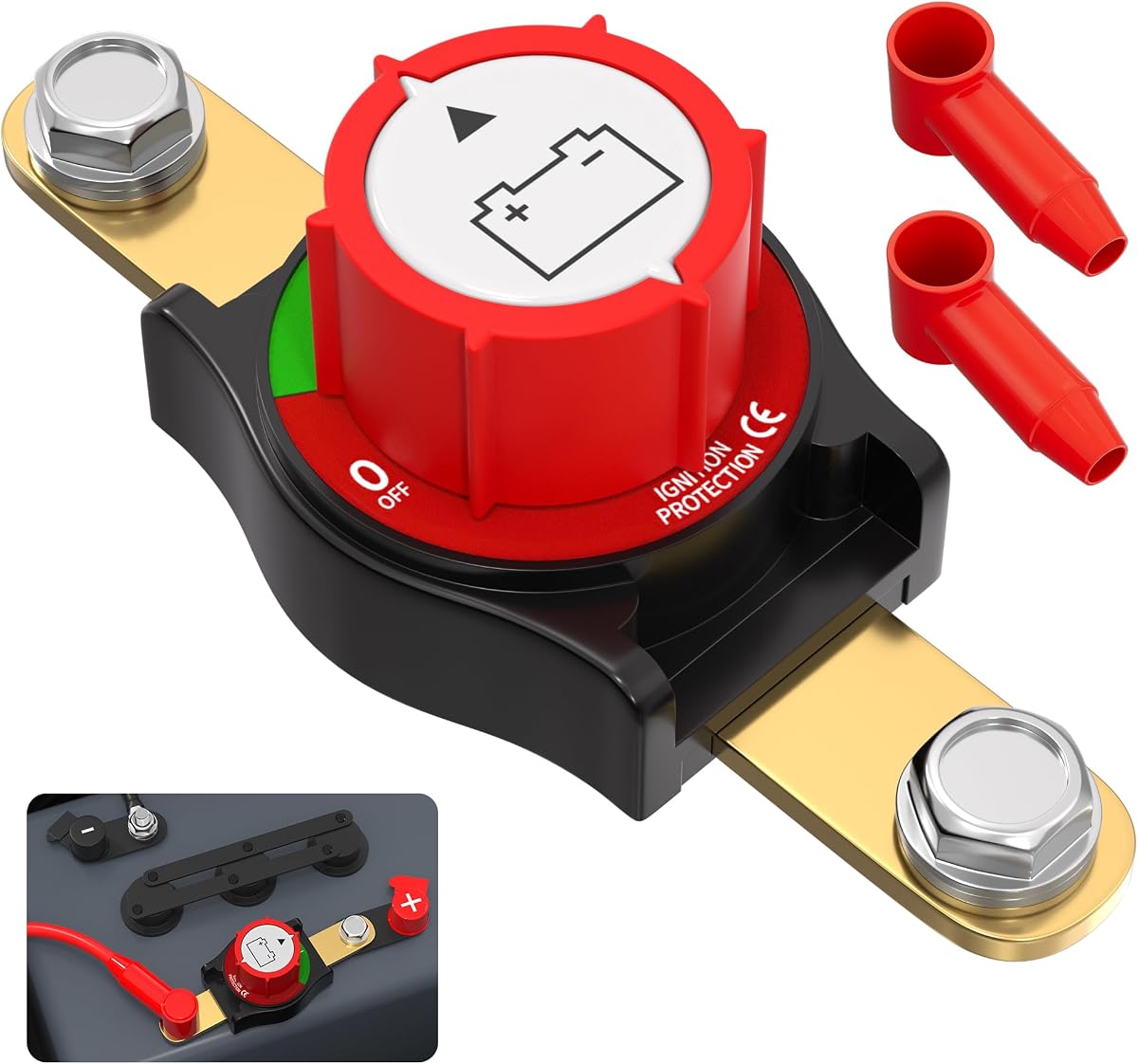
The BURMONG Universal Switch is a straightforward manual isolator for 12-to-48-volt systems, with a 4.2 customer rating and a listed continuous capacity of 275A. It offers the core function sought by most battery-disconnect buyers without the complexity of remote electronics.
We may earn a commission when you buy through this link, at no additional cost to you.
Its 90-degree movement between ON and OFF gives users a clear manual control. A solid brass or copper clamp and high-quality ABS housing are described as corrosion-resistant, while the bolt-on format is designed for installation with basic tools. The product is generally mounted at the negative terminal for safety.
The main drawback is that the supplied specifications do not provide a separate cranking or momentary-current figure. That makes it harder to compare its short-duration performance directly with switches that list 900A, 1000A, 1250A, or other cranking capacities. Buyers with unusually high starting loads may prefer a model with more complete data.
This is the best budget-oriented recommendation for a straightforward car, truck, RV, boat, camper, or ATV installation within the stated voltage and current limits. Its value comes from delivering familiar rotary isolation, useful materials, and broad application coverage without electronic complexity.
A physical 90-degree control is immediately understandable and can be checked at a glance. It also avoids the standby draw and control complexity associated with remote battery disconnect systems.
The 12-to-48-volt range and 275A continuous capacity suit many common systems. A bolt-on installation and conductive clamp make this a practical option when the priority is straightforward isolation rather than advanced monitoring.
We may earn a commission when you buy through this link, at no additional cost to you.
This two-pack provides two manual rotary battery disconnect switches in one package, making it distinctive in a roundup dominated by single-switch listings. It supports 12- and 24-volt systems and carries a 4.0 customer rating, placing it at the lower end of the supplied ratings.
We may earn a commission when you buy through this link, at no additional cost to you.
Pure copper contacts are the central construction feature, intended to support high conductivity, low resistance, and stable power flow. The switches rotate 90 degrees to connect or disconnect battery power, with no electronic control or standby draw involved in their operation.
The supplied information does not list a continuous or cranking current rating, which is an important omission for high-load installations. The pair is most attractive when two independent battery-isolation points are genuinely useful, such as separate circuits in an RV, truck, boat, or trailer. Buying two units for routine single-battery use offers little added value.
This product is best for installers seeking simple mechanical isolation across a multi-battery setup. Its compact form and basic-tool installation make it approachable, but buyers handling high-current starters or substantial loads should verify current capacity with the manufacturer before relying on it.
The two-switch configuration can support separate isolation points or provide a spare. It is most useful when an electrical architecture genuinely calls for more than one control point rather than a single battery connection.
Pure copper contacts and direct rotary operation focus on a simple mechanical connection. There is no remote module to configure, and the switch itself has no battery-powered standby function.
We may earn a commission when you buy through this link, at no additional cost to you.
The right battery disconnect switch depends on more than a broad vehicle label. Terminal geometry, load requirements, environmental exposure, installation space, and control preferences should guide the decision before comparing appearance or extra features.
Battery terminal compatibility is the first practical filter. Top-post switches generally clamp over a post rising from the battery, while side-post models use threaded studs and mounting brackets. Several products in this roundup specify accepted post diameters, including 15 to 17 millimeters and 17 to 19 millimeters, and one model is expressly limited to negative top posts.
Measure the battery post and inspect its shape before ordering. Also verify whether the intended connection is on the negative side, since most installation guidance places the disconnect at that terminal. A visually similar battery can still use an incompatible post size or side-terminal layout.
Continuous-current and cranking-current figures describe different jobs. A continuous rating indicates the load the switch can carry for an extended period, while a momentary or cranking rating covers short bursts associated with engine starting. The roundup includes 250A, 275A, and 300A continuous ratings, with some products also stating 900A, 1000A, 1250A, or 455A for other duty conditions.
Compare the ratings with the starter, alternator, accessories, and any load-bank equipment connected to the battery. If a listing omits a relevant rating, do not assume it is equivalent to a model with a published figure. For unusually demanding systems, complete technical documentation is more useful than broad compatibility language.
Manual rotary switches are simple, dependable, and easy to inspect. Removable knobs add a physical deterrent to casual use, while remote models allow the battery to be isolated without reaching into the engine compartment. Remote switches can also include automatic low-voltage cutoff, driving-state interlocks, and manual emergency controls.
Choose a manual model for simplicity and the lowest chance of control-electronics complications. Choose a remote model when convenience, anti-theft deterrence, or automatic discharge protection justifies additional wiring and installation work. Check the standby current and operating thresholds of any remote system before installing it for long-term storage.
A switch can have the right electrical rating and still fail as a practical choice if it does not fit. The compact product in this roundup is only 1.5 inches high, while adjustable-angle and rotating-terminal models offer ways to align cables in crowded compartments. Side-terminal and top-terminal layouts also change the space needed for brackets and cable movement.
Measure clearance beneath the hood or within a battery box, then trace the path of the existing negative cable. Look for adequate room for the switch body, terminals, wrench access, and protective covers. Correcting an awkward installation after mounting is considerably more time-consuming than checking it beforehand.
Engine compartments and marine installations expose switches to moisture, salt, dust, and temperature changes. The Nilight has a waterproof-oriented rear terminal cover, the compact 300A model has an IP66 rating, and the side-post model includes an insulating cover intended to reduce short-circuit risk. Other products emphasize brass, copper, or corrosion-resistant clamps.
Protection matters most where water and conductive debris are likely. Review the housing, terminal cover, fastener materials, and stated environmental rating together. A waterproof label should not be treated as permission to leave connections loose or exposed, since the quality of the installation remains essential.
A master battery switch disconnects the whole electrical system, not merely a single accessory circuit. The compact switch's description specifically warns that electronic devices storing information, such as a radio, may lose memory each time the switch is turned off. Other settings, clock displays, pairing data, or vehicle functions can also be affected depending on the vehicle.
Test or learn the vehicle's behavior before making the switch a regular habit. Some owners choose to isolate the battery only during extended storage rather than every time they drive. If the switch is used frequently, account for the inconvenience of resetting electronics and preserve any important information beforehand.
The completeness of the package can materially affect installation. The dual rotating model includes a wrench and washers; the compact 300A product includes a clamp, terminal post, adjustable spacer, and guide; the Nilight includes four sets of bolts. Other products may require the installer to provide suitable cable lugs or additional fasteners for a particular configuration.
Compare the included pieces with the battery arrangement before purchase. A clamp-on installation may be sufficient for a straightforward negative-terminal connection, while a custom cable setup can require lugs, longer cable, extra fasteners, or a different mounting approach. Matching the hardware to the planned method prevents an incomplete installation.
Begin by identifying the battery type, terminal polarity, cable size, and the location where the switch will be mounted. Disconnect power before installation, remove the negative battery cable, and follow the manufacturer's orientation and torque instructions. Avoid creating sparks near batteries and make sure the switch cannot be turned on while the circuit is open.
To isolate the battery, rotate or remove the control according to the product design, then confirm that the intended circuits are no longer receiving power. Remote systems should be tested for their low-voltage cutoff, driving-state interlock, and manual override. Reconnect power only after every terminal is secure and the switch is positioned so it cannot be accidentally operated.
Inspect the switch periodically for looseness, corrosion, heat discoloration, damaged insulation, or moisture around the terminals. Clean the battery posts and reconnect any accessories that need to remain powered. Recheck the fit periodically, especially on vehicles exposed to vibration, and replace the switch if contacts become loose or the enclosure is damaged.
Most vehicle battery disconnect switches are installed on the negative terminal. This helps reduce the chance of a tool contacting a grounded metal surface and creating a spark while the battery remains connected. Some specialized systems may use another arrangement, so installers should follow the product instructions and consult a qualified technician when the configuration is unclear.
A purely mechanical switch does not require standby power and normally draws no current while switched. Remote models can have a small standby draw, although the magnetic-latching products in this roundup list very low consumption. A remote switch can also automatically disconnect at a low-voltage threshold, which helps limit long-term parking drain.
A manual switch should be turned to the appropriate operating position before the vehicle is driven, and it should not be activated while the engine is running. The remote models in this roundup include interlocks that disable operation during cranking or at higher operating voltages. Those safeguards are intended to prevent an accidental shutdown while the vehicle is in motion.
A top-post battery has cylindrical posts protruding vertically from the battery case, while a side-post battery has connections on the sides. The most reliable method is to measure the post diameter and compare it with the product specification. Do not rely solely on the battery's shape, because cases and terminal arrangements vary among manufacturers.
The switch should have a continuous rating appropriate for sustained connected loads and a cranking rating that covers the starter's short high-current demand. Comparing the complete vehicle load is more informative than focusing on one number. A listing that omits current ratings may be adequate for a light application, but it should not automatically be treated as equivalent to a fully specified high-current switch.
It can. A switch that isolates the entire battery also removes power from electronics that retain settings in memory. The compact 300A/900A product explicitly notes that stored information may be lost each time power is switched off. Check the manufacturer's instructions and be prepared to reset radio presets, clock functions, or other settings after disconnection.
Water resistance varies by model. The compact 300A/900A switch has an IP66 rating, while the Nilight and side-post options describe waterproof or insulating terminal-cover features. Buyers should still check the exact rating, mounting orientation, and seal condition, because a water-resistant housing cannot compensate for loose terminals or an improperly fitted cover.
A remote switch is more convenient and may provide automatic low-voltage cutoff, but it requires more wiring and depends on its electronic controls. A manual rotary switch is simpler, has no standby consumption, and can be inspected at a glance. The better choice depends on whether convenience, automatic protection, or mechanical simplicity matters most in the intended installation.
The Nilight 90015A is the strongest all-around recommendation because it pairs a 4.7 rating with detailed current specifications, terminal insulation, and broad 12-to-48-volt compatibility. The BURMONG switch offers the best budget approach, while the compact 300A/900A model earns the premium recommendation for its high-current rating, IP66 protection, removable knob, and space-conscious height.
The right choice for a particular vehicle still depends on the battery connection. Top-post owners should verify post diameter, side-post owners should choose a dedicated stud-and-bracket design, and high-current users should compare both continuous and cranking figures. Remote systems add convenience and automatic protection, while simple rotary models remain attractive for their mechanical clarity.
Before buying, measure the terminal and available clearance, review the complete installation package, and consider whether vehicle electronics will tolerate repeated power removal. Product specifications and availability can change, so confirm the current listing details and current price before making a final purchase.
