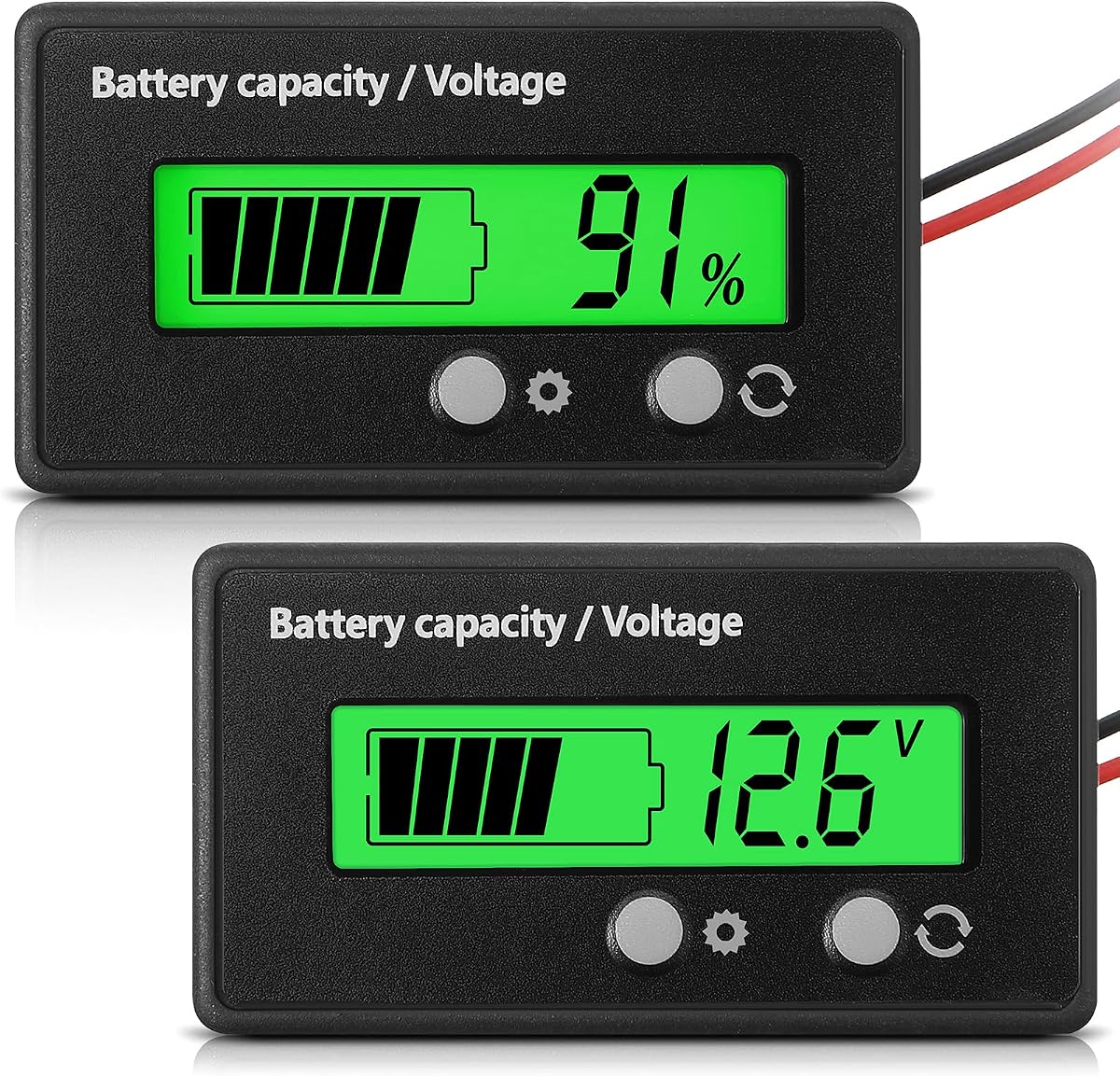
Frienda 12V-84V Battery Monitor
4.1Editor score
Voltage and percentage display
Low-capacity flashing alarm
Supports 12V through 84V
Configurable battery chemistry
Explore the best battery meter for golf carts and compare voltage range, displays, alerts, waterproofing, compatibility, and installation features.
A battery meter for golf carts helps riders see remaining charge, voltage, and low-battery warnings before a weak pack cuts the outing short. The best meter matches the cart’s battery chemistry, voltage, and installation needs while remaining readable in sunlight and dependable around dust, moisture, and vibration.
The products in this guide were compared using their stated voltage ranges, supported battery types, display formats, alarm functions, waterproof ratings, power consumption, memory features, and installation options. The list covers LED bar gauges, digital LCD monitors, and multifunction units suitable for common lead-acid and lithium-powered golf carts.
Each review explains the standout features, practical trade-offs, and likely buyers for that model, with the top three highlighted separately. Product details and availability can change, and prices fluctuate frequently, so readers should verify the current listing and compatibility information before purchasing.
4.1Editor score

4.8Editor score

4.2Editor score
The comparison below highlights each meter's display type, voltage coverage, battery compatibility, and most useful alert or installation features, making it easier to match a monitor to a particular golf cart setup.



The IPX7 Waterproof 7-100V Battery Monitor combines a wide measurement range with temperature reporting and programmable voltage alarms. It earns a 4.2 rating and stands apart from basic LED bar gauges through its enclosed housing, seven-to-100V range, and support for high-voltage custom configurations.
We may earn a commission when you buy through this link, at no additional cost to you.
Its strongest features are flexibility and monitoring depth. The unit works with ternary lithium, lead-acid, AGM, and LiFePO4 batteries, while the short M-key press switches between voltage and Celsius temperature. Low- and high-voltage buzzer thresholds can be configured, and the power-off memory retains those settings when power is removed. A mounting bracket, double-sided adhesive, and screws support several installation approaches.
The trade-off is that this is not a fully automatic plug-and-play gauge. The instructions require an initial setup, and the product note warns that an incorrect configuration may leave the percentage reading at 100%. Buyers must also decide whether an audible alarm fits their environment, since the buzzer could be intrusive in quiet settings or workshops.
This meter is well suited to owners of modern carts with mixed battery technologies, custom voltage packs, or a need for temperature information. It is also attractive for outdoor installations where the fully enclosed IPX7 shell offers stronger moisture protection than a basic panel gauge. For those who read the instructions and configure it correctly, the feature set makes it a premium choice.
Showing both voltage and temperature helps distinguish a simply low charge from a broader electrical condition. Temperature context can also make the meter more informative during long drives, charging, or storage in changing weather.
The included bracket, screws, and adhesive allow the meter to be mounted on a panel, bracket, or another suitable surface. Its twenty-three-and-a-half-inch leads also provide more routing flexibility than a very short fixed cable.
We may earn a commission when you buy through this link, at no additional cost to you.
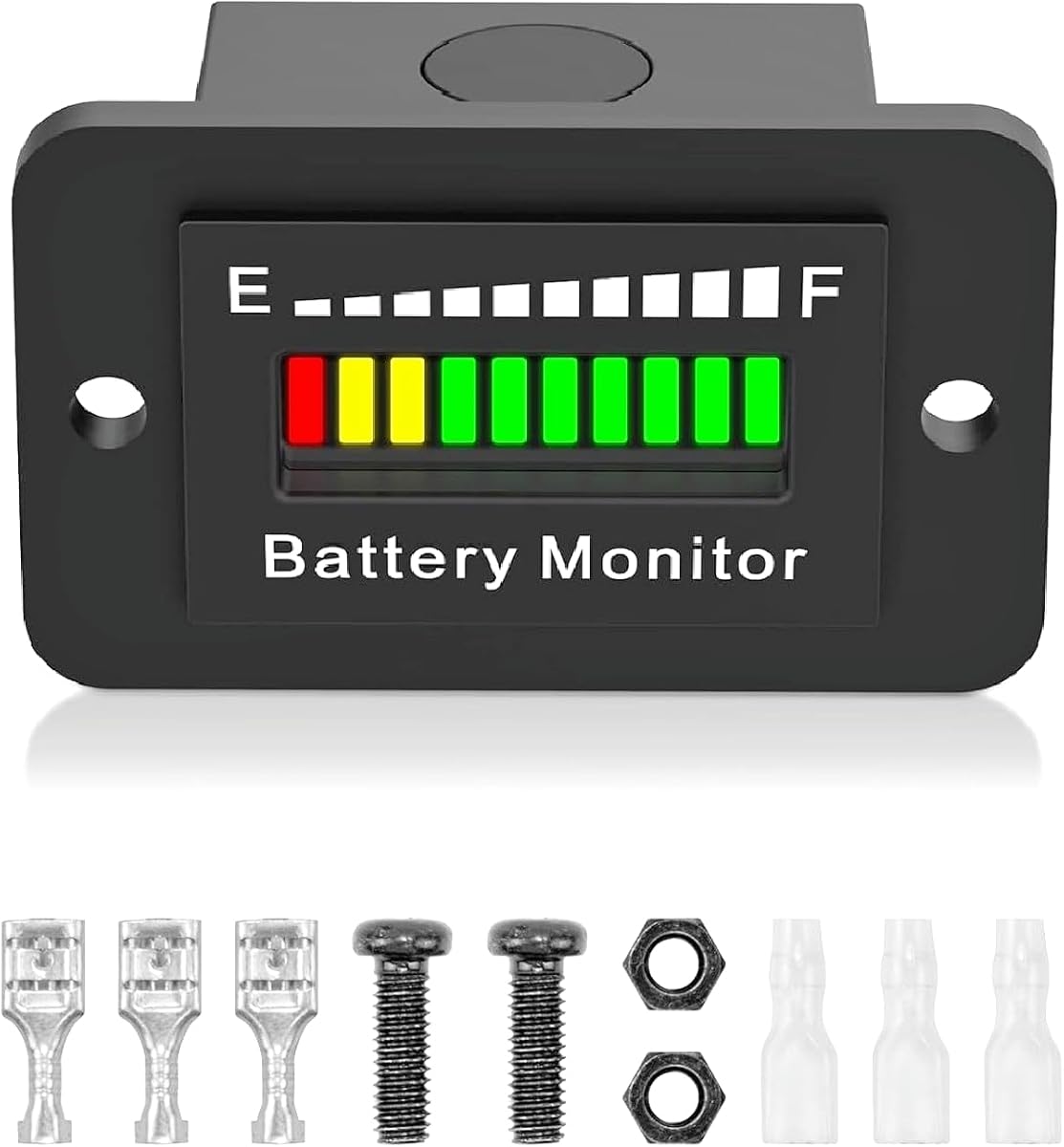
The 12V-24V-36V-48V-60V-72V LED Gauge is a straightforward visual monitor for golf carts and other battery-powered vehicles. Its 4.1 rating reflects a generally practical feature set, with a ten-segment LED display, selectable system voltage, reverse-polarity protection, and an IP65-rated housing.
We may earn a commission when you buy through this link, at no additional cost to you.
The display uses one red, two yellow, and seven green segments to represent ten-percent increments. This makes charge status understandable at a glance without requiring the rider to interpret a number. The meter supports lead-acid and lithium systems and can be connected directly or through a key switch. A bright backlight and PVC screen protector improve visibility from different angles.
Its main limitation is the absence of a numeric voltage readout, which makes it less useful for detailed troubleshooting. Some users may also find the installation process more involved because the stated panel cutout is 37 by 25 millimeters. As with many adjustable gauges, choosing the correct voltage and battery type is essential to avoid a misleading display.
The gauge is a good fit for riders who prefer a large, simple indicator over a detailed digital menu. It suits EZGO, Club Car, and other cart configurations within its voltage range, as well as boats, forklifts, scooters, and sightseeing vehicles. For straightforward charge awareness and clean dashboard integration, it remains a practical choice.
Ten color-coded segments make the meter useful for quick checks before leaving a parking area or beginning a long route. The rider can identify a declining charge without navigating several display modes.
The unit can sit in an existing compatible slot or be installed through a specified panel cutout. Connection through either a key switch or keyless arrangement lets owners control when the gauge receives power.
We may earn a commission when you buy through this link, at no additional cost to you.
The Universal LED Battery Level Indicator is designed around the charge information a typical golf cart rider needs most: a quick visual estimate of remaining power. It holds a 4.0 rating and supports a wide selection of lead-acid and lithium formats, including three-to-fifteen-series lithium-ion packs.
We may earn a commission when you buy through this link, at no additional cost to you.
Its ten-segment display provides ten-percent steps, with red, yellow, and green zones that make changing charge levels easy to recognize. A bright backlight and clear screen protector help preserve visibility outdoors, while maximum operating consumption is listed at five milliamps. Direct and key-switch connections give owners flexibility in how the meter is powered.
The main concern is configuration. The manufacturer explicitly warns that a display stuck at full power may result from an improper setup or incorrect voltage code, requiring the user to consult the instructions and adjust the setting. Because it does not show a numeric voltage, a rider also cannot use it for precise electrical diagnosis.
This meter is best for owners with a varied battery setup or a cart using a less common chemistry within the supported range. It also fits riders who want a simple dashboard gauge rather than a programmable diagnostic display. Correct setup and familiarity with the coding chart are essential to getting the most from it.
The unusually broad battery list includes ternary lithium, lithium iron phosphate, lead-acid, storage, and water batteries. That makes the meter useful for carts converted from one battery type to another.
The backlit LCD and protected viewing surface help riders see the colored bar graph in bright or dim conditions. The low-power design also limits the effect of a permanently connected monitor.
We may earn a commission when you buy through this link, at no additional cost to you.
The Frienda Golf Cart Battery Meter is an affordable, compact option for riders who want both numerical information and a low-battery warning. It carries a 4.1 rating and covers systems from 12V through 84V, making it unusually flexible for the product category.
We may earn a commission when you buy through this link, at no additional cost to you.
A front button cycles between voltage and battery percentage, while additional controls manage the backlight, sleep mode, and battery type. The low-capacity alert flashes when charge becomes critically low, which offers a useful warning before a complete discharge. Lead-acid, ternary lithium, Li-ion, and AGM batteries are among the supported types.
The central trade-off is that accurate readings depend on selecting the right battery code, as the manufacturer specifically notes. The alert is also centered on a critically low state rather than offering the customizable upper and lower buzzer thresholds found in more specialized monitors. Users who want exact voltage first and alert thresholds second may find another model better aligned.
Despite those limitations, this is a compelling budget purchase for owners of common 36V, 48V, or 60V carts who want more information than a simple LED bar. It also applies to e-bikes, scooters, motorcycles, trolling motors, RVs, and solar installations within the stated range. For a small, straightforward monitor with an integrated warning, it serves its purpose well.
A flashing low-capacity indicator gives the rider a clear prompt to reduce driving demands or recharge. This can help avoid the abrupt loss of power associated with allowing a battery pack to become deeply depleted.
The broad voltage range makes the unit useful beyond standard golf carts. Buyers can match the battery code and voltage to motorcycles, RVs, solar setups, and other compatible electrical systems.
We may earn a commission when you buy through this link, at no additional cost to you.
The 12V-84V Bracket Voltage Meter offers a balanced mix of readable diagnostics, outdoor protection, and installation hardware. It has a 4.2 rating and measures across a DC seven-to-100V range, covering 12V, 24V, 36V, 48V, 60V, 72V, and 84V systems.
We may earn a commission when you buy through this link, at no additional cost to you.
Its backlit LCD presents both voltage and remaining power, giving users more detail than a ten-segment LED gauge. A low-voltage warning activates below ten percent, and power-off memory restores the previous settings and data state after the supply is interrupted. The IP67 rating provides dustproof and waterproof protection for exposed cart installations.
Its omission of temperature measurement may matter to owners who want more diagnostic context, but otherwise the feature set remains focused. Buyers also need to select the correct battery type and voltage before trusting the capacity estimate. The included nuts and bracket simplify mounting, although the dashboard space and wiring route still require planning.
This meter is well suited to outdoor carts where a backlit numerical display and stronger sealing are priorities. It also works with lithium packs, LiFePO4 batteries, lead-acid batteries, solar batteries, cars, and motorcycles within the stated limits. For owners who want clear information and dependable configuration retention, it is a strong general-purpose choice.
The backlit screen displays both voltage and remaining capacity, making it useful before driving in darkness as well as during daylight. The dual information also helps riders distinguish a low reading from a setup issue.
An IP67 enclosure helps protect internal electronics from dust and water exposure. That level of protection is especially relevant to carts stored outdoors, driven through damp grass, or washed with a hose during routine maintenance.
We may earn a commission when you buy through this link, at no additional cost to you.
The Green Backlight LCD Meter is a compact digital monitor that shows either voltage or estimated battery percentage. Its 4.1 rating reflects a versatile display and broad battery support, including DC 12V-84V lead-acid systems and three-to-twenty-six-series lithium batteries.
We may earn a commission when you buy through this link, at no additional cost to you.
The right switch cycles through voltmeter, percentage, and off positions, while the left setting key handles backlight, sleep mode, display selection, and battery type. A large LCD with a green backlight makes numerical information accessible at night, and the stated maximum operating consumption remains low. Reverse protection is included for safer wiring.
Its most noticeable omission is a dedicated low-battery alarm. Riders who want an audible or flashing warning must watch the display more closely, which makes it less reassuring for extended trips. The product also describes a PVC film and surface waterproofing without providing a formal IP rating, so buyers who require a specific ingress rating may prefer a model with one.
The meter fits riders seeking a small, adjustable digital display rather than an LED dashboard gauge. It is compatible with ternary lithium, polymer, lithium-ion, storage, and lead-acid batteries. For owners comfortable navigating a few control functions, it provides useful voltage information in a compact form without a complicated installation.
Switching between voltage and percentage lets the rider choose a detailed electrical reading or a simpler estimate of remaining energy. The green backlight improves visibility in low-light conditions.
A built-in thirty-centimeter cable simplifies the basic connection process. Reverse-polarity protection reduces the risk of component damage if the leads are accidentally reversed.
We may earn a commission when you buy through this link, at no additional cost to you.
The DIP Switch LED Monitor provides a familiar color-coded charge display with flexible mounting options. It has a 4.2 rating and supports 12V, 24V, 36V, 48V, 60V, and 72V systems for golf carts, motorcycles, electric carts, lawn equipment, forklifts, and other vehicles.
We may earn a commission when you buy through this link, at no additional cost to you.
Its ten LED segments represent ten-percent capacity increments, with one red, two yellow, and seven green lights. On startup, all segments flash three times to confirm initialization before the meter identifies the current level. The DIP switch selects the cart's voltage, and the product listing notes that a mismatch will not create a short circuit.
The absence of numerical voltage and percentage data limits its usefulness for detailed troubleshooting. A rider also has to consult the voltage chart and physically set the DIP switches correctly. Nevertheless, for simple at-a-glance charge awareness, the display is immediately understandable and less complicated to interpret than a digital menu.
Installation is a notable strength because the gauge can fit an existing slot or be mounted with a specified 37-by-25-millimeter cutout. It may also simply be positioned where visible. It is a good fit for Yamaha, EZGO, Club Car, and other cart owners who prefer a bold LED indicator and straightforward wired installation.
The meter can be inserted into a compatible dashboard slot, attached to a prepared cutout, or simply mounted where it remains visible. That range makes it easier to accommodate carts with different dashboard designs.
The color progression communicates a falling charge without requiring interpretation of percentages. A rider can quickly recognize when fewer green segments remain and plan to charge sooner.
We may earn a commission when you buy through this link, at no additional cost to you.
The 12V-72V Digital Monitor combines broad compatibility with a clear real-time display and strong customer feedback, earning the highest rating in this roundup at 4.8. It supports standard golf-cart voltages from 12V through 72V and accommodates lithium-ion, lead-acid, LiFePO4, storage, and flooded batteries.
We may earn a commission when you buy through this link, at no additional cost to you.
Its high-definition display monitors capacity digitally and uses a bright backlight behind a PVC waterproof screen protector for viewing from multiple angles. To configure it, users long-press the three-second button and adjust the voltage to match the cart. Direct and ignition-switch wiring methods support both permanent dashboard use and more controlled activation.
As with other adjustable meters, the display should not be trusted until the correct voltage is selected. Digital readouts also take slightly more attention to interpret than a simple row of colored LEDs. Even so, the combination of detailed information, protective construction, reverse-polarity protection, and installation accessories creates a balanced package for a wide range of electric vehicles.
This is the strongest all-around recommendation for riders who want accurate-looking digital feedback and broad compatibility. It fits Yamaha, Club Car, and EZGO carts, as well as motorcycles, lawn trimmers, sightseeing vehicles, forklifts, stackers, and other electric equipment. Buyers should complete the three-second setup carefully and verify the reading before relying on it during a trip.
The digital screen presents live battery capacity, which can be more informative than a rough visual estimate. Backlighting and the protected display surface support convenient viewing in varied conditions.
The supported voltage selection and battery chemistries cover many common golf-cart configurations. Direct connection is convenient for a dedicated gauge, while ignition-switch connection can reduce unnecessary display activity.
We may earn a commission when you buy through this link, at no additional cost to you.
The BM210 is a ten-segment LED gauge intended for golf carts and a broad range of other battery-powered vehicles. Its 3.8 rating is the lowest in the list, but the product still provides a familiar battery-level display, 12V-72V selection, and support for both acid and lithium batteries.
We may earn a commission when you buy through this link, at no additional cost to you.
One red, two yellow, and seven green segments communicate the remaining charge in ten-percent steps. The bright backlight and PVC screen protector improve visibility, and maximum working consumption is listed at five milliamps. Installation accessories and reverse-polarity protection are included, making it suitable for common dashboard upgrades.
Its key weakness is the potential for incorrect readings when setup does not match the battery. The manufacturer warns that a meter showing full power after use may have an incorrect voltage code, requiring adjustment according to the instructions. With no numerical voltage or percentage display, the rider has less information for diagnosing an unexpected result.
The BM210 is a reasonable choice for a rider who values a simple, inexpensive-looking bar graph and broad vehicle compatibility. It can serve EZGO, Club Car, cars, pickups, boats, RVs, and motorcycles within the supported range. Prospective buyers should follow the coding instructions carefully and check the configuration before relying on the colored segments.
The familiar red-yellow-green pattern is easy to interpret during a quick stop before driving. It provides a useful visual reference without requiring the rider to open a detailed digital menu.
Support for multiple voltages and battery chemistries allows the gauge to fit a range of powered vehicles and equipment. This versatility is useful for buyers who may move the monitor between carts or other compatible machines.
We may earn a commission when you buy through this link, at no additional cost to you.
The IP68 LCD Capacity Meter is built for outdoor electrical monitoring, with a 4.2 rating, a bright blue-backlit display, and a strong stated waterproof rating. It supports 12V, 24V, 36V, 48V, 60V, 72V, and 84V lead-acid systems along with numerous lithium configurations.
We may earn a commission when you buy through this link, at no additional cost to you.
The screen displays voltage and remaining capacity at the same time, making it a practical diagnostic upgrade over a bar-only gauge. A flashing low-voltage indicator activates below ten percent, while power-off memory restores previous configurations after a restart. Normal consumption is listed below fifteen milliamps, and power-saving mode falls below one milliamp.
The unit does not include temperature information, so it provides less context than a combined voltage-temperature monitor. The custom DC seven-to-100V mode also demands accurate configuration, and the flashing low-battery warning may not be desirable in every installation. Its main appeal remains the combination of simultaneous readings, memory, low power use, and IP68 protection.
This meter is a strong fit for carts stored outdoors or exposed to water, dust, and frequent weather changes. It is also compatible with cars, motorcycles, boats, and RVs within the supported battery types. Buyers who prioritize a durable enclosure, clear dual readout, and automatic configuration retention will find it especially compelling.
The IP68 rating and durable acrylic cover provide strong protection against water and dust. These characteristics suit carts used on wet grass, stored outside, or exposed during routine cleaning.
Presenting both values at once makes the meter useful for checking remaining charge while retaining more diagnostic information. The backlit screen improves visibility in less-than-ideal lighting.
We may earn a commission when you buy through this link, at no additional cost to you.
The right golf cart battery meter depends on electrical compatibility, display visibility, warning behavior, environmental exposure, and installation layout. Comparing these factors before buying helps prevent incorrect readings and ensures the gauge remains useful in daily use.
Choose a gauge with a voltage range comfortably matching the cart, then configure it before relying on its readings. Verify the setting again after installation or if the battery pack is changed.
Match the meter to the battery type, not merely the voltage. Correct chemistry selection is essential for an accurate remaining-charge estimate.
Choose bars for rapid visual awareness or an LCD for numerical detail. The most useful display is one you can interpret safely before setting off.
Choose a warning method that matches the riding environment. Ensure the threshold is low enough to provide useful notice but not so early that it creates constant nuisance alarms.
For exterior or damp-environment installations, prioritize a documented ingress rating and protected display. Basic waterproof film is not the same as a stated IP rating.
Favor low consumption and a useful sleep mode for long-term installations. Confirm that the meter does not remain illuminated when the cart is inactive.
Measure the available dashboard space and identify the power source before purchasing. Choose direct or switched wiring based on visibility, convenience, and energy use.
Treat memory, temperature, reverse protection, and screen protection as useful additions rather than substitutes for correct setup. Ensure the included extras solve a problem you actually have.
Begin by identifying the cart's nominal voltage, battery chemistry, and series configuration from the battery manufacturer or vehicle documentation. Before mounting the meter, set the voltage and battery type according to its instructions. For DIP-switch models, physically move the switches to the documented position; for button-operated models, enter the setup menu and confirm the correct code. Test the reading against a known condition before relying on it, especially if the display appears stuck at full power.
Install the unit where it can be read without distracting the driver and is protected from pedals, cables, sharp edges, and moving components. Connect the positive and negative leads as directed, taking advantage of reverse-polarity protection while still checking the wiring carefully. A direct connection provides continuous monitoring, while a key-switch connection can turn the display off with the vehicle. If drilling is required, use the stated cutout dimensions, protect sharp edges, and route the cable securely.
During normal use, compare the displayed charge or voltage with the cart's actual performance, especially after changing batteries or modifying the charger. Clean the screen gently with a soft, damp cloth, avoid directing liquid into the housing, and inspect exposed connectors for corrosion or looseness. Use the sleep mode or switch connection when continuous monitoring is unnecessary. Periodic cleaning, connection checks, and configuration verification help preserve reliable readings and extend the useful life of the meter.
Choose a meter that supports the nominal voltage of the complete battery pack, which is often 36V or 48V but may range from 12V to 84V. Check the battery label or controller documentation rather than selecting based only on the cart model. Set the meter's voltage and chemistry to match the installed pack before trusting its percentage reading.
Only if the meter explicitly supports lead-acid operation and allows the correct battery-type setting. A wide voltage range alone does not guarantee accurate capacity calculations because lithium and lead-acid packs have different discharge behavior. If the monitor cannot select your exact chemistry, a basic voltage readout may be more dependable than a percentage estimate.
A constant full-power reading often means the meter is configured for the wrong voltage or battery type. Several product descriptions specifically warn about this issue. Enter the setup menu or inspect the DIP switches, select the correct values, and restart the unit. Also confirm that the meter is connected to the correct positive and negative terminals.
An IP68 meter offers the higher stated protection level, making it a strong choice for exterior mounting, wet grass, routine washing, and dusty storage areas. An IP67-rated model is also suitable for many outdoor applications. If the meter sits inside a sheltered dashboard recess, protection requirements may be less demanding, but the screen and cable entry should remain protected.
A direct connection keeps the display active whenever the battery has power and is useful for constant monitoring. A key-switch or ignition-switch connection can reduce unnecessary display activity and power consumption when the cart is off. The appropriate choice depends on the meter, the cart's wiring, and whether the owner wants continuous information.
LED bar meters are faster to interpret during a quick pre-drive check and can be easier to read from the driver's seat. LCD displays provide numerical voltage or percentage information, which is more useful for diagnostics and precise charge planning. Consider readability, dashboard space, and how much detail you actually need before choosing.
Confirm the meter's voltage, battery chemistry, and series setting every time the battery pack is replaced or upgraded. Reset the unit according to the instructions and compare its reading with an independent voltage measurement. Persistent discrepancies may indicate incorrect configuration, a poor connection, a damaged cable, or an issue with the battery pack itself.
A correctly installed meter can reduce parasitic drain by using switch wiring, automatic sleep, or power-saving mode. A continuously illuminated or high-consumption unit uses some energy even when the cart is parked. Select a low-power model and avoid leaving unnecessary accessories active during extended storage.
The 12V-72V Digital Monitor stands out as the most balanced all-around choice because it combines digital capacity readings, broad battery support, a backlit display, flexible wiring options, and the strongest listed customer rating. For a simpler and economical installation, the Frienda 12V-84V Meter provides numerical readings and a low-battery warning in a compact format. The IPX7 Smart Battery Monitor is the feature-rich premium option, adding temperature, configurable buzzer thresholds, and a broad seven-to-100V range.
Compatibility should always come first. Match the meter to the cart's nominal voltage, exact battery chemistry, and series configuration, then choose a display that suits the rider's priorities: quick color-coded guidance for simple checks or numerical information for deeper monitoring. Also consider warnings, power consumption, dashboard space, waterproofing, and whether the gauge will remain connected while the cart is stored.
Before buying, verify the current product listing, included accessories, and instructions because compatibility guidance and availability can change. Prices and promotions also fluctuate, so compare the current offer with the features that matter most rather than selecting solely on cost. A properly configured meter can make charge planning easier and help avoid being stranded by an unexpectedly depleted pack.