
Nettbe Reusable Cable Ties
4.8Editor score
Sixty reusable hook-loop straps
Adjustable six-inch sizing
Suitable for indoor and outdoor use
No tools or permanent hardware
Cable management solutions range from reusable straps and adhesive clips to raceways, protective sleeves, power-strip boxes, and under-desk trays. The right choice depends on where cables run, how many need organizing, whether equipment must remain accessible, and how permanent the installation should be.
We compared the ten products by examining their stated materials, installation methods, capacity, dimensions, flexibility, and intended applications. The list includes comprehensive kits, individual organizers, protective components, and larger concealment systems for home offices, entertainment areas, workstations, and outdoor cable runs.
Each pick highlights a distinct way to control clutter, with the top three receiving special recognition for value, overall versatility, and premium under-desk organization. Product ratings and availability can change, so verify the latest listing details and compatibility before purchasing.
4.8Editor score

4.6Editor score

4.6Editor score
As an Amazon Associate we earn from qualifying purchases.
The comparison covers ten products spanning adhesive organizers, reusable ties, protective sleeves, raceways, concealment boxes, and under-desk trays. Dimensions, attachment methods, capacity, and intended applications help distinguish a quick fix from a more comprehensive cable-management system.


The XHF Cable Tie Mounts provide one of the most flexible approaches in this guide because every square can be secured with its adhesive backing or a screw. With a 4.6 rating, this kit is well suited to securing computer, television, USB, holiday-light, and other cords on walls, furniture, vehicles, or in an office. The large quantity also makes it practical for multi-room projects.
We may earn a commission when you buy through this link, at no additional cost to you.
The package includes 100 adhesive mounts, 100 eight-inch zip ties, and 100 screws. That combination gives users freedom to create fixed anchor points without immediately committing every location to adhesive. PA66 nylon forms the mount bodies, while the stated 3M strong adhesive is intended to bond to clean, dust-free surfaces. This makes the system useful when routing needs change or when a stronger mechanical attachment is preferable.
The main drawback is that adhesion depends heavily on preparation. The manufacturer advises cleaning the surface, applying the mount once, and allowing the adhesive to set for 24 hours before use. Repeated removal and reinstallation can impair the bond, and textured or dusty surfaces may not provide reliable results. The included screws offer a sensible alternative when the surface and load make adhesive less dependable.
This is an excellent choice for a broad household or office cable-control project because it combines many anchors with long ties and two installation methods. Choose it when you want repeatable cable routing, particularly around desks, entertainment centers, vehicles, or outdoor cable runs where exact positioning matters.
The dual attachment method is the kit's most useful feature. Use adhesive where drilling is undesirable and screws where a more secure hold is needed, especially around heavier cable bundles or exposed outdoor locations.
With 100 mounts and 100 ties, the set can support a coordinated system rather than a single isolated repair. That makes it easier to route several cable groups with consistent spacing throughout a room or workspace.
We may earn a commission when you buy through this link, at no additional cost to you.
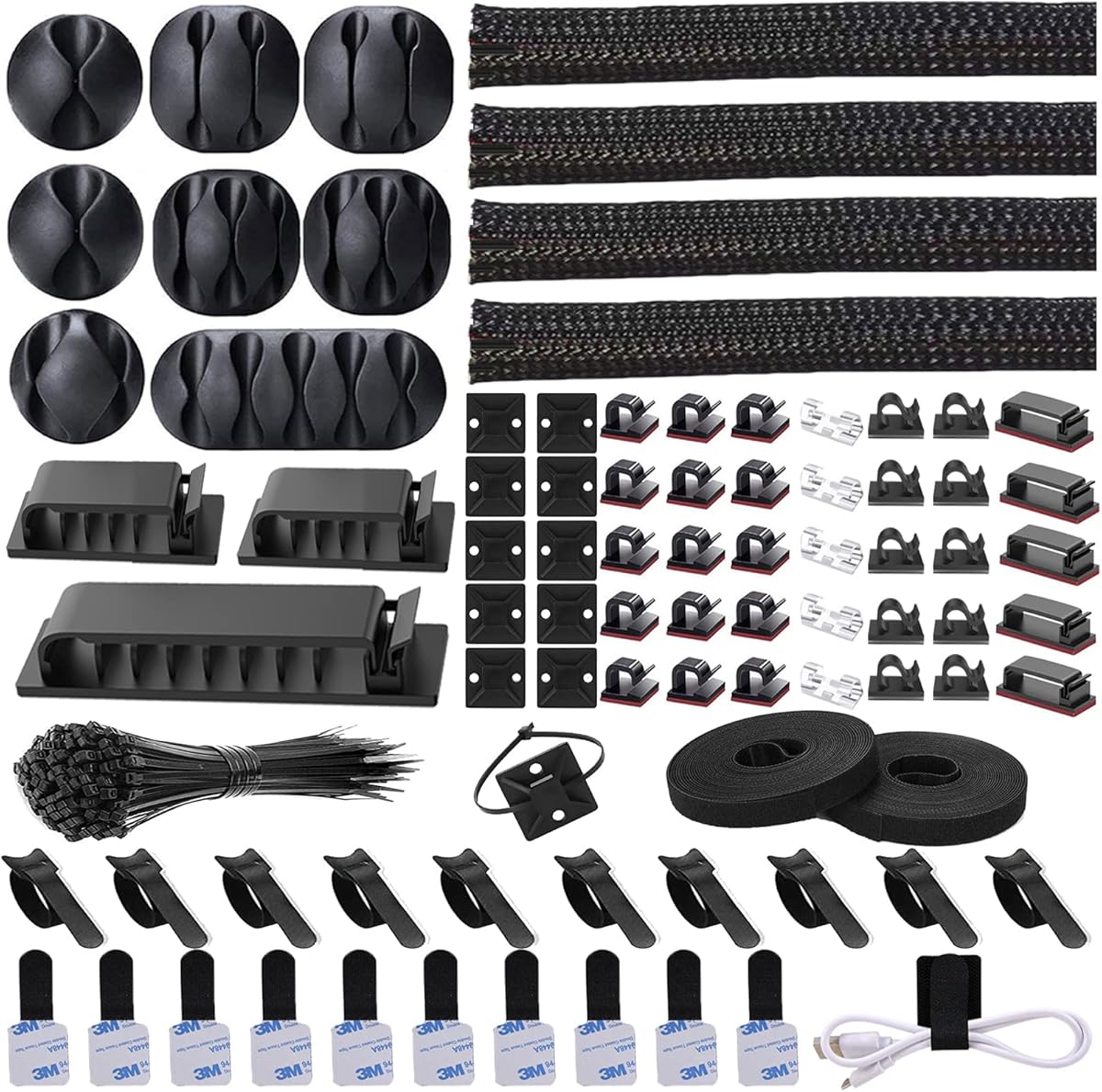
The N NOROCME 192-piece kit offers the broadest selection of organization methods among the picks, combining four sleeves, reusable wire ties, cable clips, cord holders, self-adhesive tie rolls, mounting squares, and fastening ties. Its 4.6 rating reflects a versatile package for users who want to address an entire cable zone rather than purchase several separate accessories.
We may earn a commission when you buy through this link, at no additional cost to you.
The four cable sleeves measure 20 inches long and 0.4 inches wide. Their split design opens for loading and then closes around the cables, making them useful for bundling exposed runs. The kit also includes 46 polyamide clips, 35 cord holders, 20 mounting points, 100 seven-and-87-hundredths-inch ties, 20 reusable ties, and two long rolls of self-adhesive wrapping.
Its greatest strength is flexibility, but that can also be a drawback. Users working on only one loose cable may not need the full range of components, and the different attachment methods may take some sorting to understand. Surface preparation is still important for the adhesive pieces, and the kit is better viewed as a collection of options than as a single-purpose system.
This kit is a strong fit for a home office, media area, or large installation containing several kinds of wires. It is especially helpful when you want protective sleeves alongside surface clips and reusable ties, since buying a separate item for each task can add unnecessary shopping and planning.
The assortment includes sleeve, clip, holder, mount, tie, and roll formats, allowing you to combine concealment, bundling, and anchoring in one coordinated project. It is more adaptable than a kit centered on a single attachment method.
Reusable wire ties and self-adhesive rolls allow temporary organization without committing to permanent hardware. They also make it easier to modify a layout as devices, cords, and furniture are rearranged.
We may earn a commission when you buy through this link, at no additional cost to you.
The YECAYE six-pack is designed to turn exposed cable runs into clean, surface-mounted lines. Each J-channel measures 15.7 inches long, 0.99 inches wide, and 1.55 inches high, with an outward-facing opening that lets users place or remove cables without dismantling a closed raceway. The product carries a 4.6 rating and suits office desks, computer tables, home workstations, and walls.
We may earn a commission when you buy through this link, at no additional cost to you.
Pre-applied adhesive makes installation straightforward: peel the protective film, position the channel, and press it firmly against a smooth surface. The manufacturer recommends allowing 24 hours for a strong bond. Its stated capacity extends to as many as 10 cables per channel, although the number that fits will vary with cable diameter and the space each connector needs.
The PVC channels offer a neat way to conceal and protect power cords, computer cables, and peripheral wires. The listing also highlights flame-retardant characteristics and describes the material as resistant to sustaining flames. Heat from a hair dryer may assist with removal, and the product is presented as leaving no residue, although results naturally depend on the surface and how long the adhesive remains attached.
This set is best for users who value a finished, architectural appearance and need to route cables along a wall or desktop edge. It is less suitable for powder-coated, uneven, or heavily textured walls, and careful measurement matters because the channels create a permanent visual line.
The outward-facing opening balances concealment with convenience. Cords remain hidden along the run while users can still insert, reposition, or remove a cable without opening a fully enclosed sleeve.
The matching black channels create a consistent visual line that can make a workstation or entertainment area look intentionally finished rather than simply bundled with ties.
We may earn a commission when you buy through this link, at no additional cost to you.
The D-Line Cable Management Box is built around a straightforward idea: hide the power strip and excess cord clutter in one enclosure. Rated 4.5, this large black box can improve the appearance of TV stands, desks, kitchen worktops, gaming setups, and home offices while making electrical connections less accessible to curious children and pets.
We may earn a commission when you buy through this link, at no additional cost to you.
The enclosure measures 16.5 inches long, 6.5 inches wide, and 5.25 inches high. It is made in the UK from electrically safe ABS plastic, according to the product information. Three rear entry-and-exit slots allow cables to pass through, while curved edges and pin holes help the box blend with surrounding furnishings.
Its strengths center on concealment and safety, but the fixed dimensions require attention. The listing specifically advises checking the size of the power strip before purchasing, and a tightly packed or unusually shaped strip may not fit. It also creates more visual mass than clips or straps, making it most appropriate when the goal is to remove a conspicuous cable cluster entirely.
Choose this box when one major power hub or extension assembly is responsible for visible clutter and you want a low-profile, furniture-like solution. It is less useful for a loose monitor cable or a small collection of adapters that could be handled more simply with reusable ties.
Power strips and excess cords are often the largest source of visual clutter. Enclosing them gives the surrounding area a cleaner profile without requiring every individual wire to be shortened or rerouted.
The enclosed design reduces direct access to electrical connections and can lower trip hazards around floor-level cables. It should supplement, not replace, sensible supervision and safe electrical practices.
We may earn a commission when you buy through this link, at no additional cost to you.
The Nettbe 60-piece set delivers a 4.8 rating and offers one of the simplest ways to bring order to loose cords. Each six-inch hook-and-loop strap can wrap computer leads, charging cables, speaker wires, extension cords, and other bundles, then open for adjustments without cutting or replacing a tie.
We may earn a commission when you buy through this link, at no additional cost to you.
Because the straps are reusable, they are especially valuable in offices and homes where equipment changes frequently. A conventional zip tie creates a fixed bundle, while a hook-and-loop tie can be loosened, repositioned, or moved to another group of cords. The product information also identifies the home, office, garage, and outdoor environment as suitable applications.
The trade-off is that hook-and-loop straps are not intended to replace a rigid structural mount for a heavy or permanently fixed cable run. Their fastening surface can also gather lint or dirt if used in dusty areas. Even so, they provide more flexibility than adhesive clips and require no surface attachment at all.
This is the best budget pick for anyone who wants a simple, reusable solution to recurring cable clutter. It is particularly effective for workstation cables, entertainment-center cords, and drawer or charging-cable collections where the grouping changes from time to time.
The hook-and-loop closure can be opened and closed as needed, making these ties practical for adding a new charger or separating a cable group. No drilling, adhesive, or replacement fastener is required.
From a garage to a home office, the same strap format can contain loose leads. The six-inch length provides enough range for modest bundles without taking up the space of a larger permanent system.
We may earn a commission when you buy through this link, at no additional cost to you.
The Alex Tech Wire Loom is a protective sleeving solution rather than a mount or concealed raceway. This 10-foot, half-inch black sleeve has a 4.7 rating and is intended for USB cables, power cords, audio and video cables, automotive wiring, and other grouped leads. It keeps a cable bundle visually unified while adding a layer of insulation.
We may earn a commission when you buy through this link, at no additional cost to you.
The split design opens along its length, allowing users to place cables inside without feeding each wire through a rigid tube. Once loaded, the sleeve closes around the bundle and holds a tidy wrap. The listed operating range runs from negative 103 to 257 degrees Fahrenheit, with a melt temperature of 446 degrees, and the wire loom is described as UL recognized.
This product does not fully conceal its cables, so it is not the right choice when the objective is a completely clean wall or hidden power strip. The half-inch diameter also needs to accommodate the intended bundle; several thin cords may fit comfortably, while a thick power lead or multiple large connectors may require a different size. Protection against chewing is not a guarantee against determined pets.
Choose the sleeve when you want to collect several exposed cables into one protected, manageable run. It is a strong companion to under-desk trays and wall channels because it can also organize the final section of cable between a device, outlet, or power distribution point.
The open seam makes loading cables much easier than using a closed tube. The sleeve wraps around the existing bundle, preserving connector positions and avoiding the need to disconnect every device.
Bundling wires in a sleeve reduces loose movement and provides a more finished appearance. It is particularly useful where cables are exposed to handling, pets, or routine dust.
We may earn a commission when you buy through this link, at no additional cost to you.
The Univivi 32-inch tray is a premium, dedicated solution for desks that have accumulated chargers, power strips, data cables, and adapters. Its 4.6 rating reflects a product designed not merely to bundle wires but to create a centralized storage area below the work surface, improving order and reducing floor-level cable hazards.
We may earn a commission when you buy through this link, at no additional cost to you.
The ventilated structure gives stored power strips and cables room for heat dissipation, while the enlarged cable holes simplify routing. Users can place the tray on either the front or back side to accommodate their desk structure. Installation supports both C-clips for trace-free mounting and screws for a sturdier attachment, allowing the method to match the desk construction and load.
Unlike a narrow set of hook-and-loop straps, the tray creates a defined home for a power strip and its attached cords. That can reduce floor clutter dramatically in a permanent workstation. The trade-off is that the tray needs sufficient space beneath the desk and adds a visible, fixed component beneath the work area. It is also more than necessary for a small collection of easily managed charging leads.
This is the top premium choice for a serious home office, gaming setup, or shared workstation with substantial cable infrastructure. It is especially useful when a ventilated, centralized tray and flexible mounting method matter more than a minimal or temporary solution.
The broad tray can hold a power strip, adapters, chargers, and attached leads in one location. Keeping these items off the floor reduces visual clutter and makes power connections easier to inspect.
The open, ventilated structure supports airflow around power strips and power supplies. This is an important consideration in a densely equipped office where a fully enclosed bin could trap heat.
We may earn a commission when you buy through this link, at no additional cost to you.
The 20-Pair Under-Desk Straps provide a compact alternative to a full cable tray. The set includes 20 pairs of 120-by-40-millimeter hook-and-loop holders, each with a stated capacity of up to 15 cables. With a 4.6 rating, it is aimed at home offices and other installations where several cords must be separated from the floor but maximum storage volume is not essential.
We may earn a commission when you buy through this link, at no additional cost to you.
The segmented design allows portions of the holder to be adjusted without removing the entire unit. Each cord sits in a separate retained position, helping prevent sliding and tangling. The low-profile shape is intended for tight corners, while the included acrylic adhesive pads attach to smooth wood, glass, tile, and similar surfaces and are described as removable without leaving residue.
The adhesive method requires care. Users should wait two hours after applying the hooks before loading cables, and a surface that is dusty, textured, or frequently disturbed may not maintain a reliable bond. The straps organize individual wires but do not provide the same power-strip storage or heat-management context as a ventilated tray. They are best viewed as a flexible, space-saving middle ground.
Choose this set when you have many individual signal or charging cables but lack the clearance for a conventional tray. It is particularly useful beneath a desk, behind furniture, or in a corner where a low-profile, segmented holder can keep otherwise wandering cords aligned.
The stated capacity of 15 cables per extended strap makes the system useful for dense collections of charging leads and data cables. Its low profile reduces the space it occupies beneath furniture.
The acrylic adhesive pads are designed to be removed without leaving residue, making them useful in rental spaces or temporary offices. Installation should still begin on a clean, smooth surface for the best result.
We may earn a commission when you buy through this link, at no additional cost to you.
The Univivi 36-inch fabric tray offers more storage volume than many compact holders while retaining a relatively simple installation. It measures 36 inches long, 5.5 inches wide, and 5.5 inches high, giving it room for power strips, adapters, sockets, and excess cords. The 4.6 rating and broad capacity make it a strong fit for large permanent workstations.
We may earn a commission when you buy through this link, at no additional cost to you.
Users can attach the tray with a screw-free clamp or with screws, depending on the table. Its 600D Oxford fabric is described as flame retardant, and the bottom support helps the tray preserve its shape under a load. Built-in ties keep individual items from shifting, while the tray can unfold to make adding or removing equipment easier.
Compatibility is the central consideration. The manufacturer warns that a desk with built-in drawers or a back rod needs at least 5.3 inches of clearance along the edge. The clamps also remain visible, so the tray does not become completely invisible after installation. It is a substantial permanent solution rather than a lightweight temporary organizer.
Choose this tray for a large office desk with many power adapters, an entertainment center requiring a broad storage area, or any workspace where capacity and load support are the priority. Confirm dimensions and edge clearance before installation to avoid discovering a fit issue afterward.
The 5.5-inch depth gives large plugs, power supplies, and power strips more room than a shallow strap organizer. Users can consolidate several related components without compressing them into a narrow channel.
A heavy-duty clamp can secure the tray without drilling the desktop, which is useful for rented offices or movable furniture. Screw installation remains available for users who prioritize a more permanent structural connection.
We may earn a commission when you buy through this link, at no additional cost to you.
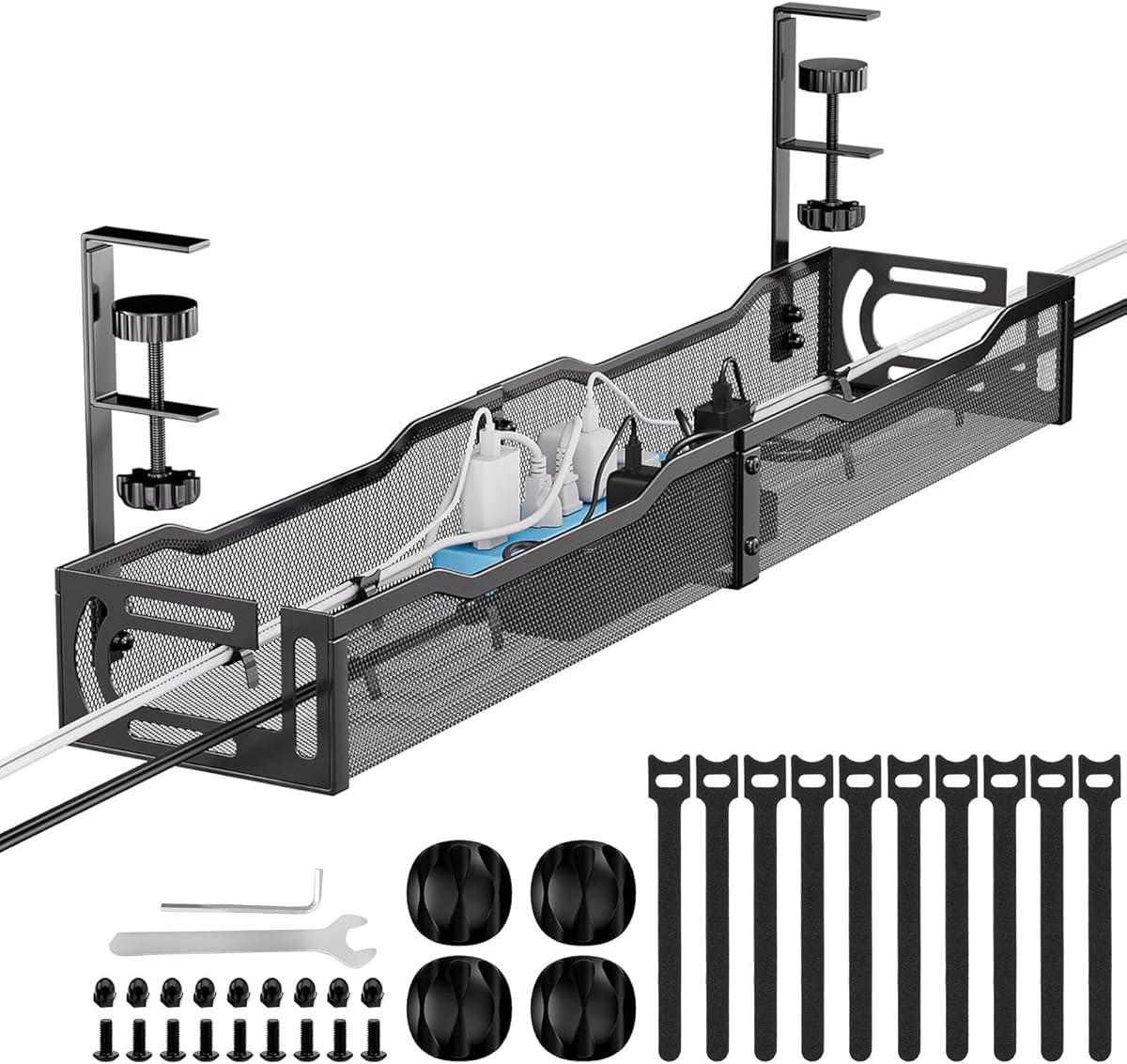
The 25-inch metal cable tray is a rigid, ventilated storage solution for users who want a durable under-desk structure. It has a 4.8 rating and a stated load capacity of approximately 15 pounds. The open mesh body stores power strips, plugs, adapters, and cables while allowing airflow and reducing the chance of dust buildup inside the tray.
We may earn a commission when you buy through this link, at no additional cost to you.
Installation uses an adjustable clamp rather than permanent drilling. The clamp fits desktops between 0.4 and 2 inches thick and includes non-slip rubber pads intended to prevent scratches. It can be mounted inward or outward, and the open side permits cables to pass freely as needed. The tray also separates into two sections for transport, then joins with screws for assembly.
The main compromise is that the two-piece tray requires a brief assembly step, even though the process is described as taking only a few minutes. Its rigid construction and clamp may also be excessive for a small number of light-duty charging cables. Compatibility with the desktop thickness and available under-desk space should be checked before purchase.
This is a compelling option for a standing desk, compact workstation, or gaming setup that needs a sturdy, ventilated tray without drilled mounting. It combines the accessibility of an open frame with the load support of metal construction and is best suited to users who want a permanent organization point.
The open metal structure stores bulky power components while allowing users to see and reach them. Vents promote airflow, and the absence of solid walls helps prevent heat and dust accumulation.
The clamp accommodates desktops from 0.4 to 2 inches thick and includes rubber pads to reduce scratching. It provides a stable hold without permanently altering the surface.
We may earn a commission when you buy through this link, at no additional cost to you.
The best cable management solution depends on the location, number of cords, required accessibility, and permanence of the installation. Measure the available area, identify how cables currently move, and choose a system that solves the actual clutter rather than merely collecting it in one concealed place.
Cable organizers fall into several functional groups. Reusable hook-and-loop ties bundle loose cords and can be rearranged frequently. Adhesive clips provide small, fixed anchor points along a wall or desk. Split sleeves protect and unify a bundle, while J-channels cover runs along a surface. Boxes conceal power strips and excess cord, and trays create a centralized storage area below a desk. Begin by deciding whether the goal is bundling, routing, protection, concealment, or power-strip storage.
Capacity should be evaluated in more than one dimension. A sleeve must be wide enough for the cable bundle, a clip needs enough room for the connector, and a tray must accommodate the power strip along with plug bodies. Some products state a high cable count, but cable diameter and connector size can reduce practical capacity. For trays, also consider the width and depth required by large power bricks and wall adapters.
Fully concealed systems can improve appearance but make power strips, outlets, and charging connections less convenient to reach. Open J-channels, mesh trays, and ventilated fabric structures preserve access while still reducing visual clutter. Avoid enclosing power strips in an unventilated container unless adequate airflow is maintained. The best layout keeps frequently used plugs accessible and gives power supplies space around them.
Adhesive products work best on clean, dry, smooth surfaces. Dust, oil, texture, paint condition, and powder-coated walls can reduce adhesion or make removal difficult. If the surface is textured or the load is substantial, consider a mechanical alternative such as a clamp, screw-mounted holder, or cable tray. Reusable hook-and-loop ties avoid surface preparation entirely and are ideal for temporary or frequently changing arrangements.
Under-desk trays and clips need room below the work surface and along the edge. Built-in drawers, support rails, back rods, crossbars, and pedestal bases can prevent a clamp from fitting. Measure the desk's thickness, the distance from the edge to an obstruction, and the depth available below the top. For adhesive under-desk straps, verify that the mounting area is smooth and that the cables will not interfere with legroom.
Temporary and movable setups benefit from reusable ties, adhesive hooks, and clips that can be relocated. Permanent workstation organization may be better served by a rigid tray, screwed raceway, or mounted power-strip box. More permanent hardware tends to look cleaner and handle heavier loads, but it can complicate moving, renting, or rearranging equipment. Choose the least demanding method that reliably addresses the cable layout.
Indoor electronics benefit from clean concealment and easy connector access. Outdoor runs require attention to UV exposure, water, debris, and surface conditions, so outdoor-rated anchors or sleeves may be more appropriate. Areas with pets or children benefit from closed boxes, protective sleeves, and concealed power strips. High-heat locations require ventilated storage and unobstructed airflow around power supplies.
A collection of clips and ties will look better when the route is planned before installation. Identify the cable source, intended path, endpoint, and any points where a cable must remain loose. Group related cables by function, leave enough slack for movement, and place anchor points at regular intervals. For a desk, route power and data cables separately when practical and keep the frequently accessed section away from chair movement.
Begin by unplugging the relevant devices and mapping the intended cable path. Remove old adhesive residue, dust, and oils before installing clips, raceways, or hook-and-loop pads. For adhesive products, follow the stated waiting period before loading the cables. Position each component while the equipment is still easy to move, and avoid stretching or sharply bending the cords.
Bundle only as many cables as the sleeve, tray, or organizer can accommodate without compressing connectors. Route power and data leads in separate groups when practical, then use reusable ties at regular intervals. Under-desk trays should be mounted to solid edges with adequate clearance, while wall channels and boxes should be positioned before furniture or equipment is returned to the area.
Inspect adapters, plugs, and cable insulation regularly, particularly in crowded trays or locations where cords are moved frequently. Clean adhesive surfaces with a suitable mild cleaner rather than pulling aggressively at a mount. Replace stretched hook-and-loop straps, tighten tray attachments, and check clamps for movement. If a layout becomes inconvenient, reorganize the cables rather than forcing a fixed system beyond its intended capacity.
Reusable hook-and-loop ties are usually the simplest starting point because they require no tools and can be moved as equipment changes. Wrap each tie around a small group of similarly sized cables, leaving enough slack to reach connectors. For a more permanent setup, combine ties with adhesive clips or an under-desk tray that stores the power strip separately.
No. Adhesive holders perform best on clean, smooth, dry surfaces such as finished drywall, wood, glass, and tile. Dust, oil, texture, and powder coating can weaken the bond or make removal difficult. Measure a small area first, and use a screw-mounted or clamped solution when the surface is unsuitable or the cable load is substantial.
Only when the enclosure provides adequate ventilation and remains compatible with the power strip's dimensions. A ventilated tray or open mesh basket is often easier to inspect and cool. Fully enclosed boxes are useful for visual concealment, but they should not block heat dissipation or make safety inspections difficult.
Ties bundle cables together, clips anchor a cable to a surface, sleeves protect and combine a group of wires, and trays hold power strips, adapters, and loose cables in a defined storage area. Each method solves a different part of the clutter problem, and a complete installation often uses more than one.
Route vulnerable wires into a protected sleeve, raceway, cable box, or elevated tray rather than leaving them across an open floor. A sleeve can reduce exposure, but it is not a guarantee against determined chewing. Keep pets away from power connections and replace any cable with damaged insulation immediately.
Yes, provided the model is designed for the desk's top thickness and has enough clearance beneath the surface. Check whether the tray can remain attached as the desk moves and whether the clamp interferes with the lifting mechanism. Metal and rigid mesh designs may be particularly appropriate for permanent standing-desk installations.
A J-channel can cover surface-level runs, a cable box can conceal a central power strip, and a sleeve can collect exposed device leads. A drawer or under-console tray works well when equipment remains accessible. Measure the rear of the television console and confirm that cables can reach their connections without being bent sharply.
Check adhesive mounts, clamps, and visible cables whenever equipment is moved or a noticeable change occurs. Inspect crowded power areas for heat, dust, and connector strain. Routine cleaning and periodic tightening help maintain a neat layout and can reveal damaged insulation or accessories before they create larger problems.
Prioritize the method that matches the actual route: choose ties for movable bundles, clips for guided runs, sleeves for protection, channels for surface concealment, and trays for concentrated under-desk storage. Measure connectors, cable bundles, desk thickness, edge clearance, and available floor space before installation to reduce the chance of an unsuitable fit.
Ratings, product configurations, and listing details can change, so check the current information and compatibility notes before purchasing. Compare the included components carefully, review the manufacturer's preparation and waiting-time instructions, and choose the solution that provides the cleanest result without restricting necessary access.