
BTECH GMRS-V2
4.4Editor score
200 programmable channels
Five-watt transmit power
USB-C charging included
Dual-band scanning support
Discover the best Gmrs Two Way Radios with a detailed comparison of range, power, weather resistance, battery life, channels, and essential features for trips.
GMRS two-way radios keep groups connected where cellular coverage fades, whether that means a mountain trail, a crowded campsite, a work site, or a family road trip. A useful radio balances transmission power, battery life, channel control, weather alerts, durability, and simple operation. The best choice depends on how far, how often, and under what conditions your group needs to communicate.
This guide compares ten GMRS radio options across essential factors such as advertised power, channel capacity, range, charging methods, weather resistance, emergency functions, and programming support. It includes approachable bundles for families, compact handhelds for travel, rugged models for demanding conditions, and more specialized equipment for users who need greater transmit power or vehicle installation.
Each review explains the product's strongest features, practical limitations, and ideal users so the list can be matched to different needs rather than treated as a single universal ranking. The featured radios include the Midland GXT1000VP4, Retevis RB48PLUS, Midland MXT275, BAOFENG GM-15 Pro, BAOFENG UV-5G Plus, Radioddity X1 Pro, Retevis Ailunce HA1G, and other capable choices. Product listings and availability can change.
4.4Editor score
4.5Editor score

4.6Editor score
This side-by-side comparison highlights the main differences in power, range claims, channel control, charging, weather protection, and programming capabilities. It also shows which radios are best suited to casual group outings, rugged field use, detailed channel management, or vehicle-based communication.


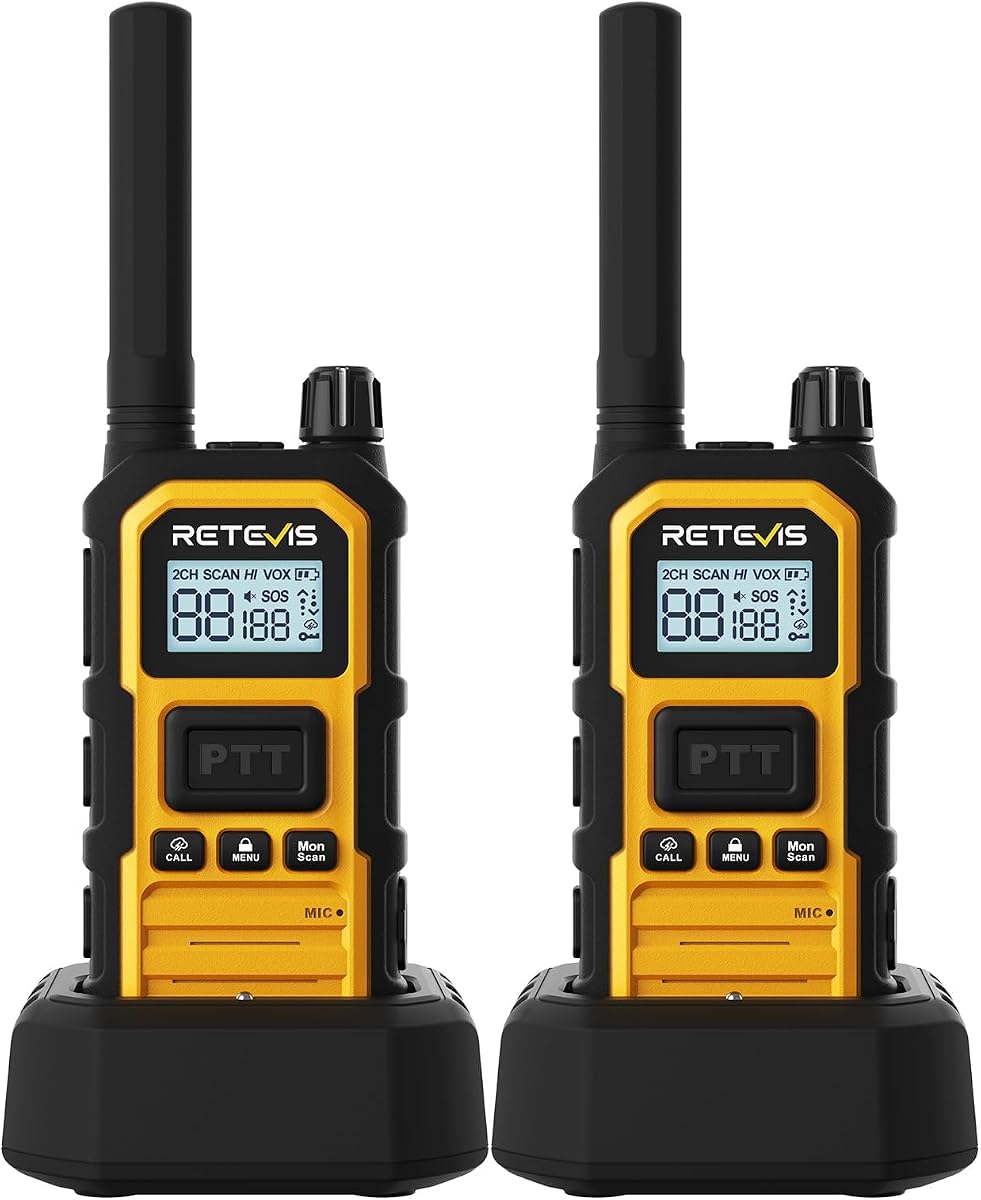
The Retevis RB48PLUS earns a 4.5 rating and stands out as a well-rounded radio for camping, hiking, convoy travel, and other situations where weather resistance matters. Its stated construction is IP67 waterproof and dustproof, with protection against a two-meter fall and the ability to cope with heavy rain, sand, and demanding outdoor conditions. That combination makes it more reassuring for exposed environments than a basic splash-resistant handheld.
We may earn a commission when you buy through this link, at no additional cost to you.
Its 2,000 mAh battery is listed for up to 18 hours of use and 100 hours of standby. The package includes two radios, a charging dock, belt clips, lanyards, a Type-C cable, an adapter, and a manual, so it is structured as a ready-to-use two-person kit. Additional controls include vibration and call-ring alerts, dual large push-to-talk buttons, and a button lock that helps prevent accidental channel changes during travel.
The radio also includes 11 NOAA channels for receiving current weather conditions and a remote emergency alarm for sending a distress signal to teammates on the same channel. These features do not guarantee that every call will be heard or that the radio itself will remain functional in every emergency, but they add useful layers for group trips. The straightforward package and durable enclosure make the trade-offs reasonable for outdoor users.
Choose the RB48PLUS when you want a complete two-radio set that balances endurance, battery life, weather monitoring, and emergency signaling without requiring extensive technical setup. It is particularly well suited to families, hunters, campers, and trail groups that need a dependable handheld. Users who require repeater access, detailed programmable channels, or advanced recording tools may prefer a more specialized model, but for most general outdoor needs, this is an excellent fit.
The IP67 rating, dust protection, and stated two-meter fall resistance make the RB48PLUS a practical choice for camping, hunting, and trail use. Its robust shell is designed for rain, sand, mud, and the kinds of impacts that occur during active trips.
The emergency alarm can send a distress signal to other users on the same channel. Combined with 11 NOAA weather channels, this adds useful planning and emergency awareness to an otherwise straightforward two-radio bundle.
We may earn a commission when you buy through this link, at no additional cost to you.
The BTECH GMRS-V2 carries a 4.4 rating and delivers an unusually broad feature set for buyers who want programmable channels without moving to one of the more specialized radios in the guide. It supports 200 channels for GMRS, NOAA, and scanner use, permits custom names and layouts, and includes repeater support. That makes it appealing for groups managing multiple channels, repeaters, or a detailed channel plan.
We may earn a commission when you buy through this link, at no additional cost to you.
Charging is straightforward because the radio supports true USB-C, and a desktop charging dock is included. A dual-watch function can monitor two channels simultaneously, while dual PTT control helps users manage team traffic, repeaters, or priority calls. CHIRP compatibility adds another layer for people who want bulk programming, repeater loading, backups, or custom configurations, although keypad programming remains available for changes in the field.
The main compromise is its IP54 weather-resistant casing. It is designed to handle dust, splashes, trails, campsites, and changing conditions, but it does not offer the deeper IP67 protection associated with the Retevis RB48PLUS or Radioddity X1 Pro. Five-watt output may also deliver less range than higher-powered options in demanding terrain. Still, those limitations are offset by the extensive channel tools, USB-C convenience, and broad scanning functions.
This is the strongest value-oriented pick for users who want more control than a basic family radio offers. It suits travel groups, off-road users, event teams, and technically comfortable buyers who appreciate CHIRP. Choose it for programmability, dual-watch, and repeatable channel management. For frequent exposure to heavy rain or submerged use, a more rugged IP67 model would be a better match.
Two hundred programmable channels, CHIRP support, custom labels, repeater readiness, and dual watch give the GMRS-V2 substantial flexibility. These tools are especially useful when a group needs more than a few fixed talk channels.
USB-C charging works with common power banks, wall adapters, vehicles, and computers, while the included desktop charger provides a stable base at home or in camp. This reduces the need to carry proprietary charging equipment.
We may earn a commission when you buy through this link, at no additional cost to you.
The Midland MXT275 has a 4.6 rating, the highest numerical rating among the ten products here, and differentiates itself through a 15-watt micro mobile design. Unlike a conventional handheld placed in a belt clip, this model is intended for vehicle-based communication. Its greater transmit output makes it a logical premium choice for road trips, convoy travel, property coverage, and other situations where a permanently installed radio can be advantageous.
We may earn a commission when you buy through this link, at no additional cost to you.
The micro mobile format should appeal to users who already understand vehicle radio installation or who want a central unit connected to a vehicle power source and antenna setup. The radio's higher output can improve transmission capability compared with lower-watt handhelds, although actual range remains dependent on terrain, antenna performance, obstructions, and the other radio used. It is a specialized platform rather than a simple two-person camping bundle.
Its main trade-off is convenience. A handheld is easier to carry on foot, while the MXT275 is designed to remain with a vehicle. Installation, mounting, antenna selection, and wiring fall outside what the supplied product information confirms, so buyers should verify the current package contents and compatibility before purchasing. The limited feature summary also does not detail the same weather ratings, channel counts, or emergency functions found on several handhelds.
Choose the MXT275 when you prioritize strong transmit power and plan to use the radio primarily from a vehicle. It is less appropriate for travelers who need one compact radio per hiker, young child, or off-foot team member. For that audience, a rugged handheld is the more straightforward purchase. For drivers seeking a central, higher-powered communications unit, the Midland MXT275 earns the premium distinction.
The stated 15-watt output separates the MXT275 from the five-, seven-, and eight-watt handhelds in this guide. It is a strong option for road travel, convoy coordination, and users who can keep an antenna and vehicle installation in place.
Because it is a micro mobile radio, the MXT275 can serve as a central communications unit rather than one item in a wearable two-radio kit. That format suits organized vehicle use more naturally than conventional handhelds.
We may earn a commission when you buy through this link, at no additional cost to you.
The Midland GXT67 Pro is a two-pack of GMRS handhelds built around a stated five watts of power. Its 4.3 rating indicates generally favorable user reception, while the paired format gives a group immediate access to two radios. The defining benefit is more transmit power than many entry-level handhelds, which can be useful for extending communication opportunities across open areas, neighborhoods, and outdoor properties.
We may earn a commission when you buy through this link, at no additional cost to you.
Five watts is not the highest figure in this guide. Higher-output handhelds include the BAOFENG GM-15 Pro and UV-5G Plus at up to eight watts, the Radioddity X1 Pro at up to seven watts, and the vehicle-oriented Midland MXT275 at 15 watts. However, transmit wattage is only one part of range. Antenna design, terrain, elevation, obstructions, and whether both users are operating at comparable power all influence real-world communication.
The supplied information is limited to the radio type, two-pack format, and five-watt power focus, so the GXT67 Pro should be compared carefully against the more thoroughly documented products. Its weather resistance, battery configuration, channel count, privacy-code selection, and included accessories are not specified here. That makes it difficult to confirm whether it better fits a particular trip without checking the current product listing and manual.
This bundle is most compelling for buyers who want a recognizable Midland GMRS platform and a modest increase in transmit power without moving to a vehicle-mounted micro mobile. It may suit camping, property management, or general group communication where two matched handhelds are the priority. Buyers prioritizing confirmed waterproofing, long battery specifications, extensive programmable channels, or advanced emergency tools should examine the better-documented alternatives in this roundup.
The GXT67 Pro focuses on five-watt transmission and includes two radios. That makes it a simple way to equip a pair for coordinated travel without sourcing matched units separately.
A stronger transmitter can improve the odds of reaching a group member, but antenna quality and environment remain decisive. Terrain, foliage, buildings, and equipment used by the receiving person all affect the practical range.
We may earn a commission when you buy through this link, at no additional cost to you.
The BAOFENG GM-15 Pro has a 4.4 rating and combines up to eight watts of transmit output with 250 memory channels, 154 privacy codes, and programmable GMRS repeater functions. It is one of the most technically versatile handhelds in the guide, making it a strong option for hunters, survival-oriented users, travelers, and anyone who wants more control than a simple channel-and-privacy-code radio provides.
We may earn a commission when you buy through this link, at no additional cost to you.
Thirty default channels are included for immediate communication, including 22 GMRS channels and eight GMRS repeater channels. Additional channels and settings can be changed through the keypad and PC programming menu. It also scans UHF and VHF activity in channel or VFO mode, receives 11 NOAA weather channels, and includes an SOS alarm, flashlight, and hands-free VOX function. The two-radio set includes earpieces, USB-C charging cables, U.S. chargers, and 1,500 mAh batteries.
The advertised range is 4–5 miles in open areas, 3–4 miles in forests, and 2–3 miles in a city, with the listing appropriately noting that actual distance depends on the environment. Those figures should be treated as scenario-based claims rather than guarantees. Buildings, vegetation, hills, antenna position, and transmit power can substantially alter the distance between two users.
Choose the GM-15 Pro for programmable channels, repeater capability, broad scanning, and high output in a conventional handheld. It is a sound pick for technically engaged users who can benefit from customization. The learning curve is greater than that of the simpler Midland bundles, and operating GMRS requires the appropriate license, so this radio is best for prepared buyers rather than someone wanting completely effortless controls.
With 250 memory channels and 154 privacy codes, the GM-15 Pro gives users a large pool of combinations for organizing different groups and activities. PC and keypad menus allow deeper customization when one channel is not enough.
The stated distance varies from open ground to forests and cities. This distinction is useful because real-world range is rarely a single number, particularly when terrain and vegetation change.
We may earn a commission when you buy through this link, at no additional cost to you.
The BAOFENG UV-5G Plus has a 4.5 rating and is built for users who want extensive channel flexibility in a two-radio set. Although the product title highlights 999 channels, the supplied description specifies 969 fully customizable channels, which is the more detailed description of the configuration. It also raises the battery capacity to 2,500 mAh, adds a 1.9-inch color display, and provides USB-C charging.
We may earn a commission when you buy through this link, at no additional cost to you.
Programming is a major strength. The radio supports CHIRP when the correct UV-5G Plus model is selected in compatible software, works with GMRS, GMRS repeater, UHF, and VHF channels, and can store repeaters with different split tones. A frequency-copy function streamlines cloning settings from one radio to another. Buyers can also select either an eight-inch or 15.5-inch high-gain antenna, allowing them to favor compactness or additional antenna length.
Up to eight watts of output is available on supported GMRS channels, and the listing states that the radio can communicate up to seven miles under suitable conditions. That is a maximum scenario rather than a guaranteed result. The larger display, extensive menus, antenna choice, and programming options also make the radio less simple than a family-oriented model. A GMRS license is required, and the batteries are not compatible with the 5R series.
Choose the UV-5G Plus when channel capacity, cloning, repeater access, and screen visibility are central to your needs. It is particularly attractive to users who already understand radio programming or want to build a detailed channel list for travel and repeater use. For casual groups that only need a few channels and uncomplicated controls, the more streamlined Midland or Retevis options may be easier to manage.
CHIRP compatibility, repeater support, split-tone storage, and frequency copying make the UV-5G Plus a strong platform for detailed radio setups. Its large channel pool allows multiple groups and local systems to coexist.
The 2,500 mAh battery and USB-C port make power management more convenient than earlier basic versions. The 1.9-inch color display also provides more room for reading channel details and menu choices.
We may earn a commission when you buy through this link, at no additional cost to you.
The Radioddity X1 Pro has a 4.4 rating and distinguishes itself with a rugged IP67 body, a replaceable 3,000 mAh battery, and up to seven watts of output. Its reinforced ABS housing is described as having been tested through more than 1,000 drops and offers up to 30 minutes of submersion protection. That ruggedness makes it attractive for trail work, hunting, farming, overlanding, and job sites where a handheld may be dropped or exposed to rain and mud.
We may earn a commission when you buy through this link, at no additional cost to you.
The removable battery is rated for up to 18 hours of use and three days of standby, while direct USB-C charging works with vehicles and other USB power sources. A selectable noise-reduction system with three levels can reduce wind, engine, tractor, and background workplace noise. These are practical benefits in genuinely noisy settings where a raw recording may be difficult to understand.
Its record-and-replay function stores as many as 20 previous voice messages, each up to one minute long. That makes it possible to revisit convoy instructions or hunting commands without immediately asking another user to repeat them. The radio also includes a one-touch SOS function, a built-in flashlight, eight repeater channels, and 10 NOAA weather scan and alert channels. These tools create a comprehensive safety and communication package.
Choose the X1 Pro for demanding environments, noisy work settings, and users who value recorded-message playback. The adjustable noise reduction and replaceable battery are especially compelling for extended trips. Because it is more feature-heavy than a basic radio, beginners should take time to understand its controls and settings. A GMRS license is also required, so plan for that before using the radio.
The IP67 rating, reinforced housing, and stated drop testing give the X1 Pro a strong durability profile. It is well matched to camping, overlanding, construction, farming, and other demanding environments.
The record-and-replay function can preserve up to 20 recent voice messages. In noisy settings, this gives users a quick way to confirm important instructions instead of relying entirely on an unclear live transmission.
We may earn a commission when you buy through this link, at no additional cost to you.
The Retevis Ailunce HA1G earns a 4.5 rating and is designed with off-road users in mind. The two-pack includes a rugged GMRS handheld with IP67 waterproof protection, a rechargeable 2,800 mAh battery, Type-C charging, 12 NOAA channels, and eight base station channels. A side button can be assigned as a secondary push-to-talk control, allowing one-button communication during fast-moving travel.
We may earn a commission when you buy through this link, at no additional cost to you.
Its broad channel and programming support suits groups that need more than a single basic talk channel. The radio supports CHIRP and VFO modes, allows manual frequency entry through the keypad, and can receive new channels and settings from a computer. Connecting through a repeater can extend call distance, making the HA1G relevant to organized off-road groups and travelers who want coverage beyond ordinary handheld range.
Sound quality receives attention through adjustable squelch and microphone gain. Those controls can improve intelligibility in noisy environments, such as inside a moving vehicle or near engines and road noise. A dedicated emergency alarm can send a signal to a preset recipient. The radio's waterproof rating also supports use in rainy or humid conditions, while Type-C charging adds convenience through mobile power banks and vehicle chargers.
Choose the HA1G for off-road travel, camping, and group excursions where a rugged body, flexible channels, and quick controls are useful. It is particularly attractive to users who can benefit from CHIRP or VFO programming. However, buyers should not assume repeater coverage exists in their area; a repeater can extend communication only when the necessary infrastructure and compatible system are available.
A programmable side PTT button supports rapid one-button communication. That is useful when a group needs to send a short update without navigating several controls while traveling or wearing gloves.
Squelch and microphone gain can improve clarity in vehicles and other loud locations. These controls make the radio more adaptable to changing noise conditions during off-road trips.
We may earn a commission when you buy through this link, at no additional cost to you.
The Midland GXT1000VP4 four-pack is designed to equip a larger family or group without requiring radios to be purchased separately. It includes four radios, four rechargeable battery packs, four boom-mic headsets, four belt clips, two dual desktop chargers, and AC and DC adapters. That extensive accessory bundle makes it especially useful for family outings where everyone needs a headset and a charging solution.
We may earn a commission when you buy through this link, at no additional cost to you.
The radios provide 50 GMRS channels, channel scanning, and 142 CTCSS or DCS privacy codes. Midland states that the privacy codes can produce up to 3,124 channel combinations to help block unwanted conversations. Voice and sound activation, or EVOX, offers hands-free operation with nine sensitivity levels. NOAA scanning covers ten weather-band channels and can alert the group when severe weather poses a risk in the area.
Its listed range reaches up to 36 miles in open areas with little or no obstruction. That is a best-case figure, not a promise for ordinary use. The housing has JIS4 waterproof protection, which is splash resistant but less comprehensive than the IP67 protection offered by several newer models. Its 4.2 rating is the lowest among the products in this roundup, although the difference should not be interpreted without considering the larger kit and feature set.
Choose the four-pack when a large group needs matched radios and included headsets, such as a family camping trip, hunting party, or coordinated outdoor event. It is less suitable for solo travel or small groups that only need two units. The simpler interface is approachable, but buyers seeking deeper programmability, stronger water protection, or higher transmit output should compare the more specialized alternatives.
Four radios, four headsets, individual batteries, belt clips, and two desktop chargers create a complete group kit. This saves users from assembling a comparable set from separate components.
EVOX offers hands-free voice activation with nine sensitivity levels. This can make longer drives and campsite activity easier for groups that prefer not to handle a radio for every response.
We may earn a commission when you buy through this link, at no additional cost to you.
The Midland GXT1000VP4 two-pack has a 4.4 rating and is an approachable kit for couples, families, and small groups. It includes two radios, rechargeable battery packs, and a desktop charger, making it convenient to start communicating immediately. Fifty GMRS channels and 142 privacy codes provide ample separation for everyday group communication without demanding advanced programming knowledge.
We may earn a commission when you buy through this link, at no additional cost to you.
The radios add a built-in NOAA scan that sounds an alert when dangerous weather conditions are detected. EVOX provides hands-free voice activation, allowing users to keep a hand on the wheel or their gear while transmitting. Dual-power operation also gives the radios flexibility when a rechargeable charge is unavailable, because they can switch to AA cells. That is a meaningful benefit for remote trips where carrying spare power is important.
Additional features include an SOS siren, keypad lock, vibrate mode, ten call tones, and silent operation. These options support different environments, such as a quiet campsite, a noisy work site, or a group trying to avoid drawing attention. The supplied information does not specify an IP rating or a high wattage figure, so the GXT1000VP4 should be viewed as a convenient, feature-rich general radio rather than a rugged high-power specialist.
Choose this two-pack for a straightforward family outing, road trip, fishing trip, or hunting excursion where two users need dependable voice communication and comfortable controls. Its dual-power option and included desktop charger make it versatile for both home preparation and travel. Users needing waterproof submersion protection, extensive programmability, or vehicle-mounted power should look to the more specialized products in this guide.
Dual-power operation lets users rely on rechargeable batteries or AA cells. The backup option is useful when a trip extends beyond the practical charge of the included batteries or charging equipment is inconvenient.
The NOAA scan can alert users to dangerous conditions, while the SOS siren and silent operation add options for emergency signaling and discreet group communication.
We may earn a commission when you buy through this link, at no additional cost to you.
A useful GMRS radio is not defined by one specification. Transmit power, antenna design, battery life, weather protection, channel tools, and the number of people who need access should all influence the decision. The right handheld for a family camping trip may be very different from the right radio for off-road coordination, hunting, or vehicle-based communication.
Transmit power is one of the first specifications to compare because it can affect how reliably one radio reaches another. The selections range from five watts in the BTECH GMRS-V2, Midland GXT67 Pro, and GXT1000VP4 models to up to eight watts in the BAOFENG GM-15 Pro and UV-5G Plus. The Radioddity X1 Pro reaches up to seven watts, while the vehicle-oriented Midland MXT275 is rated at 15 watts. Higher output can help in open or obstructed environments, but it does not guarantee a specific distance.
Antenna quality, radio height, terrain, foliage, buildings, and the other radio's capabilities all influence real range. A radio with strong output can still fail to reach a distant user if the receiving side uses a weak antenna. Matching products and testing a short channel plan before leaving home is generally more valuable than relying on a headline range claim. Treat advertised distances as comparative guidance, not a guarantee.
Battery endurance should be matched to the length and conditions of the trip. The Retevis RB48PLUS lists up to 18 hours of use and 100 hours of standby from a 2,000 mAh battery. The Radioddity X1 Pro uses a replaceable 3,000 mAh battery, while the BAOFENG UV-5G Plus, Retevis Ailunce HA1G, and BTECH GMRS-V2 use higher-capacity packs in the supplied information. Standby time can be less important when the group checks in only at scheduled intervals.
Charging method affects convenience. USB-C appears on the BTECH GMRS-V2, BAOFENG GM-15 Pro, UV-5G Plus, Radioddity X1 Pro, and Ailunce HA1G, allowing use with common power banks and vehicle adapters. The Midland two-pack can use rechargeable batteries or AA cells, which provides useful emergency flexibility. A desktop charger, included in several kits, is convenient at camp or home, while a replaceable battery gives an extra option when a spare is carried.
Water and dust protection ratings help buyers judge whether a radio can handle the environment in which it will be used. The Retevis RB48PLUS, Radioddity X1 Pro, and Retevis Ailunce HA1G carry IP67 ratings, with the first two also specifying meaningful drop or submersion protection. These are the strongest choices in the guide for exposed camping, hunting, trail work, farming, and rainy off-road trips.
The BTECH GMRS-V2 has an IP54 weather-resistant casing intended to handle dust and splashes. The Midland GXT1000VP4 models have JIS4 splash-resistant protection, while the supplied information does not confirm a weather rating for the GXT67 Pro or MXT275. No rating should be interpreted as permission to submerge a radio. Accessories, connectors, damaged seals, and operating limits still matter, so keep radios protected during heavy rain and allow them to dry before charging.
Simple groups can be well served by a radio with a manageable number of preset channels, while larger organizations may need distinct channels for teams, emergency traffic, repeaters, and event coordination. The Midland GXT1000VP4 offers 50 channels and 142 privacy codes, which is ample for most family and recreational uses. The Retevis RB48PLUS focuses more on straightforward operation and physical durability than on publicly documented programmability.
Advanced users should examine repeater access, VFO, CHIRP, split tones, and frequency-copy functions. The BAOFENG GM-15 Pro provides 250 memory channels, the UV-5G Plus supports 969 customizable channels, and the Ailunce HA1G supports CHIRP and VFO. The BTECH GMRS-V2 also supports CHIRP with 200 programmable channels. More channels are not automatically better, but they help when separate traffic needs to remain isolated.
GMRS radios are often used in areas where monitoring official weather information is valuable. NOAA scanning is available across many selections, including the Midland GXT1000VP4, BAOFENG GM-15 Pro, UV-5G Plus, Radioddity X1 Pro, Ailunce HA1G, and BTECH GMRS-V2. The Retevis RB48PLUS includes 11 NOAA channels, while the Ailunce HA1G includes 12. The number of channels and exact alert behavior should be confirmed in the manual.
Emergency tools can include a distress alarm, SOS siren, flashlight, or record-and-replay function. The RB48PLUS includes a remote emergency alarm for teammates on the same channel. The Radioddity X1 Pro combines one-touch SOS with recorded-message replay, while the Ailunce HA1G can send an emergency signal to a preset recipient. These features are useful supplements, not substitutes for a communication plan, reliable equipment, appropriate licensing, or emergency services.
Audio clarity depends on the microphone, speaker, noise filtering, and listening environment. Hands-free VOX allows users to transmit without handling the radio, which helps in vehicles and on the trail. The Midland GXT1000VP4 offers EVOX with nine sensitivity levels, while the BAOFENG GM-15 Pro includes VOX and the Ailunce HA1G provides adjustable squelch and microphone gain.
The Radioddity X1 Pro adds three adjustable noise-reduction levels designed to reduce wind, engine, tractor, and jobsite sounds. It also records and replays recent voice messages, a useful feature when instructions must be reviewed later. These controls can improve intelligibility, but they also add complexity. Groups should agree on channel settings, use clear and concise language, and avoid transmitting when the radio is too far from the speaker.
Most travelers need one wearable handheld per person, making two- and four-radio bundles the most convenient. The Midland GXT1000VP4 two-pack includes headsets and a desktop charger, while the four-pack supports larger families or teams. The Retevis RB48PLUS and BAOFENG bundles also provide two units with supporting accessories, and the Ailunce HA1G is formatted as a two-pack for off-road use.
The Midland MXT275 takes a different approach as a 15-watt micro mobile radio intended for vehicle installation. That format can serve as a central unit in a car, but it is not a substitute for a lightweight handheld carried on foot. Consider where each participant will travel. A vehicle can carry multiple radios, while a hiker needs something compact, secure, and comfortable to wear.
Begin by confirming that you have the appropriate GMRS license for your country and understanding the basic rules for the channels you plan to use. Charge both radios fully, pair them on a simple primary and secondary channel scheme, and make sure every group member understands which channel to use for routine traffic. Keep the channel and privacy-code instructions with the group rather than relying on everyone to remember technical details.
Test the radios before leaving. Move through the expected communications area, check that both units can send and receive clearly, and note where terrain or structures reduce performance. Use agreed call signs, concise messages, and a backup channel for urgent traffic. When using repeaters, advanced programming, or NOAA scanning, follow the radio's manual and ensure all participating devices are configured consistently.
Care for the hardware by keeping the charging port clean and dry, using compatible cables and batteries, and tightening any weather-resistant connections as directed. Do not charge a wet radio, and avoid exposing a unit to severe impact, extreme heat, or substances that could damage the display or housing. Store radios with some battery remaining, remove them from prolonged direct sun, and clean the exterior with a lightly damp cloth rather than abrasive chemicals.
Real range depends on transmit power, antenna design, elevation, terrain, vegetation, buildings, and the equipment used by both people. Some products list open-area distances of several miles, while others claim much longer distances under ideal conditions. Those figures are best treated as maximum scenarios rather than guaranteed everyday range. Testing the radios in the intended environment and keeping antennas unobstructed is the most reliable approach.
GMRS use is regulated, and an appropriate license is required in the United States for many users. The BAOFENG UV-5G Plus, Radioddity X1 Pro, and other advanced models explicitly note licensing requirements. Rules vary by country, so travelers should check local regulations before operating a radio. Possession and use are separate issues, and users should also follow local channel and equipment rules.
A channel is the primary radio frequency or frequency pair your group selects. A privacy code, also called a CTCSS or DCS code, narrows who can hear transmissions on that channel. Two radios generally need matching channels and compatible privacy-code settings to communicate. Privacy codes are not encryption and do not prevent every technically equipped person from monitoring traffic.
An IP67 rating indicates stronger protection against water and dust than lower ratings, making the radio more appropriate for heavy rain and demanding outdoor use. It does not mean the radio should be operated while submerged unless the manufacturer explicitly permits it. Water can still collect around a charging port or accessory connection, so operators should protect interfaces and wait for the unit to dry before charging.
Choose more channels when coordinating multiple groups, repeaters, or specialized traffic, and choose more power when overcoming difficult terrain or distance matters most. Most family trips need only a handful of channels, making simple operation more valuable than a large programmable bank. For advanced users, channel flexibility and transmit output can complement each other, provided they are comfortable programming the radio.
NOAA scanning adds useful emergency weather awareness to a GMRS radio, but it should not be the only source of critical information. A dedicated weather radio or trusted phone alert system can provide broader coverage in some situations. Users should also watch local conditions, keep emergency supplies ready, and know how their group will respond if a member becomes separated or unable to communicate.
A compatible repeater can extend communication by receiving a transmission and rebroadcasting it, helping signals travel farther or around terrain obstructions. It must be available in the area, compatible with the radio configuration, and used in accordance with local rules. Repeater access is not guaranteed merely because a radio supports repeater channels, so users should confirm local coverage and system details before relying on it.
Basic GMRS operation usually requires only selecting an already programmed channel and matching privacy code. Advanced models may use CHIRP-compatible software, a standard programming cable, a mini USB connection, or a proprietary cable. The BAOFENG UV-5G Plus and Ailunce HA1G support CHIRP, while the GM-15 Pro and BTECH GMRS-V2 offer additional programming options. Check the current manual before purchasing accessories or attempting a firmware update.
The Retevis RB48PLUS is the strongest all-around outdoor choice, combining IP67 protection, a substantial battery, NOAA channels, and an emergency alarm in a complete two-radio kit. The BTECH GMRS-V2 stands out for value-oriented flexibility, including 200 programmable channels, CHIRP support, USB-C charging, dual watch, and dual-band scanning. The Midland MXT275 takes the premium direction by prioritizing 15 watts of transmit power in a vehicle-oriented micro mobile format.
The right radio for your group depends on priorities. Families may appreciate the straightforward controls and included headsets of the Midland GXT1000VP4, while off-road groups may favor the Ailunce HA1G's rugged design and programmable side PTT. Hunters, campers, and field workers can compare the RB48PLUS and Radioddity X1 Pro for confirmed IP67 protection, while technically experienced users may prefer the extensive channels and repeater controls of the BAOFENG models.
Before ordering, verify the package contents, channel compatibility, weather rating, battery details, antenna options, and licensing requirements for the exact model. Listings, bundles, accessories, and availability can change, so review the current product page and manual before purchasing. With those details confirmed, you can select a GMRS radio that matches the group, terrain, operating style, and communication demands of the trip.
