
Cooler Master Q300L V1
4.5Editor score
Supports Micro-ATX and Mini-ITX
Accommodates 240mm radiators
Open perforated airflow design
Our PC Case for B650 Motherboard guide compares 10 ATX and micro-ATX enclosures, checking airflow, radiator support, GPU clearance, cable management, and ease
A PC case for a B650 motherboard should balance airflow, clearance, and clean installation more than any decorative feature. B650 boards commonly appear in ATX and Micro-ATX builds, so the ideal enclosure must fit the board, graphics card, power supply, cooler, and radiator while leaving room for orderly cables and accessible components.
The ten cases in this guide were compared using their supplied specifications, including motherboard support, maximum graphics-card length, power-supply clearance, radiator options, included fans, airflow design, front connectivity, and cable-management features. The list covers compact, standard mid-towers, dual-chamber designs, panoramic-glass models, and cases intended for high-performance air or liquid cooling.
Each review reveals a different reason a B650 build might work well, from a restrained micro-ATX enclosure to expansive dual-chamber models. Ratings reflect the supplied customer feedback, while practical trade-offs remain central to every recommendation. Product availability and prices can change, so confirm current listing details before purchasing.
4.5Editor score

4.7Editor score
4.6Editor score
This side-by-side comparison shows how the ten cases differ in motherboard support, cooling capacity, graphics-card room, and included fans, helping B650 builders match an enclosure to their chosen components and preferred installation style.


The NZXT H5 Flow is a compact ATX mid-tower that combines a restrained exterior with a clear emphasis on airflow. It carries a 4.7 customer rating, placing it among the strongest-reviewed products in this guide. Rather than relying on a large collection of fans or elaborate lighting, it focuses on efficient intake, perforated surfaces, and a practical arrangement of cooling positions.
We may earn a commission when you buy through this link, at no additional cost to you.
Its most important feature is the perforated power-supply shroud, which allows two 120mm fans to draw air through the side and bottom of the shroud. Two Quiet Airflow 120mm fans are already installed at the front and rear, giving a new B650 system useful airflow without requiring every fan to be purchased separately. Ultra-fine mesh covers the top, front, and side panels, helping filter dust while preserving ventilation.
Liquid-cooling support is strong for a compact enclosure. A 360mm radiator fits at the front, while a 240mm radiator can be positioned at the top. That gives builders two practical liquid-cooling routes, although the selection is narrower than the triple-radiator or multi-420mm arrangements offered by the largest dual-chamber cases. Cable management is handled through wide routing channels, hooks, and straps, keeping wiring away from visible areas and reducing obstruction around the main chamber.
The H5 Flow is best for a B650 builder who wants a smaller ATX enclosure, solid foundational cooling, and an uncluttered presentation. It is less suitable for someone planning an unusually dense collection of fans or a custom liquid-cooling loop requiring several large radiators. For a conventional gaming or productivity build, however, it offers an effective balance of dimensions, cooling capability, and installation convenience.
The perforated shroud is a particularly useful design choice because it turns the otherwise enclosed lower section into an additional air path. With the two preinstalled fans already positioned for intake and exhaust, the case can begin operating with balanced airflow while leaving additional fan locations for the builder to configure.
Supporting a 360mm radiator in front and a 240mm radiator at the top provides enough flexibility for most B650 gaming builds. It also allows a compact tower cooler for simpler systems or a modest AIO setup when additional cooling capacity is desired.
We may earn a commission when you buy through this link, at no additional cost to you.
The CORSAIR 4000D RS ARGB Frame is one of the most adaptable cases in this roundup, earning a 4.7 rating for its combination of cooling flexibility, modular construction, and a refined exterior. Its FRAME system is more than a visual feature: the case is designed so components such as the motherboard tray and front I/O panel can be changed as the user's needs evolve.
We may earn a commission when you buy through this link, at no additional cost to you.
Three CORSAIR RS ARGB PWM fans come preinstalled at the front. They use daisy-chainable four-pin PWM connections, offer a Zero RPM mode, and connect through the motherboard's five-volt ARGB header. The InfiniRail mounting system adds important placement freedom by allowing fans to slide into different positions along steel rails, including up to 200mm fans in front positions and up to 140mm fans at the roof.
The 3D Y-pattern front panel uses perforated steel in three dimensions to create a low-restriction intake path. Another thoughtful detail is the internal side panel beside the motherboard tray, which can function as a cable cover or be removed so additional fans can be mounted there. That dual purpose lets the builder choose between a tidier interior and greater cooling capacity as priorities change.
This is an excellent match for a B650 enthusiast who anticipates upgrades, fan changes, or a future shift in cooling hardware. It may be more elaborate than necessary for a simple office build, and ARGB adds another connection to manage. Even so, the combination of modular parts, flexible cooling positions, and three included fans makes it the most versatile recommendation here.
The modular FRAME platform distinguishes this case from a fixed-layout mid-tower. Swappable structural and I/O components can help the enclosure evolve with a build rather than becoming a static shell chosen once and never revisited.
The rail system lets builders spread fans across front and roof positions instead of committing to fixed holes. Three preinstalled ARGB fans provide a good starting configuration, while additional mounting flexibility makes the case suitable for a more elaborate cooling layout.
We may earn a commission when you buy through this link, at no additional cost to you.
The Cooler Master Q300L V1 is a compact Micro-ATX case aimed at builders who want a gaming-oriented enclosure without paying for full mid-tower dimensions. Its 4.5 rating reflects a broadly favorable reception, and the supplied specifications show why it remains a practical option for smaller B650 configurations.
We may earn a commission when you buy through this link, at no additional cost to you.
The case supports Micro-ATX and Mini-ITX motherboards and offers room for CPU coolers up to 159mm, graphics cards up to 360mm, and power supplies up to 160mm. That graphics-card allowance is especially useful in a compact chassis because it reduces the need to compromise between a long modern GPU and a smaller enclosure. Cooling arrangements can include a 240mm liquid cooler and as many as five fans.
Its open thermal design uses perforations on the sides to promote airflow and heat dissipation. The edge-to-edge transparent side panel gives the interior a recognizable visual treatment, while magnetic dust filters add another practical layer of maintenance support. The modular I/O panel can be placed at the front, top, or bottom, on either side, allowing the builder to adapt the case to the desk and installation layout.
The Q300L V1 is recommended for anyone using a Micro-ATX B650 board and prioritizing space efficiency, a long graphics card, and a straightforward open-air layout. It cannot accept a full ATX motherboard, so that limitation should be confirmed before purchase. Within the Micro-ATX category, however, it offers a useful combination of expansion room, transparent styling, and accessible cooling.
The case is designed specifically for Micro-ATX and Mini-ITX boards, giving it a clearer purpose than a full-size chassis squeezed into a smaller footprint. A B650 buyer should verify the exact board dimensions, but compatible Micro-ATX models can benefit from reduced overall system size.
Perforated side surfaces help move heat away from the motherboard area, graphics card, and power supply. The design is less dependent on the decorative panel as a sealed surface, which helps when the case is placed in a room with plenty of ambient airflow.
We may earn a commission when you buy through this link, at no additional cost to you.
The FOIFKIN F600 is a large dual-chamber ATX mid-tower designed around visual presentation, extensive cooling, and roomy component accommodation. It holds a 4.6 rating, and its supplied features distinguish it as one of the most ambitious cases for a B650 build that may include a powerful graphics card, liquid cooling, and extensive illuminated hardware.
We may earn a commission when you buy through this link, at no additional cost to you.
Seven 120mm ARGB PWM fans are preinstalled, with six reverse fans and one forward fan. This high fan count gives a newly assembled system a substantial airflow foundation and creates a continuous illuminated appearance. The cooling system can accommodate three 360mm radiators simultaneously, providing far more liquid-cooling flexibility than the compact NZXT H5 Flow and other restrained designs in the list.
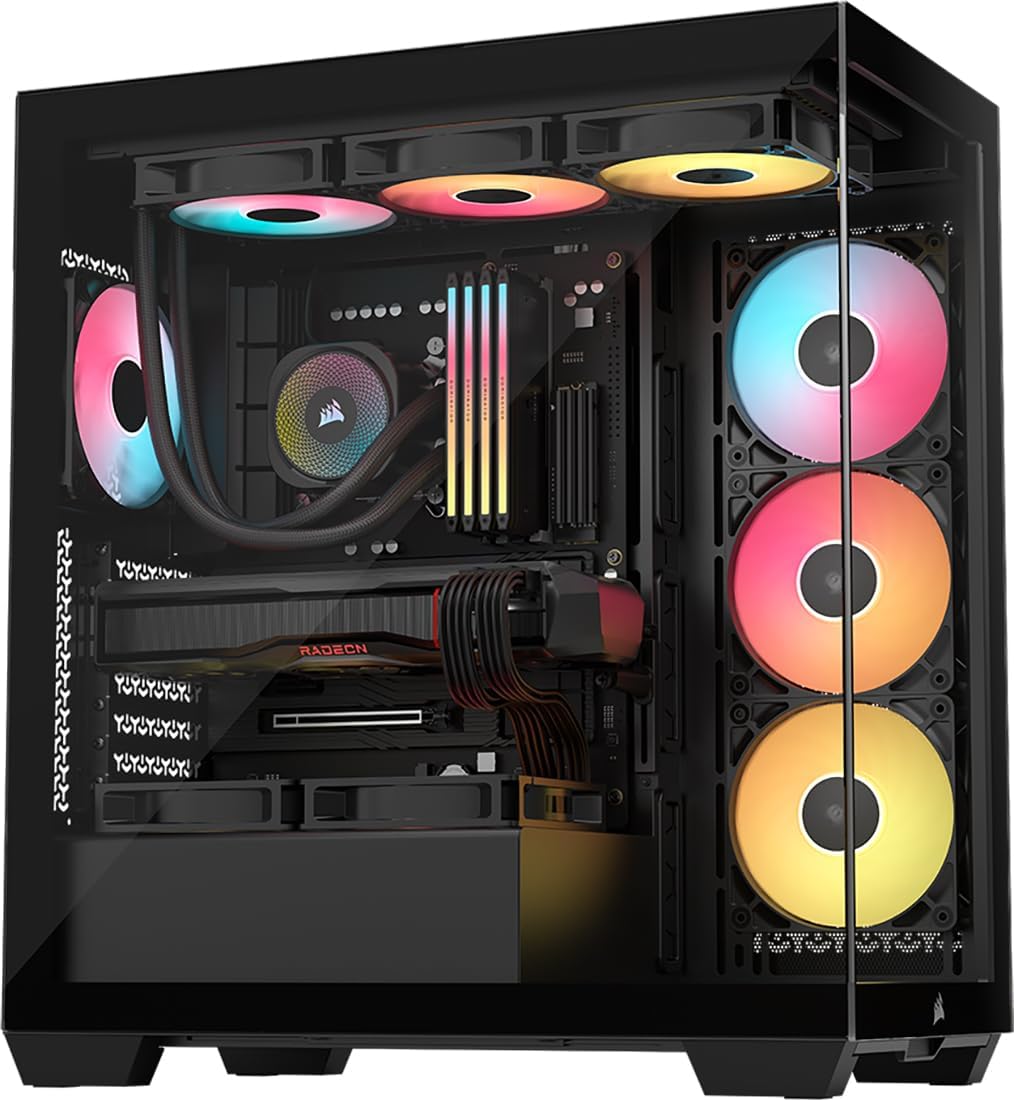
A dual-chamber layout separates the main hardware from the power supply and drive area. That separation improves visual organization, keeps cables out of the display chamber, and allows air to circulate more directly around components. The high-hardness tempered glass provides a 270-degree panoramic view, while Type-C connectivity adds a modern front-panel option. Motherboard support covers ATX, Micro-ATX, and Mini-ITX formats.
Component limits are generous, including support for graphics cards up to 400mm and power supplies up to 200mm. The case also accommodates one hard drive and two solid-state drives according to the supplied information. This is an appealing choice for a showcase build, but its dimensions and seven included fans make it less practical for a small desk or a restrained build. Buyers who want a dramatic glass-and-ARGB presentation will find the F600 especially compelling.
The ability to hold three 360mm radiators simultaneously makes the F600 suitable for builders who may expand beyond a single AIO. Seven preinstalled ARGB fans also reduce the number of separate purchases required to establish a strong initial airflow configuration.
Keeping the power supply and storage hardware away from the main display area leaves more room for the motherboard, graphics card, tubing, and illuminated components. It also supports a cleaner panoramic presentation than a traditional single-chamber layout.
We may earn a commission when you buy through this link, at no additional cost to you.
The CORSAIR 3500X RS ARGB is a panoramic mid-tower that combines a wraparound glass aesthetic with extensive cooling and motherboard support. Its 4.6 rating makes it one of the stronger choices for a high-end B650 build, particularly for users who prioritize a visible, carefully presented interior.
We may earn a commission when you buy through this link, at no additional cost to you.
The case supports motherboard formats from Mini-ITX through E-ATX, giving a B650 builder considerable flexibility. It includes three RS120-R ARGB fans controlled through a five-volt ARGB header, and side, roof, and power-supply mounting points allow up to ten 120mm fans. The three included fans provide a useful baseline, although the stated maximum requires additional fans for a fully populated configuration.
The front and side glass panels are removable, simplifying component access and making it easier to connect cables or install a radiator. The enclosure is also validated for ASUS BTF, MSI Project Zero, and Gigabyte Project Stealth motherboards whose connections are located on the rear. That compatibility is especially relevant to B650 builds because it keeps the visible motherboard area free from front-facing cable clutter.
The 3500X RS ARGB is best suited to a builder who wants a premium panoramic enclosure and has room for additional cooling hardware. It is not the most fan-packed option on the list, since only three fans are included despite support for as many as ten. For a restrained liquid-cooled or air-cooled build, however, its flexibility, broad board support, and clean rear-connector integration make it especially compelling.
The wraparound glass creates a broad view of the motherboard, graphics card, fans, and lighting. Removable front and side panels make the enclosure more approachable during assembly because the builder does not need to work around fixed glass surfaces.
Support for rear-connector motherboards allows power and other front-panel connections to remain behind the tray. This works particularly well with compatible B650 boards because the main viewing surface can stay free of visible cable runs.
We may earn a commission when you buy through this link, at no additional cost to you.
The DARKROCK EC2 is a conventional ATX mid-tower that emphasizes airflow, tempered-glass presentation, and current front-panel connectivity. Its 4.4 rating places it in the middle of the guide, but the case remains a credible option for a B650 system that needs ATX support and a straightforward cooling layout.
We may earn a commission when you buy through this link, at no additional cost to you.
The meshed front panel provides a clear intake route, while the tempered-glass side panel allows the motherboard, graphics card, and lighting to remain visible. Separate magnetic dust filters mounted at the top and bottom help prevent particles from collecting around the primary intake and exhaust areas. Type-C readiness adds another modern detail at the front of the chassis.
Cooling capacity is generous for a mid-tower. The case supports up to eight 120mm fans and a 360mm radiator at the front. Motherboard compatibility includes ATX, Micro-ATX, and Mini-ITX, so most B650 board formats are represented. Graphics cards up to 340mm and power supplies up to 200mm can be installed, providing adequate room for mainstream performance hardware.
The EC2 is a sensible choice for a builder who values mesh airflow, glass presentation, and Type-C capability without needing the extreme radiator capacity of the FOIFKIN F600 or HYXN H2. The supplied information does not list preinstalled fans, so cooling hardware may need to be added separately. It is therefore a flexible chassis for someone already planning a complete fan set or a modest AIO.
The perforated front is intended to support high airflow while the detached magnetic filters simplify maintenance. Their separate placement also makes it easier to clean or remove them without taking apart the entire case.
Type-C readiness is useful for builders who want a current connection format at the front of the system. It complements the tempered-glass and mesh design without adding the complexity of a fully modular frame or a large bundle of preinstalled fans.
We may earn a commission when you buy through this link, at no additional cost to you.
The ASUS A31 is an ATX mid-tower built around an expansive, pillar-free view and compatibility with modern high-performance components. It carries a 4.7 rating, matching several of the strongest-reviewed cases here. Its design seems particularly well aligned with a clean B650 build that uses hidden motherboard connections and a large graphics card.
We may earn a commission when you buy through this link, at no additional cost to you.
Dual tempered-glass panels and a frameless, pillar-free design remove visual obstructions from the main viewing area. The BTF hidden-connector concept allows modular cables to run behind the motherboard, producing a cleaner front-facing component view. This is particularly effective with a compatible board that places connections on its rear rather than the more visible edge.
The case supports mainstream builds with 360mm AIO coolers and is designed for compatibility with RTX 5090 and RTX 4090-class graphics cards. An eight-degree angled base is described as enhancing airflow while also widening the viewing angle and intensifying the presentation of ARGB lighting. AIO clearance extends to 80mm, giving the builder room to work with a substantial liquid-cooling assembly.
The A31 is recommended for a B650 owner who wants a dramatic dual-glass enclosure, concealed cabling, and generous graphics-card compatibility. One limitation is that the supplied specification list focuses on AIO clearance and motherboard support without providing a full fan count or detailed radiator positions. Buyers should therefore confirm their exact cooling plan, but the case is particularly attractive for a polished, modern showcase build.
Removing pillars and using two tempered-glass panels gives the system a broad, uninterrupted display area. A rear-connector motherboard can keep cables out of that view, allowing the board, graphics card, cooling hardware, and lighting to become the focus.
Compatibility with RTX 5090 and RTX 4090 graphics cards makes the A31 relevant to builders using high-end GPUs. The combination of generous graphics support and 360mm AIO clearance supports a modern performance-oriented B650 configuration.
We may earn a commission when you buy through this link, at no additional cost to you.
The HYXN H2 2026 is a very large dual-chamber ATX mid-tower aimed at builders who want maximum room for graphics hardware, fans, radiators, and storage. Its 4.4 rating reflects a generally favorable but less exceptional customer score, while the supplied specifications show one of the most spacious designs in the roundup.
We may earn a commission when you buy through this link, at no additional cost to you.
Eight non-ARGB fans are preinstalled: six 140mm reverse fans and two 120mm forward fans. Their mixed sizes allow substantial front and rear airflow while maintaining a coordinated black appearance without synchronized lighting. The case can support either two 420mm radiators or three 360mm radiators simultaneously, making it suitable for elaborate custom or multi-radiator liquid-cooling arrangements.
Component clearance is extensive. The motherboard section accepts E-ATX, ATX, Micro-ATX, and Mini-ITX boards, while graphics cards can reach 455mm and power supplies 220mm. Two hard drives and three solid-state drives are supported. Compatibility with back-mounted motherboards, an extra-large rear cable compartment, built-in Velcro straps, and dedicated mounting points further improve organization.
The H2 is an excellent choice when component size is more important than a compact footprint. A B650 builder using a very long graphics card or planning large radiators will appreciate the additional breathing room. The trade-off is obvious: the case measures 500 by 285 by 485mm, so desk space and transport should be considered. It also omits ARGB, favoring a restrained fan-focused look.
A maximum graphics-card length of 455mm provides ample margin for large modern GPUs. Combined with motherboard support extending to E-ATX, it gives a B650 builder considerable freedom to select components without compressing the layout.
Support for two 420mm or three 360mm radiators is among the most advanced cooling options shown here. This makes the H2 suitable for enthusiasts who expect their cooling layout to expand beyond a single front-mounted AIO.
We may earn a commission when you buy through this link, at no additional cost to you.
The MOROVOL 621-N4 is an ATX mid-tower that provides a straightforward package of four preinstalled RGB fans, a mesh front panel, and a removable tempered-glass side panel. Its 4.2 rating is the lowest in this guide, so buyers should interpret it as a value-oriented option rather than the strongest customer-rated choice.
We may earn a commission when you buy through this link, at no additional cost to you.
The four included 120mm RGB fans are ready for installation and intended to provide both airflow and visible illumination. Their lighting is fixed rather than addressable, which means the color cannot be synchronized with the rest of the system in the same way as a five-volt ARGB controller. This is the clearest distinction between the 621-N4 and the more lighting-focused alternatives.
The diamond-shaped mesh front panel is designed to promote airflow, while the removable glass side makes component installation and inspection more convenient. Motherboard support covers ATX, Micro-ATX, and Mini-ITX, making it suitable for many B650 systems. Maximum graphics-card length is 300mm, power-supply length is 160mm, and CPU cooler height is 155mm.
The 621-N4 works best for a straightforward gaming build using mainstream components and a fixed lighting theme. Its storage provision includes two 2.5-inch solid-state drives and two 3.5-inch hard drives. The front I/O panel includes one USB 3.0 port, two USB 2.0 ports, HD audio, microphone, reset, and power controls. It is a functional choice, though newer systems with very long graphics cards or larger power supplies should check the limits carefully.
Having four 120mm fans already installed can simplify the initial build and provide airflow across multiple intake and exhaust positions. The fixed RGB effect adds illumination without requiring extra lighting hardware.
The 300mm graphics-card and 160mm power-supply allowances are suitable for many mainstream systems. Builders using larger modern components should compare those dimensions before committing, especially when choosing a B650 motherboard with a full-size ATX layout.
We may earn a commission when you buy through this link, at no additional cost to you.
The HYTE Y50 RGB combines a snow-white dual-chamber design, panoramic glass, and four included aRGB fans. Its 4.7 rating makes it one of the best-reviewed products in the guide. It is especially suited to a B650 builder who wants a light-colored showcase system rather than the predominantly black enclosures that dominate the market.
We may earn a commission when you buy through this link, at no additional cost to you.
The three-piece panoramic glass layout is designed to present the hardware from multiple angles. Four HYTE aRGB fans are included: one 120mm FE12RS air fan and one 360mm FE12RTR reverse-blade unibody fan. They use standard aRGB and PWM connectors, allowing the lighting to coordinate with compatible motherboard controls while contributing substantial airflow immediately after installation.
The dual-chamber layout separates the main hardware from the power-supply and cable area, improving organization and reducing visual clutter. Compatibility with ASUS BTF, Gigabyte Stealth, and MSI Project Zero motherboards allows a B650 builder with rear-facing connections to keep the front of the board visually clean. Full-size expansion slots also allow additional graphics and drive space according to the supplied information.
The Y50 RGB is recommended for creators of bright, coordinated builds where the case itself is part of the visual design. It provides enough preinstalled cooling to be a meaningful starting point, while the panoramic structure keeps internal lighting and components visible. The white finish is less forgiving of fingerprints than matte black models, and additional fans may be desirable for a heavily loaded system, but the distinctive presentation makes this enclosure memorable.
The snow-white finish gives the Y50 RGB a strong identity that separates it from conventional black mid-towers. Three-piece panoramic glass lets the interior remain visible from multiple directions, making the case especially suitable for coordinated lighting and decorative components.
The 360mm reverse-blade fan is the centerpiece of the included cooling package, while the 120mm fan adds another mounting option. Standard aRGB and PWM connections make integration with compatible hardware straightforward.
We may earn a commission when you buy through this link, at no additional cost to you.
Choosing a B650-compatible case begins with the board and graphics card, then expands to cooling layout, wiring, front connectivity, physical size, and appearance. The most important rule is to verify every clearance against the exact components already selected for the build.
Short summary: choose a case that explicitly supports your B650 board's exact form factor.
Short summary: measure the GPU and leave enough clearance for its cooler, power cables, and fittings.
Short summary: match radiator dimensions to the case and avoid choosing more cooling hardware than the layout can use.
Short summary: confirm PSU length, drive quantity, connector space, and access to every storage position.
Short summary: favor a coherent intake and exhaust arrangement over a large but poorly placed fan count.
Short summary: prioritize hidden routes, service loops, and rear-connector compatibility for a clean build.
Short summary: count the ports and connector types you need instead of treating Type-C as the only consideration.
Short summary: balance available space and desired presentation against the clearances required by every component.
Begin with an empty-case inventory. Identify the motherboard standoffs, screws, fan hardware, rails, radiator brackets, cable ties, and removable panels before installation. Confirm that the board format and every major component match the specified clearances. Install the power supply and storage as appropriate, route their cables behind the motherboard tray, and confirm that connectors can bend without being pinched.
Mount the B650 motherboard, CPU, memory, graphics card, and cooling hardware according to their individual instructions. Connect front-panel wires and test the power and reset buttons before closing the case. For a dual-chamber model, inspect both chambers and ensure no cable interferes with a fan, radiator, or sliding side panel. Verify that the graphics card, CPU cooler, and AIO or radiator have the required clearance before applying final panels.
After the build is complete, use the case's filters and vents as intended. Remove dust filters at regular intervals, clean them away from the computer, and let them dry fully before reinstalling. Keep the intake path unobstructed, arrange cables so they do not press against fan blades, and check the interior after major hardware changes. If the case has removable glass, handle the panels by their edges and use a suitable microfiber cloth to maintain the finish.
You need a case that supports the motherboard's exact form factor. B650 boards can be ATX, Micro-ATX, or Mini-ITX, and a larger case usually accepts smaller boards, but a Micro-ATX-only enclosure cannot hold a full ATX board. Graphics-card, power-supply, cooler, and radiator clearances must also be checked.
No, but preinstalled fans make the initial build faster and can provide a more balanced airflow arrangement from the start. The NZXT H5 Flow includes two fans, the CORSAIR 4000D RS ARGB Frame includes three, and larger models may include as many as eight. Builders with specific fan or lighting preferences can select a case with fewer bundled fans and add their own.
A dual-chamber design can improve cable organization by separating the power supply and storage from the visible component area. It can also make panoramic glass designs look cleaner and create more direct airflow around the main hardware. The added bulk and complexity may not be necessary for a compact system, so case dimensions and component needs should guide the decision.
Among the cases reviewed, the HYXN H2 offers the largest stated graphics-card allowance at 455mm. The FOIFKIN F600 supports up to 400mm, while the ASUS A31 is specifically designed for high-end RTX 5090 and RTX 4090-class cards. Actual fit should still be checked because GPU cooler dimensions, power connectors, and mounting hardware vary.
It depends on the case's radiator support and CPU cooler clearance. The NZXT H5 Flow supports a 360mm front radiator and 240mm top radiator, while the ASUS A31 supports a 360mm AIO. The Cooler Master Q300L V1 supports a 240mm liquid cooler, making it more appropriate for a smaller installation.
A B650 board works normally in a case, but rear-connector compatibility depends on the specific motherboard and the case design. The ASUS A31, CORSAIR 3500X RS ARGB, and HYTE Y50 RGB support selected rear-connection platforms such as ASUS BTF, MSI Project Zero, or Gigabyte Stealth. Confirm the exact board model before assuming the cables can be hidden.
It depends on the priority. Glass offers a clearer view of components and lighting, while mesh usually supports unrestricted airflow and can make dust filtration more straightforward. Cases can combine both, such as a mesh front with a glass side. Thermal performance ultimately depends on the entire airflow path, not only the material of one panel.
The correct interval depends on the environment, fan speed, and how much dust accumulates. Inspect the filters every few months and clean them sooner if the intake area becomes visibly dusty. Filters should be fully dry before reinstallation, and the case interior should also be checked so that collected dust does not reduce airflow around the power supply or graphics card.
The NZXT H5 Flow stands out for compact ATX construction, two included fans, and useful 360mm and 240mm radiator positions. The CORSAIR 4000D RS ARGB Frame offers the most adaptable overall platform through its modular frame and flexible fan rails, while the CORSAIR 3500X RS ARGB provides a premium panoramic design with broad motherboard support and rear-connector compatibility. For the most affordable Micro-ATX build, the Cooler Master Q300L V1 remains a focused option.
The most important selection criterion is not the number of fans or the visibility of the glass, but whether the case fits the exact B650 board, graphics card, power supply, and cooling hardware. Compact builds should prioritize dimensions and GPU length, liquid-cooled systems should verify radiator and AIO clearance, and showcase builds should balance visual openness with usable cable routes. A rear-connector motherboard can make a clean dual-chamber or panoramic enclosure even easier to realize.
Ratings and specifications provide a strong starting point, but current listings can change as manufacturers revise products and component availability shifts. Before purchasing, compare the latest dimensions, included accessories, connector layout, and compatibility details with the parts already in the build plan. Product prices also vary, so the final decision should reflect current availability as well as the features that matter most to the finished system.