
Sewer Camera with Locator
5.0Editor score
100-foot surveyed cable
Included 512Hz locator
1080P monitor with recorder
Plumbing inspection cameras make hidden pipe problems visible without immediately opening walls, floors, or drains. A useful camera should combine a navigable probe, bright illumination, a clear display, and enough cable reach for the intended job. The right model also depends on whether you need basic visual checks, recorded evidence, or professional locating capabilities.
We compared ten real plumbing cameras and borescopes based on cable length, probe flexibility, lens options, lighting, waterproofing, display quality, recording functions, accessories, and intended applications. The list covers compact borescopes for small spaces, dedicated drain cameras, articulated probes, and professional kits capable of surveying more demanding lines.
Each pick highlights the features that distinguish it from the alternatives and explains the compromises involved. Ratings reflect the supplied customer feedback, while practical recommendations also consider how the stated specifications fit real plumbing work. Product prices and availability can change, so confirm the current listing and included accessories before buying.
5.0Editor score
4.5Editor score

4.5Editor score
As an Amazon Associate we earn from qualifying purchases.
The comparison below organizes all ten cameras by their most important selection criteria: cable reach, viewing system, imaging and lighting, and practical portability. Specifications are based on the supplied product information and should be checked against the current listing before purchase.


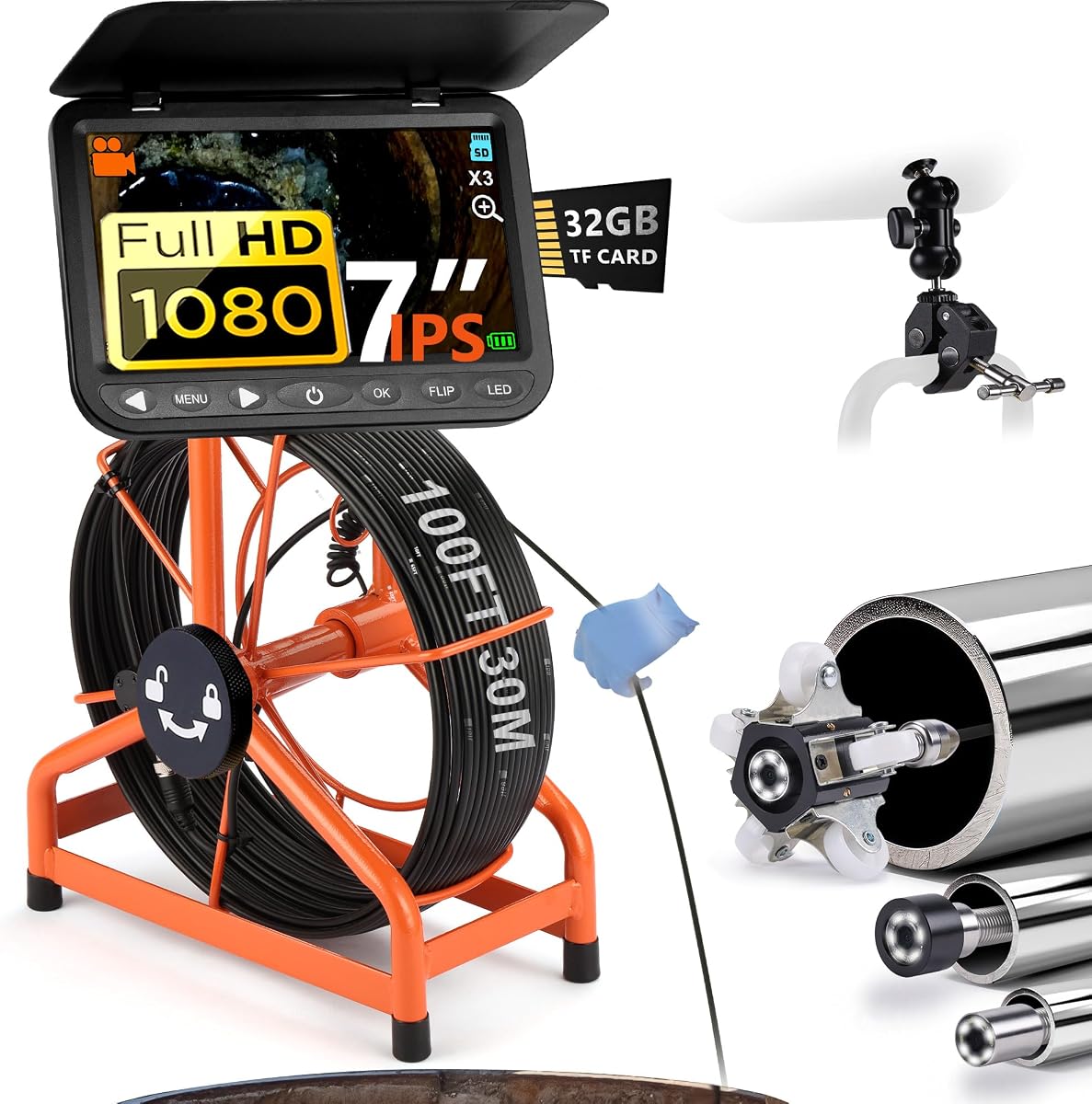
The ChoosePRO HD1080P Sewer Camera combines a long cable, a large display, and dedicated recording hardware in one purpose-built plumbing package. Its supplied customer rating is 4.5 out of 5, and the headline strengths are the 100-foot marked cable, seven-inch IPS screen, HD1080P lens, 16× zoom, and included 32GB memory card.
We may earn a commission when you buy through this link, at no additional cost to you.
The camera is designed for more than quick visual diagnosis. A 5000mAh battery is rated for more than eight hours, while USB-C power-bank support can extend work when a compatible power bank is available. Video can be reviewed instantly, transferred through the SD card or USB-C, and used to document findings. The marked cable helps estimate the distance to a blockage, while the reel uses a faster twist-lock mechanism.
The camera head carries an IP68 waterproof rating, six adjustable LEDs, interchangeable sleeves for different pipe sizes, and a flexible spring tip intended to help negotiate bends. The reel is built around 0.637-inch iron tubing, while aluminum mounting hardware includes a crab-claw clamp, peanut clamp, and a 360-degree mount. These are meaningful advantages for regular field work, although the single-lens setup is less versatile than dual- or triple-lens systems.
This is the strongest all-around recommendation for plumbers, property inspectors, facilities teams, and serious homeowners who want evidence from longer drain or sewer runs. It combines reach, recording, a usable display, lighting, and mounting hardware in a coherent kit. Those needing side-angle visibility can choose a multi-lens alternative, but for a complete general-purpose sewer camera, the ChoosePRO package is especially convincing.
The 100-foot cable extends well beyond compact borescopes, and its measured markings improve depth estimates. Real-time viewing, instant playback, and 32GB of included storage make the camera useful for both diagnosis and customer reports.
The IP68 camera head, six adjustable LEDs, spring tip, and pipe sleeves support inspection in wet, dirty, or flooded lines. The larger reel and aluminum mounting hardware also favor repeated professional use.
We may earn a commission when you buy through this link, at no additional cost to you.
This five-inch dual-lens endoscope is a practical general-purpose inspection tool for drains, pipes, automotive spaces, and HVAC work. It carries a 4.4 customer rating and pairs a 1080P camera with a 170-degree field of view. The most useful feature is the ability to switch between front and side views, which helps examine both the direction of a line and the condition of its walls.
We may earn a commission when you buy through this link, at no additional cost to you.
Its 16.4-foot semi-rigid cable holds bends while remaining flexible enough for confined spaces. Eight adjustable LEDs illuminate dark pipes, and the IP67-rated probe is suitable for wet and submerged environments. A 1.2-to-4-inch focus range helps users examine nearby cracks, corrosion, and other fine details. The five-inch screen is easy to read, and operation requires neither a smartphone nor a downloaded application.
The important limitation is that this model cannot take pictures or videos. It is therefore better suited to live diagnosis than creating a permanent record of a problem. Its 2000mAh battery is rated for approximately three to four hours, which may require charging during a lengthy workday. The shorter cable also keeps it within reach of residential plumbing rather than deep sewer lines.
Choose this model when portability, dual-angle visibility, and quick setup matter more than documentation. It is a sensible option for homeowners, mechanics, maintenance technicians, and plumbers checking accessible pipes, wall cavities, or engine compartments. Users who need evidence files or long surveys should move up to a recording camera with a longer cable.
The forward lens shows what lies ahead, while the side lens reveals pipe walls and nearby features. Switching between them reduces the need to rotate a narrow probe simply to understand the space around it.
The self-contained five-inch display and direct controls keep setup simple. This is particularly useful when working in wet environments where a phone should not be exposed or when wireless pairing is inconvenient.
We may earn a commission when you buy through this link, at no additional cost to you.
The 1920P HD Endoscope Camera offers one of the most affordable ways to inspect pipes, drains, wall voids, and other confined spaces. Its supplied rating is 4.5 out of 5. A 4.3-inch IPS display, approximately 170-degree horizontal viewing angle, and 1920x1080P imaging give it a clear and colorful view without requiring a phone.
We may earn a commission when you buy through this link, at no additional cost to you.
The 7.9mm probe is narrow enough for smaller openings, while the 16.6-foot semi-rigid cable reaches much farther than a basic handheld scope. Eight LEDs can be adjusted for dark spaces, and the IP67 waterproof head handles wet environments. A 2cm-to-10cm optimal focus range is useful for examining nearby pipe walls. Color-flip and brightness-shift functions add flexibility when the environment creates glare or unusual coloration.
This camera cannot take or store photographs, so it is a live diagnostic instrument rather than a documentation tool. It also provides only a forward-facing lens, which can make it harder to inspect the side of a pipe or obstruction. Nevertheless, its small probe, flexible cable, simple controls, and included hook, magnet, mirror, Type-C cable, and manual make it a well-rounded kit for routine checks.
For homeowners and occasional users, it is a compelling budget starting point. Plumbers can use it for smaller drain branches, mechanical spaces, and other places where maneuverability matters more than deep reach. Choose a longer recording model for major sewer work, but for compact, entry-level inspection, this camera delivers a useful combination of image clarity and reach.
The short 7.9mm camera head and semi-rigid 16.6-foot cable provide access into narrow lines and confined areas. Its stated focus range helps reveal cracks, corrosion, and buildup at close range.
The IPS screen and adjustable LEDs create a self-contained inspection system. Color and brightness controls help users interpret surfaces that would otherwise appear difficult under harsh lighting.
We may earn a commission when you buy through this link, at no additional cost to you.
The DEPSTECH DS520 is built around a 50-foot semi-rigid cable and a versatile triple-lens arrangement. Its 4.3 customer rating reflects a strong overall reception, while the front and dual side views provide more ways to inspect a pipe than a conventional single-lens borescope. The five-inch IPS screen supports real-time navigation and fault-finding.
We may earn a commission when you buy through this link, at no additional cost to you.
A 180-degree flip control and split-screen function make lens changes straightforward without repeatedly twisting the cable. Holding the control cycles through five viewing modes, while three stated focus ranges serve different working distances: 1.2–3.9 inches, 0.8–2.4 inches, and 0.6–0.9 inches. That range makes the camera useful for both general pipe views and close inspection of small defects.
The image system provides 2.0MP HD output, and the camera probe has IP67 waterproof protection for wet conditions. The kit includes a hook and magnet for retrieving dropped items and supports direct file transfer through a data cable. The long cable reaches more plumbing than a compact scope, but it is still less useful than a 100-foot dedicated sewer camera for deep municipal lines.
The DS620-style alternative listed later focuses more heavily on included storage, while this DS520 stands out through its five viewing modes and close-focus flexibility. It is a strong choice for plumbers, auto mechanics, HVAC technicians, and property inspectors who want multiple perspectives without changing cameras.
Front and dual side lenses allow operators to look along a pipe and toward its walls at the same time. Split-screen and quick flip controls make better use of the 50-foot cable without unnecessary repositioning.
Beyond drains, the probe is positioned for wall structures, HVAC ductwork, and engine compartments. The large display, long reach, and multiple focus modes make it a broader diagnostic instrument.
We may earn a commission when you buy through this link, at no additional cost to you.
The Teslong Dual Lens 50FT Sewer Camera is designed to inspect blockages, cracks, and root intrusions in straight PVC drain sections. Its supplied rating is 4.1 out of 5. The defining feature is a split screen showing a six-LED forward camera and a one-LED side camera simultaneously, letting operators see the route ahead and the pipe walls at once.
We may earn a commission when you buy through this link, at no additional cost to you.
The 4.3-inch IPS display tilts and rotates 180 degrees for use over a manhole or beneath a sink. Brightness can be adjusted for direct sunlight, and a rechargeable 3000mAh battery is intended to support all-day inspections. The self-contained design does not depend on a phone or Wi-Fi network, making operation straightforward on a job site.
The product description is notably candid about limitations. A semi-rigid cable is effective in straight runs but has limited flexibility around tight 90-degree elbows and P-traps. Murky water can also reduce visibility, so the line should be flushed with clean water beforehand. In addition, the TF memory card is not included, although standard 32GB FAT32 cards are compatible.
This camera is well suited to plumbers, home inspectors, and facilities teams dealing with accessible, mostly straight drains. It is less attractive for older lines with numerous tight bends or for users who need packaged video storage. The dual-view screen and rotating display make it particularly convenient for routine residential work.
The forward camera follows the likely path of a blockage, while the side camera exposes cracks, roots, and debris along the pipe wall. Displaying both views together reduces interpretation time.
Semi-rigid construction offers dependable straight-line control but is not designed to behave like a fully flexible articulated cable. Flush muddy lines and avoid forcing the probe through tight elbows.
We may earn a commission when you buy through this link, at no additional cost to you.
The 100-Foot Sewer Inspection Camera is a dedicated long-reach system for pipeline work, large tanks, house inspections, and other demanding environments. It has a supplied rating of 4.2 out of 5. Its 30-meter, approximately 100-foot semi-rigid cable is marked to help operators estimate the distance to visible problems.
We may earn a commission when you buy through this link, at no additional cost to you.
The camera head provides real 1080P high-definition video and high-brightness LED illumination. Its IP68 waterproof and dustproof design is intended for damp, dirty, and greasy pipelines. The five-inch DVR display supports real-time viewing and synchronized recording, while the included 32GB storage card can retain photos and videos for later analysis, reporting, or customer sharing.
One notable convenience is the integrated orange tool case. The host and accessories fit into a single organized package, reducing missing-part problems and making transport between job sites easier. The 17mm camera head and 5000mAh battery support extended work, while the reel provides a practical way to manage a substantial length of cable.
This model is a good fit for plumbers and serious DIY users who want long reach, storage, and a rugged carrying arrangement. Its single camera cannot provide the same immediate side-angle perspective as dual-lens systems, and the semi-rigid cable may be less effective through complicated bends. For straightforward, well-accessible lines and documented findings, it remains a practical choice.
Synchronized recording and included 32GB storage let users preserve a complete visual trail. That is valuable when documenting the location and nature of a blockage for analysis or a customer report.
The integrated case keeps the monitor, cable, and accessories together. A dedicated case is easier to manage than several loose components, particularly when moving between jobs.
We may earn a commission when you buy through this link, at no additional cost to you.
The Teslong 16.5FT Dual-Lens Camera is a well-rounded borescope for pipes, wall cavities, engine cylinders, and HVAC ducts. Its supplied 4.6 rating is among the highest in this roundup. A five-inch IPS display and dual lenses provide an accessible general-purpose setup for homeowners, mechanics, plumbers, and HVAC technicians.
We may earn a commission when you buy through this link, at no additional cost to you.
The forward and side cameras each have independent LEDs, allowing users to match illumination to the selected viewing direction. Brightness can be increased in deep, dark spaces or reduced around reflective surfaces. The probe is IP67 waterproof, while the 8mm semi-rigid cable holds its shape through confined routes and coils neatly for storage.
The 5000mAh rechargeable battery provides approximately 4.5 hours of continuous use and takes about five hours to recharge. This is adequate for multiple inspections but may not cover a full demanding workday on one charge. The hard carrying case, hook, magnet, and mirror add portability and utility. As with other semi-rigid probes here, tight 90-degree plumbing bends can be difficult.
This camera is an attractive general-purpose tool when the inspection area is compact and the task spans drains, walls, ducts, or engines. It avoids the complexity of a dedicated sewer system while offering two perspectives. It is best for accessible locations rather than deep sewer lines, and its strong rating reflects a balanced, easy-to-use feature set.
Separate LEDs for the forward and side lenses make it possible to light the active perspective more precisely. Adjustable brightness also helps control glare on wet or metallic surfaces.
The rechargeable host, hard case, and included accessories create a ready-to-use package. Its screen is large enough for live observation, while the 16.5-foot cable reaches most residential branches and building cavities.
We may earn a commission when you buy through this link, at no additional cost to you.
The Teslong Articulating Borescope focuses on maneuverability rather than reach. Its supplied rating is 4.6 out of 5, and the camera head can articulate in two directions to reach around obstacles and into complex spaces. The 4.5-inch IPS LCD color screen provides sharp visual feedback, and no app is required.
We may earn a commission when you buy through this link, at no additional cost to you.
A centrally positioned articulating joystick allows one-handed control from either side. A photo button on the back is placed within reach during an inspection, while adjustable high-brightness LEDs illuminate dark cavities. The five-foot semi-rigid gooseneck cable retains its shape, providing both stability and the ability to hold a selected position once maneuvered.
The primary tradeoff is reach. Five feet is appropriate for automotive interiors, wall cavities, equipment, HVAC areas, and short drain connections, but it is not sufficient for inspecting a long branch line or sewer run. Because of this, the camera is better treated as a precision inspection scope than a plumbing survey camera. Its relatively short cable can also be easier to control in locations with abrupt turns.
Choose the articulating borescope when direct visual access is blocked and the head must be steered around fittings, braces, or other obstructions. Mechanics and HVAC technicians may find it especially useful, while plumbers can use it for localized connections and cavity checks. For long plumbing routes, select a 50- or 100-foot semi-rigid camera instead.
The articulating head changes viewing direction without requiring the entire cable to be twisted. This helps reveal components hidden directly behind bends, edges, or equipment.
The central joystick and rear photo button reduce workflow interruptions. The light, compact host can remain manageable during automotive, wall, and HVAC inspections.
We may earn a commission when you buy through this link, at no additional cost to you.
The Sewer Camera with Locator is the most specialized and feature-rich option in the roundup. Its supplied rating is 5.0 out of 5. It combines a 100-foot survey cable, 512Hz locator, meter markers, a 1080P color monitor, and a DVR system, targeting professional plumbing, construction, chimney, HVAC, automotive, and industrial maintenance work.
We may earn a commission when you buy through this link, at no additional cost to you.
The locator is the key premium feature. By pairing the camera system with the 512Hz locator, operators can determine the approximate location of a blockage above or below ground. Meter markings on the 5mm cable add a second reference for how far the camera has advanced, while the 145-degree viewing angle and adjustable LEDs improve visibility inside difficult lines.
The 4.3-inch AHD screen includes a sun visor for outdoor work. A 32GB TF card is included for recording and saving images, and the 23mm camera head carries 12 adjustable LEDs. The 8500mAh battery is rated for up to six to eight hours of continuous use. The stated cable-feeding tip—passing the wire through a fixed ring—helps make handling the long line more manageable.
This is the premium recommendation for professionals who need to identify not only a pipe problem but also its physical location. The 23mm head is larger than some compact alternatives and may not suit every narrow line, but the locator and measurement system add substantial value for municipal, commercial, and serious residential surveys. Casual users can get sufficient capability from a shorter dual-lens borescope.
The included 512Hz locator helps connect the visible problem to a position on the property. That makes the system especially useful when excavation decisions or targeted repairs are being considered.
Meter markers support distance tracking, while the DVR and included 32GB card preserve visual evidence. Together, these features create a more methodical record than a live-only scope.
We may earn a commission when you buy through this link, at no additional cost to you.
The DEPSTECH DS620 combines a 50-foot semi-rigid cable, triple-lens camera, five-inch IPS display, and included recording storage. Its supplied customer rating is 4.4 out of 5. It is designed for plumbing, drains, walls, ceilings, cylinders, and other confined spaces where a longer reach and multiple viewing perspectives are useful.
We may earn a commission when you buy through this link, at no additional cost to you.
The triple-lens arrangement lets operators switch between front and side views to examine details hidden around bends or on pipe walls. Bluart 3.0 technology and adjustable camera lighting support detailed observation, while the 7.9mm slim probe and IP67 waterproofing help the camera enter narrow, damp locations. The ergonomic handheld host and protective carrying case improve portability.
A 32GB memory card is included, allowing users to capture videos and still images for later review or sharing. The rechargeable battery is stated to provide up to four hours of continuous use. For longer inspections, operators may need access to charging between jobs. The product description also recommends a cable puller for enhanced maneuverability, but bundles are not included with the camera.
The DS620 is a balanced choice for plumbers, mechanics, DIY enthusiasts, and homeowners who want more reach and storage than a compact borescope without moving to a full sewer camera. It lacks a locator and offers a shorter reach than dedicated 100-foot systems, but its triple lens and included memory make it a versatile all-around inspection package.
The 7.9mm probe combines a narrow body with front and side perspectives. This makes it useful where access is restricted but seeing around an obstruction remains important.
Included storage removes the need to purchase a card before recording. The large display, adjustable lights, and protective case support a complete workflow from inspection to later review.
We may earn a commission when you buy through this link, at no additional cost to you.
A plumbing inspection camera should fit the physical route, lighting conditions, documentation needs, and operating habits of the person using it. Cable reach and probe design matter most for drains, while lens configuration, display quality, recording, and accessories influence everyday usability.
Cable length determines how far the camera can travel from the access point. Compact scopes with roughly 16 feet are useful for small residential branches, wall voids, engine bays, and short drain connections. A 50-foot cable provides much greater reach for household drain lines and building inspection, while a 100-foot system is better suited to long sewer runs, large tanks, and commercial surveys. Longer is not automatically better because the added cable becomes heavier and harder to control.
Semi-rigid probes hold a bend and generally push through straight pipe more predictably than fully flexible cables. They remain useful around moderate bends but can struggle with P-traps and tight 90-degree elbows. Articulating heads offer an alternative when precise steering around obstacles matters more than distance. Fully articulated systems can navigate complex geometry, but their shorter reach makes them less suitable for long sewer surveys.
Single-lens cameras are straightforward and often produce a narrower head that can enter smaller pipes. Dual-lens systems add a side-facing view for examining walls, roots, cracks, and debris beside the camera. Triple-lens systems add further options and, in the DEPSTECH models, several focus ranges and viewing modes. More lenses improve flexibility but do not automatically make a camera better, so consider whether the intended access points and pipe sizes fit the probe.
Resolution should be considered alongside screen size, focus range, and illumination. A 1080P or 1920x1080P camera can reveal fine details, but adjustable LEDs are essential inside dark pipes. Brightness controls help prevent glare on wet surfaces, while color-flip and image enhancement features can improve interpretation. A larger IPS screen is generally easier to read when the user is crouching under a sink or working outdoors.
Live-only scopes are ideal for quick answers and save both money and setup time. Recording cameras support reports, customer explanations, remote review, and before-and-after comparisons. Look for a DVR, included memory card, photo controls, and straightforward transfer options such as USB or removable storage. If evidence is routinely needed, recording capability should rank above a shorter cable or extra lens.
Plumbing inspection happens in wet, dirty, and sometimes submerged environments, so probe waterproofing is a practical safety factor. IP67 and IP68 ratings appear throughout this category, but the rating generally applies to the camera head rather than the entire host. Note the stated head diameter as well: a slimmer probe enters smaller pipes, while a larger head may provide stronger lighting or support a locator system.
Battery capacity affects how many inspections can be completed between charges. Stated runtimes range from about three hours to more than eight hours, though real use depends on brightness, recording, and battery condition. USB charging or power-bank support can extend a long workday. A self-contained display, large buttons, ergonomic grip, and included carrying case also reduce setup friction, particularly when the camera is used away from a workshop.
Hooks, magnets, and side mirrors can help retrieve small objects or inspect around corners. A tool case prevents small parts from disappearing and makes transport easier. Warranty coverage is also useful, particularly for professional users who depend on a camera across many jobs. Some advanced features, such as an underground locator, require additional equipment or add bulk, so justify them according to the actual inspection workload.
Begin by reviewing the camera's controls, charging the battery fully, and checking that the probe, reel, display, and attachments are clean and undamaged. For drain work, remove avoidable obstructions and flush the line with clean water when possible. Position the camera at a stable access point, secure the reel, and begin feeding the probe gradually while watching the live image.
Advance the cable only as far as the route safely permits. Keep the probe centered, use the side or articulating view to examine pipe walls, and adjust lighting to control glare in wet lines. Mark the distance when a suspected problem appears, record photos or video if the model supports it, and retrace the route before withdrawing the camera. Never force a semi-rigid probe through a tight elbow because excess force can damage the cable or camera head.
After the inspection, disconnect power, wipe the probe and cable with a damp cloth, and let the camera head dry before storage. Avoid immersing the monitor or a host that is not rated for immersion. Retract the cable carefully to prevent kinks, check connectors for dirt or moisture, and recharge the battery according to the manufacturer's guidance. Store accessories in the included case and keep the camera away from extreme heat, corrosive materials, and direct sunlight for extended periods.
A dual-lens borescope with a 16- to 50-foot semi-rigid cable is often the most convenient starting point for residential work. It can inspect short drain branches, wall cavities, and localized pipe connections without the weight of a full sewer camera. A recording model is preferable if the findings must be saved or shared.
It depends on the probe design. A semi-rigid cable works well in straight runs but may struggle with tight 90-degree elbows and P-traps. Articulating heads can steer around some obstacles, although their shorter cables limit total reach. Trying to force any probe can damage it or the plumbing.
A 50-foot camera is often sufficient for many residential branch lines, while a 100-foot model offers better reach for longer runs, commercial drains, tanks, and municipal work. Measure the expected route from the access point, then allow extra length for bends, risers, and positioning the camera at the correct angle.
A locator is not essential for finding a visible blockage, but it can be highly valuable when determining where that blockage lies beneath the property. The included 512Hz locator on the premium pick supports more targeted excavation and repair planning. It adds cost and complexity that casual users may not need.
No. Resolution is only one part of image quality, and focus range, lighting, screen size, and sensor performance also matter. Adjustable LEDs and a clear display can be more useful than additional resolution in a dark, wet pipe. Choose the camera that provides the best combination for the environment and task.
Only models with photo and video functions can save evidence. The live-only borescopes are designed for immediate visual diagnosis, while several DVR models include memory cards and transfer options. Verify recording capabilities and storage compatibility before purchase if documentation is an important requirement.
Wipe the probe and cable after each use, protect the monitor from excessive water, and dry the camera head before closing the case. Retract the cable without sharp bends, keep connectors dry, and store all accessories together. Charging between jobs and avoiding extreme temperatures helps maintain battery and cable condition.
They can be, provided the probe has an appropriate waterproof rating and the display remains protected from rain or direct sunlight. A model with a sun visor and a long cable is better for outdoor surveys. Also consider battery life, reel handling, and whether the route requires professional locating equipment.
The ChoosePRO HD1080P Sewer Camera is the strongest overall selection because it combines 100-foot reach, a large display, HD imaging, recording, distance markings, and durable field hardware. The Sewer Camera with Locator earns the premium position for professionals who need to locate surveyed problems, while the 1920P HD Endoscope Camera delivers a capable and economical way to inspect smaller lines and confined spaces.
Before purchasing, prioritize the access point, expected pipe route, and documentation needs. A compact dual-lens scope is easier to control, a 50-foot camera covers more household drain work, and a 100-foot system is better for long surveys. Probe maneuverability and included recording features should be weighed against maximum reach rather than treated as isolated specifications.
Finally, check the current listing, package contents, warranty, and compatibility details before ordering. Ratings can change as more customers provide feedback, and included accessories may vary over time. Comparing the final listing against the route and inspection task will help ensure that the selected plumbing inspection camera is the right tool for the job.