
NEEWER Professional Microphone Pop Filter Shield
4.4Editor score
Dual-layer airflow control
Adjustable steel gooseneck
Swivel mounting clamp
Works with varied tubular stands
Our Pop Filters for Vocal Recording guide compares 10 options for plosive control, microphone fit, mounting, layering, studio use, streaming, and podcasting.
A pop filter sits between a singer or speaker and a microphone to reduce the pressure of P, B, and T sounds before they reach the capsule. The right model can also soften breath noise, limit saliva exposure, and improve consistency across vocal takes, making it an essential accessory for home studios, podcasters, streamers, and professional recording environments.
The ten products in this guide were compared using their published specifications, compatibility details, mounting systems, filtration materials, dimensions, and customer ratings. The list covers conventional dual-layer screens, multilayer foam-and-mesh designs, full isolation balls, microphone-specific covers, and a dedicated filter for the Stedman PS101 V2, with options for different microphone sizes and recording setups.
Each review explains the product's strongest benefits, practical limitations, and ideal user, helping you match a filter to your microphone and workflow. Ratings and product availability can change over time, while prices fluctuate, so confirm the current listing details before making a purchase.
4.4Editor score
4.5Editor score

4.5Editor score
This side-by-side comparison organizes all ten filters by design, compatibility, filtering approach, and mounting method, making it easier to identify the right accessory for your microphone and recording environment.


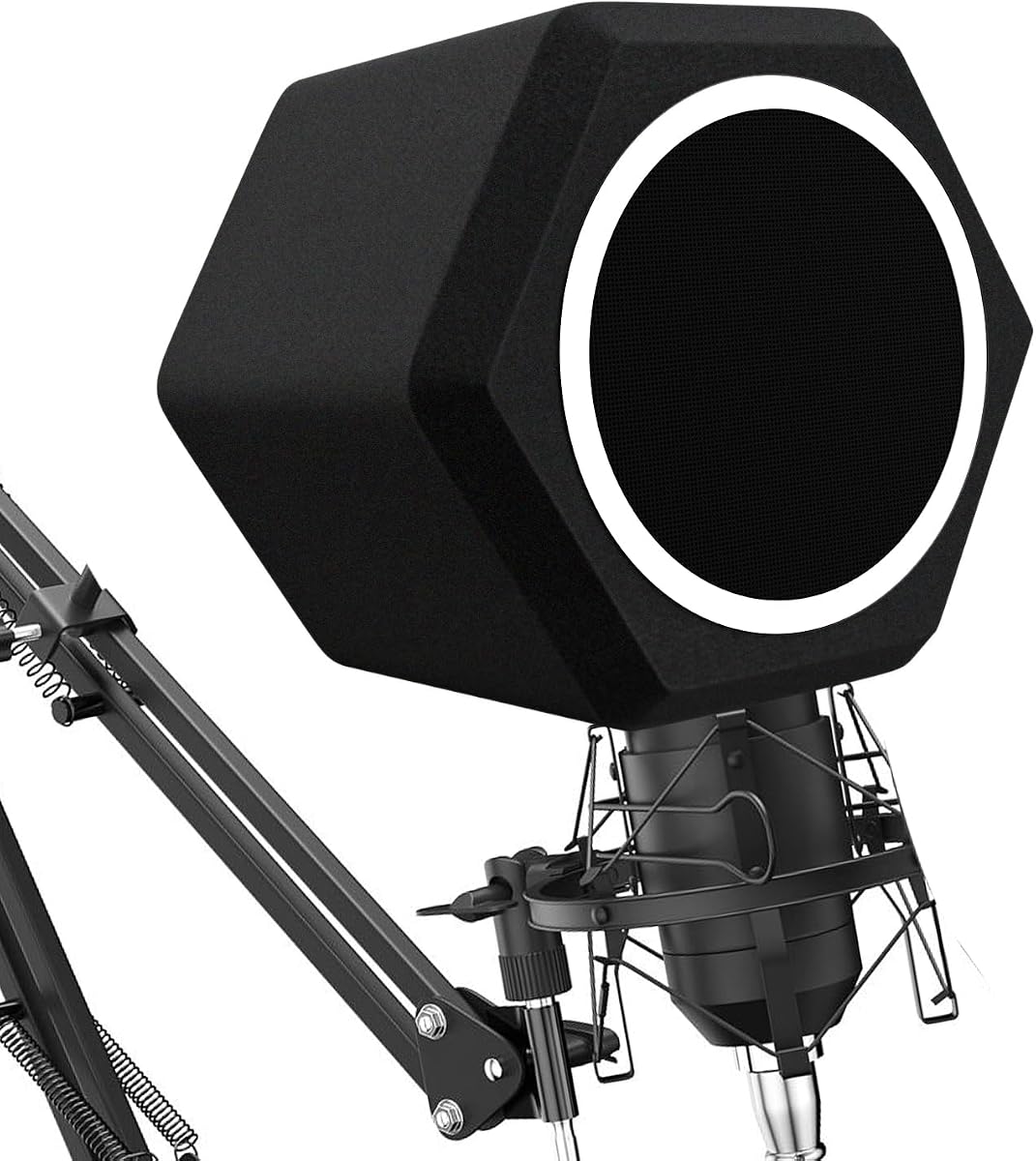
This isolation-ball pop filter has a 4.5 rating and stands apart through its enclosed approach to airflow and reflection control. Rather than placing only a flat screen in front of a microphone, it surrounds the capsule with sound-absorbing foam and adds a double-layer screen on the open face. That combination makes it a compelling choice for singers, voice actors, podcasters, and streamers who want more separation from plosives, breath noise, saliva spray, and nearby reflections.
We may earn a commission when you buy through this link, at no additional cost to you.
Compatibility is broad but clearly defined. The removable jacket accommodates most XLR and USB condenser microphones with diameters from 50 to 75 millimeters, and the included holder supports microphones of different sizes within that range. The five-sided foam construction is intended to reduce incoming noise from several directions, while the layered front screen disperses divergent air movement before it reaches the capsule. At approximately 120 grams, the housing can be moved between desktop stands, small tripods, cantilever arms, and floor stands without becoming especially burdensome.
The main compromise is physical bulk. An isolation ball occupies more room than a conventional pop filter, so it may be less convenient for compact desk arrangements. Its microphone-specific jacket also means buyers should measure their existing microphone or removable housing carefully rather than relying on a broad compatibility claim. Even so, the product's 4.5 rating, multi-directional foam design, and dual-screen face offer a more comprehensive filtration solution than a basic two-layer disc.
This is the strongest overall choice for users who can accommodate an enclosed filter and want control over both airflow and reflections. It is particularly useful in untreated rooms, close-range podcasting setups, home studios, radio environments, and live recording where stray breath and environmental sound can be distracting. Those wanting only the smallest possible screen should choose a conventional clamp-mounted model, but for broad protection and portable construction, this isolation ball is the most versatile pick in the guide.
The five-sided foam shell approaches noise control from several directions, while the double-layer front screen handles concentrated airflow. This makes the filter useful when a single flat screen would not address room reflections or off-axis sounds as effectively.
Its light weight and detachable jacket make it practical for desktop, tripod, cantilever-arm, and floor-stand arrangements. The included holder also accommodates different microphone sizes within the stated diameter range.
We may earn a commission when you buy through this link, at no additional cost to you.
The NEEWER Professional Microphone Pop Filter Shield carries a 4.4 rating and offers a conventional, easy-to-understand solution for reducing vocal plosives. Its two layers are not simply duplicate mesh panels. The first screen intercepts the initial blast of air, the space between the layers helps disperse remaining pressure, and the second screen contains the reduced airflow before it reaches the microphone.
We may earn a commission when you buy through this link, at no additional cost to you.
The steel gooseneck is a notable strength because it supports the filter while allowing the user to adjust its angle and distance from the microphone. That flexibility is valuable because the most effective position is not always directly centered or extremely close to the capsule. The rotating clamp uses a scratch-resistant gripper and works with a variety of tubular microphone booms and stands. A swivel mount makes installation, removal, and repositioning straightforward.
This design focuses on one core problem: controlling the air created by P, B, and similar sounds. It is not marketed as a full isolation chamber, so it does not provide the same directional noise reduction or reflection control as the foam-enclosed options in this guide. The relatively open frame also leaves more of the microphone exposed than a full windscreen. Buyers should also note that the microphone is not included.
The NEEWER shield is a strong budget pick for podcasters, streamers, actors, musicians, and home-studio users who want a dependable conventional filter without a model-specific fit. It should be particularly attractive to anyone who values quick setup and frequent angle adjustments. If expansive environmental control is the priority, an isolation ball may be more suitable, but for a straightforward pop-filtering upgrade, this model is versatile and well rated.
The gap between the screens gives pressurized air room to disperse, reducing the direct impact associated with plosives. This staged design is a practical alternative to a single thin screen.
The steel gooseneck and rotating clamp let users set the filter's height, angle, and distance with little effort. The padded gripper helps secure the attachment while limiting surface wear.
We may earn a commission when you buy through this link, at no additional cost to you.
This PEMOTech pop filter has a 4.5 rating and uses three filtering layers to address plosives, pops, crackles, wind interference, and breath sounds. Its construction combines foam, metal mesh, and an etamine layer, giving the screen more material than a basic one-layer accessory. The result is designed to create cleaner vocal recordings for speech, singing, video production, and streaming.
We may earn a commission when you buy through this link, at no additional cost to you.
The fit is centered on microphones with a 45–61 millimeter diameter, and the listing names a broad range of compatible examples, including Audio-Technica AT2020, AT2035, AT4040, and AT2050 models, Samson Meteor, Scarlett CM25, CAD GXL2400, Razer Siren X, Rode NT1A and NT-USB, several MXL microphones, CAD U37, and BM-800. It is explicitly not designed for the Blue Yeti, making the diameter check especially important for buyers.
Installation relies on elastic bands and an inner rubber ring. This creates a close-fitting shield without requiring a clamp or separate gooseneck, which can make the filter convenient for a fixed tabletop microphone. The fit is useful for keeping saliva away from the microphone, and the metal mesh frame is designed to preserve an unobstructed appearance. The package includes one pop filter, but not a microphone.
This is a good choice for users who want more filtration layers without a large isolation shell and whose microphone falls within the specified diameter range. The direct-fit mounting is simpler than many stand-mounted filters, although it may be less convenient if you frequently change microphones or reposition the mic. Confirm dimensions before buying, particularly if your model resembles the excluded Blue Yeti.
Combining foam, metal mesh, and etamine distributes the filtration task across several layers. Each material adds another barrier against air blasts and airborne noise.
Elastic bands and an internal rubber ring hold the filter around a compatible microphone. This makes assembly quick and keeps the screen aligned closely with the capsule.
We may earn a commission when you buy through this link, at no additional cost to you.
The YOUSHARES Blue Yeti Pop Filter has a 4.5 rating and is purpose-built for a very popular USB microphone. Rather than asking you to improvise a foam cover or use a generic screen that may fit poorly, it combines a Blue Yeti-compatible 5.5-inch windscreen with a six-layer pop-filter assembly. The package provides both pieces for a coordinated setup.
We may earn a commission when you buy through this link, at no additional cost to you.
Its material stack begins with double metal mesh and includes two layers of high-density windproof sponge. The intent is to disperse concentrated air pressure and trap saliva, dust, and vapor before they reach the Blue Yeti. The filter is specifically marketed to reduce plosives associated with P and S sounds, which is useful for spoken-word recording, gaming, streaming, podcasting, and singing.
A carbon steel gooseneck supports the filter and allows its angle and distance from the microphone to be adjusted. The product listing states that the arm is designed to withstand more than 10,000 bends. Instead of adhesive pads, the L-style swivel clip attaches to a microphone stand or the Blue Yeti, which should help the filter remain secure when the microphone is repositioned.
This premium pick is ideal for Blue Yeti owners who want a more integrated and elaborate solution than a basic universal disc. Its specific fit is both its strength and its limitation: it is the better choice for Blue Yeti users, but other microphone owners should select a more general model. For the intended microphone, the six-layer construction and dedicated foam windscreen offer an attractive combination of plosive control and physical protection.
The dedicated 5.5-inch windscreen is designed around the Blue Yeti's form rather than relying on a loose generic cover. This makes the setup more orderly and helps the filter sit in a predictable position.
The carbon steel arm holds its shape after repositioning, while the L-style swivel clip provides more security than adhesive attachment. This is useful when the microphone is adjusted regularly.
We may earn a commission when you buy through this link, at no additional cost to you.
This professional pop filter has a 4.1 rating and combines a two-layer concept with six filtering layers to manage plosives, sibilance, and unwanted noise. It combines dual metal mesh with high-density foam, giving it more material than the standard two-screen arrangement while remaining smaller and more conventional than a complete isolation ball.
We may earn a commission when you buy through this link, at no additional cost to you.
Its flexible carbon steel arm is designed to be twisted into different angles and remain in position. The manufacturer states that it supports more than 10,000 bends. The overall dimensions provide useful planning information: the outer filter diameter is 5.91 inches, the inner screen measures 5.12 inches, the arm is 13.39 inches long, and the total extended length reaches 21.06 inches. That reach makes it suitable for a desk stand or boom positioned at a comfortable distance from the speaker.
The rotating L-shaped clamp accommodates most microphone boom arms and desk stands with tube diameters up to 1.38 inches. An anti-scratch EVA pad helps protect the stand's finish. The filter is also positioned as a moisture and saliva barrier, which is valuable in podcasting, karaoke, broadcasting, home recording, and live streaming applications.
This model offers a useful middle ground between a simple screen and a foam-enclosed microphone cover. Its detailed measurements and universal clamp are especially helpful for organized desk setups. The 4.1 rating is lower than those of several other products in the guide, but the specifications indicate a substantial filtration stack and flexible positioning. Buyers should ensure that their stand has enough clearance for the full 21.06-inch extended length.
Published measurements help users understand whether the filter and arm will fit their workspace. The long extension is beneficial for flexible placement but requires enough room around the stand.
The rotating clamp accommodates common tubular boom arms and desktop stands, while the EVA pad reduces the chance of scratching the mounted surface during repeated adjustments.
We may earn a commission when you buy through this link, at no additional cost to you.
The SUNMON Fifine K688 Pop Filter carries a 4.1 rating and is designed around the shape and dimensions of the Fifine K688, with compatibility also listed for the Fifine K658. Its L-shaped clamp uses rubber pads to hold the assembly in place, providing a more model-specific solution than a generic clip-on screen.
We may earn a commission when you buy through this link, at no additional cost to you.
The filter combines metal and sponge materials in a six-layer arrangement. According to the product information, the layered screen is intended to reduce B and P plosives, background noise, and upper-frequency loss while breaking up airflow before it reaches the microphone. A 5.5-inch windscreen also helps protect the K688 from saliva and water vapor during extended recording sessions.
A carbon steel gooseneck allows the filter to be twisted into a preferred shape and angle. The listing says it remains in place without falling or wobbling, which is important because a shifting screen can change the distance between the airflow and the microphone. The rubber pads at the base of the clamp add grip and help protect the microphone's exterior.
This is a sensible pick for a Fifine K688 or K658 owner who wants a coordinated windscreen and pop filter. The same specificity that helps it fit these microphones also makes it less appropriate for a broad collection of gear. Its 4.1 rating suggests a solid but less strongly reviewed option than several alternatives, so buyers should weigh the specialized fit and layered construction carefully.
The L-clip and 5.5-inch windscreen are intended to fit the K688 and K658. This focused design can be more convenient than adapting a generic filter.
Metal and foam work together to interrupt the force of vocal air bursts. The result is designed to improve clarity while shielding the microphone from moisture.
We may earn a commission when you buy through this link, at no additional cost to you.
This professional isolation ball has a 4.2 rating and combines a detachable two-layer pop filter with a five-sided high-density foam enclosure. It is intended to reduce plosives, wind interference, saliva spray, pops, crackles, breath sounds, and echoes in one compact accessory, reducing the need to combine a separate pop filter with a larger vocal booth or windscreen.
We may earn a commission when you buy through this link, at no additional cost to you.
The detachable jacket accommodates microphone diameters from 1.96 to 2.75 inches. Compatible models named in the product information include the Audio-Technica AT2035 and AT2020 and the Blue Yeti USB microphone. The manufacturer emphasizes that this is not a miniature mic ball, so checking the stated range is essential. The high-density foam is described as fine-textured, resilient, and resistant to the deformation associated with lower-density foam.
At approximately 120 grams, the housing is light enough to mount on desktop stands, small tripods, cantilever arms, or floor stands. Its enclosed design is particularly useful for personal recording, professional studios, radio studios, and outdoor performance. The five-sided shape also provides some protection against accidental drops in addition to shielding the microphone from saliva and moisture.
The isolation ball is best for users who want more environmental control than a flat screen can offer. Its largest limitation is compatibility: the jacket is narrower than the range offered by some other enclosed options, and the product takes up more space than a traditional filter. If your microphone falls within the stated range, the combination of layered screening and high-density foam makes this a compelling compact solution.
The two-layer front screen addresses concentrated airflow, while the surrounding foam helps limit off-axis noise and reflections. Combining both functions simplifies the setup.
The product information highlights small pores, fine texture, strong tensile performance, and rapid rebound. These characteristics are intended to help the foam retain its form over repeated use.
We may earn a commission when you buy through this link, at no additional cost to you.
This microphone pop filter earns a 4.5 rating by offering a straightforward dual-layer screen with flexible positioning and quick installation. The mesh is designed to reduce the plosives associated with P and B sounds, sibilance, and breath noise, making it useful for recording, streaming, podcasting, and voice-over work from a user's first take.
We may earn a commission when you buy through this link, at no additional cost to you.
The 360-degree metal gooseneck is intended to remain firmly positioned without sagging. Users can adjust the angle and distance to find an effective location between their mouth and the microphone. That flexibility matters because airflow and vocal tone can change based on how closely the screen sits to the capsule and whether it is centered in front of the sound source.
The padded adjustable clip fits standard microphone stands and boom arms. The listing names Blue Yeti, Rode, and Audio-Technica microphones among compatible examples, although the mounting method attaches to a stand rather than fitting directly around every microphone body. An anti-slip and scratch-conscious grip is intended to keep the assembly secure without damaging the stand.
The swivel mount allows quick attachment and removal without tools, making this a practical choice for users who switch between recording configurations. It does not surround the microphone with foam, so it should not be confused with an isolation ball or full windscreen. For accessible plosive control, flexible adjustment, and quick setup, it is a well-rounded conventional filter.
The metal gooseneck is designed to hold a selected angle and distance once adjusted. This stability helps maintain a consistent relationship between the filter and microphone.
The tool-free swivel attachment makes it easy to add or remove the filter from a compatible stand. This is convenient for creators who alternate between different desktop or boom-arm arrangements.
We may earn a commission when you buy through this link, at no additional cost to you.
The Stedman PS101 V2 Pop Filter is a model-specific accessory designed to work with the Stedman PS101 V2 microphone. It is intended to reduce plosive sounds and breath noise, producing cleaner and clearer vocal recordings in home studios, podcasting environments, voice-over sessions, and professional recording spaces.
We may earn a commission when you buy through this link, at no additional cost to you.
Because the filter was created for the PS101 V2, its main advantage is the expectation of a coordinated fit. Rather than adapting a general clip, elastic mount, or windscreen to a particular capsule and body shape, the accessory is intended to attach directly to the compatible microphone. The simple attachment mechanism is designed to make installation and removal quick and uncomplicated.
Durable construction is another stated priority, with the product positioned for regular studio use and consistent performance. The filter does not promise the same broad environmental isolation as a foam-enclosed microphone ball, but it targets the central problem of reducing strong consonant bursts and audible breath movement at the microphone.
This is the clearest choice for a PS101 V2 owner, but it is not a general-purpose selection for other microphones. No customer rating is supplied in the available product data, so the absence of a numerical score should be considered when weighing the choice. Its dedicated compatibility and straightforward setup make it a specialized but logical accessory for existing Stedman PS101 V2 users.
The filter is designed around the Stedman PS101 V2, reducing the need to improvise a mounting solution. That focused fit is its defining feature.
A durable construction and straightforward attachment method suit regular recording use. The design focuses on dependable plosive and breath control for the compatible microphone.
We may earn a commission when you buy through this link, at no additional cost to you.
The PROAR multi-layer pop filter has a 4.5 rating and is built around thick filter sponge, a flexible carbon steel gooseneck, and an adjustable screw clamp. It is intended to reduce plosives, wind interference, saliva spray, hisses, pops, and thuds while supporting clear vocal output for recording, podcasting, gaming, speaking, and singing.
We may earn a commission when you buy through this link, at no additional cost to you.
Its stated compatibility includes the Blue Yeti, Blue Snowball, HyperX QuadCast, Shure microphones, Rode PodMic, and other models. The multi-layer screen offers more filtering material than a basic mesh disc, making it appealing for close-mic’d speech where consonant bursts tend to be prominent. The clamp has a scratch-resistant gripper and is stated to fit surfaces up to 1.96 inches.
The enhanced 360-degree gooseneck uses flexible carbon steel and allows the screen's angle and distance from the microphone to be changed. The metal holder supports the filter's weight and is designed to remain in position after adjustment. This is particularly useful for finding a balance between plosive control, tonal clarity, and comfortable speaking distance.
The PROAR filter is a strong all-purpose option for a varied microphone setup, especially for users who want more substantial foam filtration than a basic dual-screen product. One consideration is that dense, multilayer material can create greater resistance to airflow, so its position may need to be adjusted carefully. Confirm clamp dimensions and microphone clearance before installation, but its 4.5 rating and flexible mount make it a well-rounded final choice.
Thick filter material is intended to soften concentrated bursts of air and reduce unwanted sound before it reaches the microphone. This is useful for close-range vocals and spoken content.
The flexible carbon steel gooseneck allows changes to angle and distance while remaining in position. The screw clamp then secures the filter to compatible stands or surfaces.
We may earn a commission when you buy through this link, at no additional cost to you.
Choosing a pop filter involves balancing microphone fit, airflow control, mounting convenience, and the amount of environmental protection your recording space requires.
Compatibility is the first filter because even a well-made screen cannot provide reliable performance if it is too small, loosely fitted, or attached to an incompatible stand. Some options wrap directly around a microphone using elastic bands or a rubber-lined interior, while others clamp to a boom arm, desktop stand, or floor stand. Model-specific designs may be the most convenient for their intended microphones, but they are the least versatile. Generic clamp-mounted screens often accommodate more equipment, although their opening and depth may not surround every capsule.
Check the microphone diameter, removable-jacket measurements, and the listed stand-tube limits before buying. If the product names compatible models, compare those names with your own microphone. When exact dimensions are unavailable, measure the widest part of the body and the diameter of your stand.
A standard pop filter normally uses one or two mesh layers to interrupt the pressure of plosives. Multilayer products add foam, etamine, or additional mesh to provide more extensive attenuation. Isolation balls go further by surrounding the microphone with sound-absorbing foam, helping with off-axis noise and reflections as well as airflow. Foam windscreens are another category, usually sitting directly over a compatible microphone and offering protection from moisture, dust, and saliva in addition to some airflow reduction.
Choose a standard screen for straightforward plosive control, a multilayer filter for stronger vocal cleanup, or an enclosed design for untreated rooms. Avoid judging only by layer count; spacing, material density, and fit also influence how effectively the assembly disperses air.
Plosives are bursts of pressure associated with sounds such as P and B, while sibilance refers to the sharper high-frequency qualities often associated with S sounds. A properly positioned filter can reduce the force of these sounds before they reach the microphone. Mesh screens are particularly effective at breaking up air pressure, while thicker foam and multilayer combinations can provide additional attenuation and environmental protection. Sibilance also depends on microphone placement and the performer's distance, so a pop filter should not be viewed as a substitute for good gain control or room treatment.
Start with moderate spacing and adjust the filter as needed. The best position balances clean plosive reduction with enough airflow to avoid an overly muffled or unnatural vocal result.
A stable mount keeps the filter at a consistent distance from the microphone and prevents it from swinging during a take. Common options include screw clamps, swivel clips, elastic-band jackets, and L-shaped microphone attachments. Screw clamps tend to offer strong adjustability and work with many stands, while elastic systems attach directly to the microphone and can be simpler for a fixed tabletop setup. Goosenecks vary in length, flexibility, and tendency to retain a new position.
Consider your stand, available desk space, and how often you reposition the microphone. Make sure the clamp diameter is within the stated range and leave enough room for the filter to sit without contacting the body of the microphone.
A home office, untreated bedroom, and treated studio present different problems. A flat screen handles direct plosives in any environment, but nearby voices, computers, reflections, and air movement may still be audible. An isolation ball adds foam on several sides and is better suited to a relatively busy room. Full vocal booths offer a different level of acoustic control, but they are not necessary for every home recording project.
Use a directional microphone pattern, sensible gain, distance control, and basic room treatment alongside your filter. A pop filter solves an airflow problem; it does not automatically solve every acoustic issue in a recording space.
A flexible gooseneck makes it easy to align the filter in front of the mouth and adjust the distance to the microphone. Its usefulness depends on whether it holds that shape after movement. A metal arm that maintains its position prevents the screen from drifting during recording and makes repeated setup more predictable. Long arms provide reach but require more clearance, while shorter arms are better for compact desktop arrangements.
Look for claims about bend resistance and position retention, but also consider the diameter and weight of the filter. The arm should support the assembly without pulling the clamp downward or causing it to slip.
A pop filter also creates a physical barrier between the microphone and the person speaking or singing. Foam layers, mesh, and fitted windscreens can intercept saliva, moisture, and dust before they settle on the capsule or body. This is especially useful during long podcast sessions, voice-over work, gaming commentary, and live performances where the performer may be close to the microphone.
Choose a cleanable, removable design and avoid blocking the microphone's vents or controls. Allow the filter and foam to dry fully if they become damp, because retained moisture can affect both hygiene and long-term material performance.
Flat screens are the easiest to carry and require the least space. Multilayer units add bulk but can provide more comprehensive noise control, while isolation balls occupy a larger footprint because they surround the microphone. Model-specific accessories may be compact but cannot be transferred to other microphones. Features such as swiveling clamps, reinforced arms, and included foam covers should be evaluated against how you actually work rather than as isolated selling points.
For frequent travel, favor a lightweight screen with a compact arm. For a permanent desk setup, a larger enclosed filter may be more useful. For a broad collection of microphones, a universal clamp system generally provides the most flexibility.
Begin by mounting the filter according to its design. Clamp models should be secured to a compatible microphone stand or boom arm, with the adjustment knob tightened only enough to prevent slipping. Direct-fit models should be stretched gently around the microphone so that the screen sits in front of the grille without forcing the body. Model-specific covers should be oriented so that no foam blocks a microphone control, connector, or acoustic opening.
Position the filter directly between the mouth and the microphone, usually a short distance in front of the grille. Speak or sing at a consistent level and listen for harsh P, B, and T sounds. If plosives remain, move the screen slightly closer or adjust its angle. If the voice sounds overly muffled or the airflow becomes distracting, increase the spacing or choose a lighter filter design. Lock the arm and clamp once the position feels natural.
For care, detach the filter gently and clean removable foam or etamine according to the manufacturer's care instructions. Avoid saturating materials with water or cleaning fluid unless the product specifically permits it. Let every part dry completely before reassembly, and keep the mesh free of dust and saliva residue. Replace stretched elastic bands, damaged mesh, or degraded foam promptly, because compromised parts can alter both the fit and the sound.
A pop filter is most useful with directional condenser microphones and other microphones that respond strongly to nearby consonant bursts. It can still help with many dynamic and USB models, especially when the speaker is close. The amount of benefit depends on the microphone, placement, performer distance, and room acoustics, so a filter should complement rather than replace good gain control and positioning.
A pop filter primarily reduces concentrated bursts of air caused by P, B, and T sounds. A windscreen adds foam or another porous layer around the microphone to soften airflow and protect the capsule from moisture, saliva, and dust. Some products combine both functions, while others are designed specifically for one purpose.
There is no single perfect distance because microphone design, vocal technique, and filter type all affect the result. Start with the filter a few centimeters in front of the grille and adjust while recording. Moving it closer generally increases plosive control, while greater distance can create a more open sound but may let stronger bursts reach the microphone.
A conventional screen mainly addresses airflow and may reduce some reflections, but it does not function as a noise-canceling system. An isolation ball with foam on several sides can provide more control over off-axis sound, yet it cannot completely replace acoustic treatment, a directional microphone, or sensible recording-room preparation.
A model-specific filter can offer a cleaner fit, a correctly sized windscreen, and easier attachment. A universal model is usually more convenient if you own several microphones or frequently change equipment. The best choice depends on whether you value a secure dedicated setup or the flexibility to work with a broader range of gear.
Check that the clamp fits the stand within the stated tube-diameter range and tighten the adjustment screw securely. A padded or rubber-lined grip can also reduce movement. For gooseneck filters, position the screen before releasing the mount and avoid pulling on the filter when adjusting the microphone stand.
You can record without one, especially if you use a dynamic microphone, stay well away from the capsule, and avoid hard consonant sounds. However, a filter remains a valuable safeguard because a minor change in distance or vocal effort can introduce plosives. It is inexpensive insurance for consistent recordings.
Follow the product instructions and detach the screen carefully from the microphone. Removable foam or fabric may be gently cleaned according to the manufacturer's guidance, while metal mesh can usually be wiped carefully without soaking the frame. Do not spray cleaner directly onto the filter, and make sure all parts are completely dry before use.
The Microphone Wind Shield Isolation Ball is the most comprehensive option in the guide, combining a five-sided foam enclosure with a double-layer front screen for control over plosives, breath, and nearby reflections. The NEEWER shield is the best budget choice for straightforward, adjustable airflow control, while the YOUSHARES Blue Yeti Pop Filter is the best premium selection for owners who want a dedicated six-layer setup tailored to one microphone.
Most buyers should prioritize correct compatibility before considering layer count. Measure the microphone and stand, check the stated attachment limits, and then choose the level of protection that matches the recording environment. A durable double-layer screen is often sufficient for speech, while multilayer filters or isolation balls can add useful control in close, untreated, or demanding spaces.
Ratings, product configurations, and availability may change, and prices fluctuate from one time to another. Review the current listing, customer feedback, dimensions, and included components before purchasing so the selected pop filter integrates properly with your microphone, stand, and recording workflow.