
HP FilmScan 7-inch Touch Scanner
4.0Editor score
Seven-inch touch display
13MP color CMOS sensor
On-device editing controls
A slide to digital scanner can transform boxes of family photographs, inherited negatives, and decades of undeveloped film into files that are easy to store, share, and preserve. The best models combine broad media compatibility, accurate color capture, a useful preview screen, and straightforward controls without requiring advanced photo-editing skills.
We compared ten standalone and smartphone-assisted scanners across supported formats, optical resolution, display size, editing controls, media compatibility, batch-feeding features, connectivity, and storage options. The list includes dedicated film scanners for large archives, compact models for occasional use, and a foldable smartphone accessory for travelers or families beginning with a small collection.
Each pick reveals which use case it best serves and where its compromises lie. Ratings reflect the supplied customer feedback, while practical considerations such as screen size, adapter coverage, file handling, and workflow determine which model may suit you best. Product availability and pricing can change, so verify the current listing before purchasing.
4.0Editor score
4.3Editor score
4.4Editor score
As an Amazon Associate we earn from qualifying purchases.
The comparison covers the key differences among ten slide and negative scanners, including supported formats, display size, scanning resolution, independent operation, and storage options.




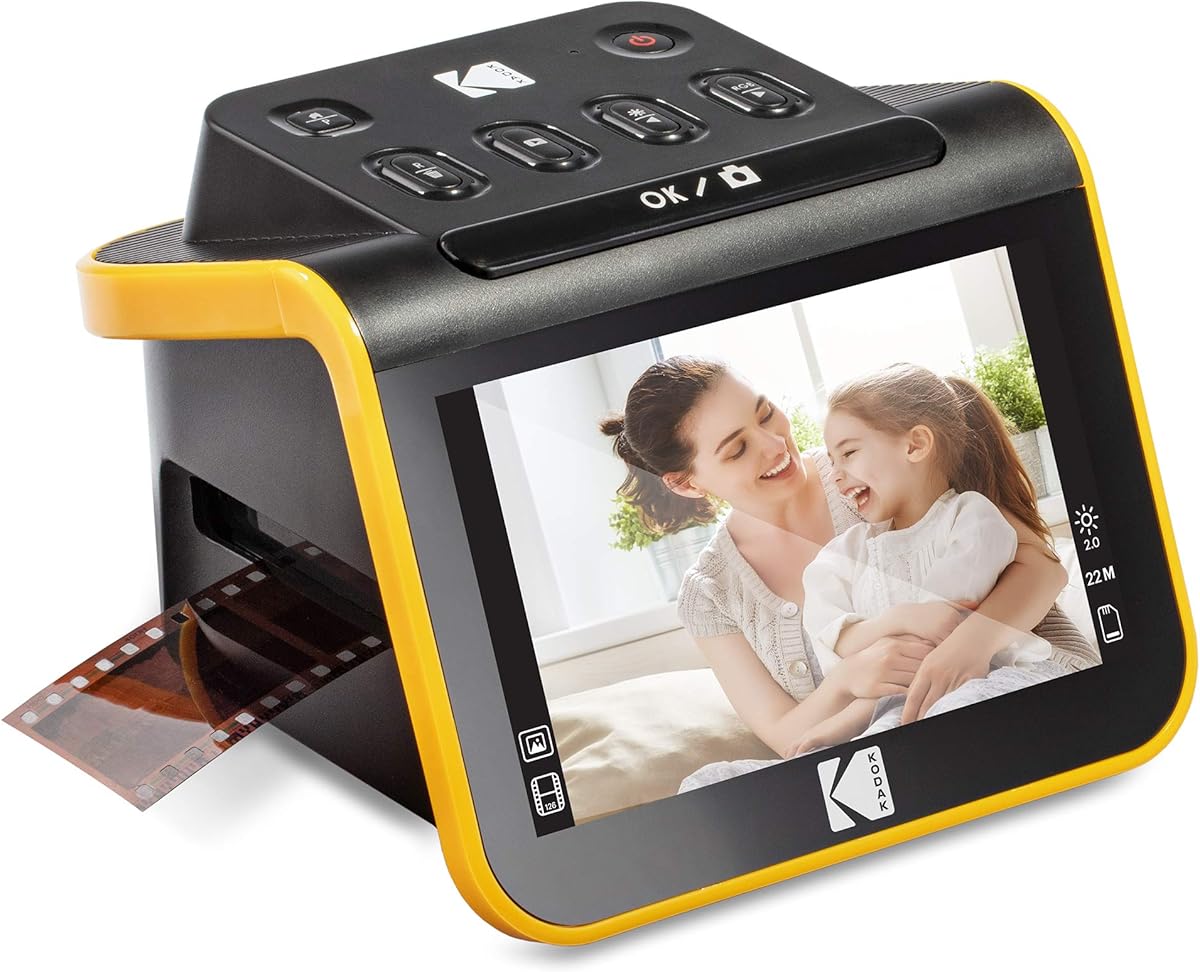
The KODAK Slide N Scan Film & Slide Scanner combines a 22MP output, a five-inch LCD, and support for three widely used negative formats with 50mm slides. Its supplied rating of 4.3 reflects generally favorable customer feedback, particularly for the combination of an approachable standalone workflow and a screen large enough to inspect slides and negatives before saving them.
We may earn a commission when you buy through this link, at no additional cost to you.
Its main advantage is the balance between useful controls and uncomplicated operation. The quick-feeding tray supports a continuous workflow, while a single Scan button handles resizing and conversion. Users can choose the film type, adjust color and brightness, assign a date and time, and save the results directly to an SD or SDHC card. The device also supports Type-C USB-enabled computers, giving users options for viewing and transferring files after digitization.
The five-inch display is useful for checking framing, color balance, orientation, and general image quality without returning every result to a computer. It can also function as a digital picture frame, which gives freshly digitized images an immediate purpose beyond simple storage. That combination of preview screen, gallery mode, and direct card saving makes the scanner particularly approachable for family archives and older relatives who may not want to navigate a desktop editing program.
There are two important limitations. The memory card is not included, so new owners must supply an SD or SDHC card up to the stated 32GB limit. The supported film types do not include Super 8 or 8mm footage, making this a better fit for standard family negatives and mounted 50mm slides than for motion-picture collections. Even so, it is our top overall pick because its format range, 22MP specification, continuous feeder, and five-inch screen offer a strong all-around balance for most home digitizing projects.
Scanning directly on the device reduces dependence on computers, complicated drivers, and separate editing software. Once a compatible memory card is inserted, the built-in controls support a repeatable process of previewing, adjusting, scanning, and saving.
The included 50mm holder and adapters for 135, 110, and 126 formats make the scanner versatile for the assortment of negatives commonly found in household boxes. A quick-loading tray also reduces the repetitive work involved in converting a larger archive.
We may earn a commission when you buy through this link, at no additional cost to you.
The 35mm Film & Slide Scanner is a compact standalone unit designed primarily for 135 negatives and slides. It carries a supplied rating of 3.7, the lowest among the ten products, but it brings together a quick slide feeder, a 2.4-inch LCD, TV-out, SD card storage, and direct USB transfer in a focused package for 35mm collections.
We may earn a commission when you buy through this link, at no additional cost to you.
The scanner offers positive, negative, and black-and-white modes, allowing users to match the conversion setting to the material being digitized. Its 1800DPI specification and 5MP or 10MP sensor options provide useful detail for display, sharing, and archival purposes. A rapid slide holder is compatible with framed slides up to 2mm thick and supports more continuous feeding than a traditional single-frame holder.
The scanner does not need a computer during the initial conversion process. Images can be captured and reviewed on the built-in display, saved to a FAT32 SD card up to 32GB, and then transferred to a PC or Mac using the USB interface in card-reader mode. The NTSC/PAL TV-out function is also useful for displaying a slideshow on a larger television without involving computer-based software.
Its primary weakness is the modest 2.4-inch screen. That display is adequate for alignment and basic review, yet it is less effective for detailed inspection than the five- and seven-inch screens on competing models. Format support is also narrower because it focuses on 35mm material rather than 110, 126, or Super 8 film. Buyers with a large mixed archive should look elsewhere, but people beginning with a box of standard 35mm slides may appreciate its compact footprint and quick feeder.
The continuous quick feeder is designed to move from one framed slide toward the next with fewer interruptions. It is especially helpful for collections made up largely of standard mounted slides rather than irregular strips of negatives.
TV-out provides a convenient way to review scans with family members or display a larger gallery. USB card-reader transfer adds a second route for moving files onto a computer for later editing and backup.
We may earn a commission when you buy through this link, at no additional cost to you.
The Magnasonic FS71 stands out for format flexibility, offering support for 35mm, 126, 110, and Super 8 negatives along with 135, 126, and 110 slides. It also pairs a 24MP output with a five-inch LCD and the ability to operate without a computer. Its supplied rating of 4.3 indicates solid customer reception and makes it a compelling option for archives containing more than standard family negatives.
We may earn a commission when you buy through this link, at no additional cost to you.
The scanner supports up to 128GB of SD card storage, which is generous for a large digitizing project and reduces the need to transfer files after every session. HDMI output allows users to view images on a television or monitor, while the built-in screen provides a convenient way to align frames and inspect results. On-device adjustments include brightness, RGB color correction, flip, and mirror functions, reducing the need for software merely to perform basic corrections.
Included fast-loading trays are designed to make the conversion process less repetitive, and the stated workflow can complete a scan in less than five seconds. That speed advantage matters when a collection contains hundreds of negatives. Because the FS71 can operate as a self-contained device, it also suits users who want to begin organizing and viewing an archive before deciding how to edit and back up the final files.
The FS71 does not include an SD card, and the HDMI cable is also listed as not included. Users should therefore budget for the storage needed to begin scanning and check which connection accessories they already own. Even with those caveats, this model's broad format support, 24MP specification, large display, and 128GB storage capacity make it one of the strongest choices for mixed or unusually varied physical collections.
Support for both still-film formats and Super 8 material makes the FS71 valuable for families whose collections span several photographic eras. Matching holders and included trays simplify the transition between formats.
The 128GB card limit provides more working storage than many competing scanners. Combined with standalone operation and quick-loading trays, it supports a practical batch-digitizing workflow without requiring a computer beside the scanner.
We may earn a commission when you buy through this link, at no additional cost to you.
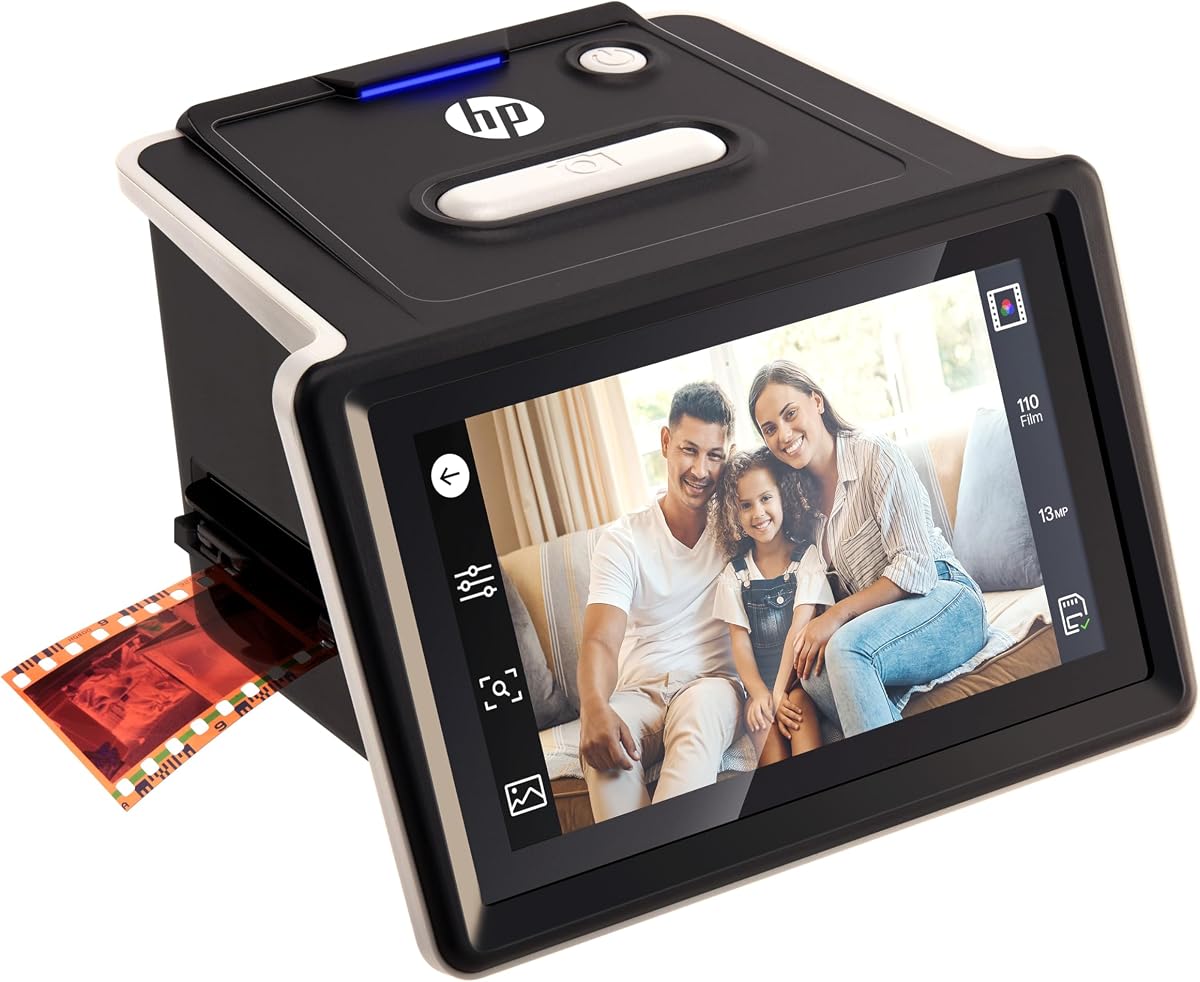
The HP Film & Slide Scanner puts a seven-inch color touch display at the center of the digitizing experience. It has a supplied rating of 4.0 and a 13MP CMOS sensor, while its touch interface supports previewing, editing, cropping, adjustment, and slideshow display without requiring a separate computer for routine work.
We may earn a commission when you buy through this link, at no additional cost to you.
The large screen is the defining feature. It provides enough room to align a slide, judge sharpness, and perform direct edits with a fingertip rather than navigating a small directional pad. A quick-feed tray and 50mm adapter streamline batch work across 135, 126, and 110 formats, making the device suitable for mixed collections of common negatives and slides.
Connectivity options broaden the post-scan workflow. USB can move digital files to a computer, while HDMI can connect the scanner to a television for slideshow viewing. Gallery mode further turns the display into a digital picture frame, allowing newly digitized family images to be shown in the home or office immediately after conversion.
Although the seven-inch screen and touch controls give the HP model a premium feel, the 13MP sensor is lower on paper than several 22MP or 24MP alternatives. The supplied 4.0 rating also suggests room for improvement in consistency or software behavior. Even so, this scanner is best for users who prioritize effortless on-device editing, a generous display, and a clean hybrid of standalone digitization and connected viewing.
Touch-based crop and adjustment tools make the scanner approachable for users without photo-editing experience. The large interface makes it easier to identify framing issues and make changes before a file is saved.
Gallery mode and HDMI output extend the scanner beyond basic capture. Digitized photographs can move quickly from the SD workflow to a television or frame, providing immediate feedback that encourages users to continue their archive.
We may earn a commission when you buy through this link, at no additional cost to you.
The KODAK Slide N Scan Max is built around a seven-inch tiltable LCD, a quick-feeding tray, and direct saving to SD or SDHC media. Its supplied rating of 4.3? No—the actual supplied rating is 4.1, which still reflects a generally favorable response. The model is intended for users who want a larger, adjustable preview screen and a simple process for converting mixed family negatives.
We may earn a commission when you buy through this link, at no additional cost to you.
The tiltable display can make a meaningful difference in a home workspace. Rather than working with a fixed screen at a single angle, users can reposition the display to reduce glare or bring it closer while checking the image. The screen also doubles as a digital picture frame, allowing completed scans to remain visible without using a separate device.
Its quick-feeding tray supports continuous scanning without repositioning each frame, reducing downtime during a large family project. The scanner handles 135mm, 110mm, and 126mm films, and its one-touch editing system simplifies resizing, conversion, and adjustment. Files save directly to SD or SDHC cards up to 32GB, so the scanner can function without a computer during the initial conversion.
The 32GB maximum is the main limitation for very large archives, and the memory card itself is not included. Users may also find that the advertised high-resolution slide-scanning experience is less demanding than models that state a 22MP or 24MP output. Within its supported format range, however, the combination of a tiltable seven-inch screen, continuous feeder, and accessible controls makes this a polished and convenient choice.
The tilt mechanism allows users to position the large screen more naturally at a desk or table. This can reduce neck strain and make frame-by-frame review more comfortable during extended sessions.
Continuous feeding reduces the amount of manual handling required for each negative. One-touch editing further keeps the workflow moving, which is useful when the goal is to preserve a large family collection.
We may earn a commission when you buy through this link, at no additional cost to you.
The HP FilmScan HPFS500 combines a 13MP CMOS sensor, 22MP interpolated output, and a five-inch all-angle touchscreen in a compact standalone package. Its supplied rating of 4.3 places it among the stronger customer-rated options, while USB-C connectivity gives it a modern approach to moving files and connecting with a computer.
We may earn a commission when you buy through this link, at no additional cost to you.
Mixed archives can include 135, 126, and 110 negatives as well as positive slides. The all-angle LCD lets users preview and edit images directly, and the quick-load tray is intended to streamline transitions between scans. This makes the HPFS500 a logical choice for someone who wants a touch interface but does not need the very large screen offered by the seven-inch models.
Standalone operation is one of the strongest elements. Users can digitize slides and negatives without a computer, then transfer the results when convenient. The touchscreen reduces the need to learn complicated button combinations, and the compact body should be easier to place in a home office or move between rooms than a larger dedicated scanning station.
The advertised 22MP figure is reached through interpolation, while the underlying CMOS sensor is 13MP. That distinction may matter to buyers who care primarily about native detail rather than output dimensions. The supported formats also exclude Super 8 and 8mm. With those points in mind, the HPFS500 remains a well-rounded option for common still-film formats, particularly for users who prioritize touch controls and a modest footprint.
The scanner removes the computer from the basic capture process while retaining USB-C for later transfer. Its touchscreen also reduces the learning curve for people accustomed to editing on a phone or tablet.
The 13MP CMOS sensor captures the underlying image data, while 22MP interpolation increases the output dimensions. Buyers prioritizing native sensor detail should compare the 13MP figure with competing models' stated optical outputs.
We may earn a commission when you buy through this link, at no additional cost to you.
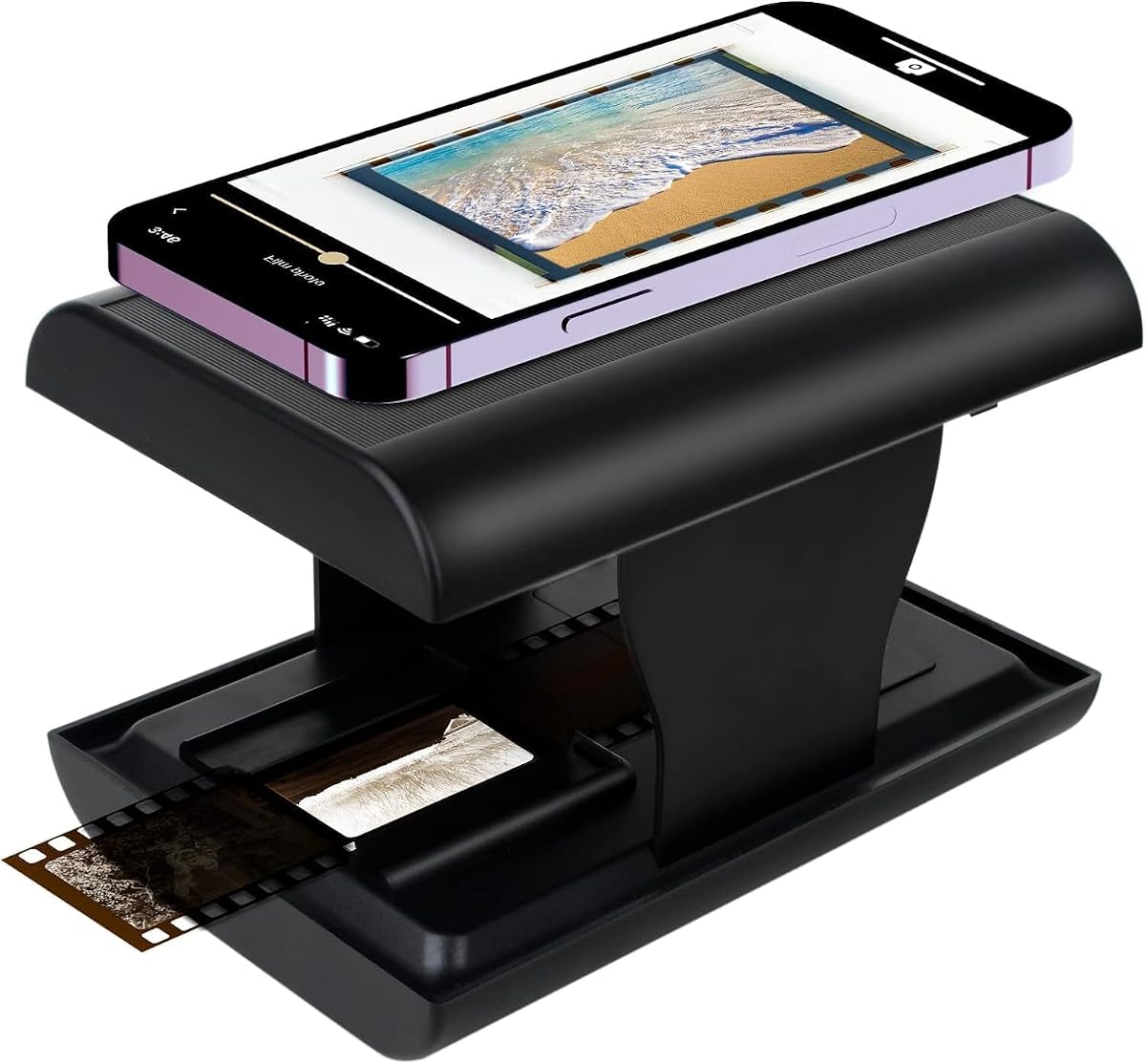
The TCNEWCL 35mm Negative Slide Scanner offers a fundamentally different approach from the dedicated electronic scanners. It is a foldable holder that uses a smartphone camera, an integrated LED, and a scanning application to capture 35mm slides and negatives. Its supplied rating of 4.4 is the highest among the ten products, indicating strong satisfaction within its simple, budget-oriented format.
We may earn a commission when you buy through this link, at no additional cost to you.
Its greatest strength is accessibility. There is no separate power supply, memory card, or complex control panel. A slide or negative goes into the shell, the LED is switched on, the phone camera is positioned over the opening, and the image is captured. The free app provides tools for editing, rotating, filtering, and adjusting color and contrast, with Snapseed recommended for more advanced work.
Portability is another major advantage. The housing folds down to approximately the size of a small box, making it easy to store in a drawer or carry while traveling. That makes it a sensible option for visiting relatives, organizing a small number of family slides, or capturing images without setting up a permanent scanning station.
Image quality is limited by the resolution of the user's phone camera, so results will vary considerably by device. The phone must also be close enough to avoid distortion and maintain alignment, and the app workflow may demand more care than a dedicated scanner with a fixed optical path. Despite those constraints, the TCNEWCL is the best budget pick for a small, portable, introductory conversion project.
The device turns a phone camera into a basic slide-capture system. This makes it useful for travelers, occasional users, and anyone who wants to begin preserving memories before investing in a larger standalone scanner.
The included application workflow provides rotation, filters, color adjustment, contrast control, and sharing options. Because capture depends on a phone, the exact result also depends on the camera's focus, stability, and available light.
We may earn a commission when you buy through this link, at no additional cost to you.
The KODAK SCANZA is a versatile standalone scanner that handles 35mm, 126, 110, Super 8, and 8mm negatives and slides. Its 3.5-inch tiltable TFT LCD, one-step scanning controls, and broad adapter selection make it a practical option for mixed physical media. The supplied rating of 4.2 supports its reputation as a well-rounded alternative to newer touchscreen models.
We may earn a commission when you buy through this link, at no additional cost to you.
The scanner offers 14MP or 22MP output choices, allowing users to balance file size and detail according to their intended use. Its built-in display has adjustable brightness, which is useful when checking transparent slides under varying room conditions. The tilt feature adds flexibility, although the screen remains smaller than the five- and seven-inch panels found on many newer devices.
The SCANZA supports SD cards up to 128GB and includes multiple film inserts and adapters. One-touch buttons simplify the scan-and-save process, while the interface allows users to edit RGB settings and resolution, browse a gallery, and manage images. Its included USB power cable, HDMI cable, AC adapter, video cable, and cleaning brush provide most of the accessories needed to begin organizing a collection.
The SD card is not included, and the 3.5-inch display may feel dated beside modern alternatives. Its broad format support is nevertheless a meaningful strength, especially for households that discovered motion-picture film strips alongside standard negatives. The SCANZA is best for users who want several media formats, generous card compatibility, and straightforward controls without paying for a large touchscreen.
Few dedicated scanners support as many familiar legacy formats in one package. The included inserts and adapters make it easier to move between still negatives, mounted slides, and motion-picture strips.
One-step buttons reduce the complexity of everyday scanning, while RGB, resolution, and gallery controls provide enough adjustment for basic archival work. The supplied cleaning brush also helps reduce dust and speckles in the scan area.
We may earn a commission when you buy through this link, at no additional cost to you.
The BEONEGLOBAL ClearScan P7 combines a seven-inch LCD, 24MP output, support for 35mm, 135, 126, 110, Super 8, and 8mm material, and an included SD card. Its supplied rating of 4.1 makes it a solid all-around option, particularly for new buyers who want to begin scanning without first purchasing a memory card.
We may earn a commission when you buy through this link, at no additional cost to you.
The included branded SD card is a meaningful convenience. Users can connect the scanner to a compatible computer, load the card, and begin digitizing rather than researching card formats and capacities. The scanner operates independently, while the large screen provides a clear surface for previewing and adjusting photographs before saving JPEG files.
Its 1/2.3-inch CMOS sensor is specified for scans up to 24MP, and the redesigned control layout places buttons beneath the display for more comfortable use. Image-size adjustment gives users greater control over framing, while one-touch scanning, editing, and color enhancement help keep the process approachable.
The P7 is not described as having a touchscreen, so it is better suited to users who prefer physical buttons. Connectivity details are also less prominent than on some competing products, making the supplied USB and included card particularly important. Even so, the combination of wide format support, a large display, 24MP scans, standalone operation, and an included card makes this one of the most complete starting packages.
The included SD card removes a common early obstacle. Combined with no-computer operation and one-touch capture, the scanner can make a new user's first conversion project feel considerably less complicated.
The seven-inch display makes alignment and immediate color review easier than a compact screen. Physical controls beneath the screen offer tactile feedback and may appeal to users who find touch interfaces less intuitive.
We may earn a commission when you buy through this link, at no additional cost to you.
The PORTTA Film Scanner provides 16MP standard or 22MP enhanced output, a five-inch preview display, and support for 135, 126, and 110 film as well as slides. It also handles color and black-and-white negatives and Super 8 material in photo-only mode. Its supplied rating of 3.9 is the lowest among the dedicated scanners, so buyers should examine the controls and current listing carefully.
We may earn a commission when you buy through this link, at no additional cost to you.
The scanner is designed for at-home use without a computer. Users can preview and align images directly on the display, adjust brightness, color, and orientation, and save the results to an SD card up to 128GB. HDMI output provides a convenient way to view real-time images or a slideshow on a television, giving the device value beyond simple digitization.
The choice between 16MP and 22MP output can suit different projects. The standard setting may produce more manageable files for everyday sharing, while the enhanced setting is appropriate when users want finer output dimensions for enlarging, detailed viewing, or long-term preservation. Built-in adjustment tools allow basic corrections before the file is committed to storage.
Super 8 support applies only to photographic material, not motion-picture footage, and the 3.9 rating indicates that some aspects of the experience may not satisfy every user. Nevertheless, the PORTTA offers a capable combination of resolution choices, a five-inch display, substantial SD card capacity, and computer-free operation. It is a sensible lower-cost dedicated scanner for common still formats.
The 16MP mode can be more convenient for everyday files and quick sharing, while 22MP provides additional pixel dimensions for detailed viewing and larger reproductions. Choosing deliberately can help users balance quality against file size.
The five-inch screen helps users check alignment, brightness, color, and orientation before saving. HDMI output extends that review experience to a television, while the large card limit supports a substantial batch workflow.
We may earn a commission when you buy through this link, at no additional cost to you.
The right slide to digital scanner depends on the formats in your collection, the size of the archive, your comfort with software, and how much you value portability, screen size, and independent operation. These factors help separate a simple occasional-use tool from a dedicated batch scanner.
Match the scanner to your actual collection, including the format you are most likely to scan later. Broad compatibility is useful, but it should never replace a verified fit for the media you already own.
Look for the underlying sensor resolution, not just the largest advertised output. Choose higher native detail when large prints and heavy cropping are important.
Choose a large display for detailed review and a touchscreen for intuitive editing, or physical buttons for straightforward tactile operation. Tilting can further improve comfort.
Prioritize standalone capture and simple on-device adjustments, then verify that USB or card-reader transfer makes later backup straightforward.
Choose enough card capacity for the project, verify compatibility, and keep a second backup of every important scan. Remember that some models do not include a card.
A continuous feeder and complete adapter set save the most time on large archives. Prioritize consistent frame placement and a short loading path.
Seek dedicated color, negative, and monochrome modes plus visible brightness and RGB controls. They make faded and dense material easier to correct during capture.
Choose a foldable phone scanner for occasional travel and minimal equipment, or a dedicated unit for consistency, batch work, and a fixed workspace.
Begin by identifying the correct adapter or holder for each format, then clean the slide or negative and the scanner's glass with a soft, lint-free cloth. Dust, fingerprints, scratches, and emulsion damage can all appear in digital captures, so handling each item by its edges protects the image area. Place the scanner on a stable surface, connect its power source if required, and insert a compatible formatted SD card when using card-based storage.
Select the film type and resolution, then feed one frame at a time unless the scanner's tray is designed for continuous operation. Use the preview display to check alignment, focus, brightness, color, and orientation before saving. For a dedicated model, make small adjustments directly on the device and use a second look to catch dust or framing errors. For the smartphone scanner, align the camera square over the illuminated opening, keep the phone steady, and use the app's crop and rotation tools to correct the image.
After saving, verify that the digital file opens correctly and that the capture looks sharp and properly exposed. Copy each file to a computer or external drive, confirm the backup, and then remove the card only when the device indicates that writing is complete. Keep the original media in a clean, labeled sleeve, separate from the digital copy. Periodically dust the scanner, clean the light box with the supplied brush where available, and avoid placing heavy objects on a tiltable LCD or touching the optical surface with bare fingers.
The easiest method for a beginner is a standalone scanner with a built-in screen and one-touch capture controls. These devices generally let you insert a slide, check the preview, correct basic color or orientation, and save the result to an SD card without installing editing software. A smartphone-based scanner is even simpler to set up, but its final quality depends on the phone camera and careful alignment.
Most dedicated scanners in this guide can capture and save images without a computer. A computer is still useful for organizing, editing, backing up, and sharing larger collections. Check that the scanner includes a compatible USB cable or supports SD card-reader transfer, and verify whether the SD card must be purchased separately.
A large archive benefits most from a quick-feed tray, broad format support, a large preview display, and generous SD card capacity. The KODAK Slide N Scan, Magnasonic FS71, HP FilmScan 7-inch, and BEONEGLOBAL ClearScan P7 offer combinations of those features. The right choice also depends on whether your collection contains only 35mm material or older formats such as 110, 126, Super 8, and 8mm.
A scanner can improve color balance, brightness, contrast, and orientation, but it cannot fully recover information that is physically lost through severe fading, scratches, mold, or emulsion damage. Cleaning the original and scanning at an appropriate resolution gives the best starting point. Digital restoration software can then address more advanced issues after the files have been backed up.
For screen viewing, family sharing, and ordinary prints, a model in the 13MP to 24MP range provides ample detail. Higher output becomes more valuable when you plan large prints, close inspection, or repeated cropping. Pay attention to native sensor resolution, because some advertised higher figures are produced through interpolation rather than additional captured detail.
A smartphone scanner can be effective for occasional use because it offers a low-cost, portable way to capture a limited number of slides. However, image quality, consistency, and framing depend on the phone camera and user technique. Dedicated scanners generally provide a fixed optical path, faster batch handling, larger previews, and more uniform results across an archive.
Use a compatible SD card within the scanner's stated capacity and formatting requirements, with 32GB or 64GB suitable for smaller jobs and 128GB useful for larger archives. Keep the card dedicated to the scanner if it has been used with incompatible equipment, and maintain a separate backup on a computer, external drive, or cloud service. Confirm important files before reformatting or reusing the card.
Supported materials vary by model. Common devices handle 135 or 35mm negatives, 110 and 126 formats, mounted 50mm slides, and sometimes Super 8 or 8mm material. Certain models also support positive slides and black-and-white negatives. Motion-picture strips may be accepted only as still photographs, so verify the exact media type and frame dimensions before buying.
The KODAK Slide N Scan is the strongest all-around recommendation because it combines 22MP output, a five-inch display, continuous feeding, useful one-touch controls, and support for several common negative formats. The HP FilmScan 7-inch is especially appealing for its large touchscreen and direct editing, while the TCNEWCL foldable scanner provides the simplest portable approach for occasional smartphone-based conversion.
Prioritize the formats you actually own, then choose based on archive size and workflow. Mixed collections benefit from broad adapter coverage and quick-feed trays, while large projects require sufficient card capacity and a comfortable way to review each frame. Buyers with a small set of slides may get more value from a portable phone scanner, whereas families preserving hundreds of negatives will benefit from a dedicated standalone model.
Before buying, verify the current product listing, included accessories, memory requirements, and supported file formats. Product details, availability, and pricing can change, and accessories may not be included even when the scanner supports them. Once selected, work slowly, clean the originals, check each preview, and maintain at least two copies of every important scan so the physical archive can be preserved without making the digital copies vulnerable to a single device failure.