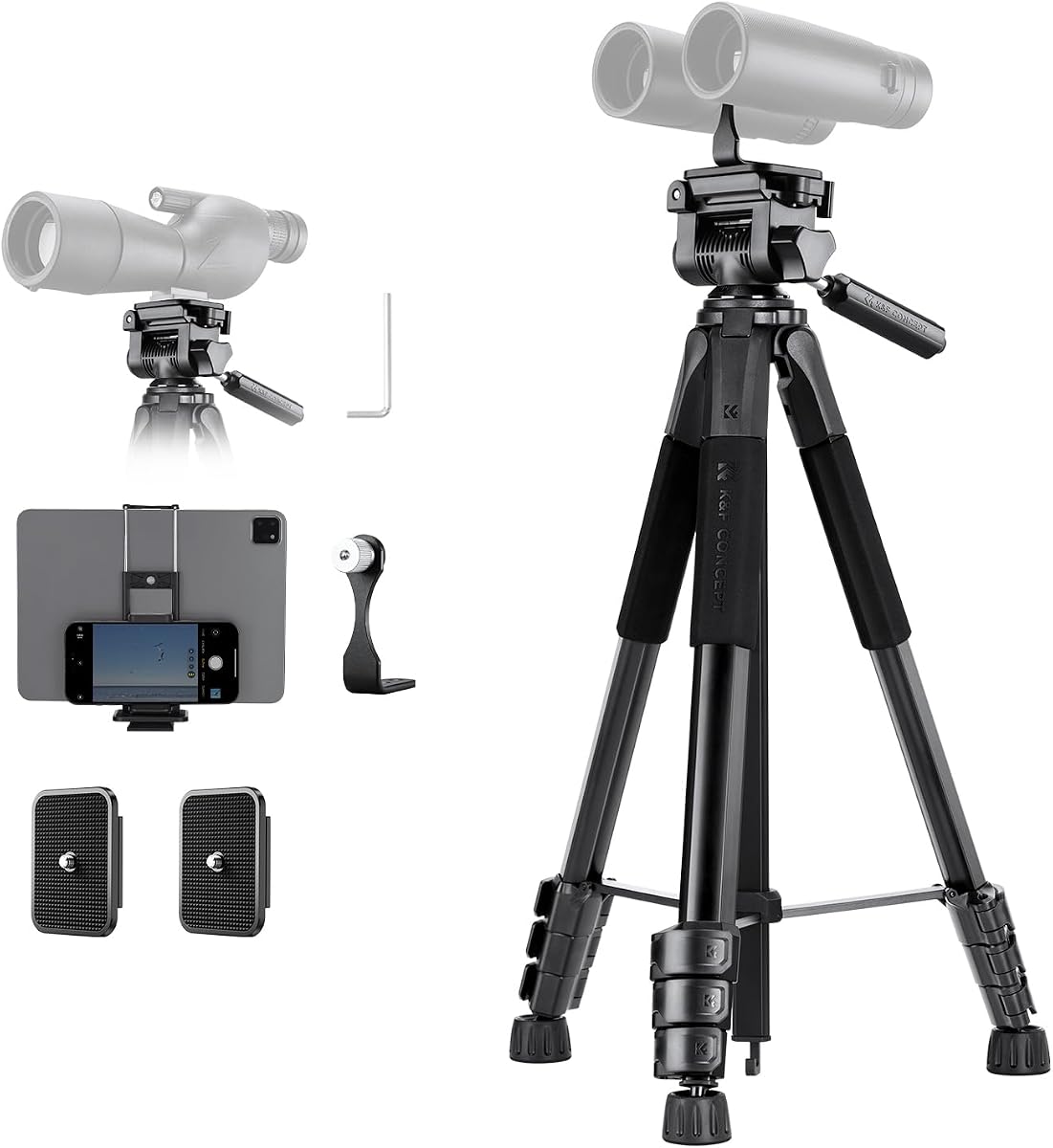
K&F CONCEPT Spotting Scope Tripod
4.6Editor score
Four-section aluminum legs
4kg maximum load capacity
48–172cm height range
Includes binocular adapter
A spotting scope tripod stand should make long viewing sessions steadier, more comfortable, and easier to set up. The right model balances support for your optic, useful height range, portable construction, smooth head movement, and accessories that simplify field use.
We compared 10 stands using the supplied specifications, emphasizing load capacity, mounting compatibility, folded size, adjustment range, head design, included adapters, and suitability for birdwatching, hunting, astronomy, landscapes, and general photography.
Each review identifies the strongest feature and the clearest compromise, helping you match a stand to your equipment and priorities. Product listings, configurations, ratings, and prices can change, so confirm current details before purchasing.
4.6Editor score

4.8Editor score

4.7Editor score
As an Amazon Associate we earn from qualifying purchases.
The comparison below highlights each stand's mounting system, height range, structural approach, load capacity, and intended applications so you can compare the options without overlooking important compatibility details.


The Lusweimi 72-inch model is a general-purpose spotting scope and binocular stand with a 4.3 rating. Its strongest attraction is flexibility: the included binocular adapter, rotating phone holder, camera-compatible quarter-inch screw, and two quick-release plates allow the same support to serve several kinds of equipment.
We may earn a commission when you buy through this link, at no additional cost to you.
The aluminum construction uses rectangular tubes, while four flip-lock feet make height adjustment straightforward. The legs adjust from 16.9 to 69 inches, and the stated shooting height can reach 72 inches when used with a binocular or spotting scope. A detachable head reduces the folded height to 16.9 inches, which is useful when transport space matters.
The load-bearing hook at the base can support a backpack to improve stability in wind, a practical detail for extended wildlife observation. The trade-off is that the binocular adapter only fits models with a standard quarter-inch threaded hole, and differences in thread depth among brands can complicate installation.
This is a good choice for buyers who want one compact stand to alternate among a binocular, spotting scope, camera, and phone. It offers more included equipment than a basic camera tripod, although buyers using a large or especially heavy optic should verify total weight, balance, and their own equipment's mounting requirements.
The included quick-release plates and rotating phone holder make this stand unusually adaptable. You can move between optics, cameras, and mobile devices without maintaining several separate supports.
A detachable head shortens the packed height to 16.9 inches, while the lower hook offers a place to hang a backpack. That combination helps when portability and field stability are equally important.
We may earn a commission when you buy through this link, at no additional cost to you.
This Lusweimi tripod earns a 4.4 rating and is designed as a complete support kit for spotting scopes, binoculars, cameras, and phones. Its selling point is the generous package: you receive the tripod, binocular adapter, two quick-release plates, a rotating phone holder, and a carry bag.
We may earn a commission when you buy through this link, at no additional cost to you.
The aluminum frame adjusts from 16.9 to 69 inches and is listed as reaching 73 inches when supporting a birding scope. Rectangular tubing reinforces the leg structure, and reinforced leg sheaths are intended to improve strength and grip comfort during adjustments.
A standard quarter-inch screw provides the primary mounting interface, while the detachable head allows the folded body to compress to 16.9 inches. As with the brand's other binocular-focused stand, the binocular adapter requires a standard quarter-inch threaded hole, so compatibility should be checked before purchase.
The main limitation is the absence of a stated maximum load figure in the supplied information. That makes it best suited to users who already know their optic's weight and mounting arrangement. For a new buyer assembling a complete and portable field kit, however, it offers practical versatility at a straightforward entry point.
Two quick-release plates, a binocular adapter, a phone holder, and a carry bag are included. That accessory mix reduces the need to source separate mounting pieces before heading outdoors.
Flip-lock height changes and a detachable head support quick setup. The 16.9-inch packed height is especially helpful for travelers carrying other field equipment.
We may earn a commission when you buy through this link, at no additional cost to you.
The Vortex Mountain Pass Tripod Kit has a 4.7 rating and is built around a compact balance of packability, strength, and value. It is particularly relevant to spotting scope users who want a dedicated optic support without carrying the larger frame associated with many traditional tripods.
We may earn a commission when you buy through this link, at no additional cost to you.
Its machined aluminum body has a 22-pound maximum load, enough headroom for larger binoculars and spotting scopes according to the product information. The two-way pan-and-tilt head holds an optic through an Arca-Swiss compatible quick-release system, enabling fast transitions between compatible equipment.
Telescoping legs adjust independently and lock with lever flips, which is useful when working on uneven ground. The compromise is that the listed package focuses on the tripod and its mounting head; no binocular adapter or phone holder is identified in the supplied information.
The Mountain Pass is our Editor's Choice because it combines a compact structure with a high stated load capacity and a widely compatible quick-release arrangement. It is an especially attractive option for users who already own Arca-Swiss-compatible gear, or for anyone willing to add the appropriate binocular adapter separately.
The quick-release head is designed to hold spotting scopes and binoculars efficiently. Rapid equipment changes are easier when your mounting accessories already follow the Arca-Swiss standard.
The machined aluminum construction and 22-pound load limit create reassuring support capacity. Independently adjusted legs help maintain a practical setup on uneven ground.
We may earn a commission when you buy through this link, at no additional cost to you.
This 72.4-inch spotting scope and binocular tripod combines a 4.4 rating with substantial accessory coverage. It is designed to serve optics, cameras, astronomy equipment, and hunting rests, making it one of the more versatile kits in the comparison.
We may earn a commission when you buy through this link, at no additional cost to you.
The aluminum structure uses five leg sections and tubes with a maximum diameter of 29.5 millimeters. It extends from 24 to 72.4 inches, carries a stated maximum load of 22 pounds, and includes a removable fluid head for controlling the mounted equipment.
A binocular adapter, hunting V-yoke, two quick-release plates, non-slip camouflage bands, and a storage bag are included. The V-yoke is particularly relevant for hunting and shooting rests, while the removable head adds configuration flexibility. The trade-off is that the package and five-section construction are less compact than the Vortex and K&F travel-oriented options.
This tripod is a strong recommendation for hunters and target shooters who value the supplied yoke and broad compatibility. It also suits users who need a tall platform for varied optic sizes. Those prioritizing minimum packed length should compare the listed 24-inch folded height against smaller travel tripods before deciding.
The included V-yoke and non-slip camouflage bands distinguish this model from general camera stands. They add value for users planning to use the support as a hunting or shooting rest.
Five-section legs cover a 24–72.4-inch range, while the fluid head and quick-release plates make it possible to reconfigure the mounted equipment for different tasks.
We may earn a commission when you buy through this link, at no additional cost to you.
The ZIKZOK 75-inch tripod combines a 4.6 rating with an emphasis on portability and photography versatility. Although it began as a camera stand, the standard quarter-inch mount and stated compatibility with spotting scopes make it a credible option for lighter optical equipment.
We may earn a commission when you buy through this link, at no additional cost to you.
The aluminum alloy and ABS resin frame adjusts from 19 to 75 inches and folds to 20.8 inches. Its listed weight is 2.91 pounds, making it easier to carry over long distances than many full-size supports. A travel bag, phone or tablet holder, quick-release plates, and wireless remote are included.
A three-way pan head supports vertical, horizontal, overhead, and 360-degree positioning. The maximum load is 15 pounds, lower than the 22-pound ratings of the Vortex kits and the hunting-oriented model. The description also emphasizes photography applications more directly than precision optic use.
This stand makes sense for photographers who also want to use a phone, tablet, or compact spotting scope. It is less compelling for a large, heavy spotting scope unless the combined load remains comfortably within the stated limit and the optic's mounting requirements are verified.
At a listed 2.91 pounds with a 20.8-inch packed length, this tripod reduces the burden of carrying dedicated optic support. The included bag makes it practical to keep the stand with the rest of your travel gear.
The three-way pan head and included wireless remote suit photo and video sessions. Those features also help when positioning a phone or a smaller optic for landscape viewing.
We may earn a commission when you buy through this link, at no additional cost to you.
The UBeesize 74-inch tripod has a 4.6 rating and is built around precise positioning with two handles. Although marketed primarily as a camera stand, its compatibility list includes binoculars and spotting scopes, giving it potential as a flexible viewing platform.
We may earn a commission when you buy through this link, at no additional cost to you.
Dual handles provide additional leverage when changing height, angle, or panoramic position. The stand supports landscape, portrait, overhead, upward, and 360-degree panoramic views, while the universal phone holder adjusts for devices from 2.8 to 5.7 inches wide.
The included wireless remote operates at distances up to 30 feet, and a carry bag supports transport. A central hook allows a bag to be hung beneath the tripod. The main omission in the supplied details is a numerical maximum load, so buyers should carefully assess the weight of their optic and any attached accessories.
This is a strong choice for a buyer who wants a camera-oriented stand with binocular and spotting-scope versatility. The dual handles make careful framing and slow positioning especially convenient. It is less specialized than a dedicated optical head, so long-distance birdwatchers may prefer a model explicitly designed around smooth panning and optic mounting.
Two handles provide leverage and fine control when changing the viewing direction. This can be useful for following wildlife or composing precise camera shots.
The adjustable phone holder and 30-foot remote expand the stand's usefulness for images and video. The carry bag and central hook also support travel and accessory management.
We may earn a commission when you buy through this link, at no additional cost to you.
The K&F CONCEPT Spotting Scope Tripod has a 4.6 rating and emphasizes travel readiness, broad device support, and straightforward height adjustment. It is a particularly appealing option for birdwatchers who carry their equipment over uneven or long distances.
We may earn a commission when you buy through this link, at no additional cost to you.
The aluminum legs collapse into a compact package, while four sections and a center column provide a 48–172 centimeter range. The stand supports up to 4 kilograms and uses a top quarter-inch screw plus dual bottom ports for compatible mirrorless cameras, phones, binoculars, spotting scopes, and small telescopes.
Its quick-release plate makes device switching faster, and 360-degree panning with multi-angle adjustment supports varied compositions. Anti-slip feet, a center hook, a bubble level, and a storage pouch round out the stability and travel features. The 4-kilogram limit is lower than the 22-pound maximum stated for several competing tripods, making load checking important.
This is our Best Budget pick because it combines an optic-focused feature set with useful travel components without concentrating on a single specialized application. It is a strong recommendation for mobile birdwatchers, photographers, and observers using compatible midweight binoculars or spotting scopes.
Collapsible four-section legs, a center column, and a storage pouch reduce the space needed for the stand. The result suits observers who regularly move between trails, wetlands, and open viewing areas.
A quick-release plate and 360-degree panning make it easier to reposition an optic. The included bubble level is a useful aid when you want a repeatable setup.
We may earn a commission when you buy through this link, at no additional cost to you.
The Vortex High Country II Tripod Kit holds the highest listed rating in this comparison at 4.8. It is designed for buyers who value a refined tripod system, a 22-pound load capacity, and precise adjustments for long-range observation or photography.
We may earn a commission when you buy through this link, at no additional cost to you.
Its machined aluminum construction is intended to combine durability with a relatively light package. The two-way pan head provides smooth directional movement, while the Arca-Swiss compatible quick-release system makes changing compatible optical and camera equipment straightforward.
Three leg sections strengthen the frame, and the three-angle pivot locks allow each leg to be positioned independently for different heights and terrains. A detachable counterweight hook is also included. No separate binocular adapter or phone holder appears in the supplied information, so those accessories may need to be sourced separately.
This is our Best Premium recommendation for users willing to invest in a more specialized support platform. It offers the strongest listed rating, robust load capacity, and a mature quick-release system. It is especially attractive if your existing mounting hardware is already Arca-Swiss compatible or you plan to build a unified kit around that standard.
The 22-pound maximum load and three-section aluminum frame provide a stable platform for larger binoculars and spotting scopes. That makes the kit relevant to serious wildlife and long-range users.
Three-angle leg pivots let each leg occupy a different position. Combined with a smooth pan head, this helps maintain a controlled view when the terrain is not flat.
We may earn a commission when you buy through this link, at no additional cost to you.
The Celestron Ultima Pan Tilt Tripod is a versatile 4.4-rated option for spotting scopes, binoculars, and cameras. It focuses on simple directional control, quick equipment changes, and a configuration that can adapt to different users and viewing terrain.
We may earn a commission when you buy through this link, at no additional cost to you.
The two-way pan head lets the mounted optic pan across the horizon or tilt up and down. It can also be turned sideways, which is useful when changing from landscape viewing to a more vertical subject. A quick-release plate allows an optic to be attached in seconds and swapped for other equipment.
Three-section legs provide multiple working heights, and an extendable center column adds further height when required. A protective carrying case is included for storage and transport. The supplied information does not state a maximum load, which is the main specification gap for buyers with heavier optics.
This tripod is a practical choice for birdwatchers, landscape observers, and photographers who value smooth adjustments more than hunting-specific accessories. It is also a natural fit alongside Celestron optics. Confirm the load and mounting requirements of your own equipment before committing to long sessions with a heavier spotting scope.
Independent pan and tilt movements make it easier to follow birds, wildlife, or celestial objects. Sideways positioning adds further flexibility when observing elevated subjects.
The quick-release plate speeds equipment changes, while three-section legs and a center column cover a broad range of working heights. The included case keeps the tripod protected between outings.
We may earn a commission when you buy through this link, at no additional cost to you.
The Celestron Heavy-Duty Alt-Azimuth Tripod is a traditional observing platform rated 4.2 among customer feedback. It is best suited to users who value controlled tracking and stable support over a compact, travel-first design.
We may earn a commission when you buy through this link, at no additional cost to you.
Two slow-motion controls permit precise movement of a mounted telescope, spotting scope, binocular adapter, or camera. This is particularly useful during astronomy and night-sky sessions when slow, controlled repositioning can make an object easier to keep in view.
The two-section legs adjust in height and are supported by a center brace, while a metal accessory tray keeps small observing tools close at hand. The slotted quarter-inch mounting plate allows the optic to slide forward or backward to improve balance, an advantage with tubes and other elongated equipment.
The practical trade-off is portability. The stand is designed around a braced, heavy-duty configuration rather than a short folded package, and the supplied details do not list a folded dimension. It is a strong recommendation for home-based astronomy, long stationary observing, or shared viewing sessions where slow controls and an accessory tray are more useful than minimum packed size.
The pair of slow-motion controls lets you make small, deliberate corrections. This is valuable for astronomy and other sessions where keeping a distant subject centered is the priority.
The slotted mounting plate lets you shift the optic forward or aft to achieve a more suitable balance. Two-section legs, a center brace, and the accessory tray support prolonged stationary use.
We may earn a commission when you buy through this link, at no additional cost to you.
The right spotting scope tripod depends on your optic's weight and connector, the terrain you visit, how far you travel, and whether you need smooth tracking. Review these factors before comparing head systems and accessory packages.
Start with the connection between the tripod head and your equipment. A standard quarter-inch screw is the most common reference point across this list, but a binocular adapter may require a quarter-inch threaded hole in the binocular body. Some tripods use an Arca-Swiss compatible quick-release system, which is convenient when you already own compatible camera plates. Spotting scopes may use their own angled or straight mounting hardware, so check the required adapter rather than assuming every optic will attach directly.
A listed load limit is only useful if your optic and all attached accessories remain comfortably beneath it. The Vortex kits state a 22-pound maximum, the hunting-oriented tripod also lists 22 pounds, the ZIKZOK model lists 15 pounds, and the K&F CONCEPT supports up to 4 kilograms. Several products omit a numeric rating, making weight verification especially important. Balance matters just as much as raw capacity: a long spotting scope can feel unstable if its weight is not centered over the tripod head.
Maximum height is useful for standing observation, while minimum height determines whether you can use the stand seated or for very low-angle viewing. Listed ranges vary considerably, from 16.9-inch folded or starting dimensions to working heights of 72, 72.4, 73, 74, and 75 inches. Consider your normal viewing posture and the height of the subject. A tall extension improves visibility over brush, but greater extension can reduce rigidity, particularly on soft ground.
The head determines how naturally you can scan a landscape or follow a moving animal. Two-way pan-and-tilt systems offer horizontal and vertical movement, while three-way heads add overhead positioning for photography. The Celestron Heavy-Duty Alt-Azimuth model goes further with two slow-motion controls for especially precise tracking. For wildlife observation, smooth movement and a quick-release plate can be more valuable than a broad collection of photography controls.
Look beyond the maximum height and consider the structure that supports it. Vortex uses machined aluminum, while several alternatives use aluminum tubes, rectangular tubing, or reinforced sheaths. More leg sections can create a longer packed size, while three-section frames may balance strength and portability. Anti-slip feet, independently adjustable legs, a bubble level, and a center hook can improve setup quality. On uneven ground, independent pivots are particularly useful for keeping the mounted optic level.
If you walk to a viewing location, the folded length and included carry bag can matter more than maximum extension. The Lusweimi models use detachable heads to reach a listed 16.9-inch packed height, the ZIKZOK folds to 20.8 inches, and the K&F CONCEPT is described as a compact travel-ready build. The 72.4-inch hunting tripod collapses to 24 inches, while traditional observing stands may be bulkier. Include the space occupied by the head, legs, and attached optic when evaluating transport.
The richest kits include quick-release plates, a binocular adapter, a phone holder, a carry bag, and sometimes a hunting V-yoke. These extras can save setup time and reduce the need for separate equipment. However, a universal adapter only works if the target binocular has the expected threaded connection. Phone and camera accessories are convenient for documenting wildlife or landscapes, but they do not compensate for a head or load rating that is unsuited to your optic.
Consider the environment, not only the tripod. A center hook can hold a backpack as extra ballast in wind, while non-slip feet and camouflage bands can help on uneven or soft surfaces. The traditional Celestron Heavy-Duty Alt-Azimuth model favors stationary use and includes a metal accessory tray, whereas several quick-release kits prioritize compact travel. Ensure locks are fully engaged, keep the optical axis balanced, and avoid extending the center column unnecessarily when wind is strong.
Begin by choosing a stable, level location and unfolding the legs completely. Extend each leg gradually, paying attention to the locking mechanism rather than forcing a section that appears resistant. On uneven terrain, adjust the legs independently, then set the center column and mount your equipment only after the frame is stable. For heavy or elongated optics, position the quick-release plate so the load is balanced over the head.
Attach the optic using the specified quarter-inch screw, Arca-Swiss plate, or manufacturer-supplied adapter. Confirm that the connection is fully tightened and that any safety mechanism is engaged. Make small movements with the head controls, avoiding abrupt swiveling or leaning on the tripod. A bubble level can help with level setup, and a backpack may be placed on the center hook when additional ballast is appropriate.
After use, retract the center column and legs in the reverse order of extension, clean dirt from the feet and locks, and let the stand dry before storing it. Protect the head and mounting plate from impacts, and keep the carrying case closed when the tripod is not in use. Check the fasteners and locks periodically, especially after travel or heavy use.
Yes, provided the binocular and tripod use compatible mounting hardware. Many stands include a binocular adapter designed for binoculars with a standard quarter-inch threaded hole. Check the connector and thread depth before buying, because some binocular bodies use a different mounting arrangement.
The useful height depends on whether you stand, sit, or observe over obstacles. Tall stands support standing viewing and can help clear brush, while a lower minimum height is useful for seated or ground-level observation. Extend the center column only as needed because additional height can reduce stability.
Not always. A standard quarter-inch screw is broadly recognizable, but Arca-Swiss compatible systems and proprietary plates can differ in shape and locking method. Confirm the stated standard and the physical plate dimensions before swapping equipment between different tripod heads.
The tripod should comfortably exceed the combined weight of the optic, adapter, and any accessories. Some models state a 22-pound limit, while others list lower figures or do not provide a number. Staying well below the stated limit improves safety and helps prevent tipping during wind or movement.
Weight can contribute to stability, but design and balance are more important than mass alone. A well-adjusted frame with secure locks and properly positioned equipment can be effective, while an awkwardly balanced heavy optic can remain unstable. Choose a support rated for the load and configured for the terrain.
A pan-and-tilt head is helpful when following birds or animals across the sky or landscape. It lets you make controlled horizontal and vertical adjustments without repeatedly repositioning the legs. If your use is primarily static landscape viewing, a simpler mounting arrangement may be sufficient.
Most of the listed models use a standard quarter-inch connection, making them compatible with many cameras when the appropriate plate is used. Several packages also include rotating or adjustable phone holders. Check the holder's supported device dimensions and the camera plate's attachment method before use.
Use all locking mechanisms, keep the optic balanced, and avoid raising the center column higher than necessary. Where permitted, hanging a backpack from the center hook can add ballast. Lowering the support and increasing the distance from the optic can also help reduce the effect of gusts.
The Vortex High Country II Tripod Kit stands out for its 4.8 rating, 22-pound load capacity, smooth pan head, and three-angle leg positioning. The Vortex Mountain Pass provides a smaller, lighter approach with similar quick-release compatibility, while the K&F CONCEPT model offers a travel-friendly package for buyers who want a capable optic stand without the premium tier.
Prioritize the connection to your equipment first, then confirm that the total weight is safely supported. Consider packed length if you hike, head movement if you track wildlife, and stability features if you work on uneven ground. Included adapters and quick-release plates are valuable, but they only simplify setup when they actually match your optic.
Product availability, included components, ratings, and prices can change over time, so review the current listing before purchasing. Comparing the latest specification with your optic's weight, mounting standard, and viewing activity will help you select a spotting scope tripod stand that remains useful beyond a single outing.