
Behringer EUROLIVE F1220D
4.5Editor score
Bi-amplified 250-watt system
Integrated feedback filters
Twelve-inch woofer
Lightweight Class-D design
Stage monitor speakers help performers hear the mix clearly without relying on in-ear monitors. A good monitor balances strong vocal intelligibility, consistent coverage, feedback control, and enough output for rehearsal rooms, clubs, and larger stages. The right model also depends on whether you prefer a portable powered unit, a rugged passive wedge, or a sophisticated coaxial system.
We compared the ten featured products by examining their stated driver configurations, amplification, coverage patterns, connection options, DSP features, portability, and intended applications. The list includes compact floor monitors, high-output powered speakers, passive wedges, and multipurpose systems suitable for musicians, DJs, houses of worship, and live sound engineers.
Each review identifies the product's strongest use case and important limitations based on the supplied specifications. The selection reflects ratings, feature sets, monitor design, and practical versatility rather than a single headline specification. Prices and availability can change, so confirm current listings and compatibility before making a final purchase.
4.5Editor score

4.8Editor score

4.4Editor score
As an Amazon Associate we earn from qualifying purchases.
The comparison below shows how these stage monitor speakers differ in driver size, power, coverage, connectivity, and portability, making it easier to match a speaker to a specific stage or rehearsal environment.



The Behringer EUROLIVE F1220D is a 250-watt bi-amplified stage monitor built around a 12-inch woofer and 3-inch tweeter. It carries a 4.5 rating and stands out for combining substantial output with a relatively compact, lightweight Class-D design. The adjustable feedback filter and integrated limiter are particularly relevant when a monitor is placed close to microphones or in an acoustically reflective rehearsal room.
We may earn a commission when you buy through this link, at no additional cost to you.
Its two-way configuration provides dedicated drivers for low and high frequencies rather than asking one driver to reproduce the entire spectrum. Behringer highlights wide frequency bandwidth, strong dynamic range, and exceptional sound quality. The bi-amplified arrangement also allows the low- and high-frequency sections to receive dedicated power, which can improve clarity and reduce the strain associated with shared amplification.
The main trade-off is physical size. A 12-inch wedge is likely to feel substantial in a small bedroom rehearsal setup, particularly if the monitor must be moved frequently. It also lacks the wireless streaming and app-oriented features found on some newer powered models, but the absence of Bluetooth is not a serious problem for a typical live monitor connected to a mixer.
This is a strong choice for bands that need a dedicated floor monitor with enough level for drums, guitar cabinets, and a lively rehearsal room. It is especially appealing to users who value feedback protection and dedicated amplification over compact dimensions. For a smaller room or a musician who carries only one light speaker, one of the more compact options may be easier to manage.
The adjustable feedback filter is the feature most likely to matter in live use. It helps the amplifier reduce unwanted feedback while protecting the speaker, allowing the wedge to operate near performers and microphones with greater confidence.
Bi-amplification assigns separate power to the woofer and tweeter sections. This design supports clean low-frequency output while preserving high-frequency definition, making the monitor easier for vocalists and keyboardists to read.
We may earn a commission when you buy through this link, at no additional cost to you.
The Gemini AS-2108P is an 8-inch, 300-watt powered monitor that weighs 11 pounds. Its 3.7 rating is lower than those of the other featured products, but its feature set and compact construction make it a credible option for rehearsal, worship, and small-venue monitoring. It can also function as a main PA speaker when a larger system is unnecessary.
We may earn a commission when you buy through this link, at no additional cost to you.
The 8-inch woofer is joined by a piezo compression driver with a 1-inch high-temperature voice coil. Gemini describes the result as precise bass and articulate highs, with enough fatigue-free output for use as either a floor monitor or a compact standalone speaker. The top handle, molded ABS cabinet, and 35mm pole-mount socket simplify moving it between rehearsal space, stage, and mobile event.
Its strongest feature is connectivity. The speaker accepts switchable XLR or 1/4-inch microphone and line inputs, RCA, AUX input, and an XLR mix output. This makes it possible to connect instruments, phones, mixers, and microphones without needing a separate powered mixer, although the absence of Bluetooth is deliberate rather than an oversight.
Choose the AS-2108P when portability, simple setup, and a wide range of wired connections matter more than sophisticated digital processing. It is particularly suitable for small church services, band practice, and DJ work where a mixer is not always available. Musicians shopping for the most refined stage-monitor image may prefer a system with more advanced DSP, but this model prioritizes practicality.
XLR, 1/4-inch, RCA, and AUX connections allow the AS-2108P to accept several source types. The XLR mix output also provides a useful path to another speaker or a larger system without requiring the unit to remain the only destination for the audio signal.
At 11 pounds, the AS-2108P is easier to carry than larger floor wedges. Its impact-resistant ABS enclosure and ergonomic handle suit musicians, instructors, and mobile worship teams who regularly move equipment between locations.
We may earn a commission when you buy through this link, at no additional cost to you.
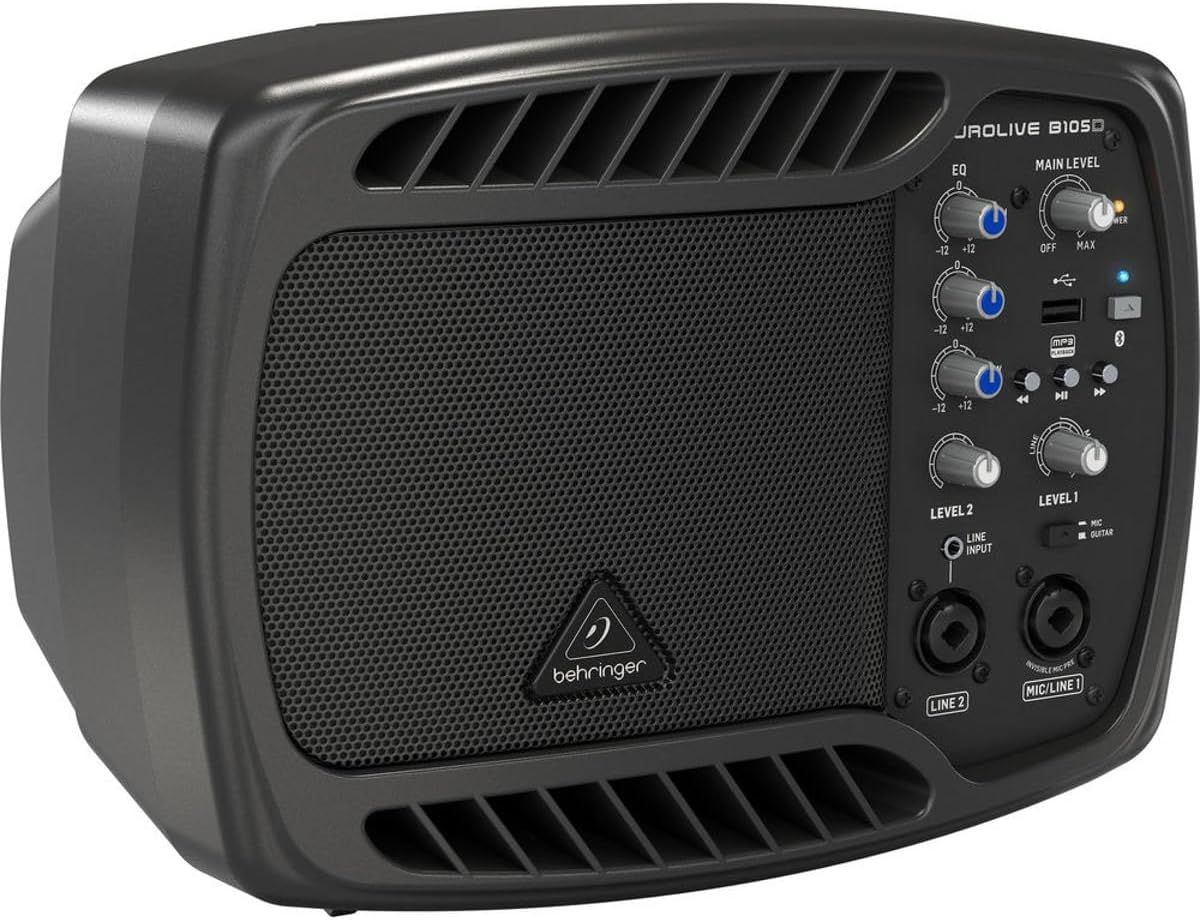
The Behringer EUROLIVE B105D is a 50-watt multipurpose PA and monitor speaker intended for vocal and keyboard monitoring, multimedia use, press conferences, and home recording. Its 3.8 rating is modest relative to the alternatives, but the compact Class-D design, built-in mixer, Bluetooth, and USB media playback give it a different kind of usefulness.
We may earn a commission when you buy through this link, at no additional cost to you.
The speaker includes a three-channel mixer with three-band equalization, allowing users to shape bass, midrange, and treble without an external mixer for basic applications. It can also play audio files from a USB stick through the included MP3 player, while Bluetooth supports compatible phones, tablets, and streaming devices. That flexibility helps it function outside a conventional live performance setup.
The primary limitation is output. With 50 watts of power, the B105D is better suited to small rehearsals, presentations, worship rooms, and solo performers than to a full band that needs to compete with drums and guitar cabinets. It also relies on a multi-purpose design rather than the larger woofer and horn arrangement found in dedicated stage wedges.
This model is a practical pick for a musician who needs one compact speaker for practice, lessons, vocals, and occasional media playback. It is less compelling when the monitor must cover a noisy rehearsal room or provide high output across a broad stage. For those needs, a larger powered wedge offers more low-frequency reach and better headroom.
Bluetooth and USB media playback expand the B105D's role beyond live monitoring. Teachers, presenters, and solo performers can use the same unit for demonstrations, background audio, or practice tracks without bringing a separate media source into every setup.
The integrated three-channel mixer and three-band EQ provide a simple starting point for gain control and tonal adjustments. It is especially helpful for beginners, although experienced live sound engineers may still prefer their own mixer and processor.
We may earn a commission when you buy through this link, at no additional cost to you.
The Seismic Audio SA-10MTSingle is a passive 10-inch floor monitor with a 4-by-10-inch titanium horn. It handles 150 watts RMS and reaches 300 watts peak, and its 4.5 rating reflects a well-regarded balance of output and stage-monitor performance. The product is built for musicians and sound providers who already control amplification through a separate rack or mixer.
We may earn a commission when you buy through this link, at no additional cost to you.
The 40-ounce magnet and 2-inch voice coil in the woofer support the stated 150-watt RMS rating. Above it, the large horn handles high-frequency reproduction and helps the monitor project a defined, directional signal toward a performer. That directional focus is valuable on a crowded stage where uncontrolled full-room output would muddy the monitor mix.
Because the monitor is passive, it cannot be connected directly to a typical line-level source without an appropriate power amplifier. It also has no onboard mixer, EQ, Bluetooth, or protection DSP. These omissions are not shortcomings for an experienced user integrating the wedge into a larger live system, but they do make it less convenient for a beginner.
The SA-10MTSingle is well suited to bands using an existing stage rack, mobile PA, or powered mixer. Its passive design offers freedom over amplifier matching and makes it straightforward to deploy alongside compatible mains. A musician seeking a self-contained monitor should instead look for an active model with integrated amplification and signal controls.
The four-inch titanium horn gives the monitor a focused high-frequency path. In practical terms, this can help the speaker deliver an intelligible vocal image while limiting unwanted spill into neighboring stage areas.
As a passive 150-watt RMS monitor, the speaker requires a correctly configured amplifier. Matching the amplifier to the stated power handling and the rest of the PA produces the most predictable results and protects the driver during demanding sets.
We may earn a commission when you buy through this link, at no additional cost to you.
The Seismic Audio SA-10MT-PW-Pair includes two powered 2-way, 10-inch floor or stage monitor wedges with titanium horns. It carries a 4.4 rating and offers a ready-made monitoring solution for performers who want two identical units rather than buying a single wedge and adding amplification separately.
We may earn a commission when you buy through this link, at no additional cost to you.
The pair is described for PA floor monitoring, live sound, stage, and studio applications. Its active configuration means each enclosure houses the necessary amplification, making the system more direct to deploy than a passive monitor. Two units can also support separate monitor mixes, a stereo configuration, or placement at opposite sides of a stage.
The principal drawback is transport. A matched pair of 10-inch wedges takes more space and requires more lifting than one compact powered monitor. The supplied data also provides fewer detailed specifications for this powered version than for the related passive model, so buyers should verify its input, control, and protection features on the current listing before ordering.
This package is a strong fit for a two-person band, worship team, or rehearsal space that benefits from a matched pair. It simplifies system planning and prevents the minor tonal and output differences that can arise when unrelated monitors are combined. A single performer working in a small room may gain more from portability and onboard mixing than from a stereo pair.
Buying two speakers together simplifies the task of creating consistent monitor coverage. Identical units are useful when two performers need different mixes or when a stereo wedge configuration is preferred over a single central monitor.
Built-in amplification removes rack space and external power amplifiers from the setup. The result is a more streamlined monitor path for mobile live sound, provided the powered inputs and controls match the user's mixer and signal needs.
We may earn a commission when you buy through this link, at no additional cost to you.
The Behringer EUROLIVE F1320D is an active 300-watt, 2-way monitor with a 12-inch woofer and 1-inch compression driver. Its 4.5 rating and stated live and playback applications make it a capable choice for performers who need more output than a compact practice speaker can provide.
We may earn a commission when you buy through this link, at no additional cost to you.
Its integrated sound processor, adjustable feedback filter, and limiter are central to its stage-focused design. These tools give the amplifier more control over operating behavior, helping the speaker remain consistent and protected when the monitor is used at high levels or positioned close to a microphone. The Class-D architecture also keeps the system relatively light for a 300-watt model.
Compared with the F1220D, this model offers more stated power and uses a compression driver rather than a 3-inch tweeter. That distinction may favor users seeking a conventional, powerful PA-style monitor. It also has fewer modern conveniences such as wireless audio, app control, or detailed digital presets, which may not matter in a fixed rehearsal or performance environment.
The F1320D is best suited to bands with a loud backline, small clubs, and worship teams that require a dedicated 12-inch floor monitor. Its size can be excessive in a bedroom or very small teaching room, and users who need more tonal flexibility may prefer a model with extensive DSP. For straightforward high-output monitoring, however, it remains a focused and capable option.
The adjustable feedback filter and integrated limiter work together to help control unwanted feedback and protect the system. These features make the monitor more practical when output levels rise and microphone placement is not ideal.
Active amplification makes the F1320D easier to deploy than a passive wedge of comparable output. The performer can connect the monitor to a suitable mixer output and begin working with the speaker without adding a separate rack amplifier.
We may earn a commission when you buy through this link, at no additional cost to you.
The YAMAHA DBR10 is a 700-watt bi-amplified, 10-inch powered speaker designed to function as either a main or monitor. With a 4.4 rating, a stated maximum output of 129 dB SPL, and a seven-year warranty, it is built for users who need professional output and expect a speaker to serve multiple roles.
We may earn a commission when you buy through this link, at no additional cost to you.
FIR-X tuning gives the DBR10 a managed operating profile, while the frequency range extends from 55 Hz to 20 kHz. The 10-inch bi-amplified format is large enough to produce meaningful low-frequency output and remains practical for many rehearsal rooms, clubs, and mobile stages. Its power also creates useful headroom when the monitor needs to compete with a strong backline.
The tradeoff is that its capabilities may exceed the needs of a home practice setup or very small room. More output does not automatically mean clearer monitoring in every environment; placement, feedback control, and a well-shaped mix remain important. Users who require extensive onboard mixing or wireless connectivity may also find the feature set more traditional than that of newer models.
The DBR10 is an excellent choice for a working musician, worship leader, DJ, or mobile sound provider who wants a single powered platform for stage monitoring and reinforcement. Its output, tuning, and warranty make it particularly compelling for demanding use, while smaller users may gain more from a lighter, less powerful wedge.
The 700-watt amplifier and 129 dB maximum SPL provide substantial operating headroom. This is useful when the monitor must remain intelligible in a loud venue without being pushed constantly to its limits.
The DBR10 is explicitly designed for main or monitor use, giving touring and event professionals more flexibility. It can support stage monitoring and then serve as a standalone main PA when a more elaborate system is unnecessary.
We may earn a commission when you buy through this link, at no additional cost to you.
The Electro-Voice Pxm 12MP is a 700-watt powered coaxial monitor with a 4.8 rating, the second-highest customer rating in this group. Its 12-inch, 1.75-inch coaxial driver produces a consistent 90-by-90-degree coverage pattern, while the adjustable 55-degree monitoring angle helps performers stand at different positions without sacrificing intelligibility.
We may earn a commission when you buy through this link, at no additional cost to you.
The coaxial arrangement places the high-frequency and low-frequency drivers on one common axis. This helps maintain a unified sound field across the listening area, which is especially valuable for musicians who move around the stage. The model can also function as a compact main PA when paired with a compatible subwoofer, using adjustable low-pass filters for system matching.
Its on-board mixer accepts two XLR or 1/4-inch combination inputs and a stereo RCA input. DSP features include four EQ presets, high and low shelving filters, parametric midrange EQ, adjustable low-cut filters, a tunable feedback notch, and recallable user settings. These controls are more comprehensive than those of conventional wedge monitors, though they also require more setup knowledge.
The Pxm 12MP is the strongest all-around recommendation for a performer who values precise coverage, flexible positioning, and deep system control. It suits stage musicians, DJs, and audio engineers who can use its mixer and DSP. A beginner looking for a simple two-knob monitor may find a less advanced powered model easier to operate, but serious users gain substantial control.
The 90-by-90-degree coverage pattern and coaxial driver create a stable listening zone. Because the drivers share an axis, the monitor can preserve tonal relationships as performers move within the coverage area rather than sounding noticeably different from one position to another.
The adjustable 55-degree monitoring angle lets users tune the speaker for closer or more distant listening positions. This is a practical feature in rehearsal rooms and on stages where wedge placement and performer movement are not fixed.
The three-channel mixer and extensive DSP allow the Pxm 12MP to serve as the central hub for a small live system. Preset EQ, parametric control, feedback filtering, and user recall make setup repeatable across rehearsals and performances.
We may earn a commission when you buy through this link, at no additional cost to you.
The Mackie Thump12v4 is a 12-inch powered loudspeaker with 1400 watts of peak power, Bluetooth, DSP, and app control. Its 4.9 rating is the highest among the ten products, making it a particularly attractive recommendation for performers who value customer feedback, portability, and modern control options.
We may earn a commission when you buy through this link, at no additional cost to you.
Mackie emphasizes a cabinet light enough for one person to carry but powerful enough for a full room. SoundCheck DSP provides application-specific voicing modes and automates part of the tuning process, reducing the need to adjust several controls manually. Bluetooth supports streaming, linking a second speaker, and connection to the compatible control app.
The primary caution concerns signal timing. Although Bluetooth is excellent for background playback and convenient control, professional stage monitoring generally benefits from a consistent wired signal path, particularly when musicians depend on precise timing. Users should evaluate Bluetooth for the intended workflow rather than assuming it should replace every mixer connection.
The Thump12v4 is an excellent multipurpose option for rehearsals, parties, mobile DJ work, and stage monitoring. It offers the highest listed rating, an easy-to-handle enclosure, and fast setup through DSP presets. Those needing only a basic monitor can find simpler and more compact units, while this model rewards users who appreciate flexibility and connected control.
SoundCheck voicing modes provide useful starting points for common applications. A performer can begin with an appropriate preset, make finer adjustments, and spend less time searching for a balanced starting point during a rehearsal or setup window.
The emphasis on one-hand transport makes the Thump12v4 appealing to mobile musicians and DJs. Its 12-inch format preserves meaningful low-frequency output while remaining more manageable than a large main PA system.
Bluetooth streaming, speaker linking, and app control extend the speaker beyond conventional wired operation. For monitoring, a wired source remains the most dependable choice, while Bluetooth can cover playback and control tasks that do not require the lowest possible latency.
We may earn a commission when you buy through this link, at no additional cost to you.
The Mackie Thump215 is a 15-inch powered loudspeaker with a 1400-watt ultra-efficient Class-D amplifier. Its 4.6 rating reflects strong customer approval, and the large heavy-duty driver makes it a notable option for applications where low-frequency impact and high output matter more than compact transport.
We may earn a commission when you buy through this link, at no additional cost to you.
Mackie specifies a frequency response from 40 Hz to 23 kHz and a maximum output of 129 dB. The 15-inch driver provides more low-frequency scale than the 10-inch and 12-inch models in the roundup. That makes the Thump215 useful for loud bands, DJ reinforcement, outdoor events, and performers who need a monitor to cut through a strong backline.
The built-in feedback eliminator and Music Ducking mode add practical controls for live use. Feedback elimination can help a powered speaker maintain clarity in challenging positions, while ducking gives performers a way to manage program audio and spoken cues. As with any automatic processing function, careful adjustment is important to avoid unwanted level changes.
Its main disadvantage is weight and footprint. A 15-inch cabinet is less convenient for a musician carrying a monitor alone or working in a small room. The Thump215 makes the most sense when the venue has space, the backline is powerful, and the additional low-frequency authority provides a meaningful monitoring advantage.
The 15-inch driver gives the Thump215 a larger low-frequency foundation than most floor monitors. It is better suited to helping performers judge kick-drum weight, bass guitar movement, and full-range playback in a high-volume environment.
The Class-D amplifier provides substantial output while supporting a relatively practical cabinet design. The stated 1400-watt rating and 129 dB maximum SPL position the model for demanding professional use.
The feedback eliminator and Music Ducking mode add useful stage functions without requiring a processor. These tools can simplify signal management, although their settings should be checked carefully during sound check.
We may earn a commission when you buy through this link, at no additional cost to you.
Choosing a stage monitor requires balancing output, coverage, driver size, power, controls, and portability against the acoustics and demands of your performance space. The most capable specification does not always produce the most useful monitor if it is awkward to position or difficult to control.
An active or powered monitor includes amplification, so it can connect more directly to a mixer and operate without a separate rack amplifier. This configuration is usually simpler for rehearsals, mobile performers, and bands with limited infrastructure. A passive monitor is driven by external amplification, giving an experienced sound provider more control over amplifier selection and system integration. The Seismic Audio SA-10MTSingle is a passive option, while the powered SA-10MT-PW pair and most other products in the roundup include their own amplification.
Driver size offers a useful indication of how much low-frequency weight and physical scale to expect. An 8-inch model is easier to move and may be adequate in a small room, while a 10-inch monitor provides a more substantial balance. A 12-inch woofer can support louder bands, and a 15-inch driver is appropriate when strong low-end impact or high headroom is a priority. Actual clarity also depends on enclosure design, horn type, tuning, and placement, so driver diameter should be considered alongside those factors.
A monitor should deliver its useful sound where the performer will actually be standing. A focused pattern can improve clarity and reduce spill onto other stage microphones, while a wider pattern can make a single wedge cover more movement. The Electro-Voice Pxm 12MP offers a 90-by-90-degree coverage pattern and an adjustable 55-degree monitoring angle, making placement especially flexible. Horn-equipped passive models also use directional high-frequency behavior to support focused stage coverage.
The monitor must be loud enough to remain intelligible over drums, guitar cabinets, and other sources without being driven constantly to its limits. Headroom is valuable in a loud room, while excessive power offers little benefit in a small practice space. Compare the stated output carefully and avoid treating peak and continuous power ratings as equivalent. A 300-watt monitor may suit a rehearsal group, while a 700- or 1,400-watt model offers more margin for demanding venues.
Feedback can quickly undermine a monitor's usefulness, particularly when the wedge is placed close to a microphone. Adjustable feedback filters, notch filters, limiters, and automatic feedback elimination are therefore valuable. The Behringer F1220D and F1320D use adjustable feedback filters, the Pxm 12MP includes a tunable feedback notch, and the Mackie Thump215 has a built-in feedback eliminator. These systems do not replace correct placement, but they can make a live setup more stable.
The available connections determine how easily a monitor fits into a rehearsal, mobile, or fixed sound system. XLR and 1/4-inch inputs suit professional mixers and instruments, while RCA and AUX inputs are convenient for phones and media sources. The Gemini AS-2108P provides a broad wired selection and an XLR mix output. The Pxm 12MP includes a three-channel mixer, and the Behringer B105D offers Bluetooth, USB media playback, and an integrated three-band mixer.
A stage monitor may need to move between rehearsal, load-in, and performance, so weight and cabinet design can be as important as specifications. The Gemini AS-2108P weighs 11 pounds, while Mackie describes the Thump12v4 as light enough for one-handed handling. Larger 12-inch and 15-inch models generally require more space and effort. Impact-resistant ABS, recessed handles, pole mounts, and wedge-shaped cabinets can improve daily usability, particularly for touring or mobile worship teams.
Digital signal processing can simplify setup and provide access to features that would otherwise require external equipment. Presets are helpful for users who want repeatable results, while parametric EQ, shelving filters, low-cut controls, and user recall support more precise system work. The Pxm 12MP and Mackie Thump12v4 offer the most sophisticated stated control packages. More advanced DSP is not automatically better, however; simple bass and treble controls may be easier for a beginner to manage.
Begin by identifying the monitor's input type and matching it to the source. A line-level mixer output can feed a powered monitor, while a passive model requires a correctly configured power amplifier. Keep speaker cables and signal cables separated where possible, secure every connection, and use a separate monitor mix when your mixer provides one. Starting with moderate gain helps prevent clipping and makes it easier to judge the monitor's actual tonal balance.
Position the wedge so its high-frequency coverage reaches the performer's ears without pointing directly into nearby microphones. Listen while the performer moves, then adjust the mix by reducing problematic frequencies rather than turning every channel up. Use the feedback filter sparingly and verify any automatic feedback-elimination setting during sound check. For Bluetooth, confirm that the source and speaker are paired, but prefer a wired path for the most consistent live timing.
Care for the speaker by keeping the grille, controls, connectors, and cabinet vents free of dust and moisture. Use a soft, dry cloth to clean the enclosure, and avoid pushing liquids into input sockets. Do not exceed the stated power handling of a passive monitor, and give an active model time to cool after extended high-level use. Before each event, inspect cables, test the input, and confirm that feedback protection and level controls are functioning as expected.
It depends on whether the monitor is powered or passive. Powered and active models contain their own amplifiers and usually connect directly to a mixer output, although an appropriate line-level source is still required. Passive monitors need an external amplifier capable of handling their stated power requirements. Always check the product type, input connectors, and manufacturer guidance before connecting a speaker.
A 10-inch or 12-inch monitor is commonly a practical starting point for a full band because it balances output with manageable size. Smaller 8-inch models can work in modest rehearsal rooms, while a 15-inch model is more appropriate when maximum low-frequency impact is important. The loudness of the backline, venue size, and available transport space are usually more decisive than driver size alone.
Active monitors are easier to deploy because they include amplification and often provide onboard EQ or mixing. Passive monitors offer more freedom over amplifier choice and can suit engineers who already have a matched rack system. For a beginner, musician, or mobile performer, an active model usually reduces setup complexity. For a fixed professional system, either approach can work when it is correctly matched to the venue.
Start with correct placement, keeping the monitor's horn or listening area away from microphones and using the lowest practical monitor level. Then reduce the frequency responsible for feedback, adjust the monitor mix, and use the built-in filter as a secondary tool. Feedback control features can stabilize a setup, but they cannot compensate for severe acoustic feedback or a poorly chosen position.
Bluetooth can be convenient for playback, linking, and app-based control, but wired connections are generally preferable when musicians need dependable timing and minimal interference. Some Bluetooth implementations may introduce latency, and a crowded radio environment can affect performance. For a professional monitor mix, use a wired signal path unless the specific system's latency and reliability have been confirmed for the intended application.
Separate mixes are ideal when performers need different levels or sources, such as more kick for a drummer and more vocal for a singer. A single mix can work for a small group with similar needs, but even a shared mix may contain instruments that one performer wants less of. The benefit depends on the input count and routing flexibility of the mixer, not just on the monitor speakers themselves.
A wedge monitor is angled upward toward a performer and is usually positioned at the front of the stage. A main PA speaker projects toward the audience and prioritizes broad audience coverage. Some powered products, including the YAMAHA DBR10, can serve both roles, while a coaxial model such as the Electro-Voice Pxm 12MP can also support a compact main system. The required coverage and position should determine the role.
Choose Bluetooth when convenient playback, speaker linking, or app control is important and the system's latency is acceptable for the task. Choose a wired-only model when reliable professional monitoring, broad connection options, or freedom from wireless interference matters most. The Gemini AS-2108P emphasizes multiple wired connections, whereas the Behringer B105D and Mackie Thump12v4 provide wireless convenience alongside more conventional live-sound connections.
The Electro-Voice Pxm 12MP is the strongest all-around choice because it combines a 12-inch coaxial driver, 90-by-90-degree coverage, a flexible monitoring angle, extensive DSP, and an integrated mixer. The Mackie Thump12v4 stands out for portability, modern wireless features, and the highest customer rating, while the YAMAHA DBR10 delivers exceptional output and a seven-year warranty for users who need a speaker that can work as a monitor or main PA.
Prioritize the monitor that fits the environment rather than the model with the largest specification. Consider driver size, required output, feedback control, connection requirements, and how much weight you can realistically carry. Match the speaker to a loud backline or small rehearsal room, and make sure the system includes any external amplifier or mixer needed for a complete setup.
Finally, check the current listing, availability, connector details, and included accessories before ordering. Product configurations and manufacturer details can change, and current pricing varies across sellers. The comparison is intended as a practical starting point, but the best stage monitor is the one that provides clear playback, stable feedback control, and dependable operation in your specific performance space.
