
30W Flat USB C Charger Block
4.8Editor score
Ultra-thin foldable plug design
Thirty-watt USB-C output
Dual-port simultaneous charging
Our expert guide compares the best Thin Flat USB C Charger options, covering port counts, power delivery, portability, compatibility, safety, and ideal use
A Thin Flat USB C Charger is most useful when you need convenient power without a bulky adapter blocking an outlet or protruding awkwardly behind furniture. The best models balance a low-profile design, adequate charging speed, useful port selection, portability, and protection for connected devices.
This guide compares ten slim and flat USB-C wall chargers using the specifications and feature information supplied for each product. It covers everything from compact two-port adapters to higher-capacity Gallium Nitride models and four-port charging blocks designed for phones, tablets, and computers.
The picks show which charger suits each priority: the highest-rated compact option, the most versatile multi-port design, and the strongest premium choice for demanding devices. Product listings and prices change over time, so check the latest details before making a purchase.
4.8Editor score

4.8Editor score

4.4Editor score
The comparison below highlights the main differences in output, port configuration, physical design, and intended use across all ten chargers, helping you identify the model that best matches your devices and travel needs.




The BUDI Flat USB C Wall Charger is a four-port adapter built for people who want one compact block to handle several everyday devices. Its 4.5 rating reflects a generally favorable user reception, while the supplied specifications distinguish it through a combination of two USB-C and two USB-A ports, total output of up to 34W, and a USB-C port capable of delivering 20W.
We may earn a commission when you buy through this link, at no additional cost to you.
Its most practical strength is port flexibility. The dedicated USB-C Power Delivery output is well suited to compatible iPhone models, tablets, earbuds, and other USB-C devices, while the USB-A ports accommodate the enormous installed base of older cables and accessories. The listed compatibility is broad, covering current and recent iPhone families, iPads, Google Pixel phones, Samsung Galaxy devices, watches, and numerous smaller electronics. The multi-protection system is specified to guard against overcurrent, overvoltage, short circuits, and overheating.
The primary limitation is the relationship between aggregate output and the number of connected devices. A 34W charger is well suited to phones, earbuds, watches, and light tablet use, but it is not intended to match the performance of a dedicated 70W or 100W laptop charger. When several devices are connected, output is shared, so the 20W fast-charging claim is most relevant when that port receives appropriate power without a heavier simultaneous load.
This is a strong recommendation for a traveler, household, or shared workspace that values four usable ports in a single slim block. It is especially helpful when the alternative is carrying several wall plugs or repeatedly removing devices from outlets behind furniture. Choose it for broad compatibility and convenient multi-device charging; choose a higher-output model instead when a MacBook or other high-power computer is the main priority.
Two USB-C and two USB-A ports let the charger serve newer USB-C equipment alongside accessories that still rely on USB-A. Consolidating four connections into one block also reduces wall-outlet clutter in busy rooms.
The listed 20W Power Delivery capability provides a practical upgrade over basic five-watt charging for compatible phones and other USB-C devices. The supplied information also reports charging an iPhone from zero to 50 percent in 30 minutes under appropriate conditions.
We may earn a commission when you buy through this link, at no additional cost to you.
The Nekmit Dual Port USB C Wall Charger combines a 40W maximum output with two USB-C ports and a very slim profile. Its 4.4 rating indicates positive customer feedback, and the supplied feature set positions it as a clean all-USB-C option for people who have moved away from legacy cables.
We may earn a commission when you buy through this link, at no additional cost to you.
According to the product data, one port can deliver the full 40W when it is used alone, making this a capable everyday charger for a MacBook Air and other USB-C devices that accept that level of input. When two phones are connected, the listing reports that both can reach 60 percent in 30 minutes. A dedicated Smart IC dynamically balances output, and GaN II technology supports a more compact form than many conventional chargers.
The main compromise is the absence of USB-A. That omission is welcome for a modern device ecosystem, but it excludes older phones, accessories, and peripherals that still depend on Type-A connectors. Also, 40W is appropriate for many smaller and medium devices rather than every high-end laptop, and using two ports simultaneously means the charger cannot provide full single-port power to both connections.
Choose this model if your priority is a remarkably slim, modern two-port charger that can handle a MacBook Air or tablet while retaining USB-C-only simplicity. It is less suitable for a mixed-cable household or anyone who must charge several lower-power USB-A accessories at once.
Gallium Nitride II technology is the core of the compact design. The product information specifically highlights use behind beds and furniture, where a thin adapter can sit more neatly and remain easier to access.
The full 40W allocation is intended for a single connected device. With two devices attached, intelligent distribution keeps charging efficient, but users should expect each connection to receive a share of the available power.
We may earn a commission when you buy through this link, at no additional cost to you.
This two-pack is a practical choice for anyone who wants slim chargers in more than one location, such as a home nightstand and a travel bag. Each charger combines a 30W USB-C port with a 20W USB-A port and can deliver up to 50W combined power. The 4.4 rating suggests generally positive experiences, while the foldable-plug design makes each block easier to store.
We may earn a commission when you buy through this link, at no additional cost to you.
Its most distinctive advantage is the number of adapters in the package. Two units can cover separate rooms, serve as home and office chargers, or remain packed for travel while the other is left behind. The 90-degree folding prongs protect the plug pins during transport and allow the chargers to fit in pockets or backpacks. The USB-C port supports faster charging for compatible modern devices, and the listing reports an iPhone reaching 58 percent in 30 minutes.
The phrase 40W in the product title should be considered alongside the more detailed port specifications. The supplied data states that the USB-C port is rated up to 30W, the USB-A port up to 20W, and combined output can reach 50W. A USB-C connection and a USB-A connection cannot both reach their individual maximum at the same time, so buyers seeking the headline figure on the USB-C port alone should focus on its 30W specification.
This set is a strong fit for travelers, couples, families, or anyone who wants a backup adapter without giving up mixed-port compatibility. Its protections against overheating, overcharging, overcurrent, overload, and short circuits add reassurance, while the two-pack format provides more flexibility than a single charger.
The two-pack removes the need to move one adapter between a bedside table, office, and suitcase. Foldable prongs further improve packing efficiency, and the reported one-ounce weight of each unit keeps bulk to a minimum.
The 30W USB-C port serves modern phones, tablets, and other compatible accessories, while the 20W USB-A port supports older cables. This makes the set more adaptable than an adapter with USB-C ports only.
We may earn a commission when you buy through this link, at no additional cost to you.
The 30W Flat USB C Charger Block is among the most compact adapters in this guide and carries a 4.8 rating, tied for the highest customer score among the listed products. Its defining measurements are 2.99 by 1.72 by 0.57 inches and 1.75 ounces, making it particularly suitable for outlets located behind furniture or for a minimalist travel kit.
We may earn a commission when you buy through this link, at no additional cost to you.
Despite its small body, the charger provides a 30W USB-C port and an 18W USB-A port. The product information reports charging an iPhone 16 to 55 percent in 30 minutes and a MacBook Air from zero to full in two hours when using the USB-C port alone. It also supports Super Fast Charging for listed Samsung Galaxy models and recognizes an extensive range of protocols, including PD3.0, QC3.0, PPS, VOOC, and others.
GaN technology is specified to reduce heat by 40 percent compared with traditional chargers, while the protection system includes over-current, over-voltage, short-circuit, overtemperature, overload, under-voltage lockout, and electrostatic discharge safeguards. When both ports are used together, the total output is listed as up to 15W, which is a significant reduction from the 30W available through the USB-C port alone.
This is the best pick for a traveler who wants a thin charger with credible high-power phone charging and broad protocol support. It is also appropriate for occasional light MacBook Air use, provided the laptop's charging requirements are compatible. It is less appropriate for users who expect fast simultaneous charging of two substantial devices, and buyers should remember that a charging cable is not included.
A thickness of 0.57 inches and weight of 1.75 ounces make this one of the easiest chargers to carry. It can also sit closer to a wall than deeper blocks, reducing strain on a cable connected behind a bed or sofa.
Support for PD3.0, QC3.0, PPS, AFC, SCP, FCP, DCP, VOOC, SVOOC, UFCS, Apple 2.4A, and PE+ makes the adapter broadly useful across modern phones, tablets, earbuds, and smartwatches. Compatibility with the appropriate protocol allows devices to request their preferred charging rates.
We may earn a commission when you buy through this link, at no additional cost to you.
The MINIX 70W Flat USB C Wall Charger stands out by combining a 4.8 rating with enough power for laptops and a body only 0.5 inch thick. It is one of the most balanced choices in the guide because it does not ask buyers to choose between a slim travel profile and the ability to charge more demanding USB-C devices.
We may earn a commission when you buy through this link, at no additional cost to you.
The charger can supply up to 70W through one port, with intelligent two-port distribution of 45W and 20W when two devices are connected. That arrangement is particularly useful for a phone paired with a tablet or other moderate-power device. GaN technology supports efficient, cooler operation, while the product data identifies overheat and surge protection as core safety features.
The 70W rating is not equivalent to 70W available from every connection at the same time. The single-device mode is intended for compatible laptops, tablets, and phones, while the dual-device mode divides the available output and prioritizes the higher-power device. The USB-C-only port selection also means legacy USB-A accessories would need a separate adapter.
For most buyers seeking one thin charger that can handle a phone during the week and a laptop on a travel day, this is an excellent recommendation. The foldable plug, 79.5-gram weight, and 12.8-millimeter thickness make it easy to pack. Confirm your device's charging protocol and cable requirements before relying on the maximum output.
The 70W single-port output offers enough headroom for many USB-C laptops and tablets while preserving a half-inch profile. It is a more capable travel option than a basic phone adapter without approaching the bulk of some desktop replacement chargers.
When both USB-C ports are occupied, the charger assigns 45W and 20W according to device demand. This is a useful arrangement for charging a higher-power tablet alongside a phone, although exact results depend on the connected devices.
We may earn a commission when you buy through this link, at no additional cost to you.
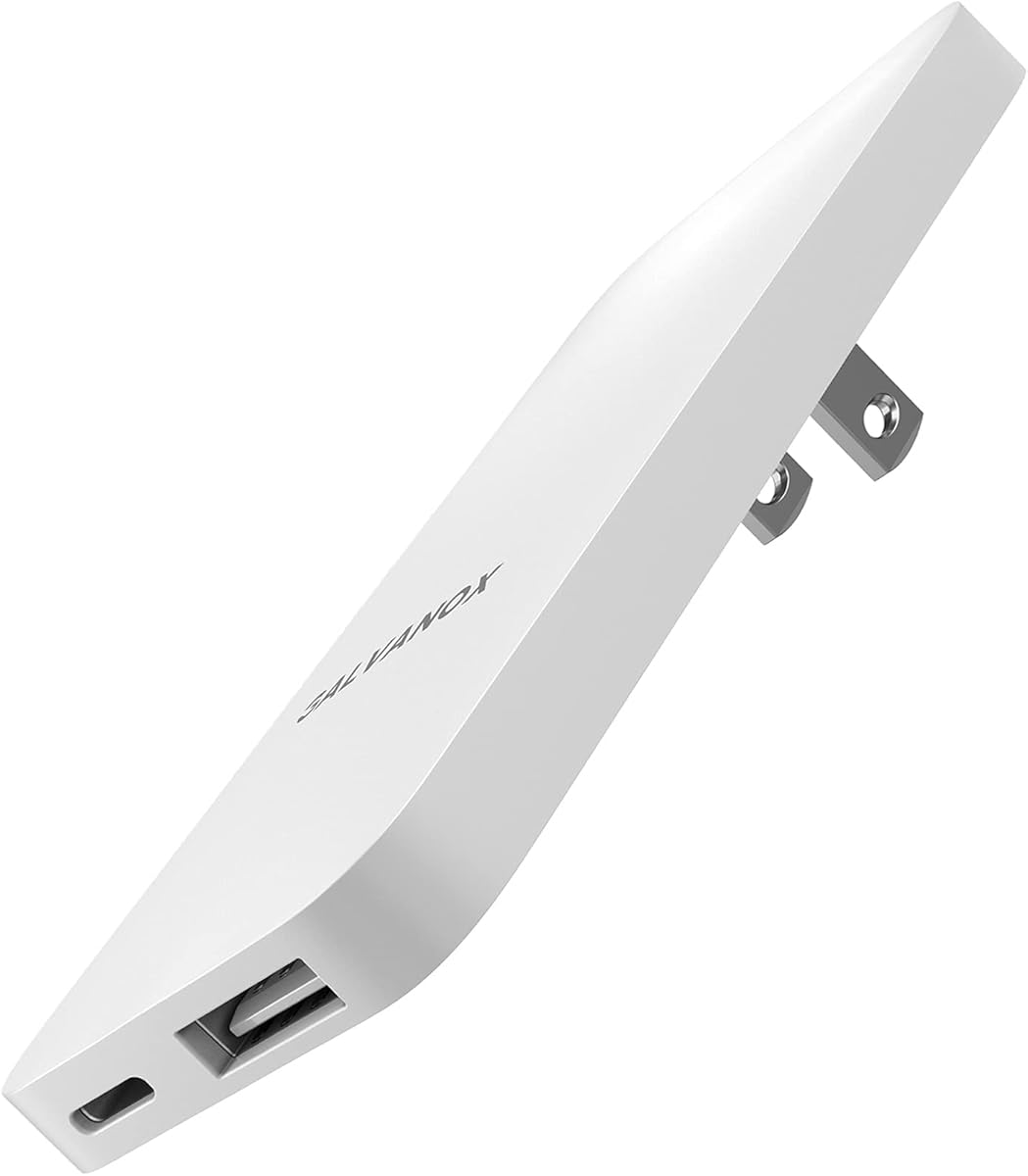
The Galvanox 20W Multi-Port Charger is defined by its physical efficiency: the product description calls it under half an inch thick and emphasizes how little space it occupies behind furniture. It has a 4.5 rating, a foldable-prong design, and both USB-C and USB-A connectivity.
We may earn a commission when you buy through this link, at no additional cost to you.
Its 20W total output and Power Delivery support are appropriate for fast charging compatible iPhone and Samsung Galaxy models. A dedicated USB-C port supports modern devices, while the USB-A port maintains compatibility with older phones and accessories. The low weight of 1.7 ounces and the folding prongs make it easy to place in a pocket, purse, or small travel pouch.
The design is most valuable in constrained outlets where a deep charger would prevent access to neighboring sockets. However, the shared 20W ceiling means it cannot provide the performance of a 45W, 70W, or 100W adapter. It is not designed for demanding laptop charging, and simultaneous use may reduce the rate available to each connected device.
Choose this charger when space, portability, and mixed-port convenience matter more than maximum output. It is a particularly good fit for a nightstand, a travel bag, or outlets behind furniture where a larger block would be inconvenient. The listed lifetime guarantee also adds a notable ownership benefit, although buyers should still verify the current guarantee terms on the product listing.
The sub-half-inch profile makes the charger sit close to the wall and preserve access to adjacent outlets. That makes it useful in hotel rooms, beside beds, behind sofas, and in other locations where depth is inconvenient.
Having one USB-C and one USB-A port covers both newer fast-charging equipment and older accessories. The adapter is therefore a versatile daily option without requiring a collection of separate wall plugs.
We may earn a commission when you buy through this link, at no additional cost to you.
The Nekmit 45W Flat Charger combines a slim profile with a 45W USB-C output and a secure three-prong plug. It carries a 4.5 rating and is aimed at users who want dependable wall placement, strong phone charging, and enough power for selected tablets or a MacBook Air.
We may earn a commission when you buy through this link, at no additional cost to you.
The product data reports that the USB-C port can charge an iPhone 17 from zero to 50 percent in 20 minutes and can deliver the full 45W to compatible Samsung Galaxy devices and MacBook Air models. PPS support is included for compatible Android devices. When both ports are active, the listed distribution is 20W through USB-C and 18W through USB-A, allowing a phone and tablet to charge at the same time.
Unlike a folding-plug model, the non-folding three-prong design is intended to remain stable in the outlet and resist being pulled loose accidentally. That can be a meaningful advantage in a busy household or a workstation. The trade-off is that the protruding prongs make the charger less convenient to pack, and the single USB-C port limits users with more than one modern device.
This charger is best for someone who values a firm outlet connection and strong one-device charging more than a completely pocket-flat adapter. It works well as a bedside or desk charger and gives useful flexibility through its USB-A port. Check the power requirements of a particular laptop and use a compatible cable for the fastest results.
PPS permits compatible devices to negotiate suitable charging levels, while the specified 20-minute result to 50 percent for an iPhone 17 shows the potential speed of the USB-C connection. Actual charging time varies by device, temperature, battery condition, and cable.
The fixed three-prong plug is designed to grip the outlet securely and reduce accidental removal. It stays in place well, although the non-folding construction is less convenient for packing than a travel adapter with retractable pins.
We may earn a commission when you buy through this link, at no additional cost to you.
This two-pack of flat 40W multiport chargers is built for busy homes, shared offices, and families with several devices. Each adapter has four ports—two USB-C and two USB-A—and the product listing assigns the adapters a 4.4 rating. The two-pack format makes it easy to place one charger where the family gathers and another in a bedroom or travel bag.
We may earn a commission when you buy through this link, at no additional cost to you.
The USB-C port is specified to support Power Delivery up to 20W, with a reported iPhone charge from zero to 58 percent in 30 minutes. Four ports permit phones, tablets, watches, and USB-A accessories to connect simultaneously, reducing the need for separate wall plugs. A built-in smart chip is said to recognize connected devices, optimize charging, and stop power when batteries reach full capacity.
The aggregate ceiling of 40W is important when evaluating a four-port design. No single connection will receive 40W, and the available output is divided among active devices. The charger is therefore better for many light-to-moderate loads than for a laptop and several other power-hungry devices connected at once. The foldable plug also adds travel convenience while preserving a very thin body.
Choose this set for users who need many ports and value having two separate charging locations. It is a particularly good fit for a family nightstand, a dorm room, or an office where several people charge different devices. If fast laptop charging is the priority, a single higher-wattage USB-C charger may be a better use of space.
Each block can consolidate a phone, tablet, watch, and accessory into one outlet. With two blocks included, the same convenience can be established in separate rooms or retained as a travel spare.
The built-in smart chip is specified to adjust output to connected devices and end charging when a battery is full. Additional safeguards cover overcharging, overcurrent, and overheating, supporting safer unattended use.
We may earn a commission when you buy through this link, at no additional cost to you.
The Nekmit 100W Flat USB C Charger Block is the premium selection for users who need one wall charger to power a demanding laptop alongside other devices. It has a 4.4 rating, a 100W maximum USB-C output, and a three-port configuration that remains reasonably flat for a charger of this class.
We may earn a commission when you buy through this link, at no additional cost to you.
The product information states that either USB-C port can provide up to 100W with a compatible cable. A 14-inch MacBook Pro is reported to charge from zero to 50 percent in 30 minutes under appropriate conditions. With all three ports occupied, the combined output reaches 97.5W, making the charger suitable for a MacBook, iPad, and phone at the same time. The USB-A port preserves compatibility with an older accessory or cable.
The 100W and 97.5W figures should be understood as maximum or aggregate capabilities, not guaranteed rates for every device. A connected product must support the relevant USB-C Power Delivery profile, and the charging cable must carry the required current. Some laptops may also require a specific wattage or protocol for their fastest setting. GaN technology helps maintain efficiency and heat management despite the high output.
This is the best premium choice for a desk that serves a MacBook Pro or Air, an iPad, and a phone, provided those devices are compatible and high output is worth the step up. It is less compelling for basic phone charging and less convenient for travel because of its fixed prongs. It is also not the smallest option in the guide despite its flat construction.
A 100W single-port ceiling gives compatible modern laptops and tablets meaningful charging headroom. The reported half-charge result for a 14-inch MacBook Pro illustrates the intended benefit of using a compatible high-current USB-C cable.
The 97.5W combined output is more than sufficient to maintain a mixed desk setup of a laptop, tablet, and phone, subject to each product's capabilities. The intelligent allocation lets the charger serve multiple device types without requiring three separate wall plugs.
We may earn a commission when you buy through this link, at no additional cost to you.
The Nekmit 52W Four-Port Charger delivers one of the strongest aggregate-output ratings among the multiport adapters in this guide. It has a 4.6 rating, four ports, and a 52W total output, with two USB-C Power Delivery ports capable of 20W each and two standard USB-A outputs.
We may earn a commission when you buy through this link, at no additional cost to you.
The two fast USB-C ports give modern phones, tablets, and accessories two opportunities to charge at their preferred fast rate. The USB-A ports support older devices and accessories, allowing up to four items to charge at once. Its compatibility list includes iPhone 14-family models, Galaxy devices, Google Pixel phones, iPad Pro, and AirPods, while the flat design is intended to fit behind couches and beds without forcing attached cables into an awkward angle.
The fixed three-prong design is explicitly described as non-grounded and non-slip. It is intended to remain secure in the socket and resist accidental removal, which can be helpful in a frequently used location. Because 52W is an aggregate limit, however, four connected devices will not receive their individual maximum ratings, and the charger is not intended to match the single-device power of the 70W or 100W models.
This is a strong all-around pick for a household that needs multiple ports and more aggregate capacity than a basic flat charger. It fits particularly well in a bedroom, family room, or shared office where phones, earbuds, watches, and tablets are charging together. It is less suitable for travelers who need the smallest possible packable block or for users whose primary device demands a higher single-port output.
Two 20W Power Delivery outputs are useful when more than one current-generation phone or accessory needs fast charging. The remaining USB-A ports accommodate legacy peripherals without requiring a separate adapter.
The three-prong plug helps the charger stay securely seated, while the flat body allows attached cables to run closer to the wall. That combination reduces accidental unplugging and awkward cable bending in busy household locations.
We may earn a commission when you buy through this link, at no additional cost to you.
A useful thin charger is not simply the smallest block on the market. The right choice depends on device power, connector types, outlet conditions, safety features, and how often the charger will travel.
Total output tells you what the charger can deliver across its connections, while single-port output tells you what one device may receive under the right conditions. A 20W adapter is best suited to phones, earbuds, watches, and light accessories. A 30W to 45W model can handle more demanding phones and tablets, while 70W and 100W options are relevant for compatible laptops. Always verify the power requirement of the device you plan to charge most often.
Choose enough output for your largest device, but account for power sharing when several devices are connected. A four-port charger with 40W may be more convenient for many small devices, while a two-port 70W charger may serve a laptop and phone more effectively.
USB-C is essential for modern phones, tablets, and laptops, but USB-A remains useful for older accessories, battery packs, and devices without USB-C connectivity. Adapters with one of each port offer the broadest everyday flexibility. USB-C-only designs are cleaner and often better optimized for Power Delivery, while additional USB-A ports can serve legacy accessories without a separate wall plug.
Count the connections you realistically need rather than simply choosing the largest port number. A four-port model is advantageous in a shared household, but a compact two-port adapter may be more convenient for travel or a single desk.
A flat body sits closer to the wall and can make it easier to use an outlet hidden behind furniture, a bed, or a sofa. It also reduces the leverage applied to a cable when the plug is inserted. Some flat designs use folding prongs, which are better for packing, while fixed prongs can sit more securely and avoid snagging on objects inside a bag.
Measure the available clearance before buying. If the outlet is close to furniture or the charger must fit in a narrow travel pouch, prioritize a genuinely slim profile and consider whether foldable prongs are available.
The highest advertised wattage often applies to one port used alone. Once two or more devices are connected, the charger divides its available power according to its internal design. This distinction matters for laptops because a 100W charger can be excellent for one computer yet only supply a smaller share when several devices draw power simultaneously.
Look for stated multi-device distribution figures where available. If charging a laptop and phone together is routine, favor a model with enough aggregate power and intelligent allocation rather than one that merely lists many ports.
USB Power Delivery is important for modern USB-C devices, while PPS can provide finer voltage and current adjustment for compatible Android phones. QC, AFC, SCP, FCP, VOOC, and other protocols can improve compatibility across a wide range of accessories and phones. A charger that supports more protocols is not automatically better, but it can be more useful in a mixed-device household.
Match the protocols to the devices you own. A broad protocol list is useful when your household includes phones from different manufacturers, while a USB-C-only laptop user may mainly need reliable Power Delivery and a suitable cable.
Modern wall chargers should include protection against overheating, overcurrent, overvoltage, overload, short circuits, and overcharging. GaN technology can improve efficiency and reduce heat relative to conventional designs, but it does not replace the need for protective circuitry. A smart chip that recognizes devices and adjusts output can further improve safe charging across mixed loads.
Prioritize models that clearly describe multiple safety mechanisms rather than relying only on a general claim of being safe. Never use a charger with a damaged cable, discolored housing, loose plug, or unusual heat behavior.
Travel chargers benefit from folding prongs, low weight, and a body that slides easily into a pocket or laptop sleeve. Fixed three-prong designs can be more stable in an outlet but are bulkier during transit. Chargers sold in two-packs add flexibility because one unit can remain at home while the other travels.
For frequent travel, prioritize a compact body, retractable pins, and a low stated weight. For stationary desk or bedside use, a secure fixed plug may be more valuable than the smallest possible packed size.
A wall charger does not include a USB-C cable in most of the models reviewed, and an included cable may still have a lower current rating. To reach a charger's maximum output, the device, cable, and charger must all support the relevant power profile. Some laptops also specify a minimum wattage or particular protocol for their fastest charging mode.
Check the device's charging requirements and use a certified cable capable of carrying the required current. When a result appears slower than expected, test with a compatible cable, verify the selected port, and confirm that no second device is drawing power.
Read the charger and device instructions before first use, then insert the charger fully into a grounded wall outlet. Connect a compatible USB-C or USB-A cable, select the appropriate port, and allow the device to negotiate its charging rate. For a laptop, confirm that the charger and cable meet the manufacturer's minimum power requirements.
Do not overload the adapter with more devices than its output can support, and avoid using a splitter or unpowered hub that draws more current than the charger can provide. Place the charger on a stable, dry surface and avoid covering it with bedding or other materials that could trap heat during high-output charging.
Unplug the charger when it is no longer needed, especially during extended travel or storage. Clean the exterior with a dry or lightly damp cloth, keep liquid away from the ports, and inspect the prongs, housing, and cable for damage. Replace the charger if it becomes unusually hot, smells burnt, sparks, produces a buzzing sound, or behaves inconsistently.
Total output is the maximum power the charger can provide across all connected ports at once. Single-port output is the maximum available when only one device is connected and receives the charger's full attention. With several devices attached, the charger divides its available power, so each device usually charges more slowly.
It depends on the charger's output, the MacBook model, and the connection requirements. The 45W, 70W, and 100W options in this guide are designed in part for MacBook Air or MacBook Pro use, while lower-output chargers are better for phones and smaller devices. Confirm the laptop's required wattage and use a compatible high-current USB-C cable.
Foldable prongs generally protect the plug pins and make a charger smaller inside a bag. Fixed prongs can provide a more stable grip in an outlet and avoid catching on objects during travel. The better choice depends on whether portability or maximum physical stability matters more in your setting.
Two devices share the charger's total power budget. Even if one port is capable of a high individual rating, the charger may reduce outputs after the second device draws current. Check the listed multi-device distribution to understand the expected performance with a particular combination of ports.
You need a compatible USB-C cable unless the charger includes one. None of the reviewed products is stated to include a cable, so most buyers will need to supply one. For high-output laptop charging, verify that the cable supports the current and power profile required by the computer.
GaN can allow a charger to achieve higher efficiency with less heat than conventional designs. That benefit is especially useful in small adapters with substantial output. It is not the only factor affecting quality, so you should also consider port selection, safety features, protocol support, and device compatibility.
It can, especially when you have several compatible USB-C or USB-A devices. A four-port model may consolidate phones, earbuds, watches, and tablets into one outlet, although total output is divided among connected devices. For a laptop plus multiple smaller devices, a higher-output charger with intelligent distribution is usually preferable.
Choose a two-pack when you need charging in multiple locations, want a spare, or regularly travel with one charger while keeping another at home. Choose a single premium model when your priority is maximum output for a laptop or a powerful device used at one location. Compare the port and protocol requirements of your devices before deciding.
The 30W Flat USB C Charger Block is the most compelling budget-oriented pick, combining a high 4.8 rating with an exceptionally thin, lightweight body and broad charging protocol support. The MINIX 70W Flat USB C Wall Charger is the most versatile overall option because it combines the same rating with enough output for laptops, tablets, and phones.
Prioritize the device that needs the most power, then choose a port layout that matches your cables. A compact two-port model is ideal for travel, a four-port block suits shared charging areas, and a 70W or 100W adapter is the better choice when a compatible laptop is part of your regular routine. Also consider plug stability, foldability, and the quality of the cable you already own.
Product details and prices can change, so review the current listing before ordering. Confirm the charger's output, protocol support, plug style, included accessories, and warranty at that time, and use a compatible cable to ensure your devices receive the charging performance the adapter is designed to provide.