
Spin-Clean Record Washer Kit
4.6Editor score
Manual dual-sided washing
Alcohol-free cleaning concentrate
Support for three RPM formats
Our Record Cleaning Machines guide compares ten manual, ultrasonic, vacuum, and brush-based options for capacity, convenience, drying, and collection care.
Record cleaning machines range from simple hand-operated washers to ultrasonic systems that automate cleaning and drying. The right choice depends on collection size, cleaning method, available space, and how much routine maintenance you want to perform without risking your vinyl.
We compared ten products based on their stated cleaning mechanisms, brush or ultrasonic design, capacity, record compatibility, drying features, fluid requirements, and overall convenience. The list includes manual washers, sonic cleaners, vacuum systems, and a compact brush-based cleaner.
Each review identifies the strongest feature and the compromises worth considering, helping you match the machine to your habits. Product listings and availability can change, so confirm the current specifications and included accessories before making a final purchase.
4.6Editor score

4.7Editor score

4.5Editor score
The comparison highlights the principal differences among manual, ultrasonic, vacuum-operated, and brush-based record cleaning machines, including cleaning method, capacity, automation, drying, and format compatibility.




The HumminGuru EZ Record Washer combines a 4.7 rating with a thoughtful approach to manual cleaning. Its defining feature is the patented clamp, which holds a record by the label area and forms a waterproof seal intended to keep the label dry. That design makes it especially appealing for collectors who want more control than a brush-only cleaner but prefer not to use a powered system.
We may earn a commission when you buy through this link, at no additional cost to you.
Operation centers on a handle that moves the record back and forth. The manufacturer recommends 12 clockwise turns followed by 12 counter-clockwise turns, allowing the goat-hair brushes to pass over the grooves while the user keeps both hands away from the vinyl. The brushes are described as ultra-soft, and their positioning accommodates records between 1 and 3 millimeters thick. An alcohol-free solution is included to lift dust, fingerprints, grease, and grime without introducing alcohol or requiring direct hand contact with the record.
The draining system is designed for controlled pouring, while the removable drying rack holds up to eight records and fits beneath the unit with a protective lid. A 7-inch adapter supports 45 RPM records with the specified 38-millimeter center hole, and the washer is also described as suitable for 7-, 10-, and 12-inch records. The trade-off is that cleaning is entirely manual, and the machine washes only one record at a time, making it less suitable for collectors wanting rapid high-volume processing.
This washer is a strong recommendation for attentive owners of mixed-format collections who value label protection, compact storage, and hands-off record handling. It is less compelling for someone who regularly cleans dozens of albums at once or wants a fully automated clean-and-dry cycle. Even so, the combination of a protective clamp, gentle brushes, controlled drainage, and an integrated rack makes it the most balanced overall option in this guide.
The clamp's watertight seal is the EZ Washer's most important distinction. It secures the label area while allowing the grooved surface to be washed, reducing the amount of fluid that reaches the paper label.
The eight-record rack doubles as integrated storage, keeping the washer and accessories together while individual records air-dry. This makes the system more practical for home listening rooms where counter space is limited.
We may earn a commission when you buy through this link, at no additional cost to you.
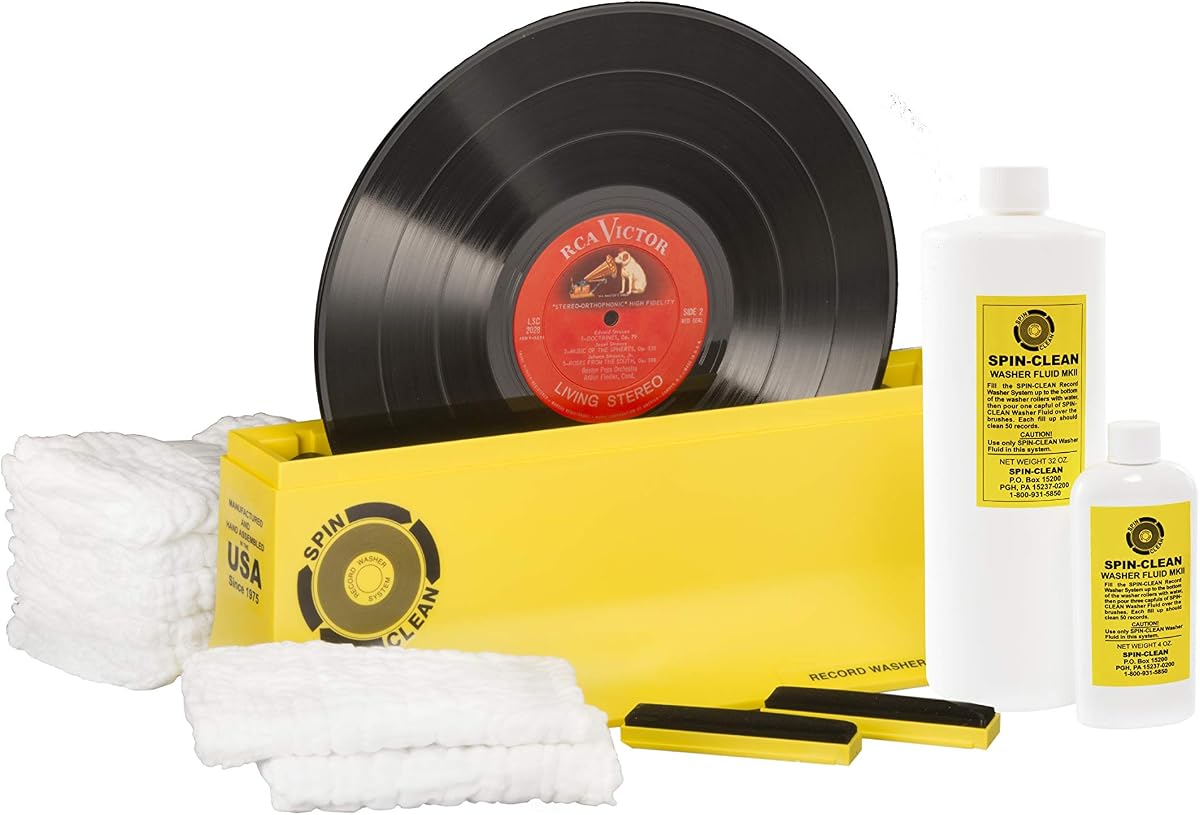
The Spin-Clean Record Washer Kit offers a straightforward manual cleaning method with a 4.6 rating. It is designed for collectors who want to wash both sides of a record at the same time without introducing a noisy motorized vacuum system. The washer operates through manual rotation, and its snap-in rollers and wedge-fit brushes are intended to remain securely positioned during the wash.
We may earn a commission when you buy through this link, at no additional cost to you.
The kit includes the washer basin, secure lid, one pair of record-cleaning brushes, one pair of rollers for different record sizes, two soft lint-free drying cloths, and a 4-ounce bottle of alcohol-free cleaning concentrate. The fluid must be diluted before use, which gives the user some control over the cleaning process. The basin is designed for easy cleaning, while stability-enhanced feet help limit wobbling while the record is being turned.
The principal limitation is that this is a manual system with no powered drying stage. Users must rotate the record, remove excess fluid, and dry it with the supplied cloths or another safe method. Although the kit supports 33, 45, and 78 RPM records, that broad compatibility does not eliminate the need to handle each record carefully and verify the correct setup before washing.
For budget-conscious collectors seeking a proven manual format, this kit is a strong value. It is especially appropriate for occasional cleaning of a general collection, while those who routinely process many records may prefer a larger-capacity or automated machine. Overall, it provides a capable dual-sided wash, broad format support, and useful accessories without a complicated installation process.
The brush arrangement is designed to clean both surfaces at once, reducing the number of separate wash steps. This can be convenient for routine maintenance when each disc is handled only a few times per year.
There is no complex setup or electrical connection. The snap-in rollers, wedge-fit brushes, and stable basin make the system approachable for users who want direct control over each cleaning cycle.
We may earn a commission when you buy through this link, at no additional cost to you.
The HumminGuru Ultrasonic Vinyl Record Cleaner is the most feature-oriented premium machine in the guide, earning a 4.5 rating. It uses dual transducers and a closed-loop stainless steel basin to deliver 40kHz ultrasonic cleaning, targeting deep-groove dirt, dust, and manufacturing release agents without physical contact with the vinyl.
We may earn a commission when you buy through this link, at no additional cost to you.
Its clean-and-dry cycle is fully automated. During drying, an air filtration system is intended to prevent airborne particles from settling back onto the cleaned record. The compact design measures 34.2 by 15.2 by 27.4 centimeters, and its lightweight frame and hidden cable management make it practical for standard record shelving. A 7-inch adapter is included for smaller formats, while the stated compatibility covers 7-, 10-, and 12-inch records.
The machine uses only 350 milliliters of distilled water, and a built-in filtration system allows the water to be reused. A thermal sensor monitors the basin and automatically halts operation if the water reaches 55 degrees Celsius, helping reduce the risk of heat-related warping. The trade-offs are ownership costs associated with a powered premium device, the need to supply distilled water, and the fact that ultrasonic care still requires sensible handling and appropriate record materials.
This cleaner is best for audiophiles who want hands-off cleaning and drying without giving up a compact footprint. It is less suitable for someone seeking a simple passive washer or someone with very limited shelf space. For collectors who regularly clean records and value automatic filtration, contactless ultrasonic action, and integrated safety monitoring, it is the most complete premium option here.
At 40kHz, the ultrasonic system is designed to loosen embedded contamination without a brush touching the groove walls. The record's proximity to the basin wall is tightly controlled to support consistent energy transfer.
The integrated air filtration stage helps keep the drying environment cleaner, reducing the chance that airborne dust will settle on the record after washing. The result is intended to be ready for playback when the cycle ends.
We may earn a commission when you buy through this link, at no additional cost to you.
The HumminGuru HG01 Ultrasonic Vinyl Record Cleaner delivers a 4.5 rating and brings automated contact-free cleaning to a compact shelf-ready form. Like the premium HumminGuru model, it uses dual transducers, 40kHz ultrasonic action, and a single-unit closed-loop stainless steel basin to clean without physical contact with the record.
We may earn a commission when you buy through this link, at no additional cost to you.
An automatic cycle handles both cleaning and drying, while an efficient air filtration stage is intended to prevent airborne debris from re-contaminating the album. Its 350-milliliter basin uses considerably less liquid than large industrial-style ultrasonic tanks, and the built-in dual filtration system allows water to be reused across multiple sessions. That makes the machine easier to integrate into a regular maintenance routine.
Safety is handled through an integrated thermal sensor that monitors water temperature and stops the machine at 55 degrees Celsius. The 34.2 by 15.2 by 27.4 centimeter body is designed to fit standard record shelving, and the power cord can be stored under the lid. The main constraints are the need for distilled water and the one-record-at-a-time format of the automatic cycle.
The HG01 is a compelling choice for collectors who prioritize automation, conservation-focused controls, and a modest footprint. It may not be the most appropriate option for high-volume processing, but it offers a more hands-off alternative to manual washing. The combination of filtered drying, reusable water, and automatic thermal protection makes it especially useful for listeners who want routine care without a separate drying step.
Real-time temperature monitoring and the automatic shutdown provide a clear response to excessive heat. This adds an important layer of control for collectors who want consistent results with minimal supervision.
The small basin and reusable dual filtration make routine ultrasonic cleaning more practical. Users can maintain the cleaning fluid across multiple sessions instead of handling a large volume of water for each record.
We may earn a commission when you buy through this link, at no additional cost to you.
The VEVOR Sonic Cleaner 6L stands out for batch cleaning, receiving a 4.4 rating. Its 40kHz ultrasonic system uses three 180-watt transducers and can clean up to six records at once, with support for records from 7 to 12 inches. A separate drying rack allows washed records to air-dry without crowding the washing stage.
We may earn a commission when you buy through this link, at no additional cost to you.
A digital control panel gives users direct control over washing temperature and duration. Temperature can be adjusted from 20 to 80 degrees Celsius, while operating time can be set from zero to 30 minutes. The 304 stainless steel body and internal tank are intended to resist rust and leakage, and the fitted lid helps keep dust out during storage.
Unlike the small single-record ultrasonic cleaners in this guide, this model prioritizes capacity and flexible programming. That makes it more relevant to a collector cleaning groups of records or operating in a shared listening space. The trade-off is its larger physical footprint and the greater importance of selecting suitable settings for different records rather than relying on a fully automatic cycle.
The package includes the ultrasonic cleaner, cleaning rack, drying rack, screwdriver, cover, power cord, plug, and user manual. For users who value batch processing and manual control over time and temperature, the VEVOR is a strong fit. It is less convenient for occasional users with little storage space, but its six-record capacity and adjustable controls offer a different kind of utility from the compact automated models.
The ability to clean up to six records in one cycle is the VEVOR's primary advantage. It can reduce repetitive setup work for collectors with several records that need the same treatment.
The digital panel and separate temperature and duration settings provide more control than a fixed automated cycle. Users can adjust the process to suit their records and their level of experience.
We may earn a commission when you buy through this link, at no additional cost to you.
The Big Fudge Vinyl Record Cleaning Machine earns a 4.1 rating and focuses on an efficient manual spin-cleaning method. Its microfiber brushes wash both sides simultaneously, while an adjustable roller system accommodates many record sizes. The manufacturer describes each wash cycle as capable of handling up to 50 records.
We may earn a commission when you buy through this link, at no additional cost to you.
The package includes a spinner machine with brushes and rollers, record washer fluid, an all-purpose cleaning cloth, and a microfiber cloth. This combination gives new users the basic accessories needed for regular maintenance without requiring a separate ultrasonic device. Its dual-side approach also helps reduce the work involved compared with cleaning each face separately.
The main trade-off is that the machine does not provide a powered or filtered drying stage. Users remain responsible for removing residual fluid and drying records properly. Its manual approach may also take practice, particularly when a large group of records is being processed. The provided cloths and scratch-conscious microfiber materials are useful, but correct handling remains important.
Big Fudge is best for a collector who wants a straightforward spinner washer and values the claimed batch efficiency. It may appeal more to someone regularly cleaning groups of well-maintained records than to an owner seeking automatic ultrasonic restoration. Despite the lower rating than the leading models, the inclusive accessory set and dual-sided design make it a practical manual option.
The microfiber brushes are arranged to wash both surfaces during the same manual process. This can save time and reduce the number of wash cycles for routinely maintained albums.
The adjustable roller system is designed to support varied record dimensions. Proper adjustment is still essential, since a secure fit is necessary to keep the record aligned while it rotates.
We may earn a commission when you buy through this link, at no additional cost to you.
The Spin-Clean Deluxe Record Washer shares a 4.7 rating with the leading product and focuses on a refined manual cleaning kit. It washes both sides simultaneously, uses a quiet non-powered design, and includes a straightforward basin with stability-enhanced feet. The format support covers 33, 45, and 78 RPM records, making it useful for collections that extend beyond standard LPs.
We may earn a commission when you buy through this link, at no additional cost to you.
The kit is especially notable for its supply of alcohol-free cleaning fluid. It includes a 4-ounce bottle plus an additional 32-ounce bottle, and the product is described as providing enough material for up to 6,300 cleaning applications. The fluid is a concentrate that must be diluted in the basin, so users should follow the included directions carefully and avoid treating it as ready-to-use solution.
Compared with the standard Spin-Clean kit, the deluxe version is positioned for owners who intend to clean frequently or maintain a large collection. The broad fluid supply reduces the need for frequent refills, while the stable basin helps make repeated manual cycles more consistent. As with other passive washers, however, there is no automated dry stage, and users must remove records carefully and dry them with suitable cloths.
This washer is an excellent choice for long-term manual maintainers, particularly listeners with mixed RPM formats and an established cleaning routine. It is less attractive for someone who wants unattended ultrasonic cleaning, but the deluxe fluid allowance and stable basin make it a high-capacity, collector-oriented version of the Spin-Clean approach.
The two-bottle cleaning-fluid package is designed for extensive use. Because the solution is concentrated, correct dilution remains important for effective cleaning and vinyl safety.
Support for 78 RPM records alongside 33 and 45 RPM media makes this kit more versatile for collectors of older formats. Buyers should confirm that their records are appropriate for wet cleaning before proceeding.
We may earn a commission when you buy through this link, at no additional cost to you.
The Pro-Ject VC-E2 Record Cleaning Machine has a 3.5 rating and offers a compact vacuum-assisted approach to record care. Its 0.5-liter tank holds cleaning liquid that is removed with vacuum assistance, a process intended to leave records dry rather than relying solely on absorbent cloths.
We may earn a commission when you buy through this link, at no additional cost to you.
According to the supplied product information, the machine can produce a completely dry record within two rotations and removes the static load carried by vinyl. Those features make it interesting for listeners who want a quick dry cycle and reduced attraction between the record and airborne particles. The silver design also suggests a relatively straightforward countertop format.
The available specifications are brief, so buyers should verify the complete operating procedure, included accessories, and record compatibility before purchase. A vacuum-assisted system also requires a reliable power connection and more care than a passive spinner. The relatively low rating does not erase the useful design, but it does make a careful review of current customer feedback sensible.
The VC-E2 is best for a collector seeking a small, fast vacuum-assisted option rather than a multi-brush manual washer or full ultrasonic system. It may suit someone who cleans albums one at a time and values rapid fluid removal. The 0.5-liter capacity and two-rotation drying claim are the main reasons to consider it, provided those features align with the user's collection and routine.
Vacuum assistance is the VC-E2's central advantage over simple cloth-and-fluid cleaning. The stated two-rotation drying result indicates a focus on quickly removing residual solution from the vinyl.
Static removal can help reduce the way dust and loose particles cling to a record. This is especially useful before playback or when handling discs that have attracted contaminants.
We may earn a commission when you buy through this link, at no additional cost to you.
The Pro-Ject VC-S3 Premium is a larger-tank version of the vacuum-assisted record cleaning concept, carrying a 3.5 rating. Its 2.5-liter reservoir provides substantially more capacity than the 0.5-liter tank in the VC-E2, potentially reducing interruptions during multi-record cleaning sessions.
We may earn a commission when you buy through this link, at no additional cost to you.
The vacuum system is designed to extract cleaning fluid and remove residue without leaving the record wet. The manufacturer states that a record can be completely dry within two rotations, while the system also removes static load. These features are attractive to listeners who want a rapid transition from washing to playback and who dislike wiping away large amounts of fluid by hand.
The larger tank is the main functional distinction, but it also means the machine occupies more room and may be overkill for someone cleaning only an occasional record. Users will need to follow the intended fluid preparation and vacuum procedure, and the supplied information provides only a concise feature summary. Current owner feedback and the complete package contents are therefore important parts of the buying decision.
The VC-S3 is best suited to an enthusiast or shared listening space that anticipates more regular vacuum cleaning. It offers the speed and residue removal of the compact Pro-Ject system with more fluid capacity. The lower rating and limited published detail argue for careful research, but the 2.5-liter tank, two-rotation drying, and vacuum extraction form a compelling feature set for high-use cleaning.
A 2.5-liter reservoir can support a longer run of record cleaning without repeated fluid changes. That makes the system more practical for owners cleaning multiple records in sequence.
The vacuum extraction and claimed two-rotation dry result focus on removing liquid quickly. This can make the workflow more convenient for listeners who prefer to clean and play records in the same session.
We may earn a commission when you buy through this link, at no additional cost to you.
The Audio-Technica AT6013a is the simplest machine in the guide, but it earns a 4.6 rating for a focused dry-cleaning approach. Two carbon-fiber brushes and a central velvet pad collect dust and other contaminants during a single pass, offering a convenient alternative to washing when only routine surface maintenance is needed.
We may earn a commission when you buy through this link, at no additional cost to you.
The anti-static brush fibers are designed to remain straight while reaching into the grooves, and the combined brush-and-pad design is intended to capture debris rather than merely redistribute it. A protective metal guard bracket helps shield the unit and nearby equipment during use. The product also includes no liquid, basin, or power requirements, making it easy to keep near a turntable.
This simplicity is also its main limitation. A dry brush cleaner cannot provide the fluid removal and deeper cleaning offered by the manual washers, ultrasonic systems, or vacuum machines. It is better suited to routine dust removal between occasional deep cleans than to records covered in fingerprints, grease, or substantial grime.
The AT6013a is an excellent first tool for new collectors, a convenient accessory for a larger cleaning setup, or a quick solution for removing dust before playback. It is not the right primary machine for a collection that needs frequent wet cleaning. For its focused purpose, though, the anti-static fibers, velvet pad, and protective bracket create a simple and effective maintenance tool.
The dual carbon-fiber brushes and central velvet pad work together to collect loose contaminants in a single pass. This makes the AT6013a useful for quick care between more thorough cleaning sessions.
No cleaning solution is needed, so there is no fluid to mix, dispose of, or allow to contact the record label. The compact, cordless format also makes it easy to store and use.
We may earn a commission when you buy through this link, at no additional cost to you.
The best record cleaning machine depends on the level of dirt involved, your collection size, preferred workflow, and willingness to handle fluids or connect a powered device. The following factors help narrow the field before comparing individual models.
Dry brush cleaners are the simplest option and are best for routine dust removal. Manual washers use brushes and fluid to clean both sides, while ultrasonic systems use high-frequency vibrations to loosen contamination without physical contact. Vacuum-assisted cleaners remove fluid quickly after a wash. Consider both the condition of your records and the amount of supervision you want; a method that handles deep grime is less useful if it cannot be used consistently and safely.
In short, choose dry cleaning for light maintenance, manual washing for hands-on control, and ultrasonic or vacuum-assisted cleaning when convenience and deeper cleaning are priorities.
Check which record sizes and playback speeds the machine supports. Common LPs and 45 RPM singles are widely covered, while 7-inch adapters, 38-millimeter center holes, and 78 RPM support can matter for specialized collections. Also consider unusual vinyl or shellac records carefully, because wet cleaning methods may not be appropriate for every historical format.
Match the machine directly to your collection rather than relying on broad terms such as universal. Verify size, diameter, thickness, and speed compatibility before every new type of record.
Good record care depends on keeping labels dry, distributing pressure evenly, and avoiding harsh contact with the grooves. A label-protecting clamp, adjustable roller system, stable basin, or precisely positioned brushes can all improve handling. The materials should also be described as soft or scratch-conscious, and the cleaning solution should be appropriate for vinyl and free from ingredients that could harm the record.
Prioritize designs that reduce direct hand contact and include clear instructions for setting the correct gap. A protective feature is valuable only when it is used as intended.
Capacity can mean several different things: the number of records washed together, the number held for drying, or the number of cleaning cycles a machine can handle before fluids or filters require attention. The VEVOR model cleans multiple records in one ultrasonic batch, the HumminGuru EZ Washer stores up to eight records on its drying rack, and the Big Fudge is described as capable of handling as many as 50 records per cycle. These claims are not directly comparable, so consider the actual workflow rather than the largest number alone.
For a large collection, prioritize batch capacity, fluid supply, and filtration. For occasional use, one-record capacity may be entirely sufficient and can mean a smaller, simpler machine.
Cleaning is only half the task; the record must also dry without attracting new dust. Manual systems generally require cloths or an air-drying rack, while the ultrasonic HumminGuru models add filtered automatic drying. Vacuum systems emphasize rapid fluid extraction. Think about where you will dry records, whether you need to play them soon after cleaning, and how much open space you have for a rack or machine.
Choose a drying method that fits your available space and routine. Fast, integrated drying is convenient, while simple racks and lint-free cloths remain useful and require little power.
Manual Spin-Clean products use alcohol-free concentrates that must be diluted, while the ultrasonic HumminGuru machines use distilled water in a filtered basin. Reusable filtration can reduce fluid consumption and interruptions, but it also requires correct maintenance. A powered machine may have additional requirements involving water quality, temperature, cleaning, and storage, so read the operating instructions before purchasing.
Factor in both the initial setup and ongoing upkeep. Choose a system whose required fluid and cleaning routine you can realistically maintain between record-care sessions.
The most capable machine is not necessarily the easiest one to live with. Compact ultrasonic cleaners are designed for standard shelving, while larger batch systems need more floor or counter space. Manual washers are quiet because they need no motor, but their rotation and drying add time. Vacuum systems use power and may produce more sound than passive options. Cable management, basin size, and rack storage can determine whether the machine blends into your listening space.
Measure your available area and compare it with the stated product dimensions. A quieter, smaller machine may fit your routine better than a larger one with higher throughput.
A complete kit can be more useful than a bare machine. Compare the number and softness of drying cloths, whether a 7-inch adapter is included, how much cleaning fluid is supplied, and whether a spare brush or roller is provided. Warranty coverage and clear support are also useful considerations, particularly for powered models with sensors, filters, and electronic controls.
Check what is genuinely included before assuming accessories are supplied. The most complete package for your routine is usually the one that covers cleaning, drying, and the record sizes you actually own.
Begin by reading the machine's instructions and identifying any records that may not be suitable for wet or powered cleaning. Clean the basin, brush, rollers, clamp, or tank as directed, and prepare the cleaning fluid at the specified concentration. For ultrasonic models, use the required distilled water, place the record correctly, and avoid interrupting the cycle unless the safety system requires it.
Handle vinyl by the edges throughout the process. Keep the label dry when possible, do not force a record into an adapter, and make sure the brushes, clamp, or suction surface are correctly aligned. Rotate manual washers evenly and avoid rushing the motion. Never add solvents or cleaners that are not included or approved for the machine and the record material.
After cleaning, remove excess fluid carefully and use a clean, soft, lint-free cloth or the designated drying rack. Let records finish drying in a clean area away from direct heat, sunlight, and dust. For ultrasonic machines, follow the filtration and storage instructions, empty or dry the basin as directed, and inspect brushes, rollers, filters, and sensors periodically.
It can be worthwhile for collectors who play records frequently or own albums that have accumulated dust, fingerprints, and other surface contamination. A machine makes cleaning more repeatable and reduces the chance of transferring dirt to the stylus. The most useful choice depends on whether you need light dry maintenance, occasional wet cleaning, or frequent automated processing.
Ultrasonic cleaning can be effective on records that are suitable for immersion and mechanical cleaning, but not every collectible should be washed. Records with damaged vinyl, non-standard labels, special materials, or uncertain construction may require a gentler method. Check the cleaner manufacturer's compatibility guidance and use a conservative professional assessment for valuable or unusual pieces.
A dry brush is best for routine dust removal and light maintenance. Wet cleaning is more appropriate when a record has fingerprints, grease, or more substantial grime that brushing cannot remove. Whichever method you choose, work carefully from the outside inward and never use household products unless the manufacturer explicitly approves them.
Many models can, but the record center-hole diameter and supported speed must match. Some machines include a 7-inch adapter, while others use adjustable rollers or clamps. Confirm that the adapter is compatible with the center hole of your singles and that the machine can support the smaller record securely before washing.
Use the solution supplied with or specified by the machine manufacturer. The Spin-Clean products included in this guide use alcohol-free concentrates that must be diluted according to their instructions, while the ultrasonic HumminGuru models use distilled water. Never mix cleaners or improvise solvent ratios, because residue and overexposure can affect the vinyl or the machine.
The record should be fully dry rather than merely surface-dry. Manual washers generally need absorbent cloths and additional air-drying time, while filtered ultrasonic and vacuum systems are designed to remove fluid more quickly. Use a clean, lint-free cloth and keep the record in a low-dust area until no moisture remains.
No. A record cleaner removes surface contamination and may reduce the effects of dust-related noise, but it does not repair scratches, flatten warps, or restore damaged grooves. A machine should not be presented as a restoration tool for structural vinyl problems.
Not necessarily. Larger batch systems and machines with more drying storage can help owners who clean many records at once, but they may require more space, fluid, or setup. For a small collection or occasional cleaning, a compact washer or dry brush can be more practical and easier to maintain.
The HumminGuru EZ Record Washer is the best overall choice because it combines a label-protecting clamp, gentle brushes, controlled manual rotation, and an integrated drying rack in a compact package. The Spin-Clean Record Washer Kit is the best budget-oriented manual option, while the HumminGuru Ultrasonic Record Cleaner is the most complete premium machine for collectors who prioritize automation.
The right alternative depends on your routine. VEVOR offers multi-record ultrasonic capacity, Big Fudge emphasizes efficient dual-sided manual washing, the deluxe Spin-Clean supports long-term use and uncommon formats, and the Pro-Ject vacuum systems prioritize rapid fluid removal. Audio-Technica's AT6013a remains a useful dry-cleaning tool for routine dust maintenance. Prioritize record compatibility, groove and label protection, drying, and the cleaning method you will actually use consistently.
Before purchasing, verify the current product listing, included accessories, warranty details, and operating requirements. Product specifications and availability can change, and the best machine is the one that fits your collection, available space, and maintenance habits.