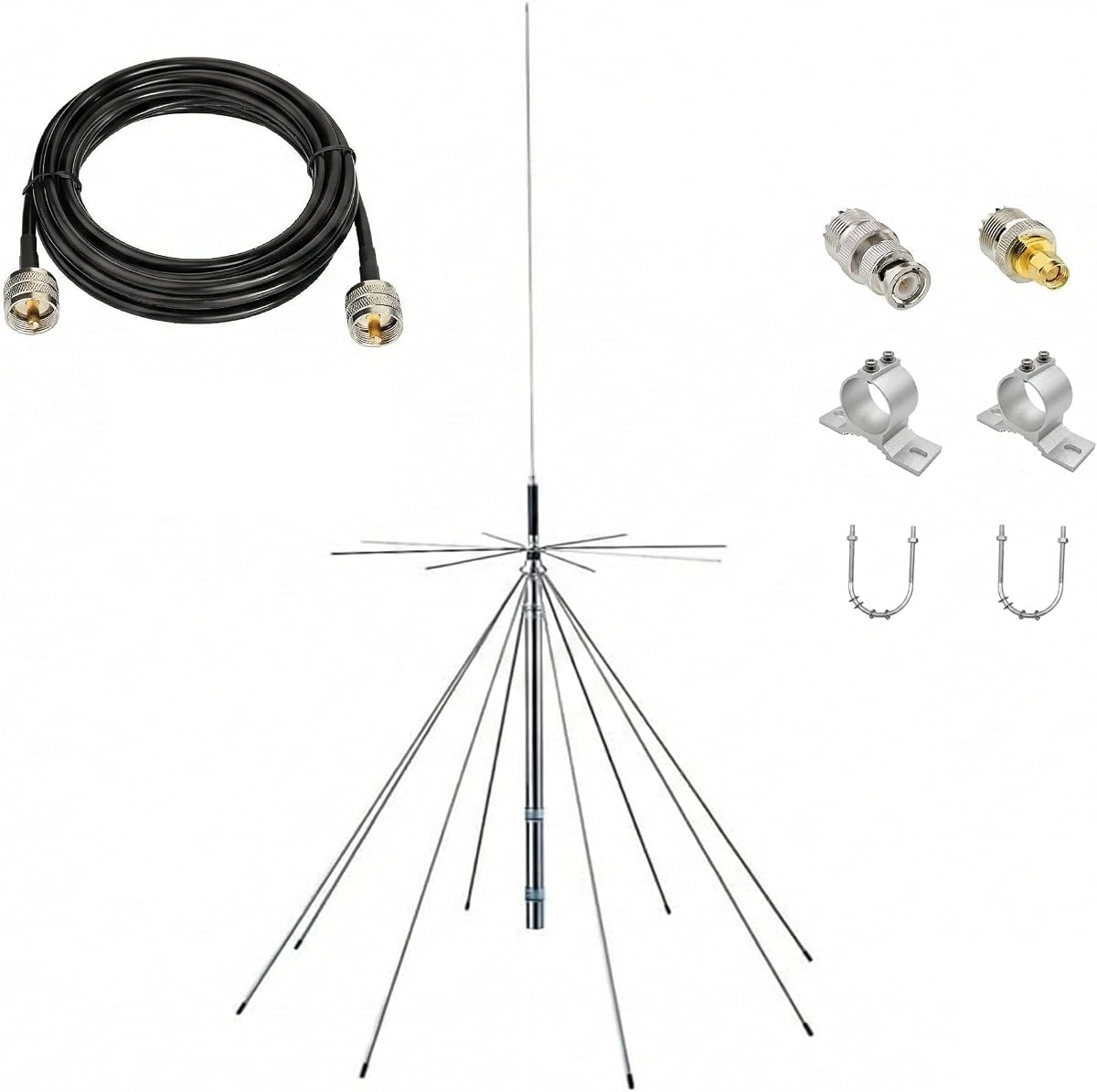
D3000N Discone Scanner Antenna
5.0Editor score
25–3000 MHz reception range
200W upper-band transmission
Stainless-steel discone design
This guide compares the 10 best Base Station Scanner Antenna options for wideband reception, flexible mounting, range, build quality, and device compatibility.
A Base Station Scanner Antenna can materially improve reception across public-safety, aviation, amateur, broadcast, and other monitored frequencies. The right model balances wideband coverage, gain, impedance, mounting flexibility, weather resistance, connector compatibility, and the distance between your radio and the nearest sources of interference.
We compared all ten products by examining their stated frequency ranges, antenna designs, gain figures, included cables, mounting hardware, transmission capabilities, and supported devices. The list covers permanent rooftop discones, portable magnetic-base antennas, a tripod model, and a dedicated dual-band fiberglass base antenna.
Each review explains where that antenna stands out, where its compromises may matter, and which type of listener it suits best. Ratings and product details can change, and prices fluctuate over time, so confirm the latest listing and your radio's connector before purchasing.
5.0Editor score
4.7Editor score

4.2Editor score
This side-by-side comparison highlights frequency coverage, antenna type, mounting method, power handling, and the practical compromises associated with each portable or permanent base-station solution.


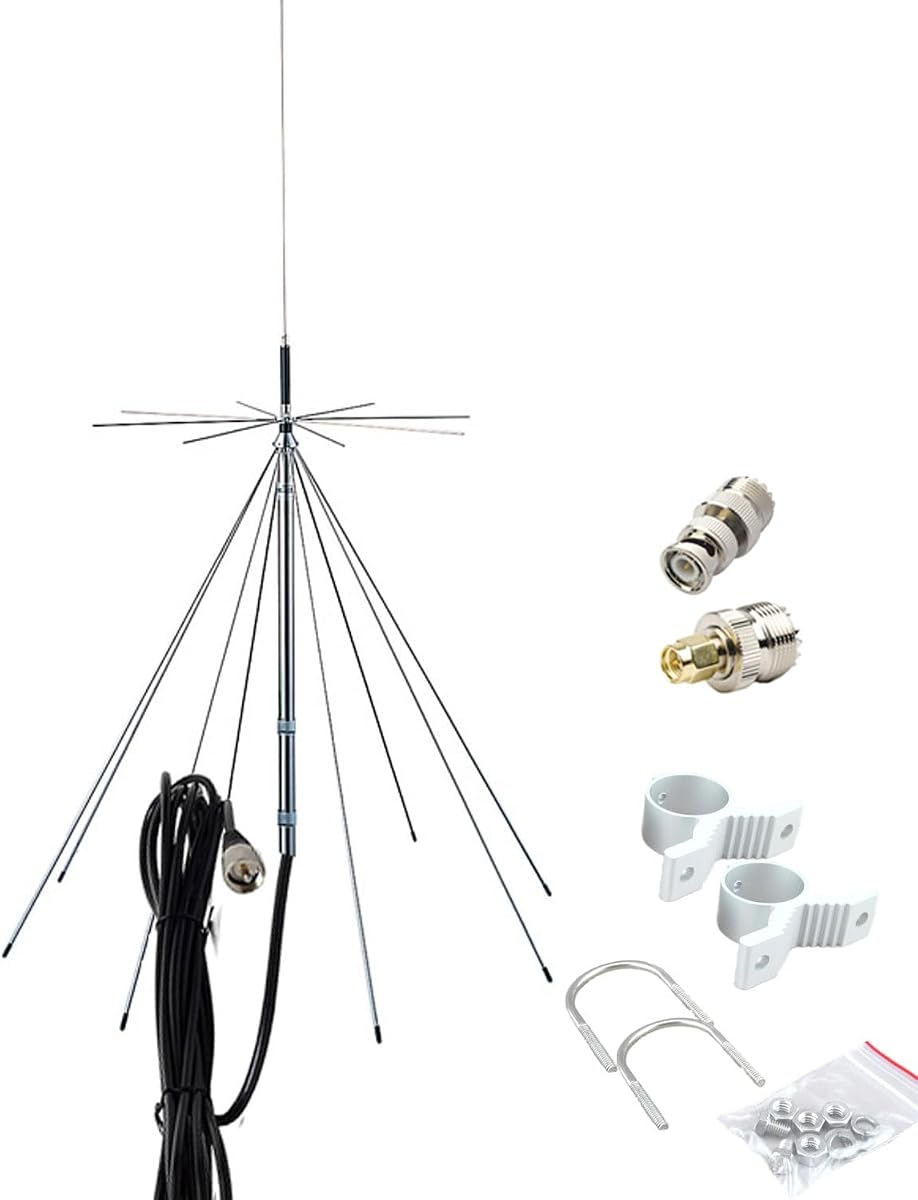
The Discone Antennas D3000/ combines a 25–3000 MHz range with a customer rating of 4.7, making it the most convincing all-around choice in this guide. Its wideband discone format is intended for scanners, SDR radios, CB equipment, and multiple conventional radio bands rather than one narrow slice of spectrum.
We may earn a commission when you buy through this link, at no additional cost to you.
Its standout strength is versatility. The stated coverage includes MW, SW, HF, CB, aviation, FM, FRS, GMRS, UHF, and VHF, while the included ten-meter RG58 cable and PL-259/UHF, BNC, and SMA connections provide useful setup flexibility. Installation on an apartment balcony, roof, or mast also gives the antenna a clear path to incoming signals.
The trade-off is that this is primarily a fixed-installation antenna rather than a grab-and-go accessory. The removable top loading coil can reduce size when 25–50 MHz reception is unnecessary, but users still need suitable mounting hardware and must verify whether their radio and transmitter are compatible with the antenna's operating characteristics.
This is the recommendation for listeners who monitor many services, want a single antenna to cover numerous bands, and prefer a rooftop or mast-mounted setup. It offers the strongest balance of reach, range, included components, and installation flexibility in the list.
Instead of matching separate antennas to individual radio services, the D3000/ covers an exceptionally broad spectrum. That makes it particularly useful for operators who move between air-band, aviation, GMRS, FRS, broadcast, and amateur monitoring.
The supplied cable and adapters cover several common radio connections, but compatibility should still be checked before assembly. Users with an unusual proprietary connector may need an additional adapter.
We may earn a commission when you buy through this link, at no additional cost to you.
The Tram 300-Watt Super Discone carries a 4.6 customer rating and stands out for high-power operation. It covers 25–1300 MHz for reception, supports 300 watts maximum power, and is rated for 200 watts when used on CB frequencies.
We may earn a commission when you buy through this link, at no additional cost to you.
A stated SWR below 1.5:1 makes this appealing to amateur-radio operators and communicators who want a single robust antenna for receiving and transmitting. The stainless-steel structure is designed to resist rust, while adjustable radials, a 55-inch top whip, and support for numerous transmit bands provide practical versatility.
Its size and installation demands are the main compromises. The top whip reaches 55 inches, and the lower radials are also substantial, so the antenna needs a suitable mast, adequate rooftop clearance, and a mounting environment that can handle its dimensions. The listed maximum mast diameter is 1-3/8 inches.
Choose the Tram when transmission capability and structural robustness matter as much as reception. For a listener restricted to a desktop radio or a small apartment balcony, the D3000/ or a magnetic-base option will usually be easier to accommodate.
The stated 300-watt maximum rating gives this discone more authority than the receive-focused portable products in the list. It is a better fit for operators who also transmit on supported amateur or CB bands.
The tall whip and long radial elements should be planned around roof lines, trees, balconies, and nearby structures. Good separation from obstructions can be more valuable than adding another antenna.
We may earn a commission when you buy through this link, at no additional cost to you.
The Scanner Antenna with Tripod is designed for users who want a substantial discone-style antenna without immediately mounting it to a permanent rooftop mast. It operates across 25–1300 MHz, provides stated 3.5 dBi gain, and includes a portable stainless-steel tripod.
We may earn a commission when you buy through this link, at no additional cost to you.
The package includes the antenna, ten meters of coaxial cable, an instruction manual, a tripod, and PL-259/UHF and SMA connections. Its stated support for HF, aviation, UHF, VHF, FM, FRS, GMRS, and amateur bands gives it broad utility for base-station monitoring.
The product does not have a listed customer rating, so its long-term user feedback is less visible than that of the leading picks. A portable tripod also needs a stable surface, and outdoor placement can leave the antenna more exposed to weather and accidental disturbance than a secured mast installation.
This is a strong option for renters, temporary listeners, field-day setups, or anyone who wants a full-size base-station arrangement that can be repositioned. It is less suitable when the antenna must remain permanently exposed on a roof without a secure tripod location.
The tripod makes it possible to elevate the antenna without a roof or mast. That portability is particularly useful when you want to compare positions or take the setup to a different listening environment.
Wideband operation, ten meters of cable, and included connectors create a flexible package. Confirm the radio-side connector and ensure the tripod is placed where it cannot obstruct access.
We may earn a commission when you buy through this link, at no additional cost to you.
The D3000N holds a 5.0 customer rating and combines 25–3000 MHz reception with transmission capability across stated frequencies from 50 to 1200 MHz. Its 1.7-meter design and heavy-duty stainless-steel construction make it a strong candidate for a permanent base-station installation.
We may earn a commission when you buy through this link, at no additional cost to you.
The product is unusual among wideband scanners because it is not limited to reception. It can support up to 200 watts above 144 MHz, while the omnidirectional design and 25–3000 MHz range suit SDR and desktop-scanner users. The included elements, loading coil, rods, bracket, bolts, support pipe, cable, wrench, and manual form a comprehensive kit.
Assembly requires attention because the disk element rods must be installed after the radial rods. Its weather-oriented, fixed-mount design is less convenient than a magnetic-base antenna, and users should confirm transmission, legal band, and local regulatory requirements before operating it as a transmitting antenna.
For a buyer who wants broad monitoring and occasional transmission in one outdoor system, the D3000N is a top recommendation. It pairs a strong customer rating with extensive coverage and unusually complete installation hardware.
The D3000N can serve as a monitoring antenna while also handling supported transmissions up to its stated limits. This dual role can simplify a station that would otherwise require separate receive and transmit antennas.
Stainless-steel construction, mounting hardware, and a compact 1.7-meter length favor rooftop or mast deployment. Check nearby obstructions and complete assembly in a comfortable workspace before raising the antenna.
We may earn a commission when you buy through this link, at no additional cost to you.
The Outdoor Indoor Police Scanner Antenna offers a 25–3000 MHz range, 3.5 dBi gain, and a customer rating of 4.0. It combines a magnetic base with a ground-plane mount and separate long and short whips for different radio services.
We may earn a commission when you buy through this link, at no additional cost to you.
The 15-centimeter whip is intended for 136–174 MHz VHF reception, while the 12-centimeter whip serves 400–470 MHz UHF use. A 50-ohm impedance, vertical linear polarization, and stated VSWR below 2.0 align with common scanner and SDR requirements. The five-meter RG58 cable gives users more freedom than a short desktop lead.
The magnetic base makes the package easy to reposition between indoor and outdoor locations, but that convenience depends on a clean, flat, secure mounting surface. A less favorable customer rating than the leading products also suggests checking recent customer feedback carefully, especially regarding the included whips and mounting hardware.
This antenna suits listeners who want one portable package for VHF, UHF, SDR, ADSB, and marine radio monitoring. It is a better fit for temporary or flexible placement than for a permanent high-elevation installation.
The two whip lengths let you favor VHF or UHF reception without replacing the entire antenna. This is useful for users who monitor both public-safety and aviation-adjacent services with one setup.
The magnetic base and 16.4-foot cable let the radio remain indoors while the antenna sits outside a window or on a suitable surface. Test several positions because metal, walls, and appliances can affect reception.
We may earn a commission when you buy through this link, at no additional cost to you.
The 2m 70cm GMRS Wideband Antenna has a 4.5 customer rating and covers 25–3000 MHz. Its ground-plane design, interchangeable whips, and heavy-duty magnetic base make it a practical option for desktop scanners, SDR receivers, marine radios, CB equipment, and amateur mobile stations.
We may earn a commission when you buy through this link, at no additional cost to you.
The stated coverage includes CB, FM, VHF, UHF, GMRS, 900 MHz, 1000 MHz, 1090 MHz, 978 MHz, and AM air band, with transmission support stated for the 2-meter and 70-centimeter bands. A five-meter RG58 cable with BNC, SMA, and SO-239 connections offers practical equipment compatibility.
The short and long whips make sense for different priorities, but the most appropriate selection depends on which services you monitor most. The magnetic base is portable rather than permanent and should be placed on a clean, stable surface. As with any transmitting setup, power and frequency requirements should be checked against the radio and antenna specifications.
This is a good middle ground for users who want broader capabilities than a simple scanner whip but more flexibility than a mast-mounted discone. It works especially well for temporary base-station listening near a window, desk, or outdoor mounting point.
The long frequency span covers conventional broadcast, two-way, aviation, GMRS, and other services. This breadth makes the antenna useful for users who do not want to maintain a separate antenna for every band.
The included ground-plane components can improve signal behavior over a simple whip antenna. Mounting the assembly away from metal and obstructions remains important for obtaining the expected benefit.
We may earn a commission when you buy through this link, at no additional cost to you.
The Bingfu 20–1300 MHz Police Scanner Antenna is a straightforward way to add an external antenna to a compatible scanner. Its 4.2 customer rating, 50-ohm impedance, magnetic base, and BNC male connector make it a practical budget-oriented choice.
We may earn a commission when you buy through this link, at no additional cost to you.
The stated 20–1300 MHz range covers many public-safety, amateur, broadcast, and two-way frequencies, while the three-meter RG58 lead provides enough flexibility to move the antenna away from the radio. The compatibility list includes numerous Uniden, Whistler, Radio Shack, Icom, Motorola, Maxon, Vertex Standard, and Wilson models.
Unlike the full discones in the guide, this product does not state a transmission power rating, and its upper limit is 1300 MHz rather than 3000 MHz. It is best understood as a receive-oriented scanner accessory. The BNC connector also means radios with SMA or other connections will need an appropriate adapter.
Buy this Bingfu model if you already own a BNC-equipped scanner, want a simple magnetic antenna, and need broad coverage without a permanent installation. It is particularly attractive for testing whether a better external antenna improves your setup before investing in a larger rooftop system.
A magnetic base and three-meter cable remove much of the complexity associated with rooftop antennas. The radio can remain at a desk while the antenna is placed on a window ledge or another suitable surface.
BNC is common on many handheld and desktop scanners, but connector layouts vary. Identify the port on your radio and confirm whether the included cable and any needed adapter are compatible.
We may earn a commission when you buy through this link, at no additional cost to you.
The Bingfu VHF UHF Magnetic Antenna has a 4.1 customer rating and offers a 20–1300 MHz range in a portable magnetic-base format. It is aimed at public-safety scanners, ham radio, two-way radio, walkie-talkies, and mobile radio users.
We may earn a commission when you buy through this link, at no additional cost to you.
The antenna has a stated 50-ohm impedance, VSWR below 2.0, a three-meter cable, and a BNC male connector. Its long compatibility list covers popular Uniden Bearcat, Whistler, and Radio Shack scanners alongside numerous handheld amateur-radio models.
Its core strengths and limitations closely resemble those of the other Bingfu scanner antenna in this guide. It provides no stated transmission power rating, so it is best treated as a receiving antenna. Magnetic attachment also depends on surface quality, and the radio-side connector must match.
Choose this option when portability and a straightforward magnetic base are priorities. It is a sensible alternative for users who prefer this listing's supported-device list or have one of the listed scanners and do not need a wideband discone or elevated permanent installation.
The product lists specific radio models across major scanner brands, which reduces uncertainty when matching it to established equipment. Buyers with newer or less common models should still verify the connector and frequency needs.
Dust, paint, and grime can interfere with magnetic attachment. Wipe the contact surfaces and choose a stable position where the cable cannot snag or pull the antenna down.
We may earn a commission when you buy through this link, at no additional cost to you.
The Wide Band Foldable Telescopic Antenna has a 5.0 customer rating and offers a distinctive portable approach. Its 95–1100 MHz range covers the major VHF, UHF, GMRS, and aviation ADS-B frequencies, while the folding and telescoping construction makes it easy to carry.
We may earn a commission when you buy through this link, at no additional cost to you.
Stated gain is 2.15 dBi from 95–300 MHz and 3.2 dBi from 300–1100 MHz. The antenna supports receive and transmit operation at 144 and 430 MHz, with a maximum input rating of 10 watts. A BNC male connector, magnetic base, three-meter cable, and BNC-to-SO-259 and BNC-to-SMA adapters support several radio types.
Its obvious limitation is the 95 MHz lower boundary, which excludes lower-frequency HF, SW, and some CB coverage. The gain figures are also more modest than those of larger base antennas. Its 10-watt ceiling means it should not be assumed to handle the output of a high-power mobile radio.
This is the pick for travelers, RTL-SDR users, and anyone who needs a compact wideband antenna for VHF and UHF without assembling a permanent system. It is especially convenient for field use, bench testing, and quick deployment near a window or outdoor surface.
The antenna retracts to 19.5 centimeters and extends to 113 centimeters, offering a practical balance between packed size and usable length. That portability makes it easy to move between listening locations.
The supplied adapters support common SO-239 and SMA-equipped devices, while the magnetic base allows quick placement. Confirm the operating band and transmit-power limit for your specific radio.
We may earn a commission when you buy through this link, at no additional cost to you.
The 144/430 MHz Fiberglass Omni Base Station Antenna is the most specialized product in the guide. It focuses on VHF and UHF amateur bands, with a customer rating of 4.1, a 200-watt power rating, and stated gain of 4.5 dBi on VHF and 7.2 dBi on UHF.
We may earn a commission when you buy through this link, at no additional cost to you.
Its fiberglass radome and copper radiating element are intended to withstand outdoor conditions, including corrosive shoreline environments. The two-section body reaches 67 inches when assembled, and included aluminum U-bolts allow mounting on masts or pipes from 30 to 62 millimeters in diameter.
Its narrow dual-band focus is the decisive limitation. It does not offer the broad reception span of a discone, and its coverage should not be treated as equivalent to a 20–1300 or 25–3000 MHz scanner antenna. It is also designed for a mast rather than a casual magnetic base.
This antenna is best for ham-radio communicators and repeater users who want dedicated 2-meter and 70-centimeter performance with higher gain. For monitoring many unrelated services, choose one of the wideband models instead.
Focused 144 and 430 MHz coverage allows the antenna to concentrate its design on the 2-meter and 70-centimeter bands. The stated gain figures are particularly relevant to users with an established ham-radio or repeater setup.
The fiberglass radome and copper element provide a durable alternative to an exposed wire antenna. U-bolt hardware and the two-section design simplify mounting and storage.
We may earn a commission when you buy through this link, at no additional cost to you.
The best antenna depends on the services you monitor, the radio you own, the available mounting space, and whether you need receive-only operation or two-way transmission. Evaluate these factors before comparing models.
In short, match the antenna's range to your listening plan and leave little room for a missed band.
In short, use the antenna only within its stated power, frequency, and regulatory limits.
In short, choose the design that matches your bands, then prioritize placement and clearance over gain alone.
In short, select a location with high clearance, stable attachment, and minimal nearby interference sources.
In short, verify both ends of the cable and keep an appropriate adapter close at hand.
In short, inspect joints and connections periodically and use hardware that suits the exposure.
In short, pick permanent equipment for a fixed station and portable equipment for flexible listening.
In short, favor a 50-ohm match and use a well-secured, undamaged connection.
Before installation, identify your radio's connector, confirm the antenna's supported frequency range, and read the included assembly instructions. Assemble disasscone elements in the specified order, especially where radial and disk rods must be positioned sequentially. Mount the antenna as high and as far as practical from computers, power supplies, transmitters, metal structures, and other sources of local interference.
For a magnetic-base antenna, clean both contact surfaces and place the base on a flat, stable surface. Route the cable so it cannot snag, carry the radio off a desk, or create an electrical safety concern. For rooftop or mast installations, use appropriate structural hardware, observe the antenna's clearance requirements, and avoid attaching components that are not designed to support its size and wind load.
After installation, compare reception and noise with the original antenna or with the antenna disconnected where appropriate. Scan several familiar services rather than judging performance from one weak or inactive channel. Periodically inspect joints, brackets, cable insulation, and connector seals, especially after severe weather. If reception changes, check attachment and cable condition before assuming the antenna itself has failed.
No. A wider range is convenient when you monitor many services, but it may not provide the same performance as a dedicated antenna optimized for one band. Consider gain, physical size, mounting location, and the actual services you use. A wideband model is usually the most flexible starting point, while a narrow-band antenna can be better for a focused amateur or repeater installation.
Many consumer scanners use BNC, while some transceivers and accessories use SMA or SO-239. Check the port printed on your radio or its specifications before ordering. You may need a cable or adapter with the correct connector at both ends, and a female-to-male adapter alone will not resolve every configuration.
Yes, although an outdoor or window position will usually have less obstruction than an indoor desk location. Walls, appliances, wiring, and metal can weaken or interfere with reception. A magnetic base and longer cable make it easy to move the antenna around and compare positions before committing to a permanent installation.
Higher gain can improve signal reception and, for a properly designed vertical, concentrate energy in a useful direction or pattern. It does not bypass interference, frequency mismatch, poor placement, or local noise. A correctly placed moderate-gain antenna may outperform a higher-gain model installed beside electronics or too close to the ground.
No. Check whether the manufacturer lists transmission capability, supported transmit bands, maximum power, impedance, and SWR for that specific antenna. Some wideband scanner antennas are receive-only, and others have clear limits such as 10 or 200 watts. Your radio's output must remain within the antenna's specifications and local regulations.
The higher and clearer the position, the fewer nearby objects will obstruct or interfere with signals. Exact height depends on the antenna dimensions and surroundings, but rooftop or elevated outdoor placement generally offers better clearance than desk level. Avoid placing the antenna close to transmitters, computers, metal roofing, chimneys, or utility structures.
A discone combines a disc element with conical radials to cover a wide frequency span. A ground-plane antenna uses radial elements around a base and often includes selectable whips for selected bands. Discones are convenient for broad monitoring, while ground planes can be more practical when a portable or band-focused setup is the priority.
Inspect the mounting bracket, radials, elements, cable, and connectors at least periodically and after severe weather. Tighten loose hardware, replace damaged cable or corroded connectors, and keep water from pooling around joints. For magnetic bases, clean the metal contact surfaces to preserve a secure attachment.
The Discone Antennas D3000/ is the strongest all-around recommendation for listeners who want broad coverage, receive and transmit flexibility, and a permanent rooftop or mast installation. The D3000N stands out with its 5.0 customer rating, complete hardware package, and broad 25–3000 MHz range, while the affordable Bingfu magnetic antenna offers a simple way to improve a compatible scanner.
Prioritize the bands you actually use, the connector on your radio, and the location where the antenna can operate with the greatest clearance. Dedicated 2-meter and 70-centimeter users should consider the higher-gain fiberglass antenna, while travelers and temporary listeners will find the folding magnetic model or portable ground-plane packages easier to deploy.
Product listings, ratings, included accessories, and prices can change over time. Before ordering, verify the current specifications, connector arrangement, mounting requirements, and any transmission limits, then choose the antenna that best matches your equipment and listening environment.