
galphi 4K Dash Cam
4.4Editor score
4K 160-degree front recording
Compact screen-free design
32GB card preinstalled
Our Dash CAM guide compares ten leading models across video quality, night coverage, parking features, connectivity, storage, and installation for drivers.
A dash cam is one of the most useful tools for documenting road conditions, recording vehicle activity, and preserving evidence after an incident. The right model combines detailed video, reliable low-light performance, useful parking surveillance, easy smartphone access, and a design that does not obstruct the driver’s view.
This guide compares ten dash cams across video resolution, sensor and lens specifications, channel coverage, night visibility, parking modes, GPS, Wi-Fi, storage, displays, and installation considerations. It includes front-and-rear systems, compact single-camera models, and three- or four-channel designs for drivers who want broader interior or side coverage.
Each entry explains who the model suits, what stands out, and where compromises remain. Ratings reflect the supplied customer feedback, while feature details come from the listed product information. Prices and promotions can change, so readers should confirm the current listing, package contents, and compatibility before buying.
4.4Editor score

4.8Editor score

4.4Editor score
The table below highlights the major recording, coverage, connectivity, and protection features distinguishing all ten dash cams, from a compact single-camera design to premium three- and four-channel systems.




The ROVE R2-4K Dual is a well-balanced front-and-rear dash cam for drivers who want strong image quality, fast phone access, and a generous storage package. Its 4.5 rating reflects solid customer feedback, while the combination of a Sony STARVIS 2 IMX675 sensor, HDR, and a wide front aperture makes it especially interesting for night and low-light driving.
We may earn a commission when you buy through this link, at no additional cost to you.
The front camera records at 2.5K and upscales to 2160P, while the rear camera captures 1080P. That distinction matters: the front channel is not native 4K, but the listed upscaled output is designed to preserve more everyday detail than a standard 1080P system. Dual-band 5.8GHz and 2.4GHz Wi-Fi supports transfers at up to 20MB/s, while built-in GPS overlays speed, direction, and route information.
The main compromise is that the headline 4K designation is upscaled rather than native. The hardwire kit needed for parking surveillance is also separate. Even so, the included 128GB card, rear camera, three-inch IPS screen, supercapacitor, emergency locking, and support for memory cards up to 1TB make this a flexible package for everyday use.
Choose the ROVE R2-4K Dual if you want a capable two-camera system, improved nighttime recording, convenient wireless transfers, and useful trip metadata without moving up to a three-channel premium model. It is a particularly strong choice for commuters and family drivers who want complete front-and-rear documentation with straightforward app-based review.
The STARVIS 2 IMX675 sensor, HDR, and wide aperture work together to improve visibility in darkness, tunnels, and changing daylight. The result is a front camera designed to retain useful road detail rather than relying only on image brightness.
Dual-band Wi-Fi and advertised transfer speeds of up to 20MB/s reduce the inconvenience of moving large recordings to a phone. GPS data, firmware updates, settings, and file management are also available through the ROVE app.
We may earn a commission when you buy through this link, at no additional cost to you.
The REDTIGER F7N TOUCH combines a 4K front camera, 1080P rear camera, STARVIS 2 sensor, and a touchscreen in a feature-rich two-channel system. Its 4.3 rating indicates generally favorable feedback, and the variety of control methods makes it a practical option for drivers who want direct access without navigating the app for every adjustment.
We may earn a commission when you buy through this link, at no additional cost to you.
Front coverage uses a 170-degree lens, while the rear camera offers a 140-degree view. WDR, HDR, and enhanced night vision support the stated goal of balanced recordings in difficult lighting. The touchscreen can lock emergency footage, activate Wi-Fi, or capture still images, while voice commands offer another hands-free route. Built-in GPS tracks location, speed, and routes.
Its principal limitations are practical rather than fundamental. Parking monitoring requires a separately purchased hardwire kit, and a touchscreen unit may be less minimalist than a compact screen-free camera. Buyers who care more about day-to-day image detail and accessible controls than the lowest possible complexity will find those trade-offs reasonable.
The F7N TOUCH is a good match for drivers who regularly use the dash cam for both commuting and trip documentation. It also suits anyone who appreciates a rear camera, included 128GB card, fast 5.8GHz Wi-Fi, loop recording, G-sensor event locking, and an 18-month guarantee without moving to a three-channel system.
The touchscreen, physical buttons, and voice commands give the driver several ways to interact with the camera. That flexibility is useful when a quick event lock is more important than navigating settings through a smartphone.
The 4K front and 1080P rear combination records in opposite directions simultaneously. Wide lenses, HDR, WDR, and night-vision processing improve context when a vehicle approaches from behind or the road ahead contains bright and dark areas.
We may earn a commission when you buy through this link, at no additional cost to you.
The AProX 3-Channel Dash Cam stands out for true 4K recording in both the front and rear channels, plus a 1080P cabin camera. Its 4.8 rating is the highest among the listed products, reflecting strong customer feedback, while the three-angle setup gives it broad coverage for daily driving, rideshare work, and vehicle security.
We may earn a commission when you buy through this link, at no additional cost to you.
The front camera uses a 170-degree field of view, while the rear and cabin cameras each use 150 degrees. Four infrared lights in the cabin camera help it record inside a dark vehicle, a valuable feature for rideshare and taxi drivers. A laminated 3.18-inch display, WDR, and HD night vision further support clear viewing in challenging light.
Wi-Fi 6 across 5.8GHz and 2.4GHz bands is another meaningful advantage, with stated transfer speeds of up to 20MB/s and OTA firmware updates through the TERUNSOUL app. The included 128GB card supports loop recording and G-sensor locks, while built-in GPS adds speed and location data. The trade-off is complexity, along with a separate hardwire kit requirement for parking mode.
This is the strongest all-around recommendation for a driver who wants more than road coverage. It is particularly suitable for rideshare operators, families concerned about cabin activity, and anyone who wants simultaneous 4K front and rear footage without paying for the most specialized premium three-camera system.
Four infrared lights give the cabin camera a way to see in darkness, which can help document passenger behavior, pet activity, or unexpected movement inside the vehicle. The 1080P interior channel is not 4K, but it remains useful as supplementary evidence.
Wi-Fi 6 offers a faster and more stable connection than earlier dual-band systems, while the app supports viewing, downloading, sharing, settings, and firmware updates. This makes the three-camera recording setup easier to manage after a trip.
We may earn a commission when you buy through this link, at no additional cost to you.
The REDTIGER F7NP is a front-and-rear 4K dash cam built around a STARVIS 2 sensor, a wide F1.5 aperture, and a six-layer optical lens. Its 4.1 rating is the lowest in this group, but the underlying specification remains well suited to commuters and drivers who want stronger low-light performance than a basic dashboard camera.
We may earn a commission when you buy through this link, at no additional cost to you.
It records 4K through a 170-degree front lens and 1080P through a 140-degree rear lens. WDR and HDR balance bright headlights against darker surroundings, while the fast 5.8GHz Wi-Fi connection supports app transfers at up to 20MB/s. GPS data, seamless loop recording, and G-sensor event locking are all handled through the Redtiger Cam app.
The supercapacitor is a worthwhile reliability feature, particularly for hot climates and extended parking periods, because it is designed to withstand heat better than a conventional lithium battery. Parking mode still requires a separate hardwire kit, and the supplied guidance stresses the use of original or recommended charging accessories. The lower rating may reflect a more conservative overall customer experience than newer alternatives.
The F7NP is worth considering if the combination of STARVIS 2, a low-light-oriented aperture, and a rear camera is the priority. It suits daily drivers, road-trip users, rideshare drivers, and newer motorists who want reliable evidence without moving to a more complex three-channel arrangement.
The STARVIS 2 sensor, F1.5 aperture, and multi-element lens work together to gather more light and preserve contrast. These specifications are especially relevant at night, in tunnels, and during heavy rain or snow.
A built-in supercapacitor is designed for more reliable operation in high temperatures than a standard lithium battery. It is a practical advantage for vehicles that remain parked in direct sun.
We may earn a commission when you buy through this link, at no additional cost to you.
The XYGCACO 4-Channel is the broadest directional system in this guide, recording the front, rear, left, and right sides at the same time. Its 5.0 rating is the highest supplied score, and the four-lens approach is distinctive for drivers who want to reduce blind spots around the vehicle.
We may earn a commission when you buy through this link, at no additional cost to you.
The front channel records at 4K, while three adjustable cameras provide 1080P views. A three-inch IPS display synchronizes the channels, and the 64GB preinstalled card enables immediate loop recording. The G-sensor locks relevant footage after a sudden shake or collision so it is not automatically overwritten during normal recording.
The important distinction is that only the front view is 4K. The other three channels are 1080P, so the system trades uniform resolution for wider spatial coverage. Dual-band 5GHz Wi-Fi, GPS, the Viidure app, WDR, an F1.6 aperture, and eight infrared lights make the system versatile, while a separate hardwire kit is needed for parking monitoring.
Choose the XYGCACO 4-Channel if side visibility is more important than giving every camera 4K resolution. It can be especially useful for large vehicles, parking-lot awareness, rideshare drivers, and anyone who wants a single unit to document more of the vehicle’s immediate surroundings.
Simultaneous front, rear, left, and right recording provides better situational awareness than a conventional two-channel system. Adjustable side lenses are particularly helpful in larger vehicles or when the camera is mounted off-center.
WDR, an F1.6 aperture, automatic exposure adjustment, and eight infrared lights help the cameras remain usable in low light and when headlights create bright foregrounds. The system can preserve context even as lighting changes quickly.
We may earn a commission when you buy through this link, at no additional cost to you.
The galphi 4K Dash Cam is a straightforward front-facing camera for drivers who want clear recording, modern wireless access, and a compact design without paying for multiple cameras. Its 4.4 rating suggests favorable customer feedback, and the 160-degree 4K front lens provides broad road coverage for ordinary driving.
We may earn a commission when you buy through this link, at no additional cost to you.
The screen-free body is one of its most appealing features because it reduces dashboard clutter and keeps the camera visually unobtrusive. A preinstalled 32GB card means the camera can be used without a separate storage purchase, while 5GHz Wi-Fi supports app transfers at up to 8MB/s. F1.6 aperture and WDR are designed to balance low-light scenes and bright headlights.
This is not a front-and-rear system, and parking mode requires a separately sold Type-C hardwire kit. The included card is smaller than those bundled with many competing models, although the camera supports cards up to 256GB. Those limits are reasonable for a value-oriented single-camera purchase, particularly for straightforward road recording and evidence capture.
The galphi model is a strong choice for new drivers, commuters, and families seeking a simple way to record the road without a conspicuous screen. It is also suitable for rideshare use where the driver primarily wants a compact front camera and quick phone access. Buyers who need rear coverage should plan for a different model.
The compact, screen-free design keeps the camera visually simple and avoids adding another display to the windshield area. It is a practical option for drivers who prefer recording without an on-device preview.
A compatible memory card is already installed, so setup can begin without separately sourcing storage. The small body, included instructions, and straightforward windshield mounting further reduce the learning curve.
We may earn a commission when you buy through this link, at no additional cost to you.
The Vantrue N4 Pro S is the most specialized premium option here, combining triple STARVIS 2 sensors with 4K, 2.5K, and 1080P recording. Its 4.4 rating reflects a favorable customer response, while the flexible rear camera, HDR processing, and up-to-1TB support separate it from conventional three-channel systems.
We may earn a commission when you buy through this link, at no additional cost to you.
The front, cabin, and rear cameras cover 155 degrees, 160 degrees, and 165 degrees respectively. The rear camera rotates through 360 degrees, allowing it to monitor traffic or the trunk area, while PlatePix technology is intended to improve license-plate recognition at night and under strong backlight. A front-and-rear mode records at 4K and 2.5K, reducing heat and power use compared with triple recording.
Buffered parking mode can preserve ten seconds of footage before a detected motion or impact, and all three cameras remain active. The system also offers 5GHz Wi-Fi, high-precision GPS, voice control, a supercapacitor, and storage support up to 1TB. Its main disadvantages are clear: a compatible memory card and hardwire kit must be purchased separately, and the installation is more involved than a single-camera setup.
The N4 Pro S is the premium recommendation for drivers who want the most flexible recording architecture in this roundup. It suits rideshare operators, families, enthusiasts, and professional drivers who value interior coverage, low-light plate detail, and the ability to reconfigure a rear camera for multiple monitoring needs.
The rotating 2.5K rear camera can serve different roles rather than remaining fixed toward the road. Drivers can choose front-and-rear recording or use the additional cabin channel to build more complete trip documentation.
Triple STARVIS 2 sensors, triple HDR, and PlatePix processing focus on difficult nighttime conditions. The system is designed to balance highlights and shadows while improving the readability of plates on lit streets.
We may earn a commission when you buy through this link, at no additional cost to you.
The 4K+4K Starlight is a strong two-camera choice for drivers who want higher resolution in both viewing directions. Its 4.9 rating is the second-highest in the group, and the listed 3840x2160P output for both the front and rear channels makes it distinctive among the more affordable dual-camera options.
We may earn a commission when you buy through this link, at no additional cost to you.
A wide 170-degree front lens and 150-degree rear lens provide broad road coverage. The F1.5 aperture, five-element optical lens, and WDR are designed to maintain high contrast and balanced exposure in darkness, dusk, tunnels, and scenes with mixed bright and dim areas. Dual-band Wi-Fi supports transfers of up to 20MB/s through a smartphone app.
Its standard package includes a 128GB card and supports loop recording, collision sensing, emergency locking, voice guidance, GPS, and app-based photo capture. Parking surveillance uses time-lapse recording and creates a one-minute locked clip when an event is detected. A hardwire kit is necessary, and the system lacks an interior camera, keeping it simpler than a three-channel model.
This model is an attractive middle ground for drivers seeking genuine 4K in both the front and rear without stepping up to the Vantrue N4 Pro S. It works well for commuting, long trips, and general evidence collection, particularly for those who value resolution and customer ratings over cabin monitoring.
Recording 4K through both exterior cameras avoids the common compromise of pairing a 4K front camera with a lower-resolution rear unit. That makes the footage more consistent when reviewing traffic approaching from behind.
The collision sensor can trigger a one-minute parking clip and lock it in an event folder. Loop recording still manages storage efficiently, while emergency locking keeps significant files from being overwritten.
We may earn a commission when you buy through this link, at no additional cost to you.
The REDTIGER F17 combines a 4K STARVIS 2 front camera with 1080P cabin and rear cameras, giving drivers the option of full three-channel coverage. Its 4.4 rating indicates solid feedback, while two distinct recording modes allow the system to prioritize resolution or comprehensive simultaneous documentation.
We may earn a commission when you buy through this link, at no additional cost to you.
In triple mode, the front camera records at 4K and the cabin and rear channels at 1080P. The camera can also be switched to a 2.5K dual-channel mode with the front and rear cameras, or a 4K front and 1080P rear arrangement. Viewing angles are listed at 150 degrees for the front, 160 degrees for the cabin, and 155 degrees for the rear.
A STARVIS 2 IMX675 sensor, WDR, and HDR support low-light and dynamic-range performance. Dual-band Wi-Fi lets users replay three channels, access GPS information, and manage files through the REDTIGER app. The included 64GB card is smaller than the 128GB bundles offered by several rivals, and parking modes require a separate hardwire kit. The supercapacitor helps with temperature resilience.
The F17 is best for drivers who want a three-camera system but occasionally need to change how it operates. It is especially relevant to rideshare drivers, parents monitoring cabin activity, and commuters who want an option between maximum channel count and focused front-and-rear recording.
Triple recording provides simultaneous front, rear, and cabin views, while dual modes reduce complexity and can preserve higher resolution on the primary road-facing cameras. This flexibility makes the F17 easier to adapt to different trips.
The IMX675 sensor is designed for improved light sensitivity, dynamic range, and reduced image noise. Those characteristics help the front camera retain detail on dim streets and nighttime roads.
We may earn a commission when you buy through this link, at no additional cost to you.
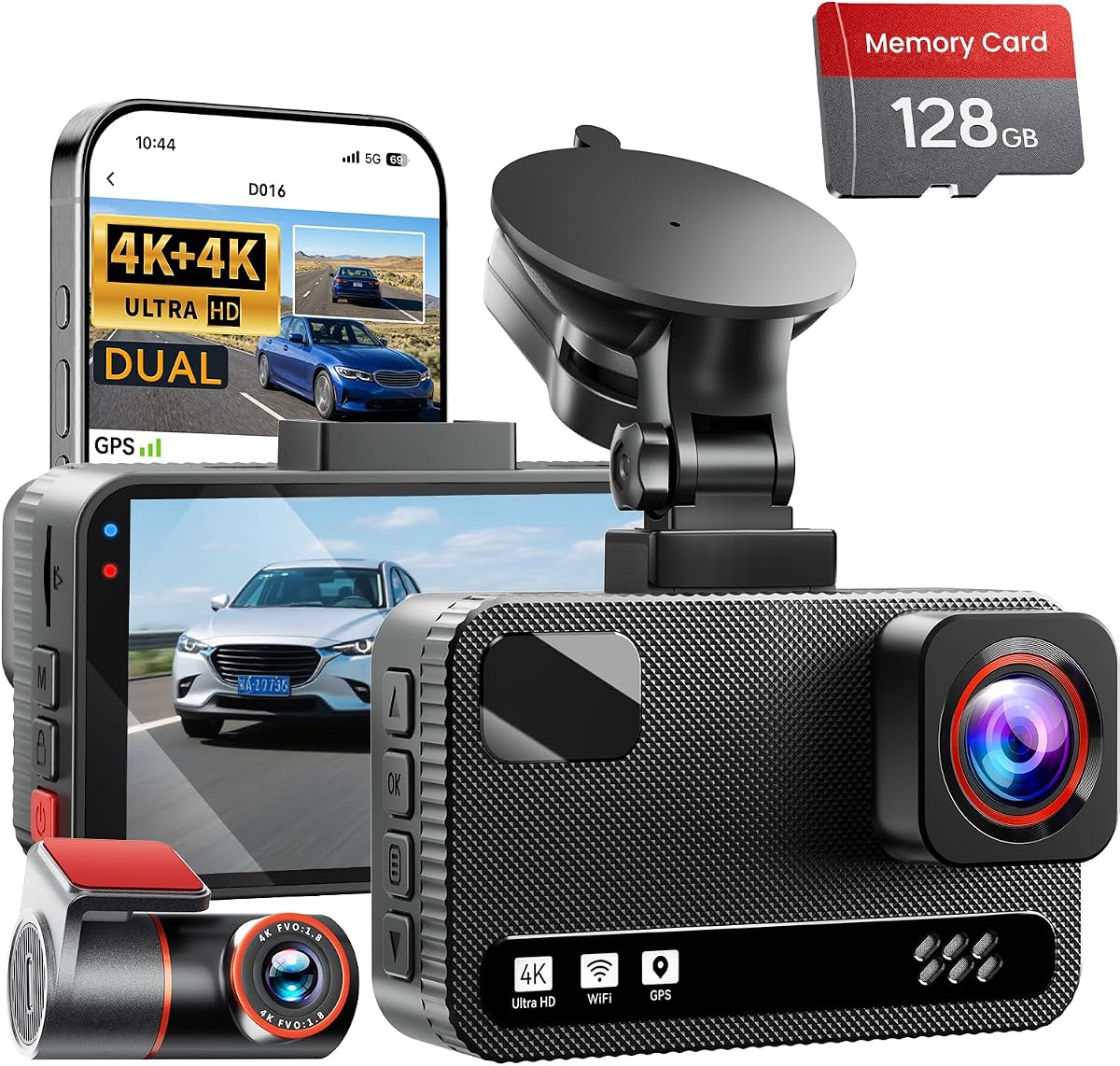
The 4K+4K IPS Dash Cam is a clean, approachable two-camera system with a 4.9 rating. It records 4K through both the front and rear cameras, includes a 128GB card, and adds built-in GPS plus 5.8GHz Wi-Fi, covering most of the essential needs of a modern dash cam without a screen-free minimalist design.
We may earn a commission when you buy through this link, at no additional cost to you.
The three-point-nine-inch IPS display helps with setup, live viewing, playback, and camera-angle adjustment. An F1.8 lens supports clearer road images, while 5.8GHz Wi-Fi allows live preview, video playback, downloads, clip saving, and sharing without repeatedly removing the memory card. GPS overlays route, speed, and location data onto trip recordings.
Loop recording automatically replaces older unlocked files, and the G-sensor helps preserve footage associated with an impact. Parking Monitor and Time-Lapse recording require a compatible hardwire kit sold separately. Compared with models using an F1.5 aperture, the F1.8 design is not the most aggressive low-light option, although 4K resolution can still preserve useful detail.
This camera is well suited to ordinary drivers who want front-and-rear 4K, a visible screen, and straightforward phone connectivity. It is also a logical choice for anyone comparing the value of a simple dual-channel package with the additional coverage and complexity offered by three- and four-camera systems.
The IPS display provides a practical way to check camera angles, confirm recording status, and review footage before transferring files. It balances the dashboard clutter associated with screen-free models against the convenience of direct control.
Recording route, speed, and location alongside the image gives each trip additional context. That information can make footage easier to organize and potentially more useful when reconstructing an incident.
We may earn a commission when you buy through this link, at no additional cost to you.
The right dash cam depends on the coverage you need, the lighting conditions you drive in, and how you intend to access and protect recordings. Resolution is important, but sensor quality, storage support, parking operation, and installation should be considered together.
Resolution determines how much visual detail a recording can preserve, making 4K front footage useful when license plates, road signs, lane markings, or distant traffic need to be examined. However, resolution alone does not guarantee clarity. Sensor size, aperture, HDR, WDR, lens quality, and low-light processing all influence the final image. Two 4K channels are more balanced than a 4K front paired with a low-resolution rear when both directions are equally important.
Also distinguish native 4K from upscaled 4K. The ROVE R2-4K Dual’s front channel records at 2.5K and upscales to 2160P, while the AProX and 4K+4K systems list true 4K front and rear output. Choose based on the desire for detail, file size, storage capacity, and realistic nighttime performance.
Night footage should be judged by more than whether it appears bright. A sensor such as STARVIS 2 can improve sensitivity, while a wider aperture such as F1.5 or F1.6 gathers more light than an F1.8 lens. WDR and HDR help balance headlights, illuminated signs, and dark roadside areas. Cabin cameras may also include infrared lights for recording inside a dark vehicle.
For frequent night driving, favor a model that combines a capable sensor, wide aperture, HDR, and WDR. For rideshare work, interior infrared coverage can be more valuable than adding resolution to a rear camera. Review sample footage when possible and consider the camera’s stated performance in tunnels, rain, dusk, and oncoming headlight glare.
A single front camera is simple, compact, and often sufficient for general road evidence. A front-and-rear system provides coverage of a vehicle approaching from behind, making it the more balanced choice for commuting and road trips. Three-channel systems add an interior camera, which can be valuable for rideshare drivers and families. A four-channel system records front, rear, left, and right simultaneously for the broadest spatial awareness.
More cameras add information but also mean more cables, more installation decisions, more heat to manage, and more storage demand. Choose the channel count based on the situations you actually need to document rather than on the number alone. Flexible models that let you switch between triple and dual modes can provide a useful compromise.
Parking mode typically uses time-lapse recording, motion detection, or collision detection while the vehicle is unattended. Many of the listed cameras include these functions, but nearly all require a compatible hardwire kit sold separately. A hardwired connection allows the camera to continue recording after the engine is switched off, subject to the vehicle’s power system and installation requirements.
Look for buffered recording if you want footage from immediately before an impact or motion event. A front proximity sensor can also help reduce unnecessary parking clips. Before installing, review the vehicle’s fuse layout, parking-mode requirements, and local guidance on dash cam operation. Professional installation may be worthwhile in vehicles with complex electrical systems.
Higher-resolution and multi-channel recording consumes more storage, so memory-card capacity and maximum supported size deserve careful attention. Included cards range from 32GB in the galphi model to 64GB in the REDTIGER F17 and XYGCACO system, while several dual-camera products include 128GB. Vantrue supports cards up to 1TB, and ROVE also lists 1TB support.
Use a reliable high-speed card with an appropriate speed rating and format it according to the manufacturer’s instructions. Loop recording extends continuous operation, but it can overwrite older files. Lock event footage promptly, back up important clips to a phone or computer, and periodically check the card for errors because storage media is a consumable component.
Wi-Fi makes a dash cam much easier to use because drivers can preview, download, play back, and share footage without removing the card. Dual-band 5.8GHz and 2.4GHz systems offer a faster path for large video files, with listed speeds ranging from 8MB/s to 20MB/s depending on the model. Wi-Fi 6 adds a newer connectivity standard in the AProX system.
Built-in GPS records route, speed, and location information directly with the video. This metadata can help establish where a trip occurred and support later review. Consider whether the app is compatible with your phone, how footage is transferred, and whether the camera offers firmware updates over the air. A physical display or buttons can remain useful when hands-free phone operation is inconvenient.
The best dash cam is one you can mount securely without blocking the driver’s view or interfering with airbags and visibility. Many of the listed systems use a windshield suction mount, while the ROVE includes multiple mounting pieces and a trim tool. Compact screen-free designs reduce visual clutter, whereas models with a three-inch or larger IPS display are easier to operate directly.
Check whether cables can be routed neatly along the windshield pillar and headliner. A rear camera requires a longer cable run, and three- or four-channel systems add additional branches. Review the included accessories before buying, and avoid improvised power cables or poorly fitting mounts that could result in an unreliable connection or obstructed view.
Dash cams operate in vehicles that can become extremely hot, especially while parked. Models with a supercapacitor are designed to manage heat more reliably than units relying on a conventional lithium battery. The ROVE, REDTIGER F7NP, REDTIGER F17, and Vantrue N4 Pro S all list supercapacitor-based power designs. The AProX also states that its construction is designed for heat and cold resistance.
A dual-channel mode can reduce heat and power use, as the Vantrue N4 Pro S offers in its front-and-rear configuration. Parking mode also demands stable low-power operation. Keep the camera out of direct sun when it is not recording, inspect cables and cards for damage, and follow the manufacturer’s guidance about heat, power sources, and firmware updates.
Begin by reading the product-specific manual, checking the included components, and confirming that the memory card is properly seated. Mount the front camera in a clear portion of the windshield, keep it within the driver’s permitted line of sight, and ensure it does not interfere with an airbag. Route the power cable along the pillar and headliner so it cannot obstruct controls or create a loose hazard.
For a multi-camera model, position the rear camera to cover the intended direction and mount the cabin camera where it does not obscure the driver or passengers. Connect the power source, format the card if instructed, and test both live view and recording before beginning a trip. Confirm the date, time, GPS data, loop-recording behavior, and app connection so timestamps and metadata are meaningful later.
During routine use, leave the dash cam powered in the appropriate recording mode, avoid touching the lens, and keep the windshield area clean. Review footage regularly, save or back up important clips, and clear storage when necessary according to the manual. For long-term reliability, inspect mounts and cables, keep the card slot free from dust, use recommended charging accessories, and update firmware when the manufacturer provides a verified release.
No. Resolution is only one part of image quality, and sensor size, aperture, HDR, WDR, and lens design also affect the result. A 4K camera that is upscaled from a lower-resolution source may not outperform a well-equipped 1080P model, particularly at night. Match the recording specification to the camera sensor and prioritize balanced front-and-rear coverage when both directions matter.
A front-and-rear system is the most balanced choice for ordinary driving because it records the road and vehicles approaching from behind. A single front camera is simpler and more compact, which may suit basic evidence collection. A three- or four-channel system adds cabin and side views, making it more relevant to rideshare work, family monitoring, and broader blind-spot awareness.
Use a reliable high-speed microSD card with a capacity supported by the camera and a speed rating appropriate for 4K or multi-channel recording. The galphi listing specifically recommends Class 10, U3, and V30 or higher for extended use. Format the card as instructed, inspect it periodically, and replace it if recording reliability declines or errors appear.
Most of the models in this guide support parking surveillance, but almost all require a compatible hardwire kit sold separately. Depending on the model, the camera can use time-lapse recording, motion detection, collision detection, or a combination. A hardwired parking installation should follow the vehicle manufacturer’s fuse and electrical guidance.
The listed products generally support both Android and iOS through their respective apps, but compatibility and firmware should be verified before purchase. Wi-Fi makes previewing, downloading, and sharing easier, yet the camera remains fully functional as a recorder when the phone is not connected. A physical screen or buttons can help with basic setup and event locking.
A supercapacitor is generally better suited to the heat conditions inside a parked vehicle and is designed to provide more reliable power management than a conventional lithium battery. Several models here use that design. It does not eliminate the need for a stable hardwire connection, and parking mode still requires the appropriate kit.
Save important clips to a phone, computer, or cloud service as soon as possible, and do not rely on the card indefinitely. Loop recording may overwrite ordinary files when storage is full, while G-sensor locks help protect detected impact footage. Keep the card and firmware current, and periodically verify that the app can retrieve locked files.
Mount the camera high enough to capture a useful road view without blocking the driver’s sightline or interfering with an airbag. Clean the glass before attaching the suction cup, and route cables along the windshield edge and pillar. Test the view in both daylight and darkness because a position that looks clear while parked may capture glare or reflections on a night drive.
The AProX 3-Channel Dash Cam is the most complete all-round choice here, combining true 4K front and rear video, an infrared cabin camera, dual-band Wi-Fi 6, and a 4.8 customer rating. The galphi 4K Dash Cam represents the best budget-oriented route, while the Vantrue N4 Pro S is the premium pick for flexible three-camera recording and low-light plate detail.
For most drivers, a front-and-rear system with a capable low-light sensor, loop recording, and a reliable card offers the best balance of usefulness and simplicity. Add a cabin camera for rideshare or family use, consider four directions when blind-spot awareness is the priority, and verify the extra cost and installation requirements of parking mode before making a final choice.
Prices, promotions, bundle contents, and availability can change, so confirm the current product listing before purchasing. Check the camera’s supported card capacity, required hardwire kit, app compatibility, and included accessories. Those details can materially change the value of a package, even when the headline resolution looks similar.