
Portable WiFi Hotspot for Travel
5.0Editor score
5GB free US data
Up to 10 devices
3000mAh rechargeable battery
Automatic 4G network switching
Our expert guide compares 10 no contract WiFi hotspot options across global coverage, included data, battery life, device capacity, and portability for travel.
A no contract WiFi hotspot provides a private, portable internet connection without requiring a traditional phone plan or a long-term carrier commitment. The right device can support travel, road trips, remote work, family connectivity, and temporary backup service while avoiding the setup complexity of roaming and physical SIM cards.
We compared the ten featured hotspots using their stated network standards, geographic coverage, included data, battery capacity, simultaneous device connections, charging features, and ease of management. The list covers global travel devices, North American options, compact models, high-capacity 5G systems, and hotspots designed specifically for RV travel.
Each pick reveals which use case it serves most effectively, from lightweight everyday connectivity to 5G performance for demanding groups. Product details and availability can change, and current prices fluctuate, so readers should verify the latest plan terms, coverage, activation requirements, and data expiration dates before purchasing.
5.0Editor score

5.0Editor score

4.5Editor score
The comparison below highlights the major differences among all ten hotspots, including their connection technology, included data, supported device count, and battery capacity. These specifications make it easier to identify the option that matches your destination, trip length, and number of connected users.




The SIMO Solis Hero combines a 4G mobile hotspot with a 5250mAh power bank, giving it a practical advantage over conventional travel routers. Its 4.0 rating reflects a generally useful package, and the standout features are the ability to share connectivity with up to ten devices, automatic SignalScan carrier selection, and broad international availability across 140 countries and more than 300 carriers.
We may earn a commission when you buy through this link, at no additional cost to you.
The most distinctive element is the integrated power bank. That extra capacity can help recharge a phone or other electronics while the hotspot is being carried, making it especially useful for long travel days, camping, and road trips where every bit of battery capacity matters. The recurring 1GB monthly allocation is also helpful for light use, while the separate 30GB pack offers more room for heavier activity during its limited validity period.
SignalScan reduces the need to manually research or select local carriers, while the absence of a physical SIM and locked contract makes the device attractive to international travelers. As a 4G product, however, it is better suited to ordinary browsing, messaging, navigation, and moderate streaming than users who want the highest possible throughput in areas with 5G service. The one-time global allowance also expires after 30 days, so it should not be treated as an unlimited monthly allocation.
Choose the Solis Hero if you value a hotspot that doubles as a charger and need dependable global access without a conventional SIM. It is a particularly compelling option for families, backpackers, and road travelers who want ten-device support and recurring data without an extended carrier commitment.
The integrated 5250mAh power bank separates the Solis Hero from a basic pocket hotspot. It can keep the connection available longer while also providing backup charging for a phone, making the device more useful during extended journeys.
SignalScan automatically searches across mobile carriers and selects a stronger available signal. This reduces setup friction for travelers, particularly when crossing borders or moving between areas served by different networks.
We may earn a commission when you buy through this link, at no additional cost to you.
The M5 Mobile Hotspot is a compact prepaid travel router with a 5.0 rating, support for up to ten devices, and service advertised across more than 160 countries. Its key appeal is the combination of 1GB of monthly global data with prepaid plans available by day, week, or month, allowing travelers to choose a package that corresponds more closely to the length of their itinerary.
We may earn a commission when you buy through this link, at no additional cost to you.
The device automatically switches among major local 4G networks to find a stronger signal, which can be valuable in unfamiliar destinations. It also supports a physical-SIM-free setup and emphasizes the absence of contracts, so users are not tied to a recurring service agreement. Quick Type-C charging and a 3000mAh battery add to the travel-oriented design, although the stated maximum use time of approximately six hours means it is better aligned with half-day outings than all-day expeditions.
Users can connect phones, tablets, and laptops for browsing, video calls, and file sharing, while the included security features are intended to provide a more private alternative to open public WiFi. One limitation is explicitly noted in the product information: an inadequate local signal can prevent the hotspot from registering on the network. That is a limitation of cellular coverage generally rather than a flaw unique to this model, but travelers should check local network compatibility before relying on it.
The M5 is an excellent general travel choice for readers who want recurring global data, flexible prepaid plans, and a pocket-friendly device that can serve a small group. It stands out for its 5.0 rating and broad stated country coverage, making it our Editor's Choice for the category.
The combination of daily, weekly, and monthly options offers more control than a rigid long-term subscription. The permanent 1GB monthly allowance covers basic connectivity, while larger prepaid packages can support more data-intensive travel days.
At a stated maximum of six hours of non-stop use, the M5 fits easily into a small bag or pocket. Its Type-C charging interface also makes it convenient to top up using a compatible power bank or charger.
We may earn a commission when you buy through this link, at no additional cost to you.
This Portable WiFi Hotspot for Travel has a 5.0 rating and offers a balanced set of features for domestic trips, group travel, and RV outings. It creates a private network for up to ten devices, uses an eSIM-based setup with no physical card, and automatically connects to major US carrier and Mexico networks. A 3000mAh rechargeable battery and Type-C charging keep the core package approachable.
We may earn a commission when you buy through this link, at no additional cost to you.
The generous device capacity makes it useful for families or groups carrying several phones, tablets, and laptops. Rather than depending on public WiFi in airports, malls, campsites, and crowded tourist areas, users can establish their own secured connection. The product information also positions it for streaming, navigation, remote work, and online learning, although actual performance will depend on cellular coverage and the selected data plan.
The included 5GB of US data gives users a useful starting allowance, and the lack of a physical SIM or long-term contract keeps setup straightforward. Its 3000mAh battery is stated to provide up to six hours of continuous use, so travelers on extended journeys should carry a charger. It is also more geographically focused than the global models on this list because its automatic network selection specifically mentions major US carrier and Mexico networks.
This is our Best Budget pick for readers who primarily need reliable 4G service in the United States or Mexico, want to connect a sizable group, and prefer a simple prepaid arrangement. It delivers the most balanced combination of device capacity, included data, portability, and ease of use in this roundup.
Supporting up to ten simultaneous connections makes this model practical for families and small travel groups. Everyone can use the hotspot for navigation, messaging, browsing, or light streaming without each person needing a separate cellular data plan.
The device connects without a physical SIM card and selects among available US and Mexican networks. That arrangement makes activation and cross-network operation more approachable for travelers who do not want to manage local SIM purchases.
We may earn a commission when you buy through this link, at no additional cost to you.
The Global Pocket WiFi Hotspot, also described as the T8, combines 4G LTE connectivity with an unusually generous starting allocation of 10GB preloaded US data. Its 4.5 rating reflects a strong overall package, while the ability to operate across more than 140 countries, connect eight devices, and provide up to 15 hours of continuous use makes it a strong choice for international travel.
We may earn a commission when you buy through this link, at no additional cost to you.
The eSIM or vSIM approach removes the need to purchase and insert local SIM cards. Once the preloaded allowance is depleted, an app allows users to purchase flexible data plans, monitor usage, and manage network settings. This combination of immediate connectivity and app-based control gives the product a more polished travel experience than a device that requires repeated manual configuration.
Its 3500mAh battery and 100-gram weight strike a useful balance between endurance and portability. The device can support calls, streaming, browsing, and productivity for several connected users, while its access to more than 300 global carriers is intended to improve the chances of finding usable local service. The eight-device maximum is lower than the ten-device limits offered by several competitors, but it remains adequate for a typical family or business travel party.
The T8 earns our Best Premium designation because it balances extensive global access, a useful app, long stated battery life, and a substantial included data allowance. It is especially well suited to international travelers who want immediate service and plan management without handling physical SIM cards.
The 10GB preloaded US allowance allows users to begin browsing, navigating, and communicating without an initial top-up. Additional plans can be purchased when the included data is consumed, which adds flexibility for longer trips.
A companion app provides data monitoring, network settings, and plan purchasing. Managing these functions from a phone is particularly convenient when a traveler needs to check usage or change coverage options without carrying additional equipment.
We may earn a commission when you buy through this link, at no additional cost to you.
The SIMO Solis Edge is a lightweight 5G and WiFi 6 hotspot aimed at travelers who want newer wireless technology without a locked contract. Its 4.0 rating is complemented by a 78.8-gram body, global access across 140-plus countries and 300-plus carriers, and a battery described as lasting multiple days.
We may earn a commission when you buy through this link, at no additional cost to you.
The combination of 5G mobile service and WiFi 6 can be valuable for users who need faster downloads, responsive browsing, video calls, or more demanding work while away from a fixed connection. SignalScan automatically searches for the strongest available mobile signal, reducing the need to intervene when local network conditions change. The device is also highlighted for RVs, campers, motorhomes, and road trips.
Its lightweight construction makes it easy to carry, but the actual battery duration will vary with signal quality, device count, and activity. It also connects users to a shared cellular connection, so performance can decline when many devices are active or the underlying mobile network is congested. The included 30GB global pack is a one-time, time-limited allowance rather than a monthly allotment, while 1GB per month provides the recurring baseline.
The Solis Edge suits a traveler who prioritizes compact 5G capability and global signal selection. It is a stronger fit than basic 4G routers for users handling large files, remote work, or connected entertainment, provided they purchase sufficient data and understand that shared cellular performance varies by location.
5G service paired with WiFi 6 provides a more advanced foundation for remote work, streaming, and large downloads. These capabilities make the Edge appealing when a trip involves more than light browsing and messaging.
Weighing 78.8 grams, the Edge is among the lightest full-featured models listed here. Its compact form and multi-day battery claim are well suited to travelers who want to carry the hotspot every day without giving up international access.
We may earn a commission when you buy through this link, at no additional cost to you.
The S2 Portable WiFi Hotspot is designed for users across North America and has a 4.0 rating. It combines 4G LTE with WiFi 6, supports up to eight simultaneous devices, and arrives with 10GB of complimentary data. A built-in display provides at-a-glance information about remaining data, while recurring 2GB monthly data can roll over when unused.
We may earn a commission when you buy through this link, at no additional cost to you.
This is a compelling arrangement for road trips, camping, remote work, and everyday mobile use within its intended region. Users avoid a physical SIM card, carrier restrictions, and long-term commitments. The rollover policy is especially useful for occasional travelers who do not consume a full monthly allowance every month, as the data can remain available for later.
The 15-hour stated battery life and 100-gram weight are useful for full-day activities. Nevertheless, the first use of the monthly 2GB allocation requires activation by contacting the seller, after which future monthly data is added automatically. That first-time setup step is worth understanding before travel, and the device is less directly relevant to trips centered on Europe, Asia, Africa, or other regions outside North America.
The S2 is a strong choice for domestic travelers, long-haul drivers, outdoor users, and remote workers who want recurring data and WiFi 6 without a physical SIM. Its useful display and generous starting package set it apart from bare-bones travel hotspots, while North American coverage is the central limitation.
The recurring 2GB monthly allocation can be retained when it is not used, avoiding the pressure to consume every megabyte before the next billing cycle. This is helpful for users whose connectivity needs vary from month to month.
A built-in display shows real-time data information, which offers a quick way to check remaining service without opening an app. That convenience is useful for travelers and drivers who keep the device in a bag or pocket.
We may earn a commission when you buy through this link, at no additional cost to you.
The FREEBOT WiFi 6 Mobile Hotspot is a compact, contract-free travel router intended for short trips and light connectivity. It includes 1GB of global data valid for 30 days, supports up to eight devices, and uses 4G LTE with WiFi 6. No customer rating was supplied for this product, so its evaluation here relies on the stated features rather than a numerical customer score.
We may earn a commission when you buy through this link, at no additional cost to you.
Its strongest advantage is simplicity. There is no physical SIM to insert, no activation step before the preloaded data can be used, and no long-term agreement. The device is described as credit-card size and featherlight, making it a natural fit for a passport pouch, jacket pocket, or small carry-on. The 1GB allowance is sufficient for maps, navigation, messaging, email, and selected social media activity when used deliberately.
Users can top up or upgrade through the FREEBOT app when the initial data runs out, which prevents the included allocation from limiting longer trips. However, heavy video, frequent high-resolution uploads, or sustained hotspot use could require a larger plan. The product information does not provide a specific continuous-use battery figure, so travelers who depend on all-day service should investigate current runtime details and carry a suitable charging method.
The FREEBOT is a sensible option for a weekend getaway, airport layover, short business trip, or backup connection when occasional access is enough. Its pocket-friendly construction and no-contract arrangement make it approachable, while the small starting package means buyers should match their data expectations carefully.
The credit-card-sized body is easy to carry without taking up meaningful luggage space. It is particularly useful for travelers who need secure internet for navigation, messaging, and email rather than continuous media streaming.
The preloaded data provides immediate service, and the app allows users to purchase more when necessary. This structure avoids a long-term agreement while preserving the option to expand usage during a longer journey.
We may earn a commission when you buy through this link, at no additional cost to you.
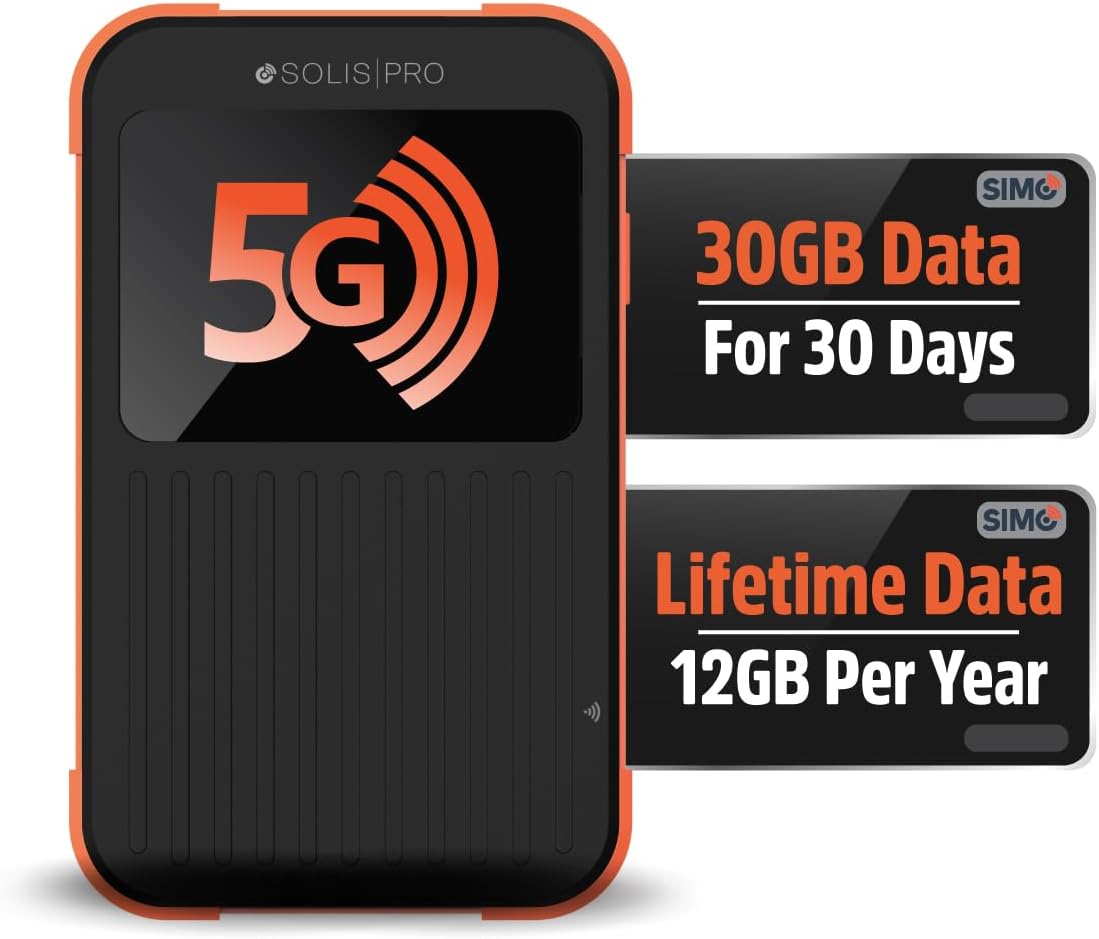
The SIMO Solis PRO is a high-capacity 5G hotspot and power bank for groups that need to connect many devices at once. Its 3.8 rating is the lowest among the products with numerical ratings, but the feature set is substantial: 5G service, WiFi 6E, support for up to 20 devices, an 8000mAh integrated power bank, and global access across 140 countries and more than 300 carriers.
We may earn a commission when you buy through this link, at no additional cost to you.
The 20-device limit is the device's defining advantage. It can support a larger family, work group, camper, or mobile office than nearly every other model in this guide. The large power bank adds resilience during extended trips and can serve as a backup source for connected phones. SignalScan automatically searches across carriers for a stronger signal, helping the hotspot adapt as the user moves through different locations.
This power comes with trade-offs. The 8000mAh battery and larger feature set make the PRO less pocket-friendly than a basic travel router, and its 4G competitors may be sufficient for users who only need browsing and messaging. Actual 5G performance depends on local coverage, plan allowances, and the number of active devices sharing the connection. The recurring 1GB monthly data is modest, while the one-time 30GB allowance is intended for a more data-intensive initial period.
The Solis PRO is most appropriate for large groups, RV travel, remote teams, or households that regularly connect many devices. Buyers should confirm that they can comfortably carry its size and that their data plan can support simultaneous use before choosing it over a lighter 5G alternative.
Supporting up to 20 devices creates a private WiFi network for large families, campsites, business groups, or travel parties. It is particularly useful when many people would otherwise need individual cellular plans.
The 8000mAh integrated power bank is the largest battery specification among the listed hotspots. It can support prolonged operation and provide reserve charging capacity, though the extra hardware makes the device less compact.
We may earn a commission when you buy through this link, at no additional cost to you.
The NomadsFi PocketFi 5G is a feature-rich mobile hotspot with a 4.4 rating and one of the largest starting data allowances in this guide. It includes a one-time 50GB US starter pack, supports 5G and 4G LTE, and can share connectivity with up to 16 devices. A 2.4-inch LCD touchscreen provides visibility into signal, data, connected devices, and network settings.
We may earn a commission when you buy through this link, at no additional cost to you.
The device is powered by a Qualcomm chipset and supports download speeds stated up to 2.5Gbps. Automatic carrier switching chooses an available network based on the active plan and local coverage. CloudSIM Smart Connect allows access to carriers without a physical SIM, and the 2.4GHz and 5GHz bands give connected users more than one WiFi option for different devices and conditions.
A 5400mAh battery is stated to deliver up to 16 hours, with USB-C charging, USB networking, and operation while plugged in. These features make it useful as a travel router, RV connection, remote-work system, rural home internet option, business backup, or monitoring connection. Its 6.8-ounce weight remains manageable, although the touchscreen and 5G hardware make it more substantial than a minimal 4G unit.
The 50GB starter pack gives users considerable room for navigation, streaming, updates, and work, but it is a one-time pack rather than a recurring monthly allowance. International coverage is available through plan choices across more than 200 countries, so the U.S.-oriented starter pack should be considered in the context of the complete service plan. The PocketFi is a strong premium-performance choice for users who value capacity and controls.
The 50GB US starter pack offers far more included capacity than most competitors in the list. It gives users time to evaluate real-world performance without immediately purchasing a larger recurring or international package.
The 2.4-inch touchscreen puts signal information, data consumption, connected-device status, and WiFi credentials in one place. This is useful when managing a network without relying entirely on a phone-based app.
We may earn a commission when you buy through this link, at no additional cost to you.
The TravlFi JourneyGo 5G is specifically designed for RV travelers, campers, and motorhome users. Its 3.3 rating is the lowest numerical score in the roundup, but its specialized feature set is clear: 5G service with 4G and LTE fallback, up to 24 hours of stated battery life, support for 16 devices, a touchscreen, and multi-network TowerSync technology.
We may earn a commission when you buy through this link, at no additional cost to you.
Automatic fallback is important for road travel because 5G coverage can disappear abruptly in rural areas, mountains, or campground locations. TowerSync intelligently connects to the strongest signal across multiple major networks, reducing the chance that a user will need to manually intervene. The touchscreen shows connected devices, data usage, and network status while allowing users to trigger TowerSync directly.
The stated broadcast range of 75 to 100 feet is designed to provide service around a vehicle, campsite, or RV. The device can support laptops, phones, tablets, and smart devices, making it practical for remote work and entertainment during a journey. Flexible month-to-month plans contain no pause fees, which is useful for owners who use the hotspot only during travel periods.
The JourneyGo is a specialized choice for RV and camper users who value automatic network selection and 4G fallback over pocket-sized portability. Its physical design and battery target are less relevant to lightweight travelers, but for its intended market it provides a focused and understandable solution. Buyers should confirm cellular coverage along their planned route and review the current plan structure before departure.
TowerSync seeks the strongest available signal across major networks, while automatic 4G and LTE fallback helps maintain connectivity when 5G is unavailable. These features are especially relevant along changing rural and highway routes.
Month-to-month plans without pause fees align with travel schedules that vary throughout the year. The device can create a private network for travel, work, entertainment, and smart-home devices around the vehicle.
We may earn a commission when you buy through this link, at no additional cost to you.
Choosing a no contract WiFi hotspot involves balancing destination coverage, included data, connection capacity, battery life, portability, and management features. The right balance depends on whether you need light access during occasional travel or high-performance service for a group every day.
Choose broad global coverage for international trips and a regional device for trips confined to its intended market.
Choose 5G for demanding multi-device use and 4G when affordability, battery life, and broad compatibility matter more.
Match the included allowance to realistic usage and confirm how quickly it expires or how additional plans are purchased.
Count every phone, tablet, laptop, camera, console, and smart device that may connect at the same time.
For all-day travel, favor a longer runtime or carry a compact charging solution that matches the hotspot's port.
Match physical size to the trip: prioritize pocketability for air travel and compact storage for road or RV use.
Complete activation before leaving and learn the data-management workflow while reliable WiFi is still available.
Use a unique password, maintain updates, and periodically review the list of connected devices.
Begin by fully charging the hotspot with the recommended cable, then confirm that any recurring service or preloaded data has been activated. If the listing specifies a first-time activation step, complete it before travel. Power on the device, connect a phone or laptop to its WiFi network using the displayed name and password, and confirm that the indicator or management app shows an active cellular connection.
For day-to-day use, monitor remaining data and connected clients from the built-in display or official app. Avoid unnecessary high-volume activity when the allowance is limited, and pause large downloads when the network is busy. Keep the device away from direct heat, moisture, and unsecured luggage. Carry the compatible charging cable and a compact power bank for long travel days, particularly if the hotspot does not operate while plugged in.
Before an international trip, verify destination coverage, roaming or global-plan requirements, data expiration, and automatic network behavior. Save the WiFi password offline in case the screen or app is unavailable. At the end of each day, disconnect unnecessary clients and power the hotspot down if it will be stored for a long period. For extended travel, checking the manufacturer's current setup guidance and firmware updates can prevent avoidable activation or compatibility issues.
A no contract WiFi hotspot is a portable router that creates a private wireless network using cellular data. It usually avoids a traditional phone contract and may use a physical SIM, eSIM, vSIM, or cloud-based carrier activation. Plans are often prepaid or available on a month-to-month basis, allowing users to change or discontinue service without a long-term commitment.
It depends on the model's supported countries and the plan attached to the service. Several featured devices advertise global access across 140 to 200-plus countries, while others are limited to North America. Travelers should check the destination list, required international package, expiration rules, and any restrictions on particular carriers before relying on a hotspot abroad.
Most devices in this roundup are designed to operate without a physical SIM. They use eSIM, vSIM, or cloud-based carrier connections to select networks automatically. Some hotspots may still offer physical-SIM options, but the products described here emphasize prepaid, contract-free activation with less need to purchase and insert a local card.
Connection capacity ranges from eight to 20 devices across the featured products. A limit of eight is adequate for a small family or compact travel group, while 10 to 16 devices suits larger parties and connected work setups. The Solis PRO supports 20 connections. More active devices share the same cellular data allowance, so a larger limit may reduce per-device performance.
Yes, provided the selected plan contains sufficient data and the local network provides adequate speed. A 5G model with WiFi 6 or WiFi 6E is generally more suitable for video calls, large files, streaming, and remote work than a basic 4G unit. Users should watch data consumption, connection limits, and network congestion when several devices are active.
A 5G hotspot can deliver higher theoretical speeds and better performance in locations with strong 5G coverage, while a 4G model generally costs less and may be easier to carry. Real-world results depend heavily on signal strength, local network availability, congestion, and the plan chosen. Travelers should not assume every listed country provides equal 4G or 5G performance.
Stated usage ranges from about six hours for the M5 and US-oriented travel hotspot to 15 or 16 hours for several compact models and up to 24 hours for the JourneyGo. Actual runtime changes with connection count, signal quality, screen use, and workload. Models with integrated power banks can also recharge phones and other electronics.
A properly secured private hotspot can reduce some risks associated with open public networks, but it is not automatically risk-free. Use a strong WiFi password, avoid unknown connected devices, keep software updated, and use a VPN for sensitive work when appropriate. A cellular connection may also mask the IP address of connected devices, though it does not replace other security practices.
The M5 Mobile Hotspot is the most well-rounded editor's choice because it combines a 5.0 rating, recurring global data, flexible prepaid plans, and support for ten devices. The US-oriented Portable WiFi Hotspot is a strong budget selection with 5GB of starting data and the same ten-device capacity, while the Global Pocket WiFi Hotspot is the premium travel pick with 10GB preloaded, app management, and broad international access.
Your priorities should guide the final decision. Choose 5G and a large battery for demanding work or streaming, 16 to 20 connections for bigger groups, a built-in power bank for extended travel, or a regional model for trips limited to North America. Carefully compare included data, expiration dates, activation steps, destination coverage, and the number of devices you expect to connect before finalizing a purchase.
Finally, recheck current pricing, service-plan details, availability, activation instructions, and travel coverage before ordering. Cellular performance and local carrier access can vary, and promotional bundles may change. Choosing a hotspot that fits both your destination and your expected data use will provide the most dependable no-contract experience.