
RV Cell Phone Signal Booster Car Truck RV
4.4Editor score
65 dB maximum gain
Eight supported cellular bands
All major US carriers
Multiple users and devices
Explore the best 4G and 5G booster for RV options, comparing carrier support, signal gain, antennas, installation, power needs, coverage, and mobile versus
A cellular booster can make an RV trip more comfortable by improving calls, navigation, streaming, and hotspot performance where carrier coverage is weak. The best 4G and 5G booster for RV is not simply the most powerful unit; it must support your carrier, fit your travel style, and work with an outdoor antenna positioned to receive a usable signal.
This guide compares ten boosters for mobile, parked, and mixed RV use. We evaluated the supplied specifications, including supported carriers and bands, maximum gain, antenna design, installation requirements, power options, app support, and stated coverage, while noting important incompatibilities and setup limitations.
Each review explains who the product is best suited for, where it fits into the comparison, and which compromises deserve attention. The leading choices include a versatile vehicle-oriented model, a feature-rich travel system, and a rugged premium booster, while prices and carrier network conditions can change over time.
4.4Editor score
4.4Editor score

4.2Editor score
The comparison below highlights the main differences among these ten RV signal boosters, including their gain, antenna systems, carrier compatibility, power approaches, and best-fit use cases.


This vehicle-focused booster earns the Best Budget badge because it combines 65 dB of gain, eight cellular bands, and compatibility with major US carriers in a package designed for RV travel. Its 4.4 rating reflects a generally favorable customer response, while the supplied details indicate support for phones, tablets, hotspots, and other cellular-connected devices. The broad band selection is particularly useful when a travel route crosses different carrier networks.
We may earn a commission when you buy through this link, at no additional cost to you.
The core strengths center on versatility. Supported bands include 2, 4, 5, 12, 13, 17, 25, and 66, giving the system opportunities to work across Verizon, AT&T, T-Mobile, Straight Talk, Cricket, and U.S. Cellular service. The listing also identifies RV, truck, car, van, SUV, trailer, boat, and motor-home applications, so its installation concept is not tied to a single RV floor plan. Multiple users can use the boosted signal for calls, streaming, browsing, navigation, and hotspot tasks.
There are practical qualifications to consider. The claimed improvement of up to 100X and communication distance of 5–8 miles should be understood as maximum marketing figures rather than guaranteed results, because terrain, tower distance, carrier congestion, antenna placement, and available outdoor signal all affect results. A booster also cannot create cellular service where no usable tower signal reaches the receiving antenna. Buyers should therefore avoid treating the stated range as a promise in every landscape.
Despite those caveats, this is a compelling option for travelers who want one system to cover several major carriers without paying for a specialized stationary kit. It is best suited to RVs that continue moving, camp in varied locations, and need a straightforward plug-and-play arrangement. For most buyers, its combination of carrier breadth, supported bands, automatic gain control, and 65 dB gain makes it an unusually well-rounded entry in this comparison.
Supporting eight bands is valuable for an RV that crosses provider territories. The wide selection can help the unit engage with more available cellular networks, although local carrier deployment and tower access remain decisive. Check that your provider and local network use frequencies included in the stated band list.
Automatic gain control, inactivity mode, and oscillation elimination are useful for a vehicle that repeatedly enters stronger and weaker coverage zones. These features help the system adapt without constant manual adjustment. A careful outdoor antenna position remains as important as the automatic controls.
We may earn a commission when you buy through this link, at no additional cost to you.
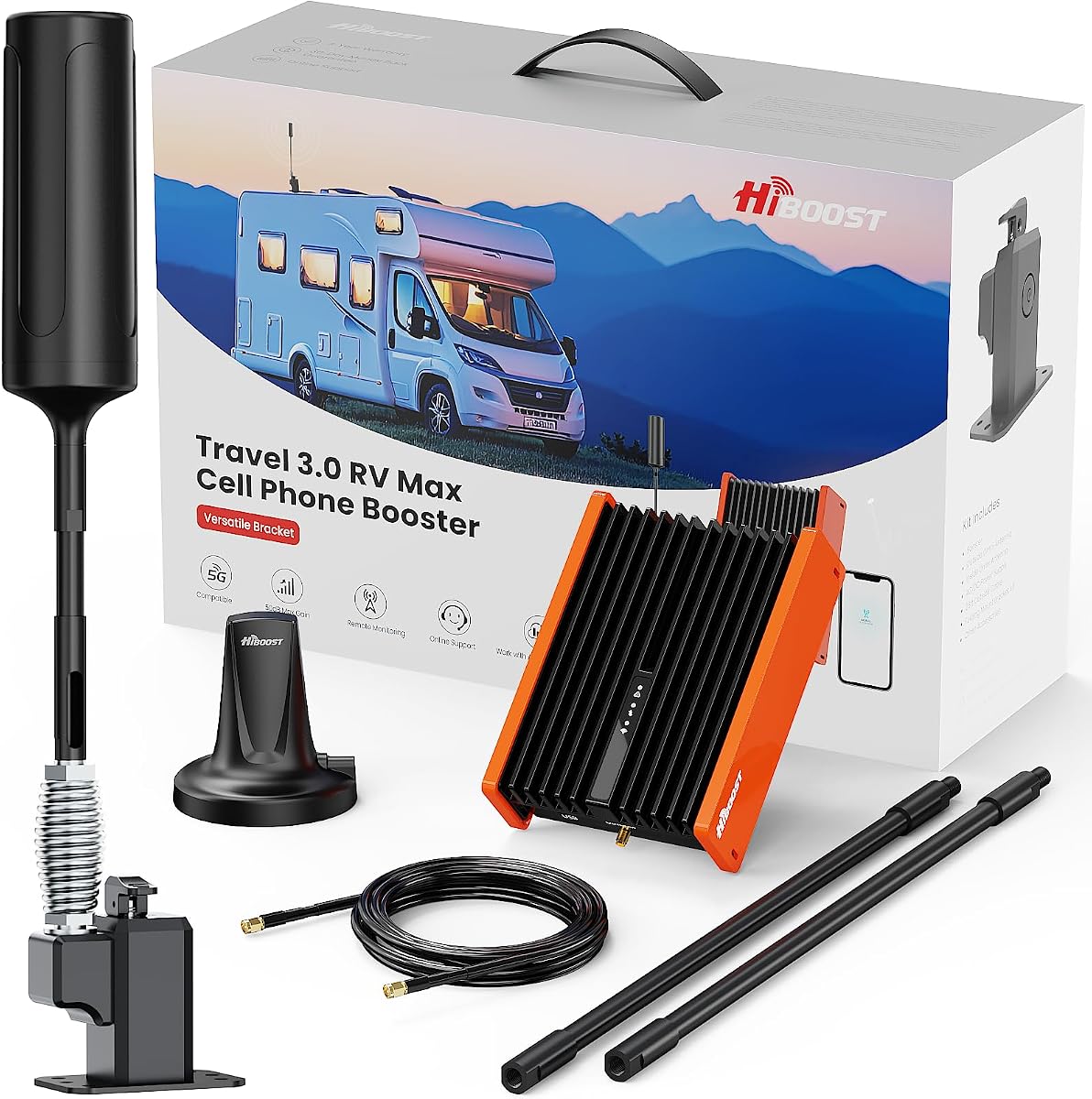
The HiBoost Travel 3.0 RV Max receives the Editor's Choice badge because it addresses the realities of RV signal enhancement more thoughtfully than a generic indoor kit. Its 4.4 rating is joined by a 180-degree foldable outdoor antenna, magnetic 360-degree indoor antenna, app-based monitoring, and support for both 12V vehicle power and standard AC outlets. It is explicitly designed for RVs, vans, and trailers.
We may earn a commission when you buy through this link, at no additional cost to you.
The flexible antenna bracket is the standout feature. Folding the outdoor antenna can make it easier to use under a roof, garage, covered parking structure, or another height-restricted location. Multiple mounting options—including roof racks and poles—let the installer balance clearance and reach. Inside the RV, the omnidirectional magnetic antenna is intended to distribute service through the living space, benefiting several phones, tablets, and connected devices without requiring the system to point at one carrier tower.
The HiBoost app adds practical value by providing installation guides, setup videos, performance monitoring, and troubleshooting assistance. Dual power support also makes the system more flexible than a permanently hardwired installation. Owners can use vehicle power while traveling and an AC outlet when parked, provided the power source matches the supplied equipment. The product is FCC certified, supports major US carriers, and works with 5G and 4G LTE networks.
The main trade-off is that this remains a complete antenna-and-booster system, and an outdoor antenna must still be mounted where it can receive a usable signal. A carefully selected indoor antenna position will also influence how evenly the signal reaches the RV interior. For travelers who value a purpose-built bracket, accessible app support, and flexible power, this is an excellent all-around choice and a particularly strong fit for RVs that alternate between travel and extended parking.
The folding bracket adds practical clearance in locations where a rigid antenna cannot be deployed fully. Travelers can experiment with orientation while driving between covered and open areas. On the roof or a pole, the same hardware supports a more permanent exterior position when needed.
Installation guidance, videos, status monitoring, and troubleshooting in one app can make a complex system easier to understand. The app does not eliminate the need for good antenna placement, but it helps users diagnose common errors and confirm whether the booster is receiving a workable signal.
We may earn a commission when you buy through this link, at no additional cost to you.
This booster holds a 5.0 rating and is among the strongest performers in the guide, offering 70 dB of maximum gain and 17 dBm of maximum output. Its defining technical detail is support for Bands 5, 12, 13, and 17, allowing it to work with major North American cellular networks, including Verizon's 5G Nationwide data signals. It is also compatible with Class A, B, and C RVs, travel trailers, truck campers, vans, destination RVs, and boats.
We may earn a commission when you buy through this link, at no additional cost to you.
Its 70 dB gain makes it appealing for locations where a usable tower signal exists but interior walls, metal construction, or RV layout degrade reception. The system is described as improving voice, text, data, and streaming while also reducing dropped calls and improving audio quality. A bracket and accessories are included, and the listing points users to an app video or manual for installation without requiring professional service.
Band support deserves careful attention. The supplied information explains that practical 5G enhancement is generally available through Dynamic Spectrum Sharing on existing 4G bands, while new millimeter-wave and 600 MHz cellular enhancers are not broadly permitted under the described regulatory framework. Users who require 5G should first confirm that their area has usable 5G service within the supported bands. The smaller band list also means this model is less versatile when travelers move among heavily varied networks.
This is an attractive choice for an owner whose carrier and local deployment align with Bands 5, 12, 13, or 17 and who wants substantial gain for an RV or fixed location. Its perfect listed rating is encouraging, although ratings should not substitute for carrier and frequency verification. For compatible users, the combination of output, gain, certification, and straightforward setup makes this one of the most compelling selections in the comparison.
A booster can only enhance a cellular signal already present on a supported frequency. Confirm that your carrier and local area use one of Bands 5, 12, 13, or 17. This check is more important than the general claim of 5G compatibility.
The stated 70 dB gain and 17 dBm output offer meaningful headroom for weak-but-usable outdoor signals. Metal-sided RVs, travel trailers, and long interior layouts can make that headroom valuable. Placement and antenna separation still determine whether the theoretical performance becomes usable service.
We may earn a commission when you buy through this link, at no additional cost to you.
This home-and-RV booster receives a 3.8 rating and supports Bands 2, 4, 5, 12, 13, and 17, with compatibility listed for Verizon, AT&T, T-Mobile, Sprint, and other networks in the United States and Canada. Its stated maximum gain is 70 dB, and the listing says the device can amplify signals 32X across as much as 4,000 square feet. Those specifications make it relevant to RVs parked for long periods or used in areas where a stronger stationary installation makes sense.
We may earn a commission when you buy through this link, at no additional cost to you.
The setup uses a 360-degree omnidirectional outdoor antenna that receives signals from all directions without requiring precise aiming. That is convenient when the nearest tower position is uncertain or changes with campsite selection. Automatic gain control, manual gain control, and standby mode provide multiple ways to manage the system. FCC approval and support for three network generations add further utility for voice and data use.
The lower 3.8 rating is the main reason this product does not receive a top award. It is also a general home, RV, and metal-building system rather than a purpose-built traveling package, so buyers focused on quick setup and takedown may find a vehicle-specific alternative more convenient. Coverage claims depend on the strength of the incoming tower signal, the layout of the RV or building, antenna placement, and the number of connected users.
For a stationary RV, this can still be a solid option due to its six-band support, 70 dB gain, omnidirectional antenna, and stated coverage. The included 30-day money-back guarantee, three-month replacement offer, technical support, and manufacturer warranty provide some additional reassurance. Compare its band list with your provider's local frequencies before purchasing, particularly if you travel between countries or use a less common carrier.
An omnidirectional outdoor antenna removes the need to point toward a known cell tower. That makes it useful when the RV is parked in several locations or when the carrier's tower direction is uncertain. It may still require repositioning the antenna to find the strongest available signal.
The booster's broad area claim makes it useful for a parked RV, travel trailer, or metal-sided building where users need coverage throughout the interior. A mobile traveler who changes campsites frequently may prefer a kit with folding or magnetic mounting hardware and simpler repeated deployment.
We may earn a commission when you buy through this link, at no additional cost to you.
The weBoost Drive Reach Overland earns the Best Premium badge because it is a purpose-built system for off-road vehicles rather than a general home booster adapted for travel. It combines a booster, rugged outdoor antenna, and versatile mounting bracket while supporting 5G and 4G LTE service across all major US carriers, including Verizon, AT&T, T-Mobile, and U.S. Cellular. Its customer rating is 4.2.
We may earn a commission when you buy through this link, at no additional cost to you.
The construction details distinguish this model in an RV context. A tough outdoor antenna is better aligned with the vibration, dust, branches, and changing weather encountered during overland travel than a basic indoor-style antenna. The included mounting bracket gives the installer flexibility for attaching the system to a suitable exterior point. With 50 dB of maximum gain, the system offers useful amplification without reaching the higher theoretical figures of 70 dB alternatives.
One important limitation is that a 50 dB rating does not translate into a fixed coverage area. The usable result still depends on tower signal strength, distance, terrain, obstruction, and antenna placement. The product's lower 4.2 rating also suggests that customer experiences may vary more than those of the top-rated systems. Nevertheless, the brand's U.S.-based support through app, chat, phone, or email and its two-year warranty add confidence for buyers who want established assistance.
This booster is best for off-road RV travelers, overlanders, and boaters who place a premium on a rugged, integrated package. It is also a logical choice for owners who expect regular exposure to dust, vibration, and branches and would rather use a bracket designed for that setting. For a primarily parked RV, a directional stationary model may provide a more efficient antenna strategy, while this system offers a stronger all-terrain identity.
The outdoor antenna and mounting hardware are central to the system's off-road positioning. They provide a more travel-oriented package than a fixed indoor system. Secure mounting and effective strain relief are still necessary to protect connections over rough roads.
Support for all major US carriers makes sense for an RV that may pass through territories served by different providers. The network must still be available locally, and the booster needs a usable outdoor signal. Carrier branding alone does not guarantee service in every location.
We may earn a commission when you buy through this link, at no additional cost to you.
This truck and RV booster is built around a 70 dB maximum-gain specification and a 3.9 rating. It supports 3G, 4G LTE, and 5G on Bands 2, 4, 5, 12, 17, and 25, with the supplied details identifying AT&T, T-Mobile, Sprint, and U.S. Cellular as supported networks. It is aimed at highways, campsites, remote routes, and off-road travel where consistent mobile connectivity matters.
We may earn a commission when you buy through this link, at no additional cost to you.
The most significant strength is the combination of high gain and visible installation feedback. A high-resolution LCD shows real-time signal strength, helping the installer identify a stronger outdoor location instead of repeatedly guessing. The compact indoor antenna supports multiple simultaneous users, including phones, tablets, and data modems. Automatic power management and an omnidirectional outdoor antenna add to the travel-oriented design.
The critical limitation is carrier compatibility. Verizon Band 13 is explicitly not supported, and the product information does not present the unit as a general Verizon solution. Buyers who rely on Verizon should not interpret its support for several major networks as blanket compatibility. The stated 5–8-mile range and amplification of up to 100X are also maximum claims that vary with terrain, tower distance, congestion, and antenna placement.
The physical design suits rough travel. The outdoor antenna is described as waterproof, shockproof, wear-resistant, and supported by a flexible spring base. It also includes a 30-day money-back guarantee, three years of repair coverage, and lifetime technical support without a recurring subscription. This is a strong option for AT&T or T-Mobile users who value 70 dB gain, an LCD, and durable hardware, but it is a poor fit for travelers whose connectivity depends on Verizon Band 13.
A real-time signal display helps users compare positions around the RV and identify where the outdoor antenna receives a stronger signal. This feedback is especially useful when the vehicle is near several towers or partly sheltered by terrain. The display assists placement but does not overcome a total lack of carrier service.
The described waterproof, shockproof, and wear-resistant antenna is better suited to frequent mobile installation than a fragile indoor panel. A spring base helps absorb movement and road vibration. Secure the antenna and its cable route carefully so neither becomes a safety or durability concern.
We may earn a commission when you buy through this link, at no additional cost to you.
This HiBoost system has a 4.3 rating and is built for a stated 2,000-square-foot area, making it an interesting option for a stationary RV, home, or office. It supports Verizon, AT&T, Sprint, T-Mobile, Straight Talk, and U.S. Cellular across lower, mid, and upper cellular frequency groups. Its 5G and 4G LTE compatibility and support for simultaneous devices make it versatile for households or work setups with several connected products.
We may earn a commission when you buy through this link, at no additional cost to you.
The directional external antenna is the key differentiator. A directional antenna can concentrate reception toward a distant base station, potentially improving the usable signal compared with an omnidirectional design. The included color LCD displays real-time signal strength, while the HiBoost Signal Supervisor app offers another way to identify the best outdoor antenna location. Automatic gain control adjusts operation as conditions change, and LED indicators provide status feedback.
This system still requires at least one bar of usable signal at the receiving antenna. Maximum gain cannot overcome a location with no viable carrier transmission. The directional antenna also needs careful alignment, making it less convenient for travelers who repeatedly park in different locations without knowing the tower direction. Although it can serve an RV, its fixed-space design and desktop installation make it less natural than a folding mobile bracket.
The HiBoost app, three-year warranty, 30-day money-back guarantee, FCC certification, and lack of monthly subscription fees add practical confidence. This is a strong choice for a parked motorhome, a destination RV, or a travel trailer that spends extended periods near a known tower. It is less compelling for frequent mobile use, but its directional antenna and monitoring tools make it a refined option for optimizing a stationary installation.
A directional antenna can focus reception toward one base station and reject signals from other directions. That focus can be helpful at a fixed campsite where the tower location is known. If the tower direction changes, the antenna must be realigned to preserve performance.
The color LCD and Signal Supervisor app both provide signal feedback. Redundant ways to check performance can speed up installation and make troubleshooting more accessible. Users should compare readings at the proposed antenna position before fixing the hardware permanently.
We may earn a commission when you buy through this link, at no additional cost to you.
This compact RV booster has a 5.0 rating and uses an aluminum-alloy housing designed to resist wear and impact. It supports CDMA, 3G, 4G LTE, and 5G HD voice and data signals, with the listed frequency range spanning 900, 1800, and 2100 MHz. The indoor and outdoor antenna kit is intended to expand service throughout an RV or similarly sized living area.
We may earn a commission when you buy through this link, at no additional cost to you.
Its installation concept is straightforward. A 360-degree antenna receives cellular signals from all directions, and a ceiling-mounted design helps distribute the amplified signal across the room. The complete accessory set, simple construction, and included English manual reduce the learning curve. The stated coverage is up to 2,152.78 square feet, equivalent to the 200-square-meter figure in the product title, making it a reasonable fit for many motorhomes and travel trailers.
The 5.0 rating is encouraging, but buyers should distinguish customer satisfaction from independent performance measurement. The product information does not state a maximum output power, detailed gain control behavior, or a precise external antenna gain, and the outdoor antenna receives less technical description than the systems from some established booster brands. Compatibility with named carriers including Verizon, AT&T, Sprint, Straight Talk, and U.S. Cellular is stated, though real service still depends on local frequencies.
This model is best for RV owners who want a straightforward interior system, prefer a ceiling-mounted indoor antenna, and want a durable enclosure without an elaborate app-dependent setup. It may be especially suitable for a smaller motorhome, van, or travel trailer where distributing service through one main living area is the primary goal. Travelers needing advanced mobile diagnostics or highly rugged mounting hardware should look elsewhere.
Mounting the indoor antenna near the ceiling can provide broader distribution throughout an RV interior. Placement away from large metal objects and powered electronics helps maintain cleaner coverage. A quick signal check at different points in the RV helps confirm whether the chosen position works.
The aluminum-alloy housing is designed to tolerate wear and impact, which is useful in a vehicle environment. The straightforward kit and manual keep the system approachable. Owners should still protect the cable path and verify the fit of the ceiling-mounted component before traveling.
We may earn a commission when you buy through this link, at no additional cost to you.
This vehicle-oriented booster has a 3.9 rating and distinguishes itself with an integrated indoor antenna. Its slim 170-by-110-by-25-millimeter unit combines the booster and indoor antenna into one piece, reducing cable clutter and reportedly cutting installation steps by half. It supports 5G Sub-6, 4G LTE, and 3G signals on Bands 12, 13, 5, 25, and 66, with compatibility listed for Verizon, AT&T, T-Mobile, and other major US networks.
We may earn a commission when you buy through this link, at no additional cost to you.
The outdoor side uses a heavy-duty fiberglass omnidirectional antenna designed for a 700–2700 MHz range. The listed gain figures are 45±3 dB uplink and 50±3 dB downlink, allowing separate consideration of how the system handles incoming and outgoing signals. Automatic gain control is designed to reduce oscillation and protect cellular infrastructure, while a multicolor LED provides visual feedback on signal quality and installation status.
The integrated indoor antenna creates a clean dashboard or center-console installation, although it also places more emphasis on one compact internal component than a separate ceiling antenna. The 3.9 rating suggests some variability in customer experience, and the stated 5G readiness still depends on the carrier, local deployment, and supported bands. The instructions also explicitly note that users should register the device with their wireless provider as required by FCC rules.
This booster is best for travelers who value a compact, tidy installation and do not want to run a separate indoor antenna cable. The fiberglass external antenna also appears suited to semi-trucks, fleet vehicles, and overlanding rigs. Power comes through a 5V/7.5W DC supply using a cigarette lighter or USB connection, making it easy to integrate into a vehicle. Users who need broader interior distribution may prefer a kit with a separate omnidirectional indoor panel.
Combining the indoor antenna with the main unit removes one long indoor cable and reduces the number of placement decisions. It can make the installation neater in a dashboard or console area. The tradeoff is less flexibility to position an indoor antenna independently in a larger RV.
The listed 45 dB uplink and 50 dB downlink gain provide more detail than a single maximum-gain figure. Outbound calls and uploaded data depend on uplink performance, while downloads and browsing depend on downlink. Both directions still require a usable outdoor signal.
We may earn a commission when you buy through this link, at no additional cost to you.
The weBoost Destination RV has a 4.0 rating and is specifically designed for stationary use, making it a natural fit for destination RVs, travel trailers, and campers parked for extended periods. It supports 5G and 4G LTE service for multiple users and works with major US and Canadian carriers, including Verizon, T-Mobile, AT&T, Dish, and U.S. Cellular. FCC approval and U.S.-based customer support round out the package.
We may earn a commission when you buy through this link, at no additional cost to you.
Its directional antenna is the defining feature. The design is intended to concentrate reception toward a cell tower from a fixed campsite, which can make the system efficient when the RV remains in one location. The stated ten-minute setup and takedown process supports relatively convenient deployment, although real installation time depends on the bracket, cable route, and site. The weBoost app provides installation instructions for users who need guidance.
This booster is not a rolling solution. The directional antenna needs to face a suitable tower, and the system must be repositioned when the campsite changes. It is also less useful for travelers who require service while driving, because its purpose is signal enhancement at a parked location. The 4.0 rating indicates a generally positive reception, though individual results will vary with local coverage and installation quality.
The Destination RV is best for long stays where reliable entertainment, GPS, hotspot access, work communication, and calls are priorities. A directional approach can be an advantage when the tower direction is known, and the system's carrier range makes it practical for many North American itineraries. For a rig that changes location every few days, one of the folding or rugged mobile kits will be easier to deploy.
The antenna and setup process prioritize performance while stationary rather than low-profile travel. That focus makes sense at a destination RV or extended campsite. The system should be taken down or repositioned when the vehicle moves to a materially different location.
Multiple-user 5G and 4G LTE support can improve a parked RV's ability to handle streaming, navigation, hotspot work, and communication. Stable reception also reduces the need to rely solely on a phone's internal antenna near metal walls. Directional alignment and an available tower signal remain essential.
We may earn a commission when you buy through this link, at no additional cost to you.
The right RV signal booster depends on carrier frequencies, antenna placement, power source, and how often the vehicle moves. Use the following factors to narrow the field before choosing a model.
Start with the carrier used by everyone who will rely on the booster and compare its local frequencies with the product's supported bands. Compatibility statements often look broad, but actual operation depends on the network available at each campsite or along the route. Some systems omit specific bands even when they support the same carrier elsewhere, making it important to read the exclusions rather than relying on a brand name alone.
Choose only a booster that supports the bands serving your usual locations. If multiple travelers use different providers, select a model with enough band overlap for all of them. Remember that a booster amplifies an existing signal; it cannot manufacture service where a carrier offers no usable coverage.
Mobile RVs need antennas that can be deployed, secured, and retrieved quickly. A folding bracket, magnetic indoor antenna, compact housing, and straightforward power connection are valuable for frequent camp changes. Stationary RVs can favor directional antennas and larger indoor coverage because the equipment can remain aimed at a known tower and wired into a fixed location.
Your route should determine the design. Overland and off-road travelers may prioritize a rugged outdoor antenna and resilient mounting bracket, while families traveling between established campgrounds may value broad carrier support and quick setup. A system intended for parked use is not automatically the best choice for a rig that spends most of its time moving.
Maximum gain describes how much the system can amplify a received signal, not the area it will cover or the speed it will deliver. Results depend on the outside signal, tower distance, terrain, obstructions, antenna placement, and network congestion. A booster with a higher number cannot overcome a completely absent carrier signal, and excessive amplification can create oscillation.
Focus on usable specifications such as gain, supported bands, output power, and control features rather than dramatic multiplication claims. Automatic gain control is valuable because it can regulate the system as conditions change. Still, the antenna must be positioned where it can receive a stable signal before amplification begins.
An RV booster normally includes an outdoor receiving antenna and an indoor distribution antenna. Omnidirectional models are easier to orient and useful when the tower direction is unknown. Directional models can focus reception toward a distant tower and may perform more efficiently for a stationary site, but they need proper alignment and must be moved when the RV changes location.
Consider bracket style, antenna dimensions, mounting options, and the distance between the two antennas. Folding hardware helps with clearance under roofs and covered structures. Magnetic indoor antennas simplify placement, while ceiling-mounted panels can distribute service across a larger living area. Always follow the manufacturer's separation and placement requirements.
Traveling RVs commonly use 12V vehicle power, while parked systems may use AC outlets or a hardwired installation. A dual-power booster is convenient across both situations. Confirm that the included power supply matches the RV's outlets or cigarette-lighter socket and check cable length against the distance between the exterior and interior antenna positions.
The best installation is the one you can complete confidently and repeat when necessary. An app with signal readings, an LCD, LEDs, or clear instructions can make placement easier. If the product requires provider registration or FCC compliance steps, complete those before judging performance. Professional installation may be unnecessary for a straightforward kit, but it can help for complex fixed wiring.
Families and work groups may stream video, use navigation, operate a hotspot, and make calls at the same time. A booster designed for multiple users is more useful than one optimized only for a single phone, although available carrier capacity can remain a limitation even after reception improves. The indoor antenna should be placed where it can distribute service to the people using it.
Consider the devices people actually carry. A system that supports phones, tablets, laptops, hotspots, and cellular-connected equipment offers more flexibility. Also review the warranty and technical support because reliable assistance can be as important as peak gain when diagnosing a weak outdoor signal.
FCC approval, FCC certification, and related IC compliance are important considerations for cellular repeaters sold in North America. A certified product is designed to operate within regulatory limits and reduce interference risks. Some specifications also require registration with the user's wireless provider, so read the listing and follow those instructions exactly.
Compare warranty duration, return policies, replacement coverage, and access to technical support. A long warranty does not guarantee stronger reception, but it can make ownership less stressful if the unit must be replaced. Local support is particularly helpful for RV owners who can describe terrain, carrier, and installation conditions while troubleshooting.
Begin outside the RV. Check the phone's native signal at the intended outdoor antenna position without the booster operating, and compare readings at several locations around the vehicle. Mount the receiving antenna as high as practical, in a clear line of sight toward the relevant carrier tower, while following the required separation distance from the indoor antenna. For directional models, slowly rotate the antenna while watching the signal display or app until the best reading is found.
Run the indoor antenna into the main living area and place it above floor level, away from dense metal cabinets, appliances, and other electronics. Connect the booster to the correct 12V, AC, or DC supply, power it on, and allow the automatic gain controls to settle. Confirm that calls, texts, data, navigation, and streaming improve on the devices used most often. If performance is inconsistent, check the outdoor signal first, then review antenna separation and cable connections.
For travel, power down the system before moving if the manufacturer recommends it, and never leave an exterior component where it can strike branches, signs, or other obstacles. Inspect mounts, cable ties, weather protection, and connector seals after storms or long drives. Clean dust from the indoor panel without saturating it, keep ventilation paths clear, and use only the supplied or approved power adapter. Periodically verify that the booster remains operational as carrier bands and network conditions evolve.
No. A cellular booster strengthens a usable signal that reaches its outdoor antenna and then redistributes it inside the RV. It cannot invent a carrier connection when a tower is too distant, obstructed, or otherwise unavailable. Check your phone's signal outside before installing the system to establish a realistic baseline.
The product should comply with applicable FCC rules, and some listings specifically require users to register the booster with their wireless provider. Requirements can differ by device and market, so read the product instructions and current carrier guidance before operating it. Installing and using a compliant certified system in accordance with its instructions is the safest approach.
An omnidirectional antenna receives signals from all directions and is easier to use when the nearest tower is unknown or when the RV moves frequently. A directional antenna focuses energy toward a particular tower, which can improve reception at a fixed campsite but requires correct alignment. Mobile travelers often prefer the convenience of omnidirectional reception.
It can improve speeds when weak reception is the main problem and the carrier's 5G service is deployed on a supported band. If the tower is congested or far away, a better signal may not produce the full speed shown under ideal conditions. Confirm supported frequencies and local 5G availability before purchasing.
Follow the manufacturer's stated separation requirement, which varies by model. Adequate separation reduces feedback and oscillation that can degrade performance or shut the system down. If the booster behaves inconsistently, moving the indoor antenna farther from the outdoor antenna or changing either antenna's position is a common troubleshooting step.
They can be, especially for a stationary RV with a strong enough outdoor signal and sufficient room for antenna placement. Mobile travelers may find vehicle-oriented brackets, magnetic indoor antennas, and 12V power more convenient. Compare the system's supported bands, power options, and mounting requirements with your travel patterns.
Most systems described in this guide support multiple phones, tablets, hotspots, and other cellular-connected devices. The available indoor distribution and the carrier's own network capacity can limit the experience. Placing the indoor antenna centrally and testing several devices provides the best way to confirm adequate coverage.
First, compare the phone's native outdoor signal with the booster's displayed readings, then adjust the outdoor antenna position or direction. If an omnidirectional antenna is used, try a higher or more open location. Also check power, cables, and separation before assuming the system has failed, since location changes often alter the tower signal.
The RV Cell Phone Signal Booster Car Truck RV stands out as the most versatile value option, combining 65 dB of gain, eight bands, major-carrier support, and a straightforward vehicle installation. The HiBoost Travel 3.0 RV Max is the Editor's Choice because its folding outdoor bracket, magnetic indoor antenna, app support, and dual power modes are especially well matched to RV travel. For rugged off-road use, the weBoost Drive Reach Overland provides the Best Premium option.
Most buyers should prioritize carrier and band compatibility, a usable outdoor signal, correct antenna placement, and power suited to their routine. A stationary directional system is ideal for long stays, while mobile travelers benefit from folding or magnetic components. Always read carrier exclusions, follow FCC and provider instructions, and avoid judging a booster by gain or coverage claims alone.
Finally, check current prices, warranty terms, carrier requirements, and the latest product specifications before purchasing. Cellular networks, supported bands, and available hardware can change, and campsite conditions vary widely. Comparing those current details against the way your family actually uses its RV will lead to the most dependable choice.