
63A Enclosed Safety Disconnect
4.7Editor score
IP66 weather-resistant enclosure
Quick-make, quick-break action
Silver alloy contacts
Clear ON/OFF indicators
Lockable operating lever
Our generator disconnect switch guide compares manual and automatic models, safety switches, power ratings, enclosures, and installation features for informed
A generator disconnect switch provides a controlled, visible way to connect or isolate a generator from a home or other electrical load. The right device depends on power capacity, switching method, grounding arrangement, environmental exposure, and the electrical code requirements that apply to the installation.
This guide compares ten switches selected for generator-related use, including manual transfer switches, automatic service-entrance models, general-duty safety switches, and outdoor AC isolators. The comparison considers current capacity, voltage, pole and phase configuration, enclosure protection, mechanical safety features, installation scope, and compatibility with different backup-power systems.
The list shows how each option fits a distinct need, from controlling selected essential circuits to transferring an entire service entrance. Product details, availability, certifications, and prices can change, so buyers should confirm current specifications, local electrical requirements, and generator compatibility before purchasing.
4.7Editor score

4.7Editor score

4.6Editor score
The table below places the ten switches side by side, highlighting their electrical ratings, switching configurations, enclosure characteristics, and most appropriate generator applications.




This 200-amp manual generator transfer switch is designed for users who want to move an entire residence or other substantial load between utility power and an auxiliary source. Its double-throw lever makes the selected power source visible, while the stated 48,000-watt capacity indicates that it is intended to support more than a few small backup circuits.
We may earn a commission when you buy through this link, at no additional cost to you.
The galvanized-steel NEMA 3R enclosure is one of its strongest features for an outdoor generator installation. Its stated resistance to rain, hail, and wind makes it a practical choice where the switch will be exposed to weather. A lock hole, grounding position, and pre-installed wiring lugs add installation and operational details that can be valuable in a professionally planned system.
The trade-off is that every transfer requires a person to operate the lever. There are no electronic controls to fail or automatically restore utility power, but the simple mechanical design also avoids dependence on sensitive components. Buyers must still verify generator output, conductor sizing, transfer-switch ratings, and local code requirements before treating the stated capacity as proof of whole-home compatibility.
This is a strong candidate for a manually operated, high-capacity home installation. It is most appropriate when the owner wants a physical, durable way to select between sources and is comfortable having a qualified electrician handle the service-related wiring.
The 200-amp rating and 48,000-watt stated capacity separate this model from lightweight, circuit-specific disconnect boxes. That makes it relevant to appliances such as dryers, stoves, and other high-demand household loads, provided the connected generator and electrical system can support the same load.
The NEMA 3R galvanized-steel enclosure is designed for outdoor exposure, while the manual double-throw action gives operators a direct indication of the selected source. The lock hole adds another layer of control during service or maintenance.
We may earn a commission when you buy through this link, at no additional cost to you.
The Original Patented EZ Generator Switch is a compact manual solution for transferring selected essential loads rather than replacing the home's main disconnect. It can transfer power to heating, lighting, refrigeration, solar, inverters, and sump pumps, making it useful for backup setups that do not require every household circuit to operate.
We may earn a commission when you buy through this link, at no additional cost to you.
Its broad source compatibility is one of the most useful aspects of the design. The product information identifies support for battery-inverter systems, bonded or floating neutral arrangements, and multiple forms of essential load. Because the listed design avoids backfeeding and does not require touching existing circuit breakers, it can simplify a carefully planned installation around priority circuits.
The obvious limitation is that it is manual. The owner must initiate every transfer, so it does not provide the convenience of an automatic standby system. Approval listings are a major strength, but buyers should still have the installation reviewed by a qualified electrician and confirm that the switch's conductor arrangement matches the selected source.
For homeowners seeking an established, approved method to manage essential circuits, this remains one of the most compelling products in the group. It is especially attractive when automatic standby equipment would be excessive and full-home manual transfer is not required.
Support for bonded or floating neutrals can simplify planning across different backup-power systems. The correct configuration must still match the generator or inverter design, so the installation should be planned around a single, clearly identified neutral arrangement.
The stated ability to transfer essential loads without touching existing circuit breakers makes this switch approachable for priority-power projects. It avoids the need to move the home onto a new whole-service device when only a limited group of loads needs backup.
We may earn a commission when you buy through this link, at no additional cost to you.
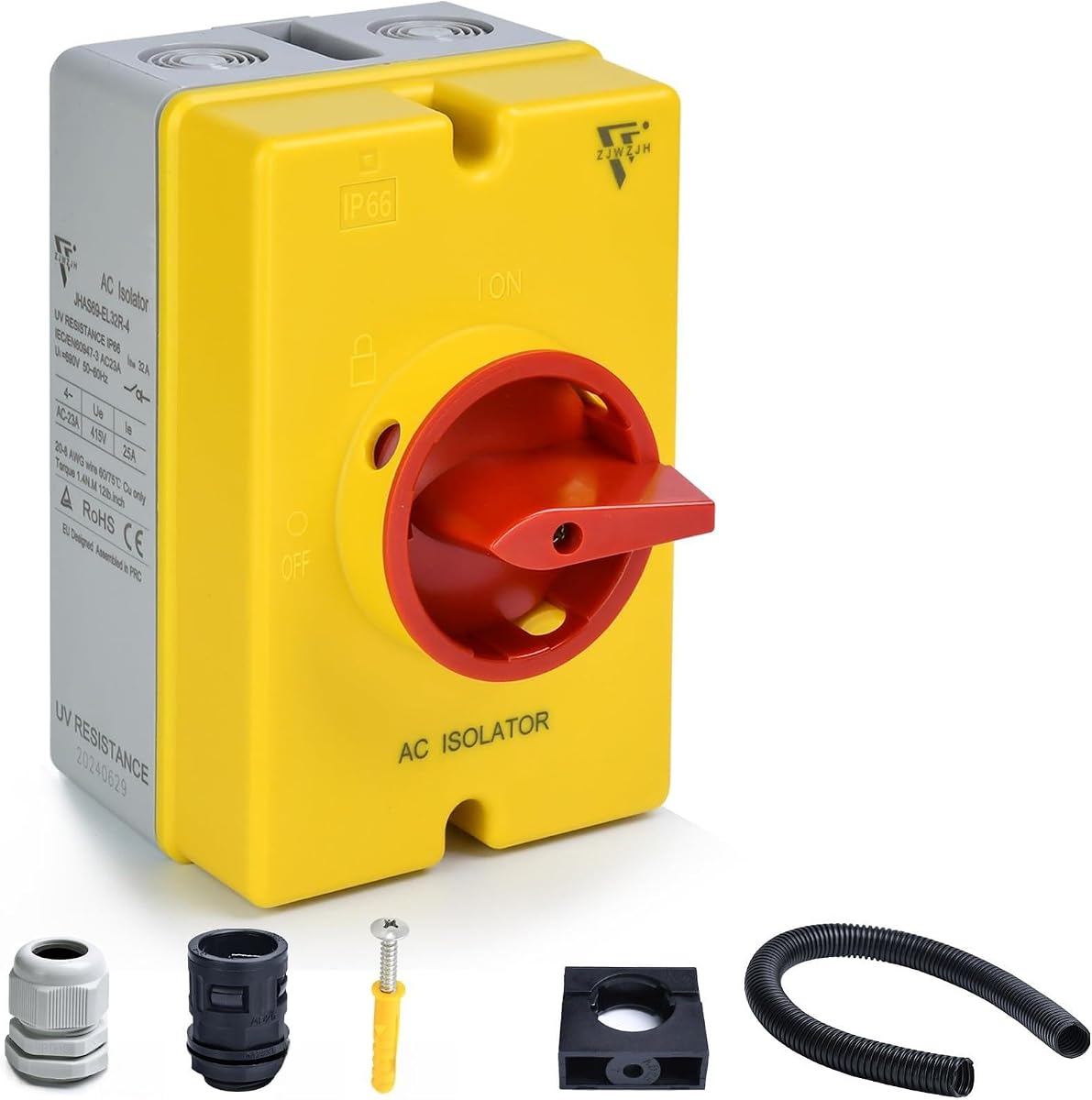
This four-pole, three-phase AC isolator is built for applications where the goal is to disconnect equipment safely rather than transfer an entire household between two sources. It is listed for generator, motor, air-conditioning, substation, and distribution applications, giving it broader industrial utility than a standard residential transfer switch.
We may earn a commission when you buy through this link, at no additional cost to you.
Its electrical range is substantial for a compact isolator. The stated compatibility includes 120V, 220V, 240V, 440V, and 690V AC, with 32-amp current and four-pole operation. The IP66 enclosure protects against dust, rain, splashing water, and hose-directed water, while the rotating handle can be secured with a lock.
It is important not to confuse an isolator with a transfer switch. This model provides a means of disconnecting power to a system, but the product information does not describe a two-source selector. It also does not present itself as a complete residential backup panel. Buyers should treat it as a component in a larger, professionally designed installation.
Choose this product when a three-phase motor or other high-voltage equipment needs a dedicated, lockable outdoor disconnect. It is a good fit for installers who require broad voltage support and rugged isolation, but it is not a substitute for a listed home transfer device.
The four-pole design opens all required conductors for isolation, which is useful for maintenance on three-phase systems. For generator backup, it should be selected as part of a larger system rather than mistaken for an automatic or manual source-transfer device.
The IP66 enclosure is designed for indoor or outdoor use and offers meaningful protection from dust and water jets. Its corrosion-resistant construction suits industrial, agricultural, construction, and utility environments where equipment may be exposed to weather.
We may earn a commission when you buy through this link, at no additional cost to you.
This 63-amp, two-pole safety disconnect offers a straightforward way to isolate a generator, welder, boat, motor, or other piece of equipment. Its universal positioning and industrial application list make it more versatile than a household-only switch, while the 63-amp rating supports substantially more current than the 30-amp and 32-amp options in this roundup.
We may earn a commission when you buy through this link, at no additional cost to you.
Durability is a central selling point. The UV-resistant ABS enclosure is designed to withstand corrosion, high temperatures, and physical impact, and the IP66 rating protects internal components from dust and powerful water jets. Silver alloy contacts are specified for conductivity and arc resistance, with the stated goal of reducing contact welding and oxidation.
Operationally, the quick-make, quick-break mechanism and clear ON/OFF indicators support decisive action during installation, maintenance, or repair. The trade-off is that this is an isolator rather than a two-source transfer panel. It does not select between utility and generator power, so a complete backup system may need additional switching and protection components.
This is a compelling option for a dedicated equipment disconnect, especially where weather resistance, visible status, and robust contact construction matter. Buyers should confirm the switch's electrical ratings against the load and have any generator connection designed to comply with local code.
Silver alloy contacts are intended to maintain conductivity while resisting arc-related wear. Combined with quick-make, quick-break operation, the design supports clear separation when equipment is serviced or switched off.
The straightforward lever and clearly marked ON/OFF positions reduce uncertainty about whether a circuit is energized. A lock can also be used when the switch must remain secured during maintenance or unattended operation.
We may earn a commission when you buy through this link, at no additional cost to you.
The General Electric TGN3323 is presented as a re-certified safety switch associated with the GE TGN model family. Its recognizable model designation may appeal to electricians and facility managers who already use that product line, although the supplied listing information contains only the basic description rather than a complete set of electrical specifications.
We may earn a commission when you buy through this link, at no additional cost to you.
Because this is a safety switch, it is best considered for equipment isolation rather than automatic home transfer. A conventional safety switch provides a visible means of disconnecting a circuit, but a generator backup installation may also require a dedicated transfer mechanism, suitable conductors, grounding and bonding arrangements, and protection for the connected load.
The limited listing details are the main consideration. Buyers should identify the exact model, inspect its nameplate, verify whether it is fused or non-fusible, and confirm pole count, current rating, voltage, enclosure type, and applicable listing marks. Those details cannot be safely inferred from the abbreviated product description.
This selection is most appropriate for a buyer who can verify the physical device and its ratings. It can be useful in an established installation that already uses GE safety switches, but a newly planned generator system should be matched to a clearly specified and fully documented disconnect rather than selected by model number alone.
The listing does not provide a full specification set, so the product's nameplate and certification markings are the authoritative source. Current, voltage, fuse configuration, poles, and environmental ratings should all be checked before installation.
The TGN designation connects this product to a recognizable industrial safety-switch platform. That familiarity can help when replacing an existing device, but compatibility still depends on the complete model configuration rather than the series name alone.
We may earn a commission when you buy through this link, at no additional cost to you.
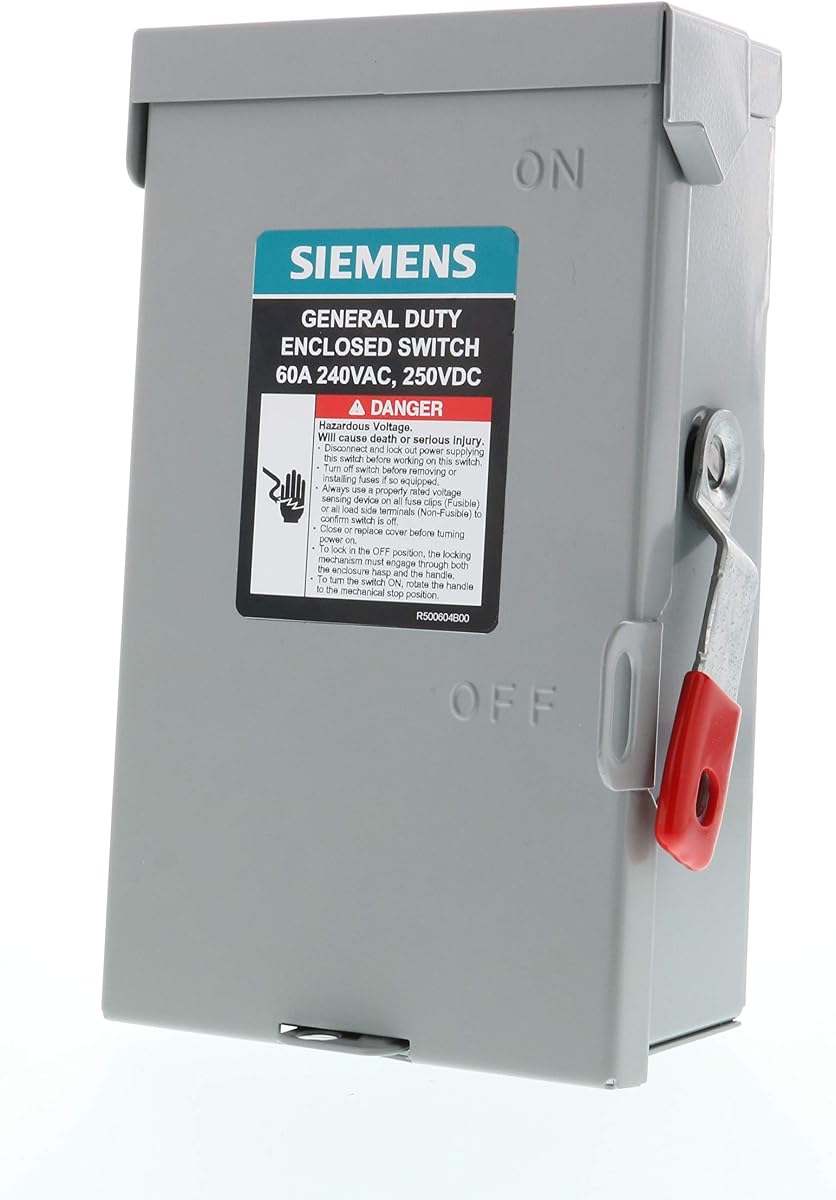
The Siemens 60-amp safety switch is a compact, outdoor, non-fusible disconnect for 120/240-volt, single-phase, two-wire circuits. It is particularly relevant where a generator, workshop machine, or other equipment needs a dedicated, plainly visible point of isolation near the load.
We may earn a commission when you buy through this link, at no additional cost to you.
Its visible-blade, double-break action makes the operating state easier to inspect than on a fully enclosed switch. The quick-make, quick-break mechanism is designed for positive operation, and the ON/OFF indication is embedded in the steel door so it will not scratch or fade like a surface-applied label.
This model is non-fusible, meaning it does not provide overcurrent protection by itself. Suitable branch-circuit and short-circuit protection must be provided elsewhere in the installation according to the load and applicable electrical code. It also isolates one source rather than transferring automatically between utility and generator.
The Siemens switch is a strong fit for installers who want a compact, durable equipment disconnect rather than a full transfer panel. Its clear state indication, double-break design, and outdoor enclosure make it practical for a generator output connection or other permanently installed equipment.
The visible blade makes it easier for operators to confirm whether the circuit is open. This clarity is valuable during installation, inspection, and routine maintenance, especially where a generator may be started or connected nearby.
The compact enclosure is intended to conserve space while remaining suitable for outdoor use. Durable embedded indicators and a steel door support dependable operation in a general-duty environment.
We may earn a commission when you buy through this link, at no additional cost to you.
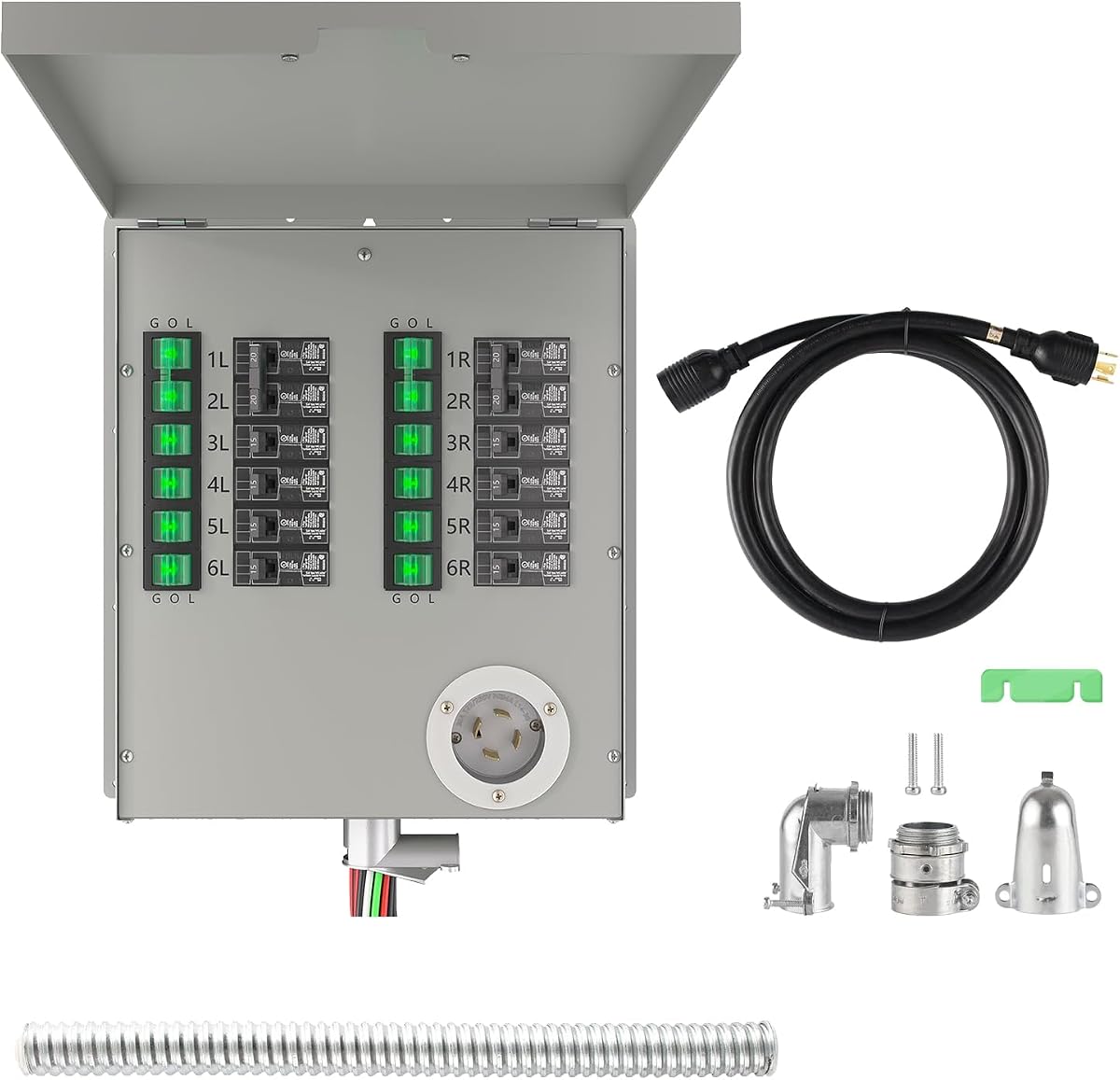
Nature's Generator's 30-amp, 12-circuit transfer panel is designed to move selected household circuits between normal power and a backup source without automatic switching. It offers a middle ground between a small essential-load switch and a full-service transfer system: users can control specific circuits, illuminate their status, and restore power selectively after a manual transfer.
We may earn a commission when you buy through this link, at no additional cost to you.
The stated compatibility with gasoline, diesel, propane or LPG dual-fuel generators, portable lithium power stations, solar generators, mini wind turbines, and micro hydro generators gives the panel unusual flexibility. Its complete connection kit includes an L14-30P inlet, a 30-amp power cord, and pre-wired components intended to simplify installation with compatible systems.
The 30-amp limit and 12-circuit format are the main constraints. It is not a substitute for a 200-amp service-entrance switch, and the generator's output and connector must match the panel. Although the product is UL approved for the stated residential transfer-switch application, approval does not remove the need to follow wiring requirements and local inspection rules.
This is a strong choice for a controlled home-backup project with several priority circuits. It is especially appealing for users who want manual control, a broad choice of backup sources, and more circuit-level flexibility than a compact essential-load switch offers.
Twelve separately controlled circuits make it possible to prioritize loads such as refrigeration, lighting, pumps, or workshop equipment. The illuminated rocker switches provide a clear indication of generator-power status.
The listed support for combustion generators, portable power stations, solar systems, wind, and micro hydro sources makes the panel useful beyond conventional portable generators. The source and L14-30 connection must still be verified as compatible.
We may earn a commission when you buy through this link, at no additional cost to you.
This two-pole, 60-amp safety switch is an outdoor, non-fusible device intended primarily for supply circuits rated at 240V AC or less. It offers double-break switching, embedded position indicators, and padlock provisions on both the handle and door, making it a versatile dedicated disconnect for equipment supplied by a generator or other fixed source.
We may earn a commission when you buy through this link, at no additional cost to you.
The safety provisions are useful in work environments where accidental energization must be minimized. A quick-make, quick-break mechanism is designed to provide positive operation, while the embedded indicators reduce the chance of confusing the switch state. The stated fault-current limitations depend on whether it is used with Class R or T fuses or Class H fuses, although the model is described as non-fusible.
The switch does not perform source transfer. It should be viewed as an isolation component within a larger system, and appropriate overcurrent protection must be included elsewhere. Its customer rating is lower than those of several alternatives, but the disclosed features are specific and useful for users who prioritize lockability and clear operating status.
This product is worth considering for workshops, equipment rooms, and generator installations where a visible, lockable service disconnect is needed. The buyer should have the final circuit design reviewed to ensure the conductors, protection, and disconnect rating satisfy the load and local requirements.
Padlock provisions on the handle and door add flexibility for controlled maintenance. The switch can be secured against unintended operation while still providing a deliberate, visible means of isolation.
Embedded ON and OFF indicators are designed to remain legible through normal use. This helps operators identify the state of the disconnect without relying on a loose or externally applied sticker.
We may earn a commission when you buy through this link, at no additional cost to you.
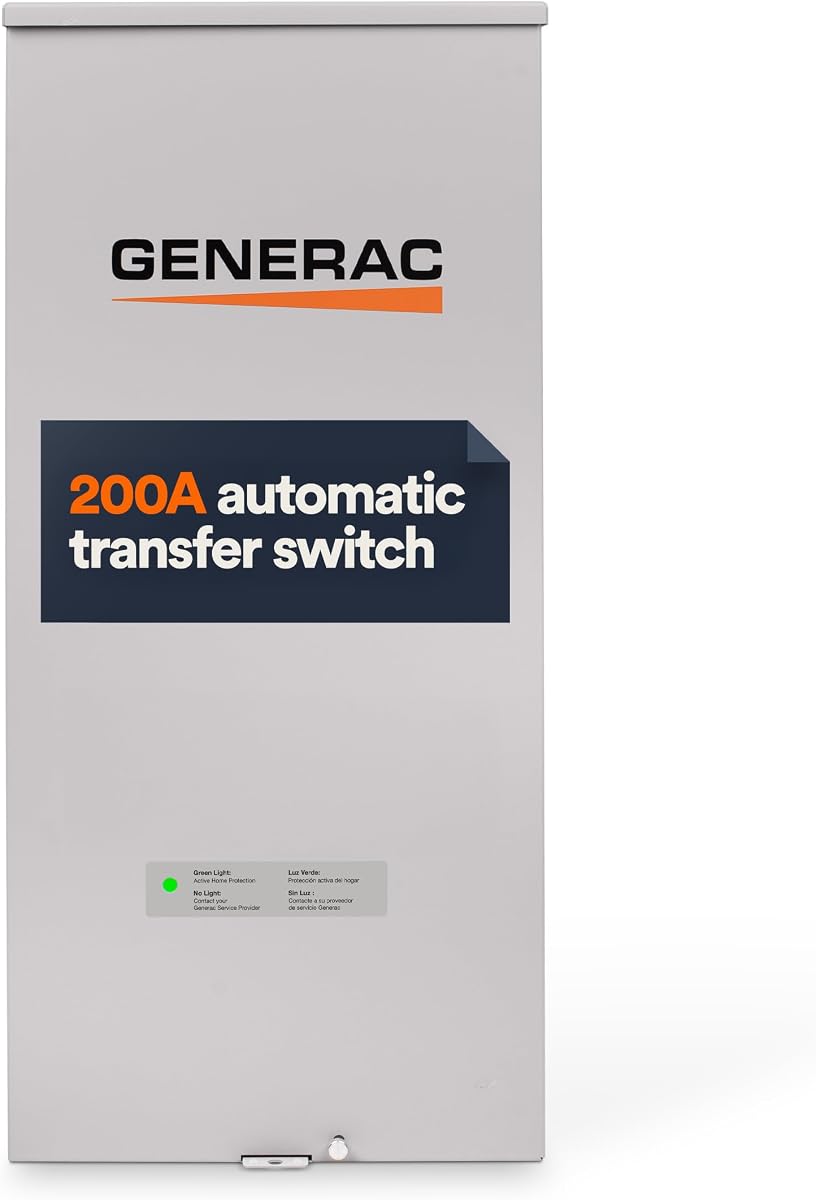
The Generac 200-amp Next Gen transfer switch is the most comprehensive option in the group. Designed for single-phase Generac standby systems using Evolution or Power Zone 200 controllers, it automatically transfers an entire home between utility and generator power without requiring the owner to operate a manual lever.
We may earn a commission when you buy through this link, at no additional cost to you.
At the service-entrance level, it can replace the main utility disconnect and support simultaneous 120- and 240-volt loads, including HVAC, pumps, ranges, refrigerators, and sump pumps. A mechanical interlock physically prevents utility and generator sources from connecting simultaneously, addressing the backfeed risk associated with standby power.
Its NEMA 3R aluminum enclosure and corrosion-resistant powder-coat finish are designed for indoor or outdoor installation in varied weather. A factory-installed commercial-grade surge protective device adds transient-voltage protection for appliances and electronics. The stated five-year limited warranty also covers the integrated surge protection device.
This switch is best for a professionally planned Generac standby installation where automatic convenience and whole-home coverage are priorities. It is not a universal add-on for arbitrary portable generators. Compatibility, load calculation, controller selection, service-entrance details, and local electrical requirements must be coordinated before purchase.
Automatic sensing and transfer remove the need for manual intervention during an outage. The service-entrance design allows the generator to support the home's complete set of 120- and 240-volt circuits when the connected Generac system has adequate capacity.
A factory-installed surge protective device helps defend connected equipment from transient voltage spikes, while the mechanical interlock prevents the utility and generator from being connected at the same time. These features add layers of protection beyond basic source selection.
We may earn a commission when you buy through this link, at no additional cost to you.
This 30-amp pull-out disconnect provides a compact outdoor means of isolating a 120/240-volt generator or other equipment connection. Its two-pole, three-wire configuration and 30-amp rating are appropriate for loads that remain within that capacity, while the UL certification adds a recognized safety element to the stated design.
We may earn a commission when you buy through this link, at no additional cost to you.
The all-metal cover is made from galvanized steel and is intended to resist rain, dust, and rust in outdoor conditions. The pull-out handle provides a clear on/off action, and its storage compartment reduces the chance of losing the handle. A lock hole allows the owner to add a lock when security or operational control is important.
Installation features include pre-drilled knockout locations on the side, bottom, and back, along with space for wiring. The device is an isolator, however, not a transfer switch, and it should not be expected to switch a home automatically or select between utility and generator power. Suitable overcurrent protection must be included in the system.
This model is a practical choice for a smaller generator output, outdoor equipment connection, garage installation, or campsite-style application where a compact and lockable disconnect is needed. Its limitations make it better suited to dedicated equipment than to a broad household backup panel.
The pull-out design makes the operating state intuitive while keeping the handle stored when the circuit is open. This is useful where equipment is started, stopped, or serviced regularly.
Knockouts on multiple sides, along with a galvanized steel cover, provide flexibility for outdoor mounting. The enclosure is intended to protect the internal disconnect from weather, dust, and rust during service.
We may earn a commission when you buy through this link, at no additional cost to you.
The most suitable generator disconnect is determined by the source, load, environment, and installation scope. Start with a complete electrical plan rather than choosing only by generator wattage or switch price.
A disconnect that serves one load is much simpler than a device that transfers an entire residence. Equipment isolators provide a safe break between a source and a motor, welder, air conditioner, or generator output, while a manual transfer switch allows a person to select between normal and backup power. A service-entrance transfer switch replaces the main disconnect and coordinates a standby generator with the home's full panel. Choosing the intended scope prevents an installer from using a single-purpose isolator where source transfer is required.
The switch must be rated for the conductors and load it will interrupt, not merely for the generator's advertised output. Compare amperage, supported voltages, pole count, phase, and whether the device is fused or non-fusible. The list includes 30-amp, 32-amp, 60-amp, 63-amp, and 200-amp options, spanning very different installation levels. A 120/240-volt single-phase system has different switching requirements from a three-phase installation, and the chosen device must align with both the generator and the circuits it serves.
An isolator has one source and one operating state: connected or disconnected. It cannot choose between utility and generator power. A transfer switch provides a safe way to connect a backup source while preventing both sources from feeding the same load simultaneously. Automatic models sense and transfer without manual action, while manual models require an operator to change position. Reading the product description for terms such as transfer, selector, isolator, and source is essential to avoiding a functionally incomplete purchase.
Neutral arrangements are fundamental to safe generator connections. Some portable generators produce a bonded neutral, while inverter and battery systems may use a floating neutral. Transfer equipment must be selected and wired for the correct arrangement to avoid unintended current paths or equipment damage. The Original Patented EZ Switch explicitly supports bonded or floating neutrals, while other models may not offer that flexibility. A qualified electrician should establish whether a bonding point is required and where grounding and bonding conductors should terminate.
A generator connection is often installed outside because the source is noisy, hot, or unsafe indoors. Look for an outdoor-rated enclosure and an appropriate NEMA or IP rating. NEMA 3R models are designed for outdoor service-entrance applications, while IP66 devices emphasize protection against dust and powerful water jets. Metal enclosures may offer greater physical robustness, while rugged ABS can provide corrosion resistance and impact tolerance. Site exposure, condensation, salt air, washdown, and direct sunlight can all affect the most appropriate housing.
Visible operating state, double-break action, quick-break behavior, and padlock provisions are useful in installations where workers need confidence that a circuit is isolated. Automatic transfer switches add physical interlocking to prevent simultaneous utility and generator connection. A manual transfer switch should still have a clear, deliberate selector that cannot be mistaken for an ordinary wall switch. Lockable handles are especially helpful for equipment that may be serviced by multiple people or remain unattended during operation.
A switch can be easy to specify but difficult to connect if essential accessories are missing. Look for pre-wired assemblies, appropriate power inlets, matching connector ratings, flexible cord, wiring lugs, knockout openings, mounting hardware, and installation documentation. The Nature's Generator panel includes an L14-30P inlet and 30-amp cord, while the 200-amp manual switch includes wiring lugs and a guide. These included components can simplify planning, but the generator's connector, conductor sizes, and grounding method must still match.
The device should remain accessible for inspection, testing, and safe shutdown. A pull-out design stores its handle, embedded indicators resist fading, and automatic transfer switches reduce the need for routine manual intervention. Nevertheless, generators and transfer systems still require periodic testing, and a manual switch may need to be operated only under the conditions specified by its instructions. The location should protect against accidental impact, weather, and unauthorized operation without preventing an electrician from servicing the equipment.
Before connecting a generator, confirm that its output voltage, frequency, current capacity, connector, and neutral arrangement match the transfer switch. A qualified electrician should inspect the load calculation, conductor sizing, grounding, bonding, overcurrent protection, and any required permits. The switch should be wired according to its instructions and local electrical code, with all enclosure openings protected and unused knockouts covered in approved ways.
For a manual transfer switch, follow the manufacturer's operating sequence exactly. The usual operating principle is to place the selector in a defined OFF or neutral position before stopping one source and starting the other, but the precise sequence depends on the model. Do not operate the switch under an overload, and do not use the selector as an ordinary on/off control. For an automatic transfer switch, follow the compatible standby controller's startup and transfer instructions, including the required delay between utility and generator sources.
During routine care, keep the enclosure closed and the operating handle free of debris, corrosion, paint, and obstruction. Check that padlocks, seals, knockouts, and covers remain secure, and inspect visible wiring or connectors for heat, discoloration, moisture, or mechanical damage. Test the transfer or isolation function on a schedule recommended by the manufacturer, a qualified electrician, or the governing local requirement, using a safe load and following the generator manufacturer's instructions.
If a switch becomes warm, difficult to operate, noisy, scorched, wet inside, or visibly damaged, stop using it and have it inspected. Do not bypass a mechanical interlock or repeatedly reset a protective device. A qualified electrical professional should diagnose the issue, because the visible symptom may originate from the generator, conductors, load, connection, or transfer equipment.
A transfer switch is generally required when a generator is intended to power a home through its wiring system because it connects only one approved source at a time and helps prevent backfeeding. A simple outdoor disconnect can isolate one piece of equipment but cannot select between utility and generator power. The exact equipment depends on whether you want to transfer selected circuits, a full service entrance, or only a dedicated load.
It can, provided the switch and its installation match the inverter's output, current, voltage, connector, and neutral arrangement. Battery-based systems often use a floating neutral, while many conventional portable generators use a bonded neutral, and the transfer equipment must be selected accordingly. Never assume a generator and inverter with similar wattage ratings are electrically interchangeable.
A safety switch is primarily a visible disconnect that opens or closes a circuit. A transfer switch adds a means of choosing between two sources, such as utility and generator, while preventing unsafe simultaneous connection. The 30A, 60A, and 63A devices in this guide are examples of safety or isolation devices rather than complete home transfer panels.
The required rating depends on the connected load and generator output, not just the generator's maximum running wattage. A 30A or 32A unit may suit a smaller dedicated application, while a 60A or 63A device offers more capacity and a 200A service-entrance switch is intended for a substantially larger home load. A qualified electrician should calculate the load and size the conductors and protection accordingly.
Only if the selected device is approved for outdoor installation and its environmental rating matches the location. NEMA 3R and IP66 are used in this guide for different outdoor applications. The switch must also be installed with appropriate clearances, secure covers, protected knockouts, and correct wiring methods.
A pull-out disconnect isolates a circuit by physically removing the operating handle from the contacts. Pulling it out opens the circuit, while seating it closes the circuit according to the manufacturer's operating instructions. It provides a clear and often lockable means of disconnecting equipment, but it does not automatically transfer power from the utility to a generator.
A properly installed manual transfer switch is designed to prevent the normal and backup sources from being connected together at the same time. That protection depends on correct wiring, the required interlocking arrangement, and the selected device being appropriate for the source and neutral configuration. Buyers should have the installation inspected and tested by a qualified electrician.
An automatic transfer switch is better when the goal is uninterrupted standby operation with no need for someone to enter the equipment and change the source manually. A manual switch can be simpler and more economical for essential-circuit control, but power does not transfer until an operator acts. The right choice depends on the available generator type, control system, installation scope, and operating preference.
The Original Patented EZ Switch stands out for essential-load control because it combines manual operation, recognized safety approvals, support for bonded and floating neutrals, and compatibility with several types of backup sources. The 63A Enclosed Disconnect is the best budget-oriented option for rugged equipment isolation, while the Generac 200-amp automatic switch offers the most advanced whole-home standby experience in the group.
For the remaining choices, prioritize the function before the enclosure. The Nature's Generator panel is suited to manually controlled, circuit-by-circuit backup across twelve circuits. The 200-amp manual switch is intended for higher-capacity manual transfer, the Siemens and 60A safety switches provide practical outdoor isolation, and the 32A four-pole unit addresses three-phase equipment rather than residential source transfer.
Before buying, confirm current ratings, voltage, poles, phase, neutral configuration, environmental protection, and included connection components. Prices and product details change, so check the current listing and obtain an electrical plan for the installation. A proper disconnect protects more than equipment; it also helps keep the property, occupants, and utility workers safer during normal operation and maintenance.